Conrad Botes
Conrad Botes: A Vision Beautifully Unrestrained
Artist Spotlight · The Collection Editorial
There are artists who work at the edges of what a culture permits itself to see, and then there are those rare figures who remake those edges entirely. Conrad Botes belongs to the second category. His practice, spanning more than three decades and moving fluidly between underground comics, painting, and works on glass, has quietly become one of the most distinctive bodies of work to emerge from post apartheid South Africa. Collectors and curators who have followed his career from the early 1990s onward speak of his work with a particular reverence, the kind reserved for artists who have consistently followed their own vision regardless of prevailing trends.
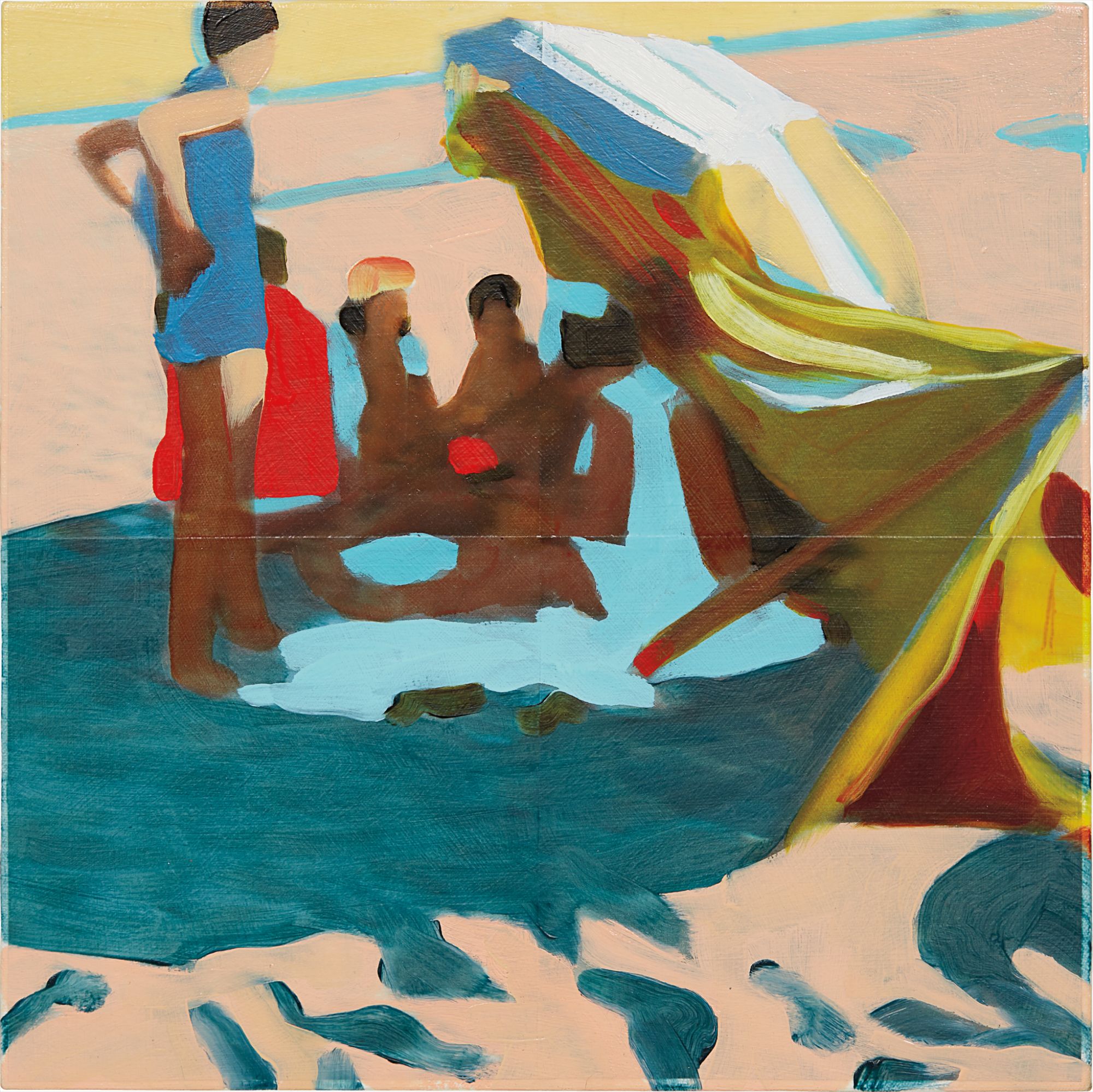
Conrad Botes
each: 64 cm (25 1/4 in.) diameter
Botes was born in 1969 in South Africa, and his formation as an artist was shaped by the turbulent, contradictory culture of a country in the last convulsions of apartheid. Growing up within Afrikaner culture gave him both an intimate knowledge of its symbols, myths, and moral codes, and an acute critical distance from them. That double position, insider and dissenter at once, would become the generative tension at the heart of everything he made. He studied at Stellenbosch University, where he encountered a community of artists and thinkers wrestling with questions of identity, language, and political complicity that few other art schools were addressing with such urgency at the time.
The foundational moment of Botes's public career came in 1992, when he and fellow artist Anton Kannemeyer co founded Bitterkomix, an underground comics anthology published in both Afrikaans and English. The publication was unlike anything else in South African cultural life. Drawing on the lineage of underground comix from the United States, particularly the transgressive work of artists like Robert Crumb and Charles Burns, Bitterkomix channeled those influences through an unmistakably South African lens. The anthology used the grammar of comics, sequential panels, expressive linework, grotesque characterization, to anatomize apartheid's psychological legacy, the violence embedded in Afrikaner nationalism, and the hypocrisies of white liberal culture.
It was confrontational, sometimes shocking, and completely serious about what it was doing. What distinguished Botes within the Bitterkomix project, and what continues to distinguish his fine art practice, is the depth of his engagement with mythology and the symbolic imagination. Where some artists in politically charged contexts default to didacticism, Botes has always been drawn to the archaic and the ritualistic. His imagery reaches back toward Jungian archetypes, religious iconography, and the storytelling traditions embedded in folklore and fairy tale.
Violence in his work is never gratuitous in the conventional sense. It carries the weight of ritual, of sacrifice, of the terrible necessity that underlies so much human myth. Sexuality, similarly, appears not as titillation but as a force bound up with power, vulnerability, and transformation. His work in painting and in oil on reverse glass represents a significant and rewarding dimension of his practice that deserves particular attention from collectors.
The technique of painting on the reverse side of glass, which has roots in folk art traditions across Europe and Asia, suits Botes's sensibility beautifully. The medium demands a kind of reverse thinking, since the artist must work backward, applying the topmost visible layer of an image first and building depth underneath. The result is a surface with a particular luminosity and stillness, the paint sealed behind glass takes on an almost enamel quality, jewel like and intense. Works in this format, including circular compositions that recall devotional objects or cabinets of curiosity, demonstrate the full range of his technical invention and his feeling for image as object.
For collectors approaching Botes's work, several things are worth holding in mind. His output, while not enormous, spans a range of formats and scales, from intimate works on paper and glass to larger painted canvases, and each format rewards close looking. The works on reverse glass in particular are rare and prized by those who have had the opportunity to acquire them. Botes operates at the intersection of fine art and graphic narrative in a way that anticipates much of the critical conversation now taking place around artists who move between those worlds.
The art market has increasingly recognized that the boundary between comics and fine art is not a hierarchy but simply a geography, and Botes was navigating that geography long before it became fashionable to do so. In the broader context of art history, Botes sits in instructive company. His graphic sensibility connects him to figures like Francisco Goya, whose Disasters of War series used printmaking to document atrocity with unflinching clarity, and to the German Expressionists, particularly Otto Dix, who brought a similar ferocity of line and moral purpose to images of war and social collapse. Within the contemporary South African canon, his work is in dialogue with figures like William Kentridge, whose animated films and drawings also grapple with the haunted landscape of post apartheid memory, though Botes's approach is rawer and more rooted in the vernacular of popular visual culture.
Internationally, his practice resonates with that of Kara Walker, Raymond Pettibon, and Neo Rauch, artists who each in their own way have used figurative narrative to excavate history and myth. What makes Botes matter today, perhaps more than ever, is precisely his refusal of comfort. At a moment when questions of cultural identity, colonial legacy, and the psychic costs of historical violence are being asked with new urgency around the world, his body of work stands as evidence that art can hold those questions without resolving them too quickly. His images do not offer consolation or easy critique.
They offer something more demanding and more lasting: the sense that you are looking at a sensibility that has truly reckoned with what it means to come from a particular place and time, and has transformed that reckoning into something visually extraordinary. For collectors who value work that endures, that continues to speak and to press, Botes represents one of the most compelling and underrecognized opportunities in contemporary art from the African continent.