Clyfford Still
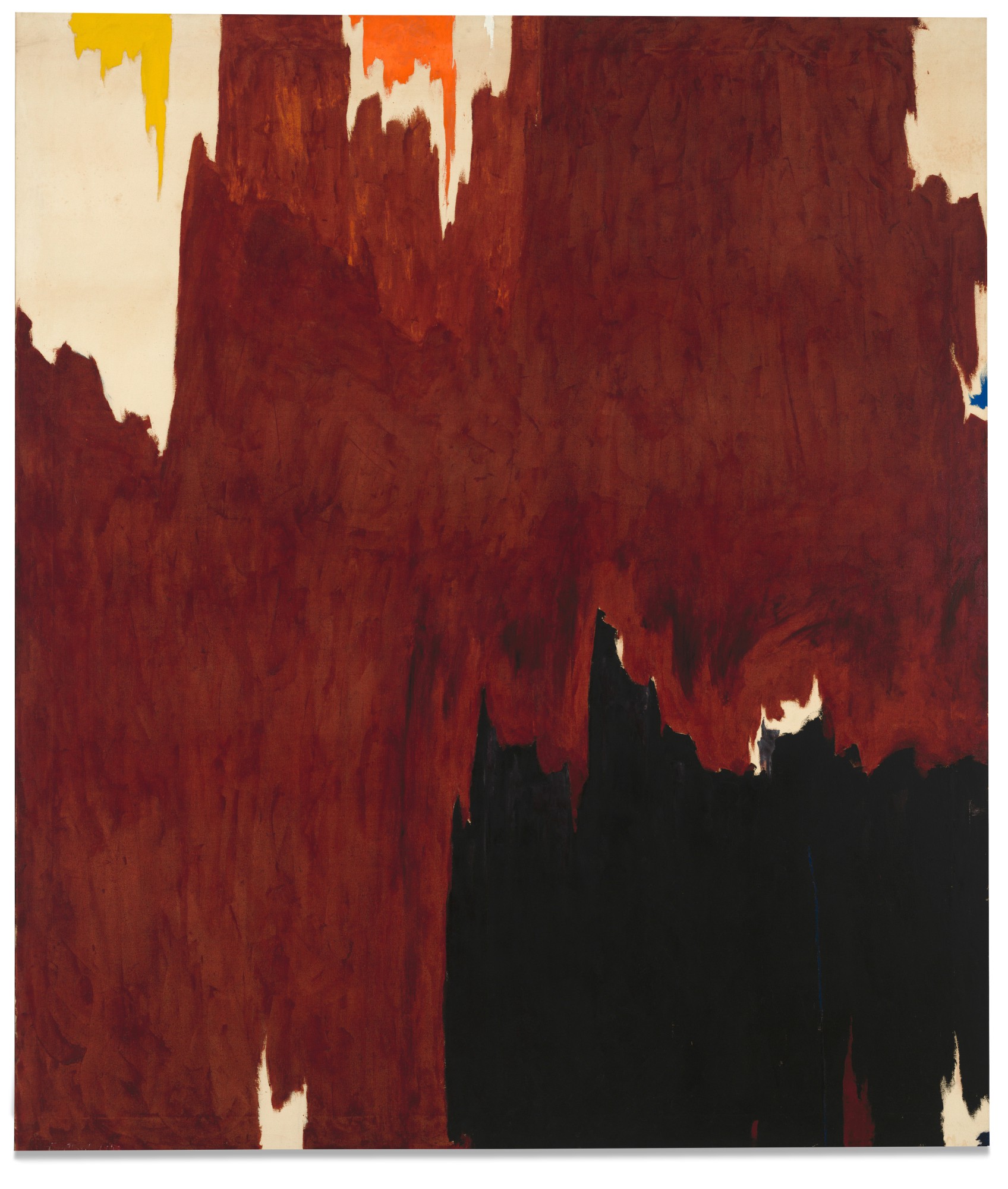
Clyfford Still Burns With Eternal Fire
Artist Spotlight · The Collection Editorial
“I never wanted color to be color. I never wanted texture to be texture, or images to become shapes.”
Clyfford Still
In 2011, the city of Denver did something extraordinary. It opened an entire museum dedicated to a single artist, the Clyfford Still Museum, designed by Brad Cloepfil of Allied Works Architecture and housing the most intact estate of any major American modernist. Nearly ninety four percent of Still's lifetime output, over eight hundred paintings and over two thousand works on paper, had been kept together precisely because Still demanded it. He left strict instructions that his work be given to an American city willing to maintain it as a collection in perpetuity.
Clyfford Still
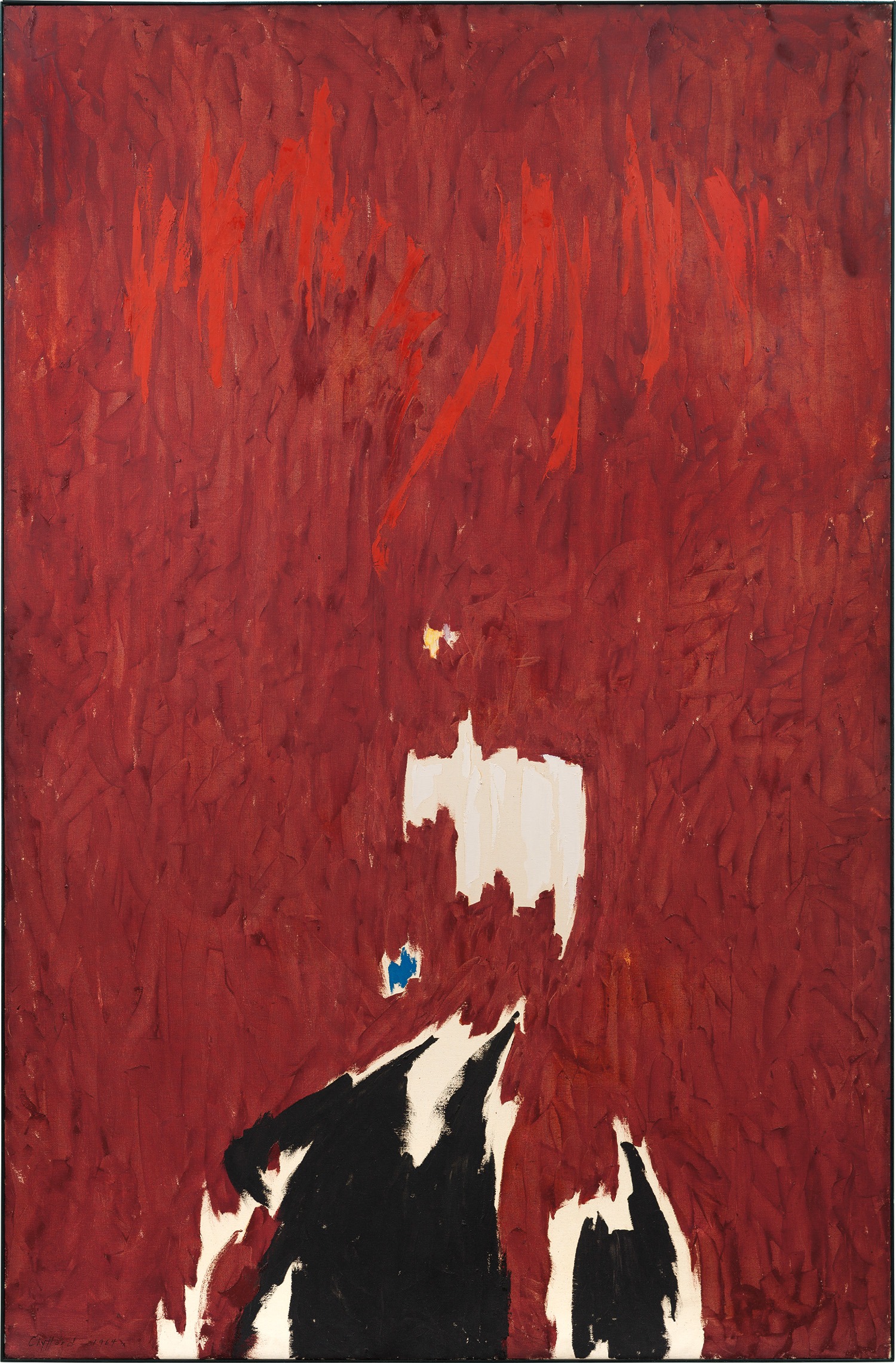
Ph-407, 1964
Denver answered. The result is one of the most singular institutions in contemporary museum culture, a monument not just to a painter but to the radical idea that an artist's vision deserves to be experienced whole. Clyfford Still was born in 1904 in Grandin, North Dakota, a flat and ferociously open landscape that would echo in his canvases for the rest of his life. His family moved to the farming plains of Alberta, Canada, when he was young, and the sheer verticality of the prairie horizon, the drama of sky meeting earth in an unbroken line, seems to have lodged itself permanently in his visual imagination.
He studied at Spokane University and later received his graduate degree from Washington State University, where he also taught. Unlike many of his Abstract Expressionist contemporaries who came of age in New York, Still spent formative years in the American West, and that distance gave him a fierce independence that would define every aspect of his career. Still's artistic development followed a path that was deliberately and defiantly his own. He worked through a figurative period in the 1930s, producing haunted, elongated figures that owe something to Grant Wood and American regionalism but feel already stretched toward something beyond representation.
Clyfford Still
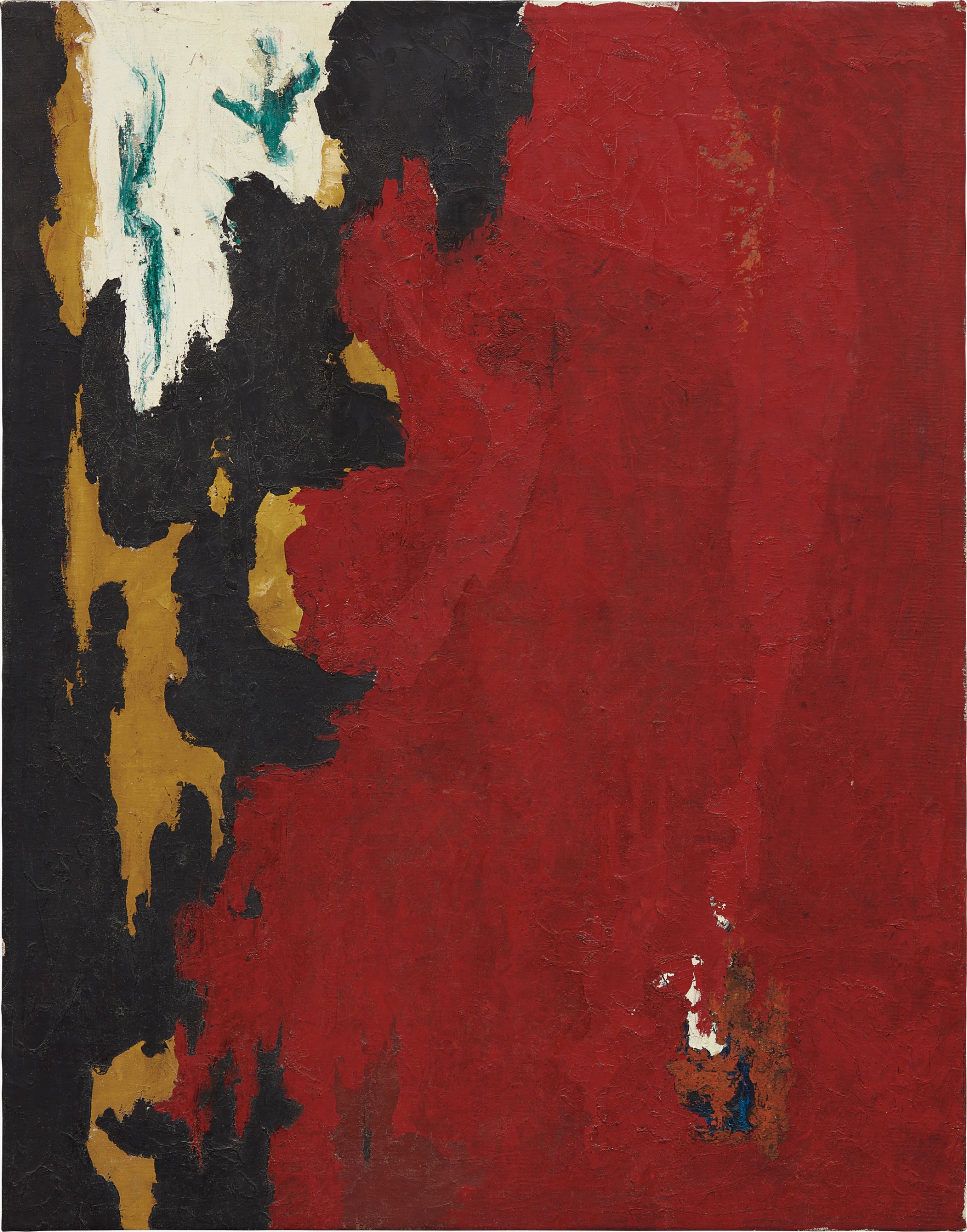
“You can turn the lights out. The paintings will carry their own fire.” Clyfford Still, 1960, 1948
By the early 1940s, he had begun breaking fully into abstraction, and by the time he arrived in San Francisco to teach at the California School of Fine Arts in 1946, alongside fellow visionaries like Mark Rothko and Ad Reinhardt, his vocabulary was unmistakably formed. His time in the Bay Area was electric and productive. He attracted a devoted circle of students and colleagues who recognized that something genuinely new was happening in his studio, a painting practice that refused every received European influence and reached instead toward something primordial and American. What makes a Clyfford Still canvas so immediately recognizable and so permanently arresting is his invention of a completely new kind of pictorial space.
“It is my desire that these works remain together and are never dispersed.”
Clyfford Still, Last Will and Testament
Where Rothko dissolved form into luminous hovering color and Barnett Newman split the canvas with his quiet zips, Still tore at the picture plane with ragged, vertical forms that surge upward like geological strata or tongues of flame. His palette was never decorative. The blacks in his paintings are absolute, as if light itself had been swallowed. The yellows crack open against them with the force of a lightning strike.
The reds pulse with something almost physical. He applied paint with palette knives and brushes both, building surfaces that are topographically rich, where light catches ridges and valleys of pigment in ways that change as you move through a room. His large scale canvases, some measuring ten feet and beyond, do not simply fill a wall. They replace it.
Among the works available through The Collection, PH 407 from 1964 stands as a late and masterful example of his mature practice. By this period Still had withdrawn almost entirely from the commercial art world, having famously rejected the gallery system and controlled the sale and exhibition of his work with extraordinary care. The 1948 oil on canvas, its title drawn from one of Still's own statements, carries all the raw authority of his breakthrough years, when he was forging a language that had no precedent. These are not simply paintings.
They are positions, statements about what painting can and cannot be asked to do. For collectors, Still's market reflects both his canonical status and the deliberate scarcity he engineered during his lifetime. Because he refused to sell freely, preferring to place works with institutions or withhold them altogether, works that do reach the market carry exceptional weight. Christie's and Sotheby's have seen Still canvases achieve significant results when they appear, and their rarity ensures sustained attention from serious collectors.
What one looks for in a Still is the full force of his compositional drama: the tension between light and dark passages, the sense of upward surge in his vertical forms, and the quality of his surface, which should feel alive rather than merely textured. Works from his key decades, the late 1940s through the 1960s, represent the full flowering of his vision and are the most sought after by institutions and private collectors alike. Within the broader landscape of Abstract Expressionism, Still occupies a position that is both central and apart. He was a peer and occasional friend of Rothko, with whom he shared an early exhibition at the San Francisco Museum of Art in 1946, and he moved in the same orbit as Franz Kline, Willem de Kooning, and Jackson Pollock.
Yet he consistently resisted the label of New York School painter, and his work rewards being seen in that light. Where Pollock's energy disperses across the canvas in all directions, Still's rises. Where de Kooning fractures the figure, Still abolishes it entirely in favor of something older and more elemental. His closest spiritual kin may be the Romantic sublime of Caspar David Friedrich or the visionary landscapes of J.
M.W. Turner, artists who also understood that nature is not backdrop but force. Still's legacy today is both institutionally secure and perpetually fresh.
The Clyfford Still Museum continues to mount exhibitions that reveal new dimensions of his practice, including his rarely seen works on paper and his early figurative canvases. Scholars continue to unpack the philosophical ambition behind his refusal to title most of his works, his insistence on alphanumeric designations that strip away narrative and force the viewer into direct confrontation with paint and form. In a contemporary art world saturated with concept and text, Still's canvases demand something older and more demanding: sustained looking. To stand before one of his great paintings is to understand why he believed they could carry their own fire.
They still do.
Explore books about Clyfford Still
Clyfford Still: 1904-1980
Rosalind E. Krauss
Clyfford Still
Michael Auping
Clyfford Still: The Artist's Museum
Karen Wilkin
Clyfford Still: Black and White Paintings
Karen Wilkin
Clyfford Still: The Painter and His Work
Thomas Hess