Claudio Bravo
Claudio Bravo: Master of the Luminous Ordinary
Artist Spotlight · The Collection Editorial
There is a moment, standing before a Claudio Bravo canvas, when the eye refuses to believe what the mind already knows. A sheet of crumpled brown paper, a length of silk carelessly folded, a pair of green boots resting on a cool stone floor: these things should not move us. And yet they do, profoundly and lastingly, because Bravo possessed a gift that arrives perhaps once in a generation, the ability to see the physical world with such piercing clarity that looking at his paintings feels less like viewing art and more like remembering a dream you cannot quite shake. Today, with the global market for Latin American modernism gaining sustained institutional and collector attention, and with Bravo's estate carefully stewarding a body of work that spans six remarkable decades, his place among the most technically accomplished painters of the twentieth century feels not just secure but newly urgent.
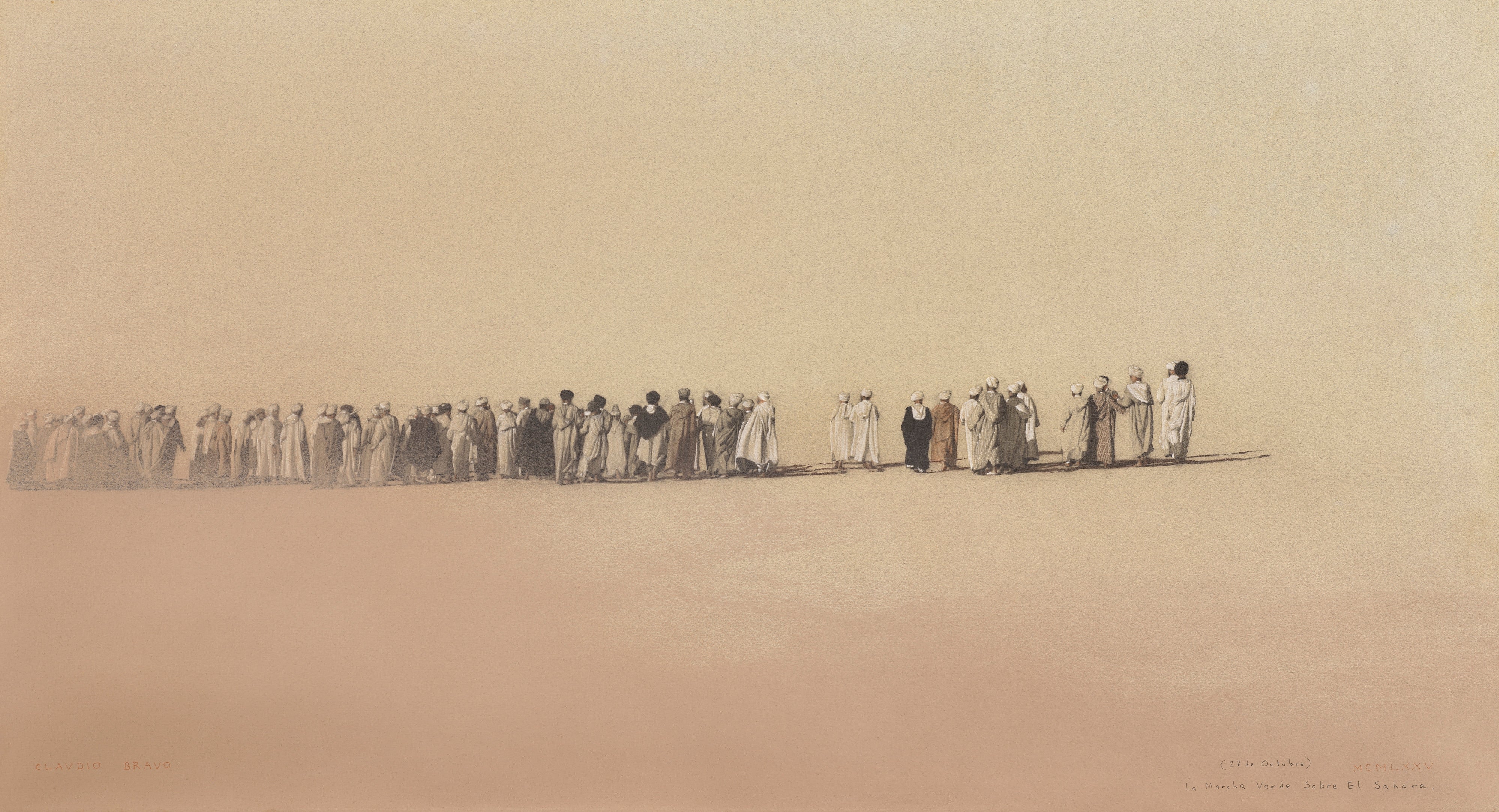
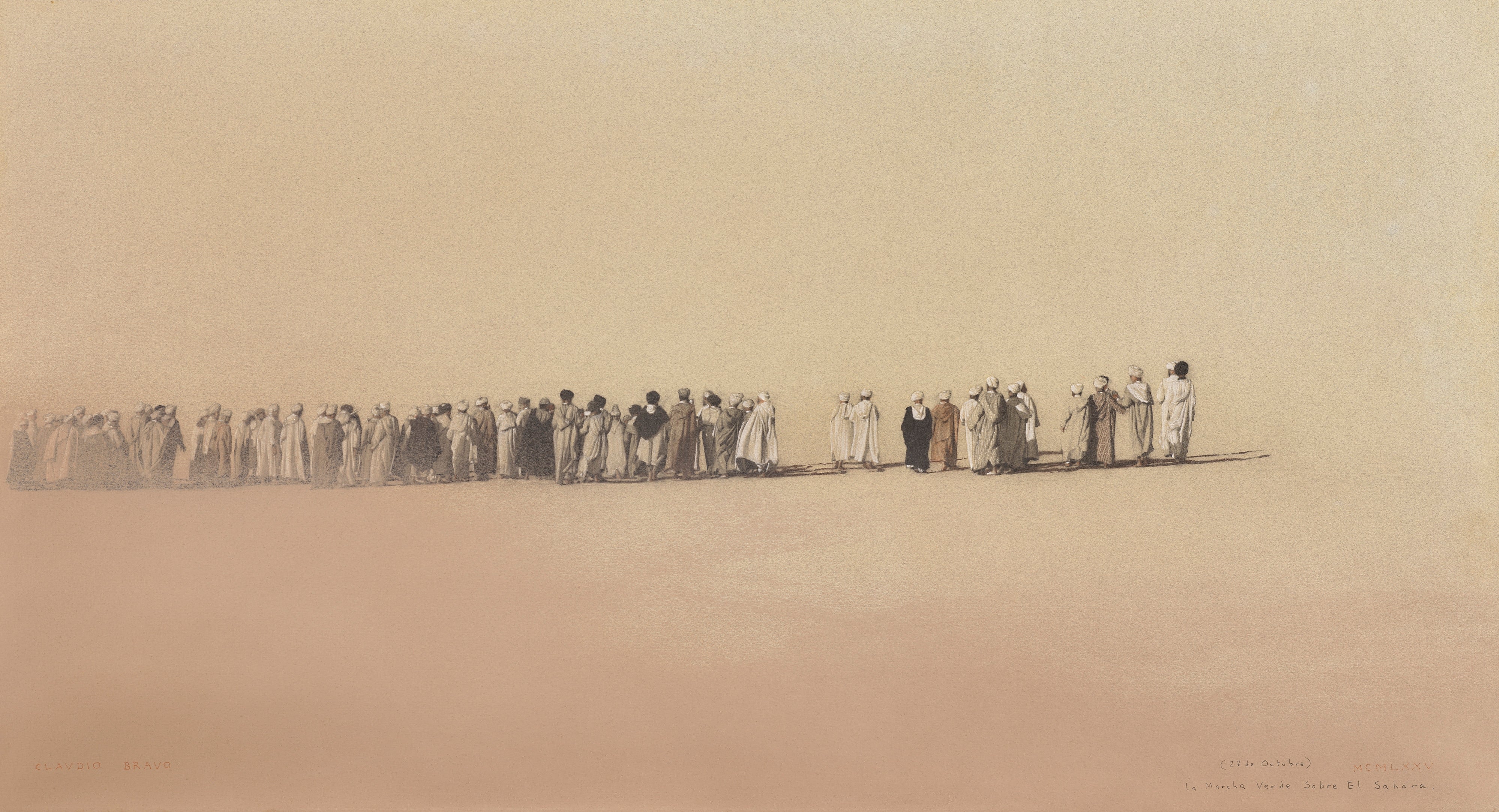
Claudio Bravo
La Marcha Verde Sobre El Sahara (27 de Octubre), 1975
Claudio Bravo was born in Valparaíso, Chile, in 1936, into a country that offered magnificent natural drama but little of the formal artistic infrastructure that might have shaped a young painter elsewhere. He studied in Santiago under the painter Miguel Venegas Cienfuentes, receiving a rigorous classical training that would prove foundational. What distinguished Bravo from the start was not ambition alone but a quality of attention, an almost devotional willingness to look at things longer and harder than anyone around him thought necessary. He left Chile for Madrid in 1961, and it was there, surrounded by the collections of the Prado, that his sensibility crystallized.
Velázquez, Zurbarán, and the entire tradition of Spanish Baroque painting entered his bloodstream. The lesson he took was not nostalgia but method: that paint, handled with sufficient care, could render the tactile world in ways that photography could approach but never fully equal. Bravo spent years in Madrid building a career as a portraitist to aristocratic and wealthy clients, a period that sharpened his technical command enormously and gave him financial independence even as it might have seemed, to outside observers, to sideline him from the avant garde conversations of the 1960s. He was unbothered by that perception.
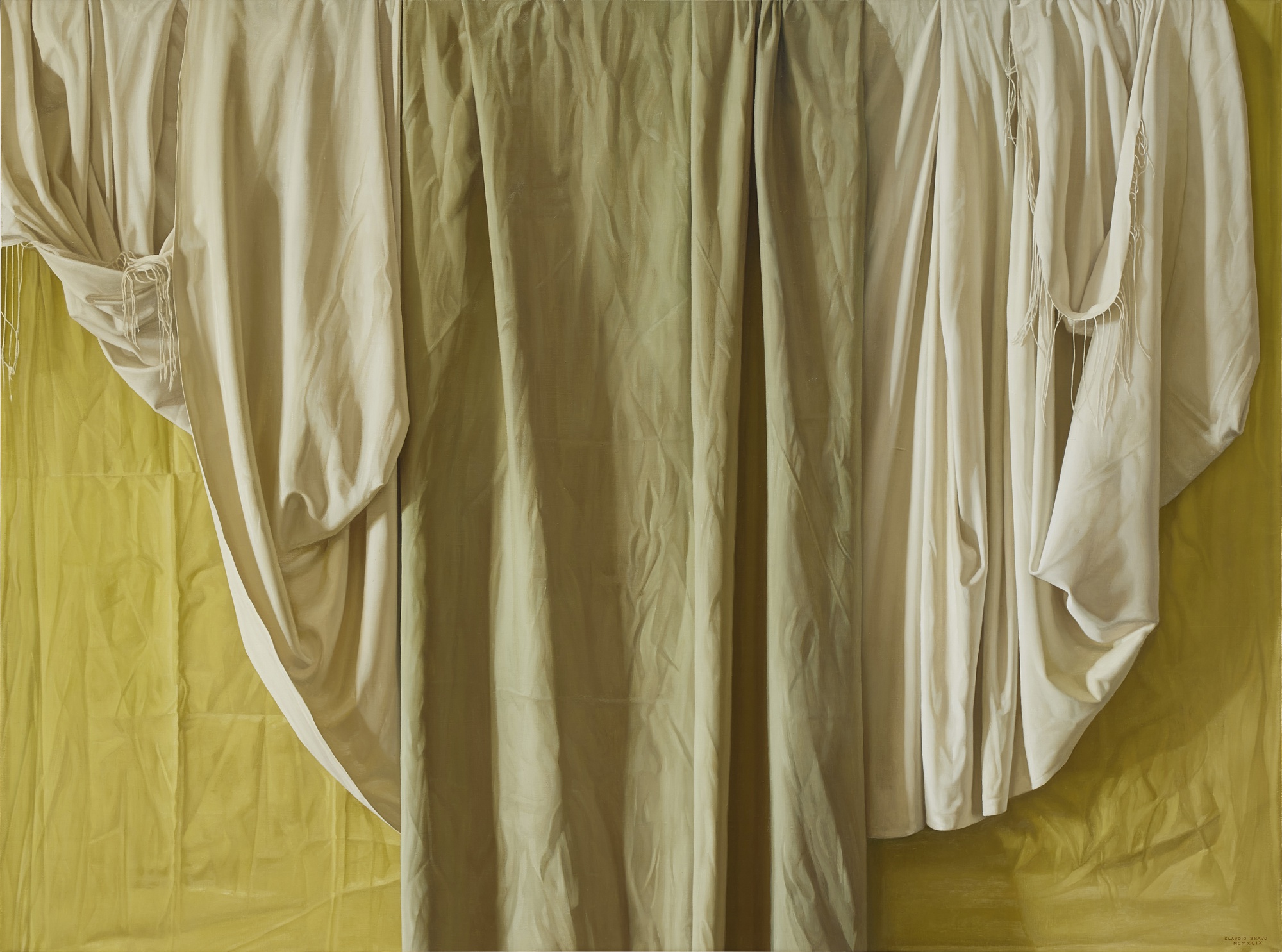
Claudio Bravo
Seraphim (White, Yellow, and Green), 1999
In 1972 he relocated to Tangier, Morocco, a move that proved transformative in ways both personal and pictorial. The quality of North African light, the textiles, the architecture, and the particular stillness of the medina all began seeping into his compositions. His palette warmed and deepened. His interest in wrapping, covering, and concealing objects gathered intensity, producing the wrapped package paintings that would bring him international recognition and that collectors still regard as among the most sought after works of his career.
His early masterwork simply titled Package, from 1969, remains a touchstone: a brown paper parcel tied with string, rendered with such exquisite fidelity that viewers have reported stepping closer to check whether it had been attached to the canvas. The range of Bravo's output is worth dwelling on because it is easy to reduce him to a single category. He was a hyperrealist, yes, and proudly so at a moment when that designation carried art world condescension in certain quarters. But the works on the platform here tell a more varied story.
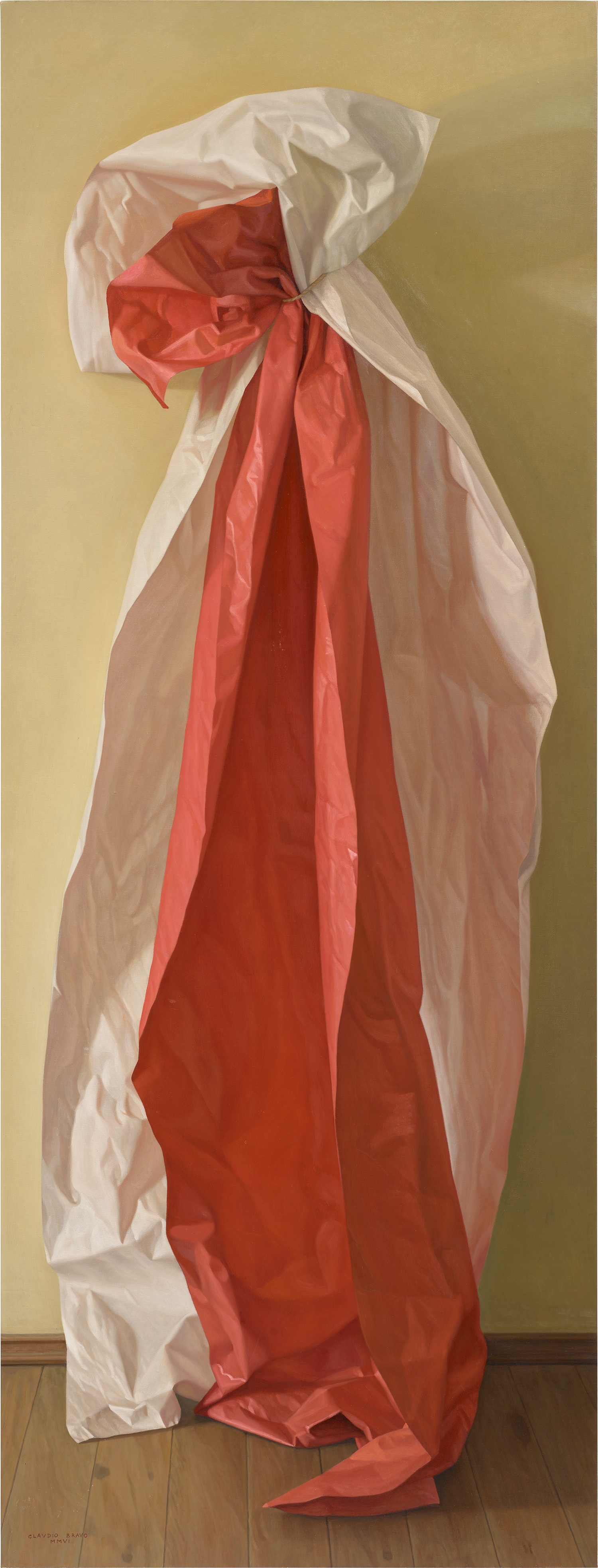
Claudio Bravo
Red and White Paper, 2006
La Marcha Verde Sobre El Sahara from 1975, executed in charcoal, pastel, and Conté crayon on paper, is an extraordinary document, a large scale drawing that connects his technical mastery to a specific geopolitical moment, the Green March in which Morocco organized a mass civilian crossing into the Western Sahara. That Bravo, living in Tangier, would choose this subject reveals the political and historical consciousness that sometimes gets obscured by the dazzle of his technique. Meanwhile, Seraphim from 1999 shows him working with transcendent ambition in oil on canvas, deploying the vocabulary of drapery and angelic form that links him explicitly to the great altarpieces he had studied for decades. And works like Red and White Paper from 2006 and the Tres Paquetes Naranjas triptych from 2007 demonstrate that even late in his career his obsession with wrapped and folded paper lost none of its freshness or conceptual tension.
For collectors, Bravo represents a proposition that becomes more compelling with each passing year. He occupies a position where several powerful market forces converge. He is a blue chip figure whose work appears regularly at Christie's, Sotheby's, and Bonhams, where his paintings and large scale drawings command prices that reflect both their rarity and their quality. The still lifes and package works have historically been the most actively traded, but informed collectors and advisors increasingly recognize that his drawings, works on paper, and the Tangier period paintings offer exceptional value relative to the oils.
Claudio Bravo
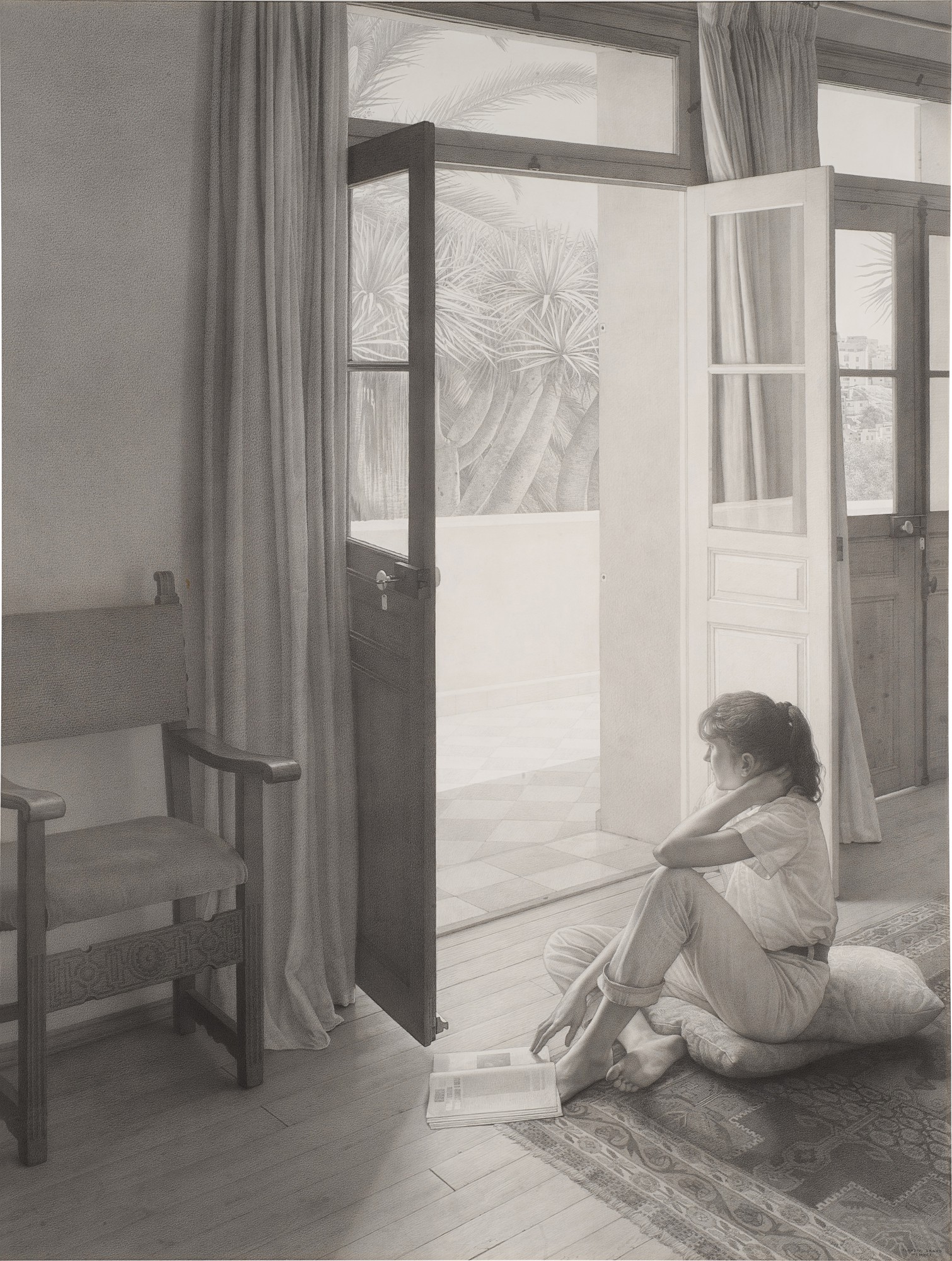
Interior with Girl, 1991
The works on paper including the pastel and Conté crayon pieces in this collection are particularly noteworthy: Bravo brought the same obsessive precision to drawing that he applied to painting, and these pieces represent an accessible point of entry into a body of work that spans a remarkable range of media and subject matter. Collectors who focus on Latin American art, on hyperrealism, or on the longer lineage of figurative painting from the Baroque to the present will each find compelling reasons to look carefully at what Bravo offers. Contextually, Bravo belongs to a generation of figurative painters who refused the dominant abstraction of the postwar decades and paid a complex critical price before the culture caught up with them. His natural peers include Antonio López García, the great Spanish hyperrealist whose patient, years long studies of Madrid interiors share Bravo's devotional relationship to observed reality.
One might also think of Lucian Freud, not for stylistic similarity but for the shared conviction that direct observation and technical mastery were not reactionary positions but radical ones. Among Latin American artists, Bravo stands as a singular figure, one who drew deeply on European tradition without being absorbed by it, maintaining throughout his career a sensibility that felt shaped by the particular quality of light and stillness he found in Morocco and carried back, transformed, into every surface he painted. Claudio Bravo died in Taroudant, Morocco, in 2011, in the country that had given him his greatest creative years. He left behind a body of work that rewards prolonged looking in a way that very few twentieth century painters can match.
His legacy is not only technical, though the technique is genuinely extraordinary, but philosophical: a sustained argument, made canvas by canvas and drawing by drawing over five decades, that the world directly in front of us, the folded cloth, the wrapped parcel, the pair of worn boots, is inexhaustibly worthy of our full and grateful attention. For collectors and institutions building collections with real depth and historical vision, Bravo is not a peripheral figure or a specialist interest. He is essential.
Explore books about Claudio Bravo
Claudio Bravo
Edward Lucie-Smith
Claudio Bravo: Paintings and Drawings
Carter Ratcliff
Claudio Bravo: A Retrospective
Museo Thyssen-Bornemisza
Claudio Bravo: Dibujos
Fundación Juan March
Claudio Bravo: The Hyperrealist
Irving Sandler