Chu Teh-chun (zhu Dequn, 1920-2014)
Between Two Worlds, Pure Luminous Feeling
Artist Spotlight · The Collection Editorial
“I want my painting to sing, like Chinese music, with spaces that breathe.”
Chu Teh-chun
In the spring of 2024, Christie's Hong Kong achieved strong prices for a group of Chu Teh chun canvases that drew spirited bidding from collectors across Asia, Europe, and North America. The results confirmed what the art world has understood for some time: that Chu Teh chun occupies a singular position in the history of modern painting, belonging fully to both the Chinese literati tradition and the grand sweep of postwar European abstraction. A decade after his passing in Paris in 2014, his reputation continues to grow, and the market for his work reflects a collector base that is genuinely passionate rather than merely speculative. Chu Teh chun was born in 1920 in Puzhou, Jiangsu province, in a China that was already convulsed by political and cultural transformation.
Chu Teh-chun (zhu Dequn, 1920-2014)
Chu Teh-Chun
He showed an early aptitude for drawing and was accepted into the National School of Fine Arts in Hangzhou, where he studied under Lin Fengmian, one of the great synthesizers of Chinese and Western painting in the twentieth century. Lin's example, a practice that held ink painting and French modernism in productive conversation, planted a seed in the young Chu that would take decades to fully flower. He later studied in Shanghai and Taipei, where he taught before making the decisive move that would define his career. In 1955, Chu Teh chun arrived in Paris, joining a wave of artists from Asia, Latin America, and Africa who were drawn to the city's extraordinary concentration of modernist ambition.
He encountered the work of Nicolas de Staël, whose densely built surfaces of luminous color had a galvanizing effect on him. He also absorbed the lessons of Cézanne, whose structural approach to landscape gave Chu a framework for thinking about how form and feeling could coexist. Paris in the mid 1950s was still vibrating with the energy of Tachisme and Art Informel, and Chu found in abstraction a visual language capacious enough to carry the weight of his dual inheritance. He became a French citizen in 1980 and made Paris his permanent home, though China never ceased to be the deep grammar of his imagination.
Chu Teh-chun (zhu Dequn, 1920-2014)
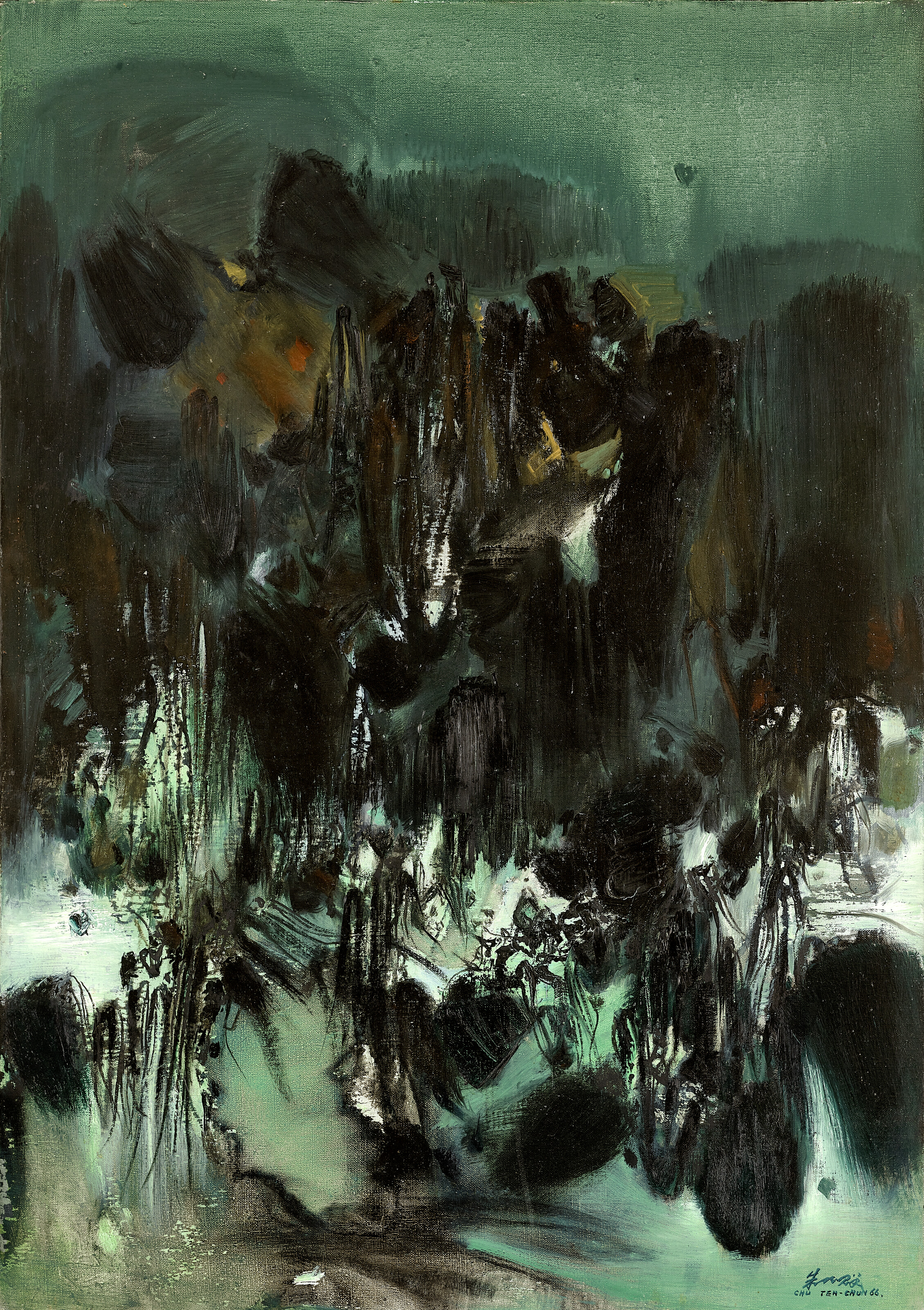
No. 223
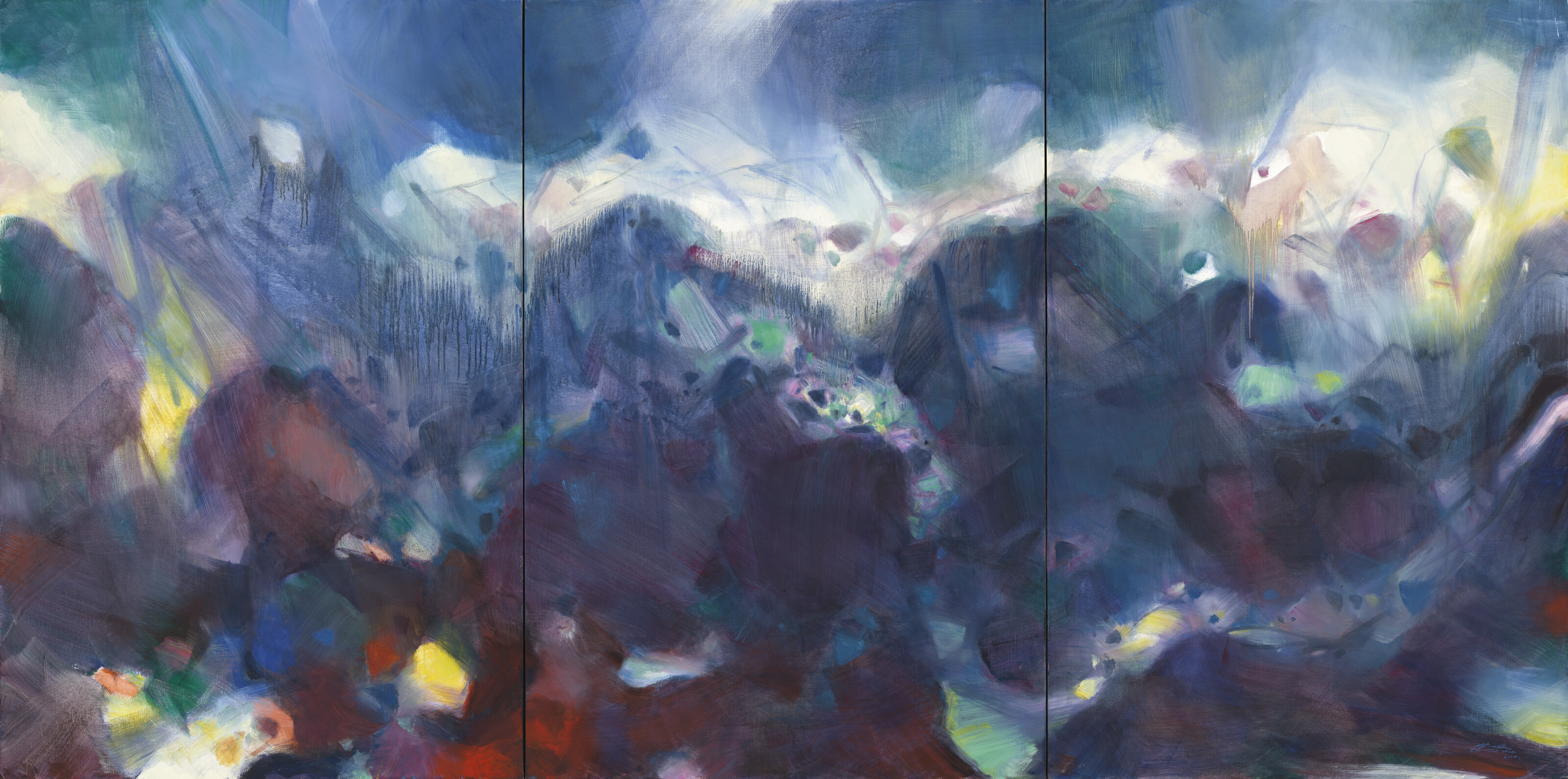
The breakthrough in Chu's practice came through a sustained engagement with Chinese calligraphy and classical landscape painting, not as subject matter to be reproduced but as an interior rhythm to be translated into oil and, later, mixed media on canvas. He described his own method as a kind of listening, allowing the brush to move with the energy of wind, water, and light rather than imposing a predetermined composition. His mature canvases from the 1960s onward are characterized by sweeping gestures of intense color, passages of near transparency that open like clearings in a forest, and a quality of inner light that seems to emanate from beneath the surface of the paint rather than sitting on top of it. The scale of his ambition grew steadily through the 1970s and 1980s, with large format works that invite the viewer to step into them as one might step into a landscape.
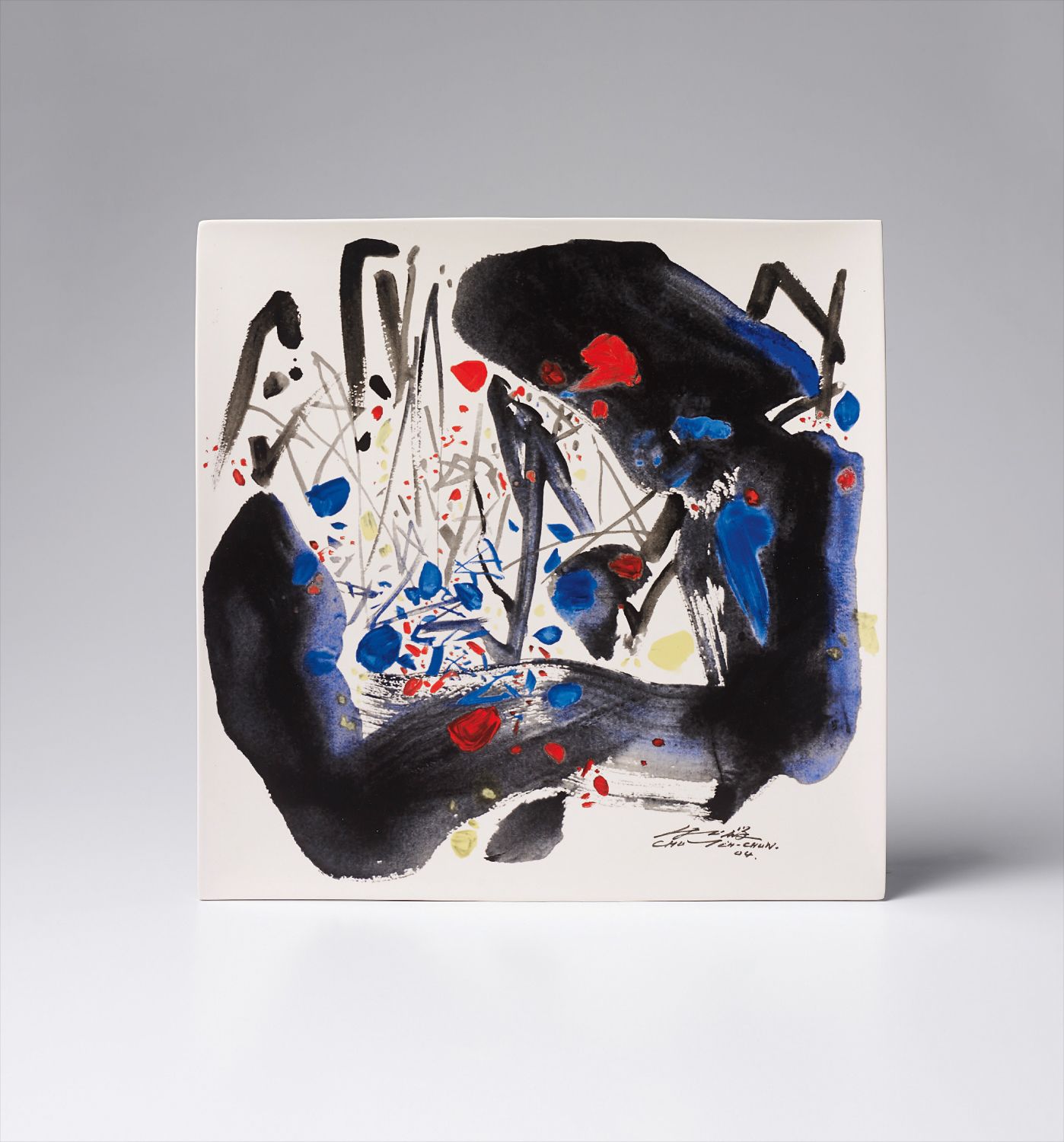
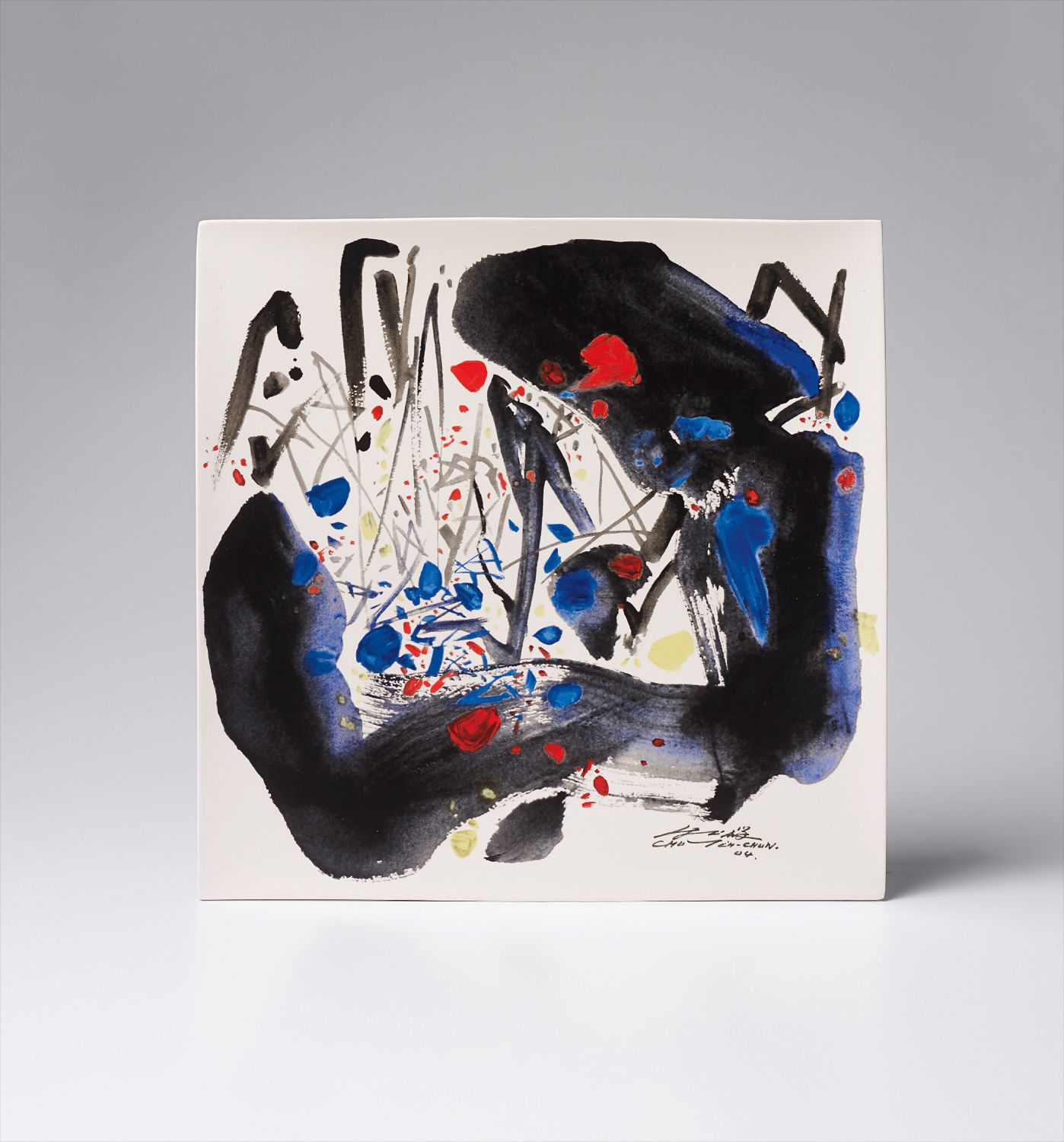
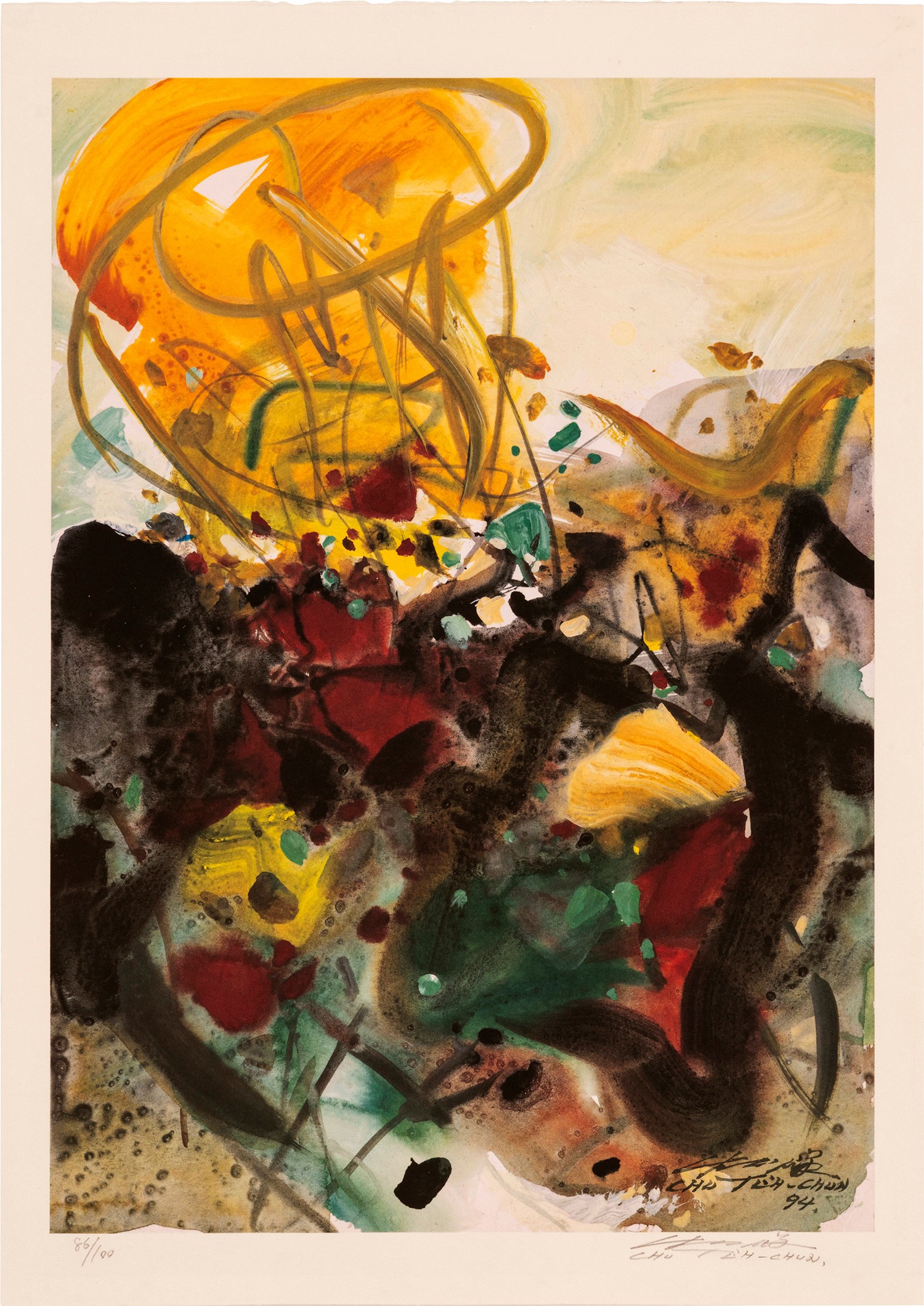
Among the works that best represent his achievement are the calligraphic abstractions of the 1970s, in which black ink like passages move across fields of blue, white, and gold in gestures that carry the authority of centuries of Chinese brushwork while remaining entirely abstract. His series exploring glacial and atmospheric light, including works such as Azur glaciaire, demonstrate his extraordinary ability to hold stillness and movement simultaneously on a single canvas. The colored lithographs, of which the platform holds a fine example, reveal a different dimension of his practice: precise yet lyrical, they show how completely he had absorbed the printmaking traditions of Paris while inflecting them with his own unmistakable sensibility. The ceramic works, painted in colours with glaze, are rarer and speak to the breadth of his curiosity as an artist willing to extend his vision across media.
Chu Teh-chun (zhu Dequn, 1920-2014)
Chu Teh-Chun
From a collecting perspective, Chu Teh chun rewards careful attention to period and medium. His oils from the late 1960s through the 1980s represent the fullest expression of his mature vision and command the strongest prices at auction. Works on paper and prints offer a more accessible entry point and are no less accomplished; they often show the same qualities of atmospheric depth and gestural intelligence that distinguish the canvases. Collectors should look for works in which the layering of paint creates genuine luminosity rather than mere surface texture, and in which the composition holds a sense of directional energy, as though the forms are in motion rather than at rest.
The international breadth of his collector base, spanning Taiwan, Hong Kong, mainland China, France, and the broader diaspora, gives the market a stability that reflects genuine cultural identification with his achievement. Chu Teh chun belongs to a cohort of artists who reshaped the terms of cross cultural modernism in the second half of the twentieth century. His closest peers include Zao Wou Ki, his great friend and fellow traveler in Paris, whose work shares a similar dialogue between Chinese spatial thinking and Western gestural abstraction. Wu Guanzhong, who remained in China but pursued analogous questions about the meeting of traditions, offers another point of comparison.
Chu Teh-chun (zhu Dequn, 1920-2014)
Azur glaciaire (Glacial Blue)
Within the Western tradition, the work of Hans Hartung and Pierre Soulages illuminates the European context in which Chu was working, though his canvases are warmer and more atmospheric than either. What distinguishes Chu from all of these is the particular quality of luminosity he achieved, a sense of light that feels climatically specific to neither East nor West but to some interior landscape shared across cultures. The legacy of Chu Teh chun is secure, and it grows more rather than less interesting with time. His election to the Académie des Beaux Arts in Paris in 1997, as the first artist of Chinese origin to be so honored, was a recognition of what the broader culture had already sensed: that he had genuinely enlarged the possibilities of painting, not by choosing between traditions but by finding the place where they dissolved into one another.
For collectors and institutions encountering his work today, the experience remains as vivid and immediate as it must have been in the studios and galleries of postwar Paris. There is a generosity in his canvases, a willingness to share the full force of feeling, that makes them as alive in the present as they were when the paint was still wet.
Explore books about Chu Teh-chun (zhu Dequn, 1920-2014)
Chu Teh-chun: A Retrospective
François Marquet
Chu Teh-chun: Catalogue Raisonné
Dominique Nabouly-Frame
The Art of Chu Teh-chun
Jean Leymarie
Chu Teh-chun: Between East and West
Michel Tapié
Chu Teh-chun: The Complete Works 1946-1995
Alain Jouffroy