Christopher Williams
Christopher Williams: Photography Perfected, Beautifully Questioned
Artist Spotlight · The Collection Editorial
When the Art Institute of Chicago mounted its landmark retrospective of Christopher Williams in 2014, the art world was offered a rare and sustained encounter with one of the most rigorous conceptual practices in contemporary photography. The exhibition, titled The Production Line of Happiness, gathered decades of work that, at first glance, resembled the polished surfaces of advertising and commercial photography, yet on closer inspection revealed themselves as deeply philosophical investigations into how images are made, what they mean, and who they serve. It was a watershed moment for a practice that had long been championed by critics and curators but had never before received such thorough institutional attention. The retrospective confirmed what many collectors and scholars already understood: Williams is among the most consequential photographers working today.
Christopher Williams
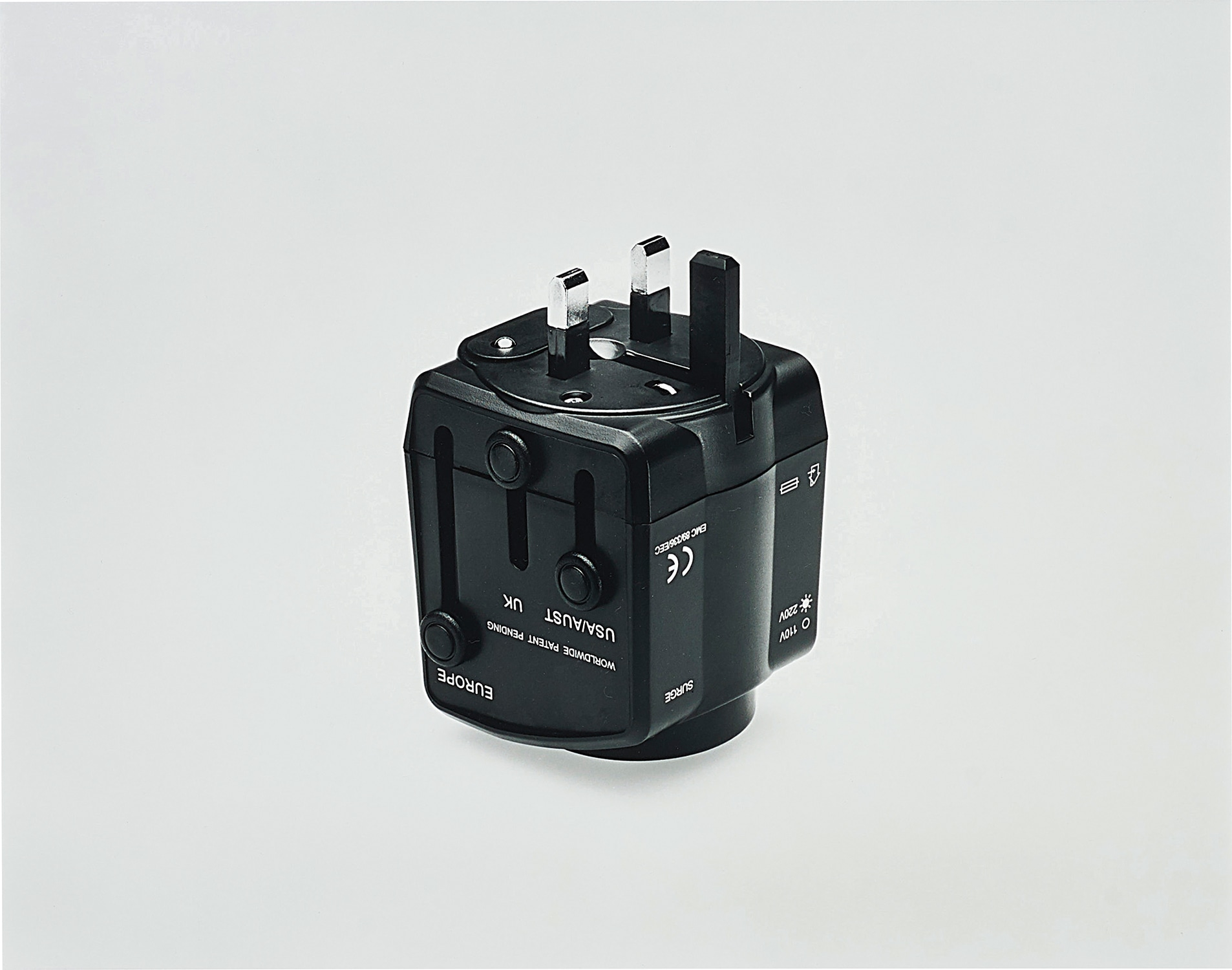
Universal Travel Adaptor, Scorpio Distributors Ltd., Unit DZ, West Sussex, Great Britain, Product number TXR770000, Power Rating: 6A Max 125/250Vac, With Built-In Surge Protector, With Safety Shutters, Surge Indicator Light 110Vac or 220Vac Light Indicator, Built-In 13A Fuse, Testing based on International Standard IEC 884-2-5 Witnessed by TUV, CE EMC Approval, Photography by the Douglas M. Parker Studio, Los Angeles, California, December 15, 2005., 2005
Born in 1956, Christopher Williams came of age in an America saturated with commercial imagery, a culture in which the visual language of advertising, product photography, and mass media had become the dominant form of public communication. He studied at the California Institute of the Arts in Valencia, where he encountered the intellectual ferment of conceptual art and post structuralist theory that would shape his entire practice. CalArts in the late 1970s was an extraordinary crucible, drawing together artists, filmmakers, and theorists who were collectively dismantling received ideas about authorship, representation, and the role of institutions. Williams absorbed these lessons deeply, and they remain visible in every photograph he has made.
Williams developed his practice slowly and deliberately, resisting the pressure to produce prolifically. His approach involves exhaustive research, meticulous pre production planning, and the engagement of professional commercial studios and technicians to execute images to the highest possible standard. Chief among his long standing collaborators is the Douglas M. Parker Studio, based first in Glendale and later in Los Angeles, California, whose name appears in many of Williams's extended, scrupulously factual titles.
Christopher Williams
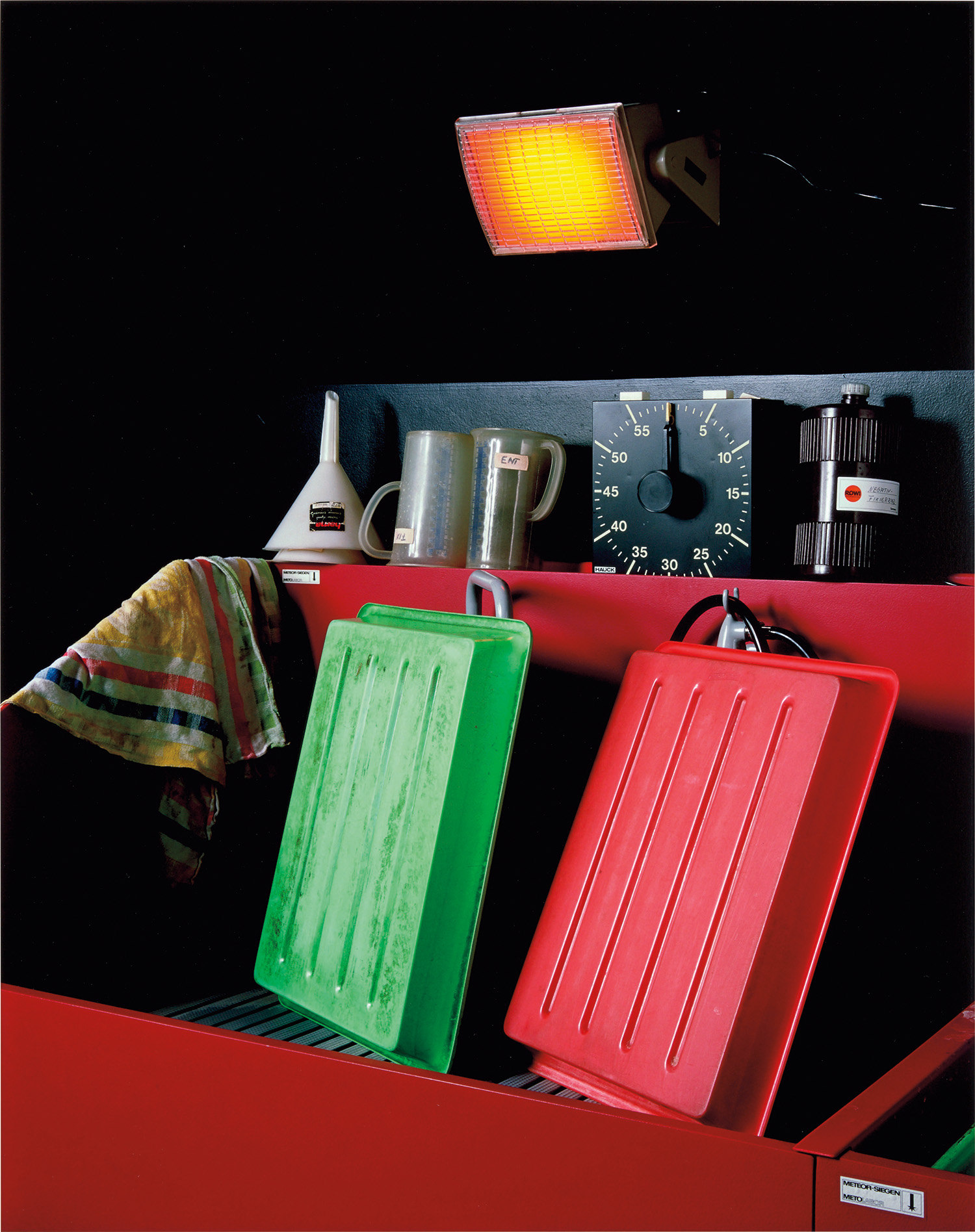
Fachhochschule Aachen, Fachbereich Gestaltung, Studiengang: Visuelle Kommunikation, Fotolabor für Studenten, Boxgraben 100, Aachen, November 8, 2010
These titles are not incidental. They are integral to the work, functioning as documentary records that make visible the labor, technology, and institutional apparatus normally concealed behind the seamless surface of a finished photograph. In this way, Williams treats transparency as a formal gesture, insisting that the conditions of production are as meaningful as the image itself. The works gathered on The Collection span several decades and illuminate the full range of Williams's preoccupations.
The dye transfer prints of 2003, produced using a technically demanding and largely obsolete photographic process, depict objects of great specificity: a Kodak Three Point Reflection Guide from 1968 showing an ear of corn, and a Soviet era Kiev 88 medium format camera manufactured at the Arsenal Factory in Kiev between 1983 and 1987. These are not nostalgic objects chosen for their charm. They are instruments of image making, and by photographing them Williams creates a kind of reflexive loop, a photograph about photography, executed with the same precision the original objects were designed to measure or produce. The gelatin silver print depicting a Universal Travel Adaptor, manufactured by Scorpio Distributors and photographed in December 2005, extends this logic into the global economy of standardization and compliance.
Christopher Williams
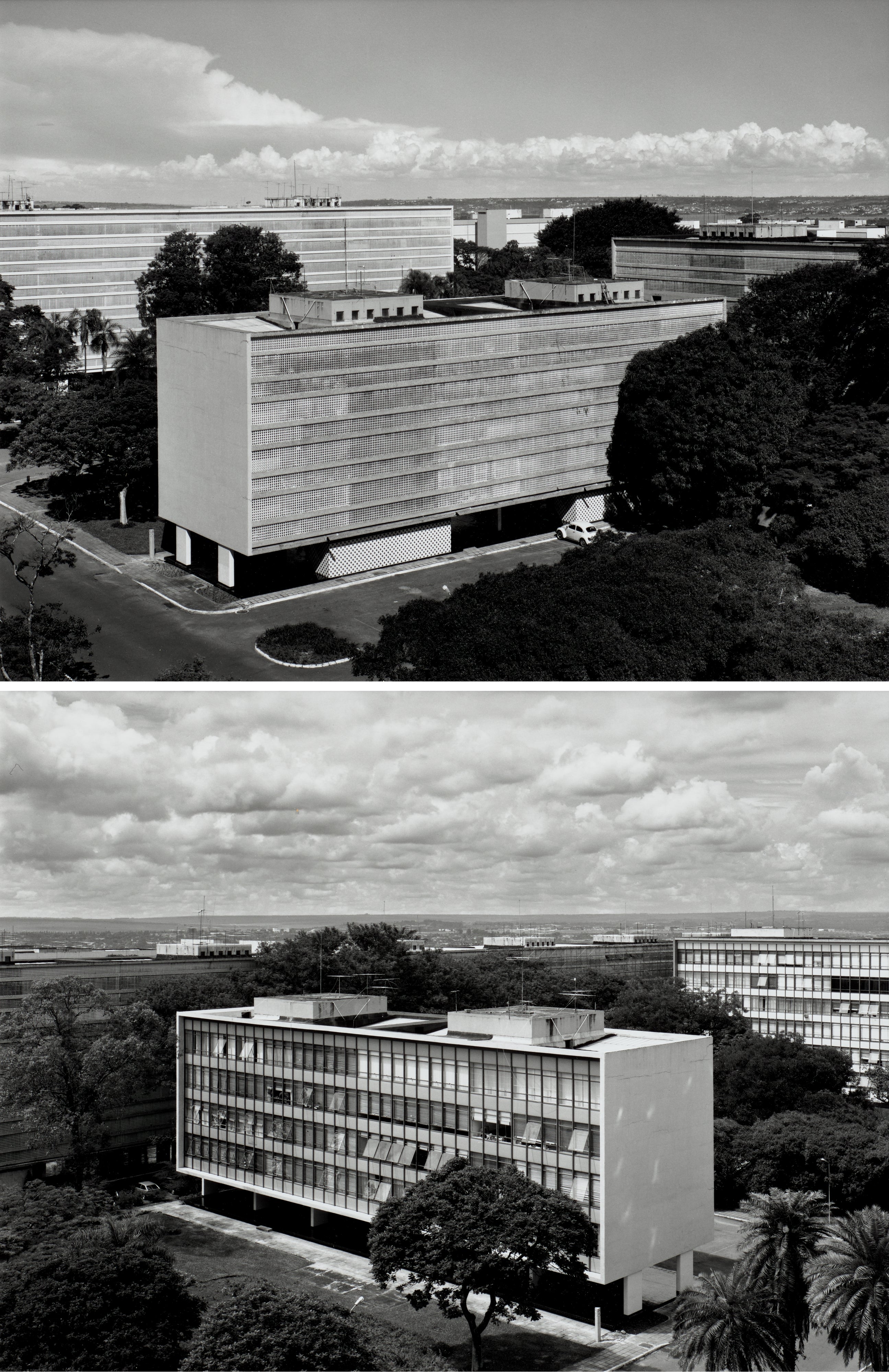
Super Quadra Sul 308 - Bloco 'D' - Asa Sul (south wing) - 70.355 - BRASILIA-DF - Lucio Costa, Oscar Niemeyer, 1960 - January 31, 1997 (No.1 - 2), 1997
The object, banal and utilitarian, is rendered with a beauty that belongs entirely to the tradition of commercial product photography, yet the relentlessly specific title undermines any pretense of commercial intent. Perhaps nowhere is Williams's conceptual intelligence more concentrated than in the Erratum print of 2000, a chromogenic work whose title unfolds into a complete technical specification: camera model, serial number, lens, lighting wattage, film stock, filter codes, exposure times, and chemical processes listed with the precision of a laboratory report. The image itself documents a failure or deviation in the color reproduction process, and yet the work is presented as a finished artwork, signed and exhibited. Williams is asking a fundamental question here: what is the relationship between technical correctness and aesthetic value, between the intended image and the one that actually emerges?
It is a question with implications far beyond photography, touching on language, meaning, and the limits of human control over complex systems. For collectors, Williams's work offers something genuinely rare: a practice that is at once visually beautiful and intellectually rigorous, where every formal decision carries conceptual weight. His prints are produced in small editions and with painstaking care, and the materials themselves, dye transfer, gelatin silver, chromogenic, and archival pigment on cotton rag, are chosen with the same attention to meaning that governs every other aspect of his practice. Works that engage directly with architectural subjects, such as the gelatin silver diptych depicting a residential block in Brasilia designed by Lucio Costa and Oscar Niemeyer, photographed on January 31, 1997, speak to collectors interested in the intersection of photography and modernist design history.
Christopher Williams
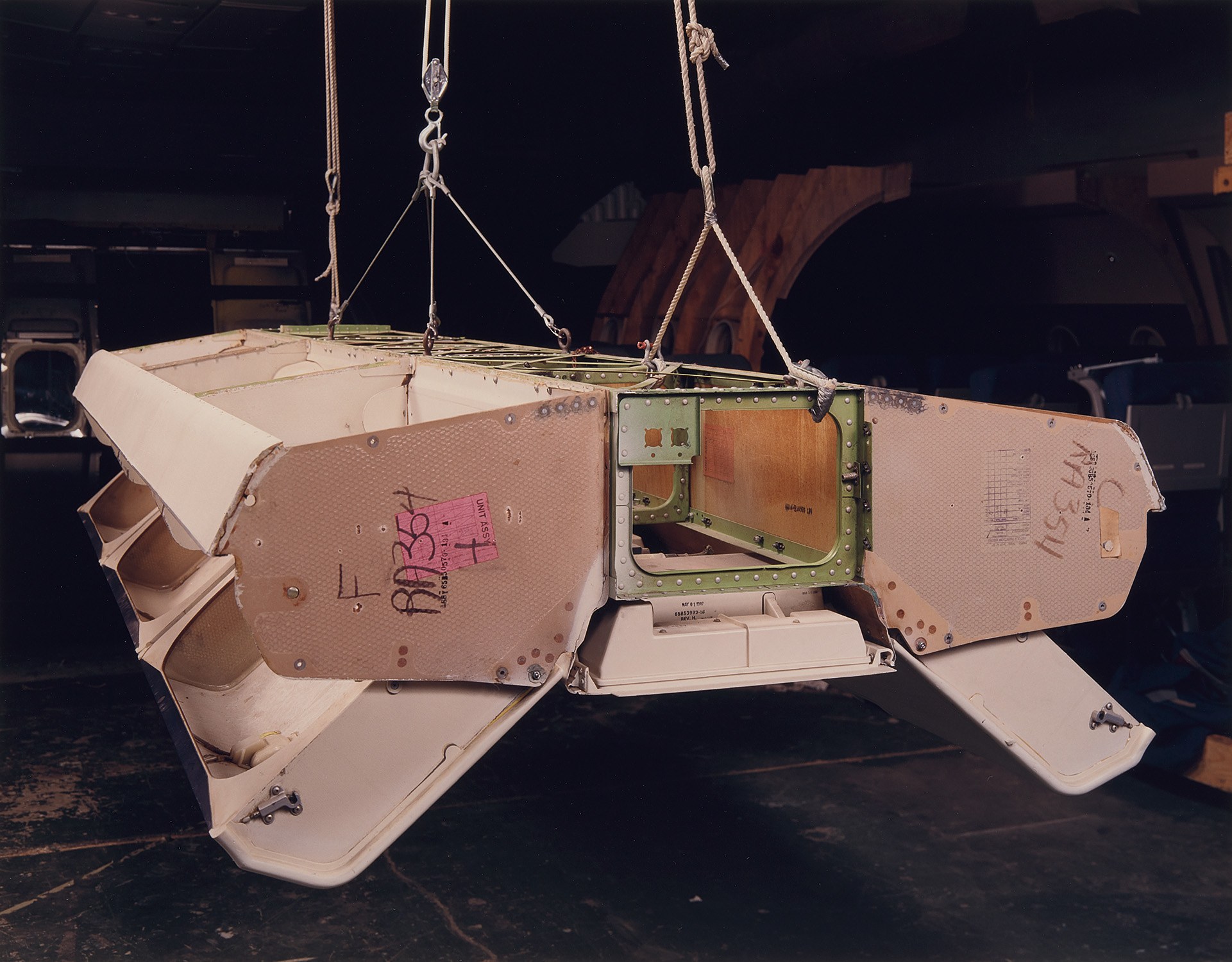
Boeing Retrofit, Overhead Storage Bins, 1970, For Boeing Model 747-200 B / (Open / Color) / Aeromock-Ups, Inc. / North Hollywood, California / August 6, 1997, 1997
The Boeing Retrofit chromogenic print of 1997, depicting overhead storage bins from a 1970 model aircraft, appeals to those drawn to the aesthetics of industrial modernity and institutional systems. Within the broader landscape of conceptual art and photography, Williams occupies a position that places him in dialogue with artists including Bernd and Hilla Becher, whose systematic documentation of industrial structures shares his commitment to serial logic and typological thinking. The influence of Dan Graham and Michael Asher, fellow travelers in the CalArts milieu, is also legible in his interrogation of institutional and commercial frameworks. More recently, artists such as Wolfgang Tillmans and Taryn Simon have explored related questions about the politics of photographic representation, though Williams's practice remains singular in its extreme specificity and its insistence on making the apparatus of image production a subject in its own right.
His work is regularly featured in major institutional surveys and his presence at documenta and the Venice Biennale has cemented his international standing. Christopher Williams matters today because the questions he poses have only become more urgent. In an era of algorithmic image generation, infinite digital reproduction, and the collapse of any stable distinction between commercial and artistic imagery, his patient, painstaking insistence on the specific conditions of photographic production feels like an act of cultural conscience. He reminds us that every image is made somewhere, by someone, with particular tools, under particular conditions, and that understanding those conditions is essential to understanding what we see.
For collectors, owning a work by Christopher Williams is not merely an aesthetic pleasure. It is an invitation to look more carefully at the world of images that surrounds us, and to appreciate the rare intelligence that has spent decades teaching us how.
Explore books about Christopher Williams