Christo and Jeanne-Claude

Christo and Jeanne-Claude Wrapped the World
Artist Spotlight · The Collection Editorial
“I am an artist, and I have to have courage. Do you know that I don't have any artworks that exist? They all go away when they are finished.”
Christo, interview
In the winter of 2005, Central Park became something otherworldly. For sixteen days in February, 7,503 saffron colored fabric panels hung from steel gates along 23 miles of footpaths, transforming one of the world's most beloved public spaces into a shimmering, wind animated river of gold. "The Gates" had been decades in the making, proposed first in 1979 and realized only after extraordinary perseverance, and when it finally arrived it drew an estimated four million visitors. It remains one of the most attended public art events in American history, and it captures everything essential about Christo and Jeanne Claude: the grandeur, the patience, the joy, and the complete refusal to accept that something beautiful was impossible.
Christo and Jeanne-Claude
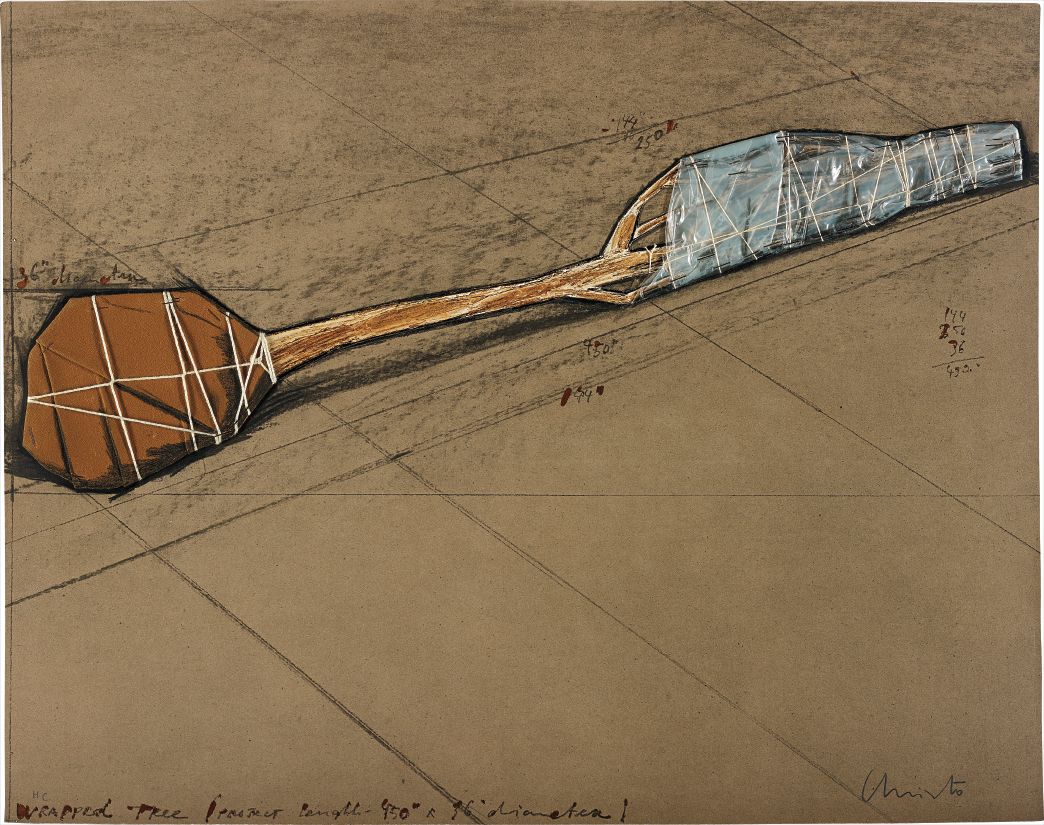
Wrapped Tree, Project
Christo Vladimirov Javacheff was born on June 13, 1935, in Gabrovo, Bulgaria, the same day Jeanne Claude Denat de Guillebon was born in Casablanca, Morocco. This shared birthday, later a source of great delight to both of them, seemed to announce from the very beginning that their lives were destined to intertwine. Christo studied at the Sofia Academy of Fine Arts before fleeing communist Bulgaria in 1957, passing through Prague, Vienna, and Geneva before arriving in Paris. There he began wrapping objects, small things at first, cans and bottles and parcels, as if the act of concealment could itself be a form of revelation.
Jeanne Claude came from a French military family of considerable distinction, and the two met in Paris in 1958 when Christo was commissioned to paint a portrait of her mother. Their partnership, personal and artistic, began almost immediately. In their early Paris years, Christo was working within a climate of fierce artistic experimentation. The Nouveau Realisme movement, championed by critic Pierre Restany and artists like Yves Klein and Jean Tinguely, was redefining the relationship between art and the everyday object.
Christo and Jeanne-Claude
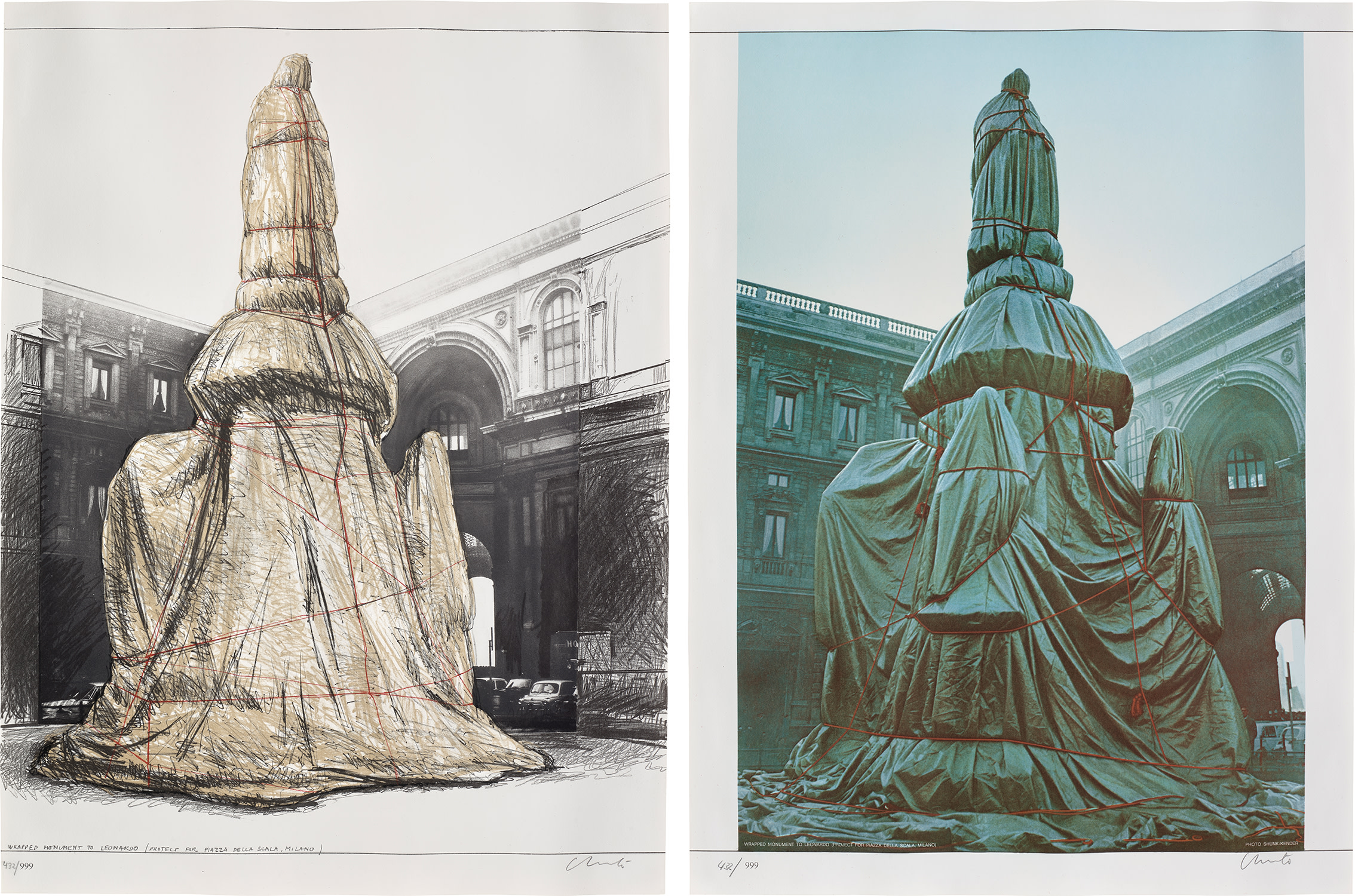
Wrapped Monument to Leonardo, Project for Piazza della Scala, Milan: two plates (S. 41-42)
Christo's wrapped cans and stacked oil drums resonated with this sensibility, and his 1962 "Iron Curtain" project, in which he and Jeanne Claude stacked 240 oil barrels across Rue Visconti in Paris to block traffic for several hours, announced that their ambitions would exceed any gallery wall. The action was provocative, witty, and impossible to ignore. It was also entirely self funded, a principle the duo would maintain throughout their careers. They accepted no corporate sponsorship and no government grants.
“The work of art is a scream of freedom.”
Christo
Every project was financed through the sale of preparatory drawings, collages, and prints, a decision that made their collecting community not merely patrons but genuine co conspirators in the work. The evolution of their practice through the 1960s and 1970s saw the scale of their ambitions grow in proportion to their technical mastery. "Wrapped Coast" in 1969 saw one million square feet of erosion control fabric draped over a mile and a half of Australian coastline near Sydney. "Valley Curtain" in Rifle, Colorado in 1972 suspended an immense saffron nylon curtain across a mountain valley.
Christo and Jeanne-Claude
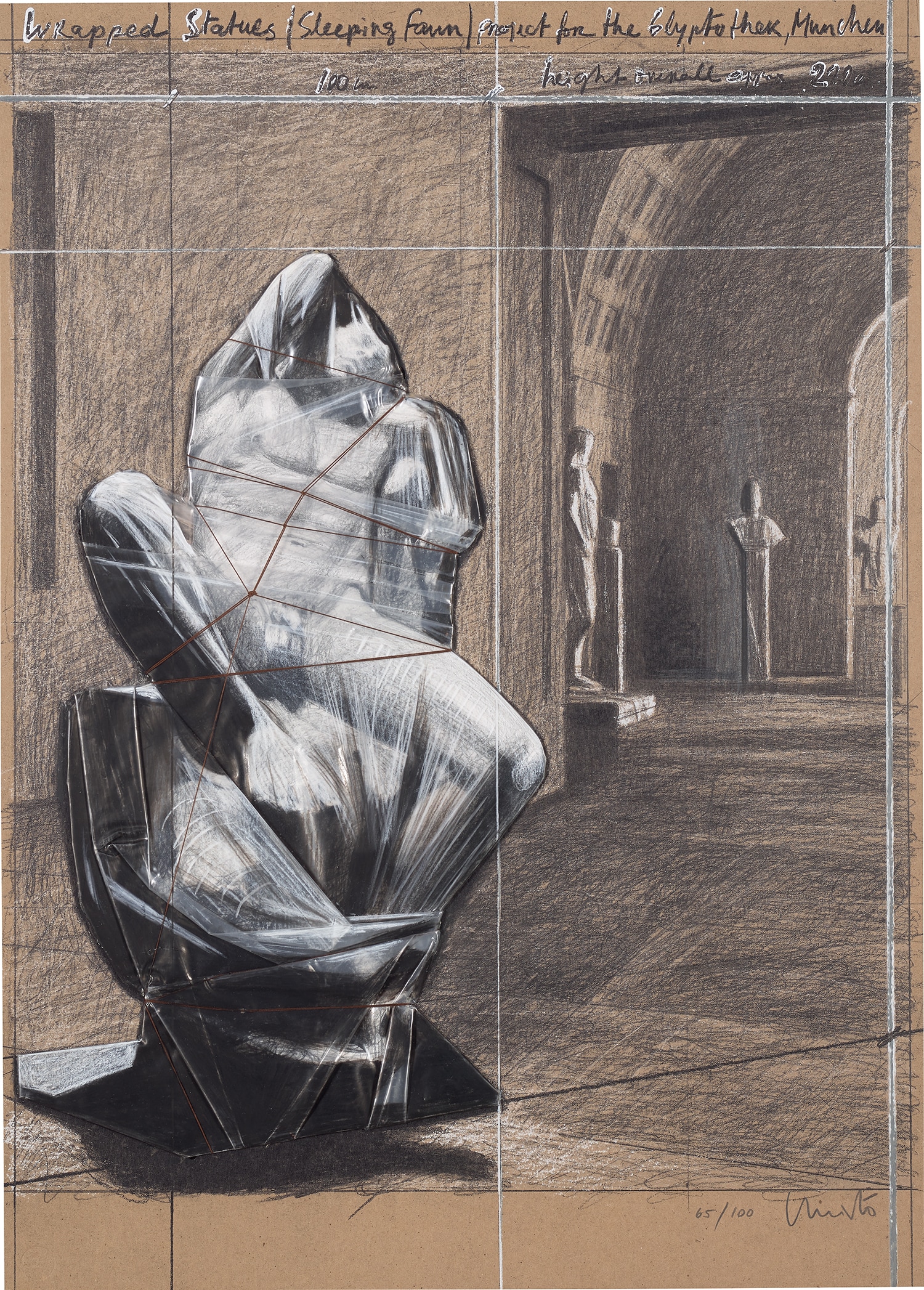
Wrapped Statues, Sleeping Fawn, Project for Die Glyptothek, München (S. 183)
"Running Fence" in 1976 stretched 24.5 miles across the hills of Sonoma and Marin Counties in California, dipping finally into the Pacific Ocean. Each project required years of negotiation, engineering studies, environmental impact assessments, and public hearings. The process itself was considered part of the artwork, democracy in its most demanding and generative form.
When the work appeared, it lasted only briefly. Nothing was sold, nothing was permanent, and everything was returned to its prior state. The temporary nature of the installations was not a limitation but a philosophy. The preparatory works on paper occupy a central and deeply rewarding place in the Christo and Jeanne Claude story.
Christo and Jeanne-Claude
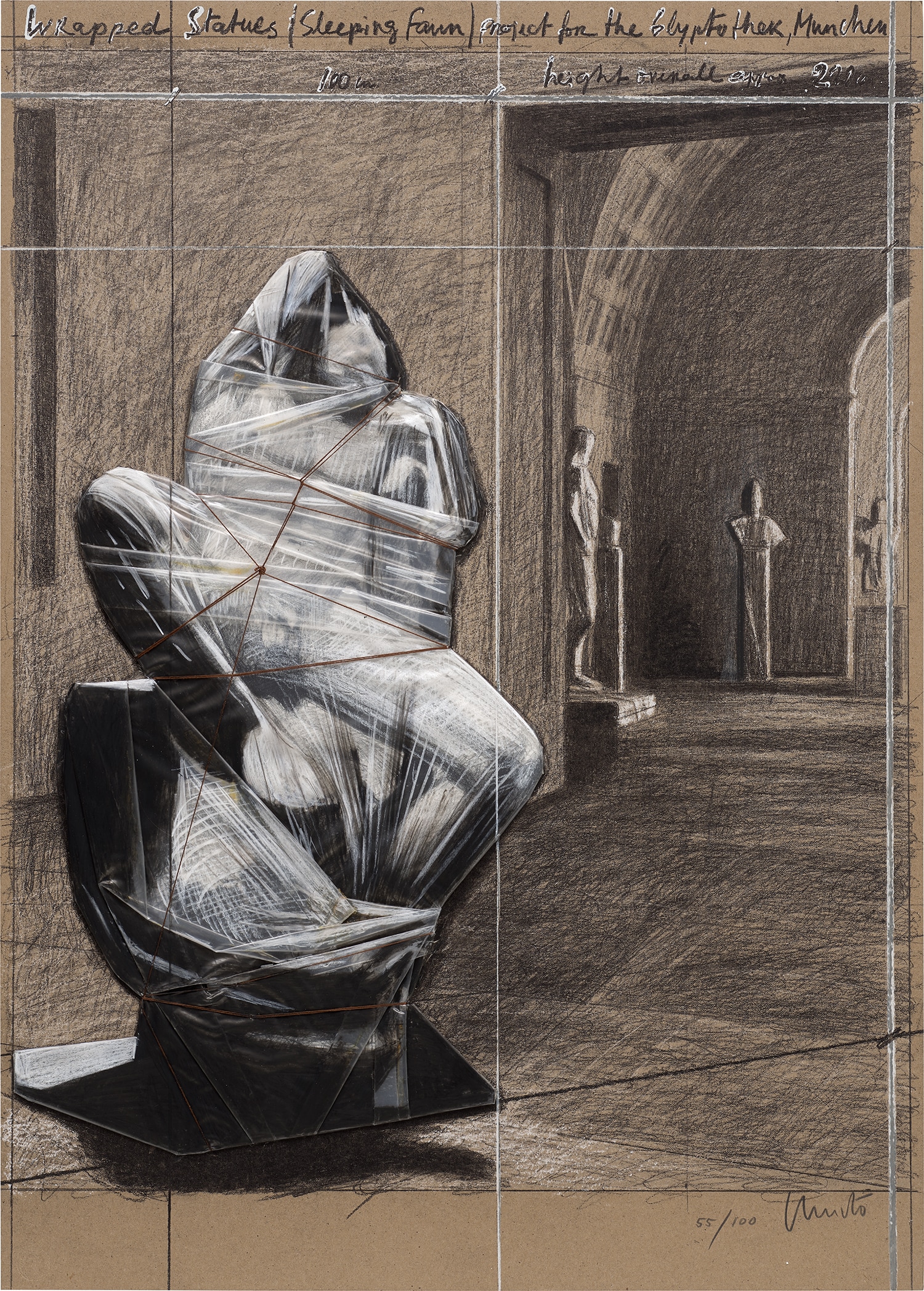
Wrapped Statues, Sleeping Faun, Project for Die Glyptothek, Munich (S. 183)
Because the monumental installations could not be owned, the drawings, collages, lithographs, and mixed media works created in their development became the primary objects for collectors. These are not mere sketches. They are fully realized compositions that combine photographic collage, hand drawn notation, fabric swatches, polyethylene, twine, and prismacolor into objects of extraordinary material richness. Works like "Wrapped Tree, Project" and "Lower Manhattan Wrapped Buildings, Project for 2 Broadway, 20 Exchange Place" demonstrate the full sophistication of this approach, layering city maps on Japanese rice paper, attenuated lithography in blues and grays, actual fabric collage, and meticulous pencil annotation into images that are simultaneously architectural proposal, poetic object, and collector's prize.
The series dedicated to the "Wrapped Statues" project for the Glyptothek in Munich, rendered in collotype and screenprint with collage of polyethylene and twine, stands as a particularly compelling body of work within this tradition. For collectors, the market for Christo and Jeanne Claude's works on paper has remained consistently strong and continues to attract serious attention at auction. Christie's, Sotheby's, and Phillips have all recorded notable results for major collages and lithographs, with works tied to landmark projects like "The Gates," "Wrapped Reichstag," and "The Floating Piers" commanding particular enthusiasm. The 1995 wrapping of the Reichstag in Berlin, a project that required 24 years of negotiation with the German government, produced some of the most sought after preparatory works in the artists' catalog.
Collectors are drawn not only to the beauty of these objects but to their documentary weight. To own a preparatory work by Christo and Jeanne Claude is to hold a chapter of an extraordinary story, one that required vision, stamina, and a profound belief in the transformative power of art in public space. The collages and prints also offer genuine accessibility compared to works by peers of equivalent historical stature, making them a compelling entry point for collectors building thoughtful modern and contemporary holdings. Within the broader arc of art history, Christo and Jeanne Claude occupy a singular position.
Their engagement with spectacle and popular culture places them in conversation with the Pop Art generation, while their insistence on process, documentation, and conceptual rigor aligns them with figures like Joseph Beuys and the broader Conceptual Art movement. Their influence on subsequent generations of installation and land artists is immeasurable, visible in the work of artists ranging from Richard Long to Olafur Eliasson. The couple worked together openly as equals from the beginning, though it was not until 1994 that Jeanne Claude was formally credited as co author of all projects created since 1961. Jeanne Claude passed away in November 2009.
Christo continued working until his own death in May 2020, completing "L'Arc de Triomphe, Wrapped" posthumously through his studio, the project realized in Paris in September 2021 as a tribute to them both. The legacy of Christo and Jeanne Claude is not simply one of spectacular images, though the images are undeniably spectacular. It is a legacy of imagination applied with absolute seriousness, of beauty understood as a civic act, of art that asked something genuine from the public and received in return something genuine back. Every wrapped tree, every draped monument, every island surrounded in pink fabric was an invitation to see the familiar as extraordinary, to understand that the world as given is only one version of the world possible.
For collectors, for institutions, and for anyone who stood on a hillside in California watching a fence of white nylon billow into the Pacific, that invitation remains open and irresistible.
Explore books about Christo and Jeanne-Claude
Christo and Jeanne-Claude: The Pont Neuf Wrapped
Werner Spies

Christo and Jeanne-Claude: On the Way to The Gates
Jacob Baal-Teshuva
The Gates: Central Park, New York, 1979-2005
Jacob Baal-Teshuva

Christo and Jeanne-Claude: A Biography
Calvin Tomkins
Christo and Jeanne-Claude: Complete Works
Jacob Baal-Teshuva
Wrapped Trees
Christo and Jeanne-Claude
Christo and Jeanne-Claude: The Running Fence
Various