Chris Martin
Chris Martin Paints the World Gloriously Alive
Artist Spotlight · The Collection Editorial
“On some level, I am always a landscape painter. Even when I make more severe abstract paintings, a horizon line establishes a ground.”
Chris Martin, 2014
In the spring of 2023, visitors to Karma gallery in New York encountered something that felt less like a conventional exhibition opening and more like a collective awakening. Chris Martin's paintings filled the rooms with an almost physical generosity, their surfaces dense with glitter, collaged paper, sequins, and paint applied in gestures that read simultaneously as ancient and entirely of this moment. For an artist who has been quietly building one of the most singular bodies of work in American painting since the 1980s, the show was another chapter in a career that rewards sustained attention and repays it with genuine joy. Martin, now in his seventies and based in Brooklyn, has outlasted trends, survived obscurity, and emerged as one of the most important abstract painters working in the United States today.
Chris Martin
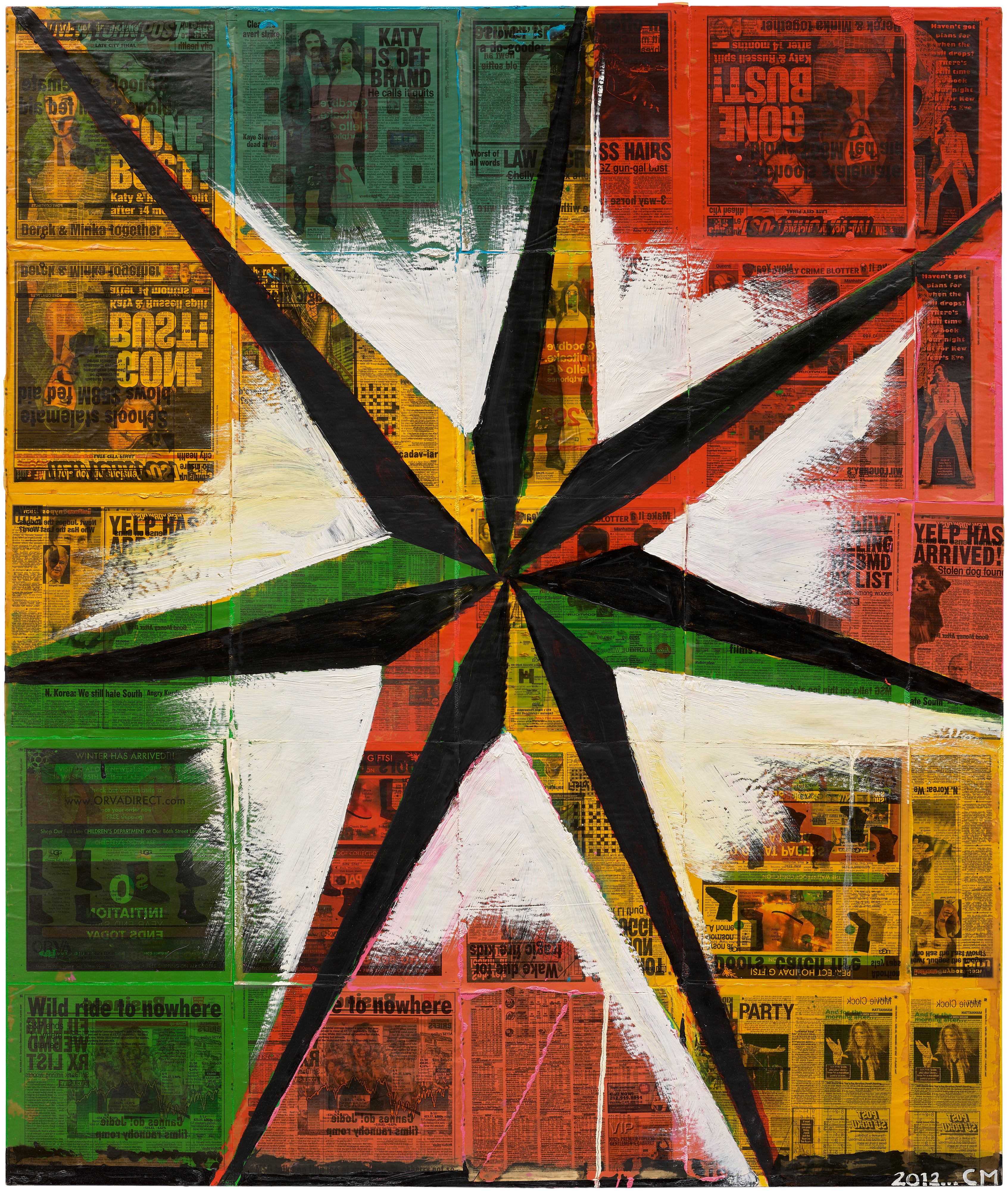
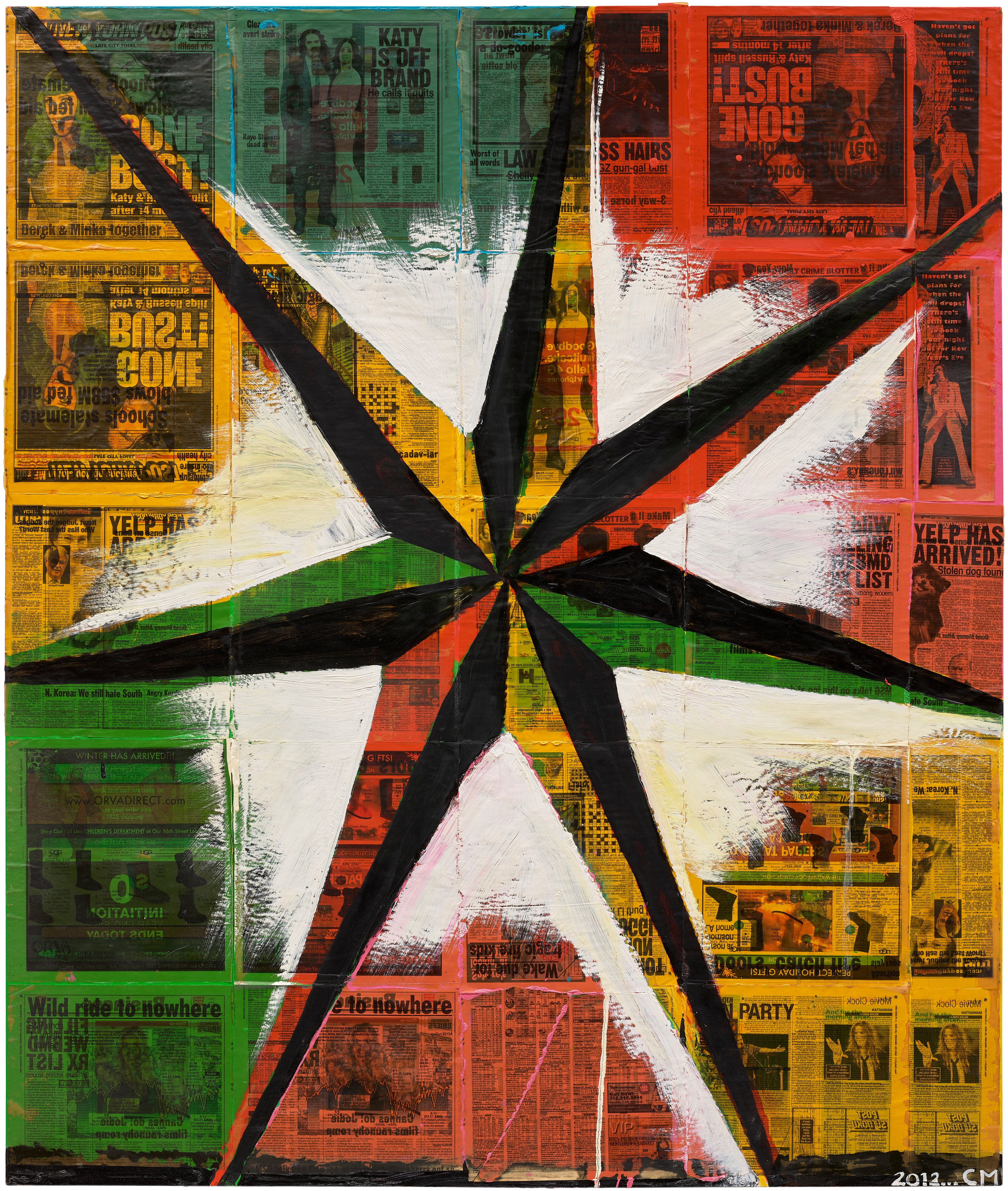
Gone Bust, 2011
Chris Martin was born in 1954 and came of age as an artist during one of the most turbulent and generative periods in American cultural life. He studied at Yale University, where he was immersed in a rigorous intellectual environment that shaped his understanding of art history without ever fully containing his instincts. The downtown New York scene of the late 1970s and 1980s formed the crucible of his early practice, a world where Abstract Expressionism's legacy was being simultaneously honored, dismantled, and reimagined. Martin absorbed all of it while maintaining an openness to sources far outside the gallery system: folk art traditions, spiritual iconography, outsider art, and the material culture of everyday life all found their way into his thinking.
His artistic development has unfolded across several distinct but interconnected phases, each marked by an expanding willingness to embrace unlikely materials and unconventional formats. Where many of his contemporaries moved toward austerity or conceptual distance in the 1990s, Martin moved in the opposite direction, layering surfaces with increasing richness and allowing spiritual references to become more explicit rather than more coded. He began incorporating glitter in ways that initially surprised even sympathetic viewers, but which now read as one of the most inspired formal decisions in recent painting history. The glitter does not decorate his canvases so much as it charges them, turning surfaces into fields of captured and reflected light that shift as the viewer moves and as the day changes around them.
Chris Martin
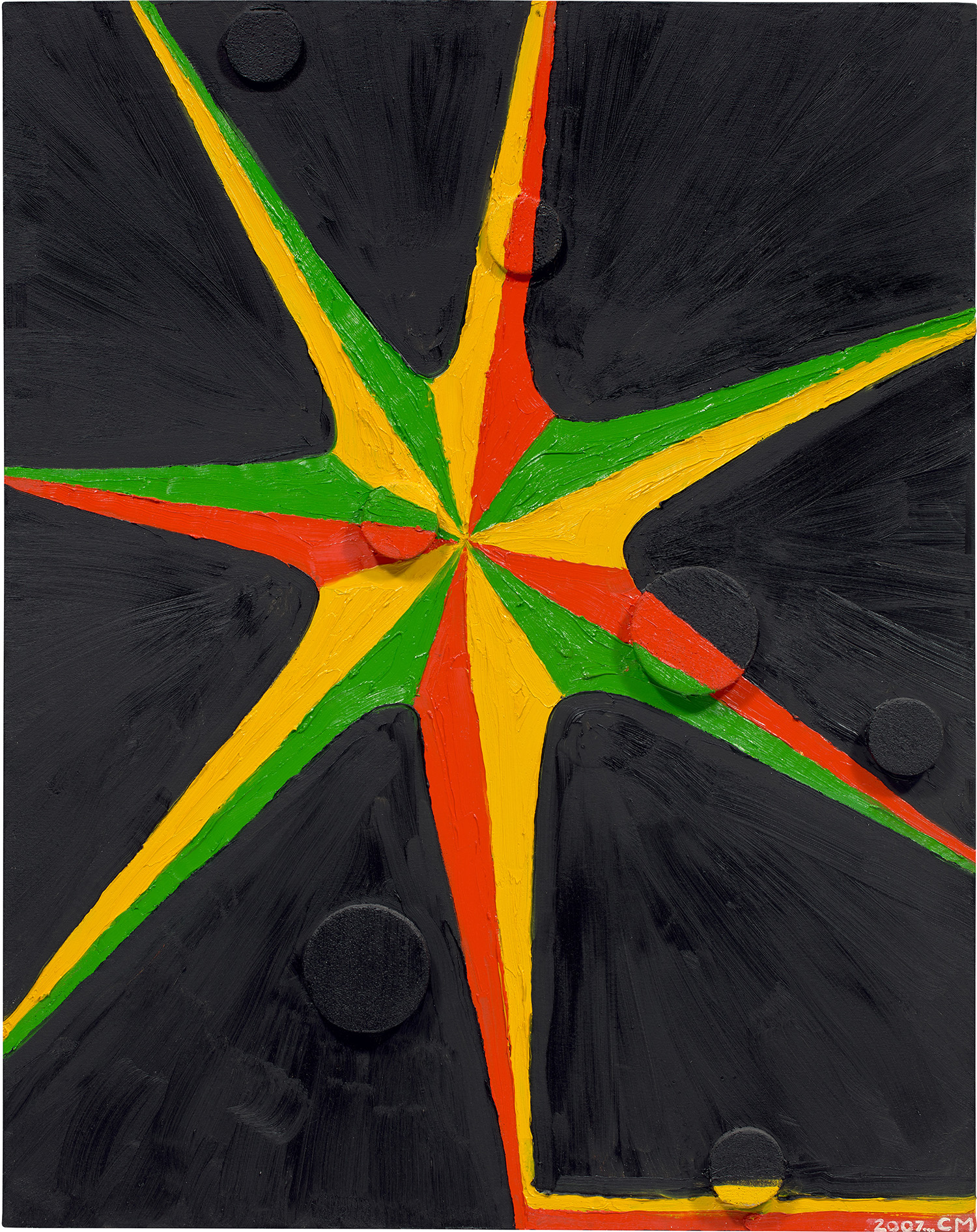
Seven Pointed Star, 2007
The works available through The Collection offer a compelling cross section of Martin's range and ambition. "Gone Bust" from 2011, combining oil, gel medium, and paper collage on canvas, exemplifies his capacity to build a painting that feels simultaneously improvised and inevitable, a surface where chance and intention reach a productive equilibrium. "Seven Pointed Star" from 2007 draws on sacred geometry in ways that connect to traditions running from Islamic architectural ornament through American folk quilting to the mystical diagrams of Rudolf Steiner, whom Martin has cited as an influence. The "Empty Frame Painting (Homage to Al Jensen)" pays tribute to the underappreciated mid century painter whose obsessive patterning and spiritual preoccupations clearly resonate deeply with Martin's own.
"Amy Winehouse (Gold)" from 2019, rendered in acrylic and charcoal, demonstrates his willingness to bring portraiture and cultural elegy into a practice otherwise associated with abstraction, honoring the singer with a luminous directness that feels both personal and universal. For collectors, Martin's work presents a rare combination of art historical seriousness and genuine sensory pleasure. His paintings do not require academic preparation to reward a viewer, and yet they repay deep looking with layers of reference and intention that continue to unfold over years of living with them. Works on paper and prints, including the screenprint "Wednesday Miles" from the Miles Davis series, offer accessible entry points into a practice where even modest scale works carry the full weight of his thinking.
Chris Martin
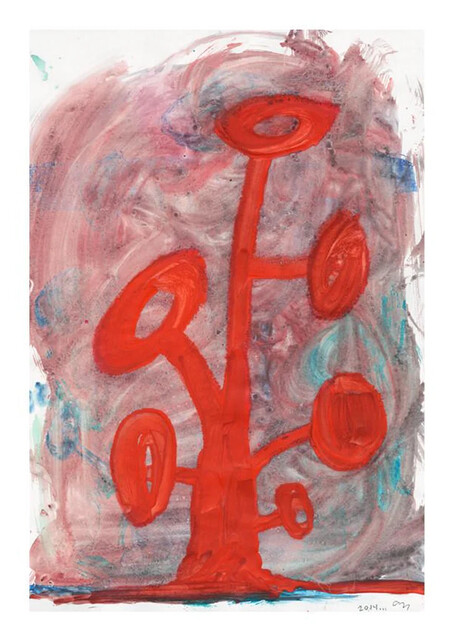
Tree, 2014
Collectors who have followed his career with attention have found that his market, while long undervalued relative to his critical standing, has strengthened steadily as institutional recognition has grown. The shaped canvases, the large scale works on burlap, and the collage heavy paintings from the 2000s and 2010s represent particularly strong areas of focus for serious collectors building a position in his work. To understand Martin fully it helps to see him in relation to the painters he admires and the broader currents he navigates. His emotional directness connects him to Philip Guston, whose late career turn toward raw figuration and personal myth Martin has clearly absorbed.
His material inventiveness recalls early Rauschenberg and the combine tradition, while his spiritual seriousness places him in conversation with painters like Blinky Palermo, to whom he has dedicated a work, and Sigmar Polke, whose own promiscuous relationship with unconventional materials transformed what painting could mean in the late twentieth century. The homage to Al Jensen signals his respect for painters who pursued visionary private systems without concern for fashionability, a quality Martin shares in abundance. He is also deeply connected to the New York abstractionist tradition running through Abstract Expressionism while insisting that tradition remain permeable to the vernacular, the festive, and the sacred. Chris Martin's significance in contemporary art rests on something that has become increasingly rare: a practice sustained over decades by genuine conviction rather than market calculation or institutional strategy.
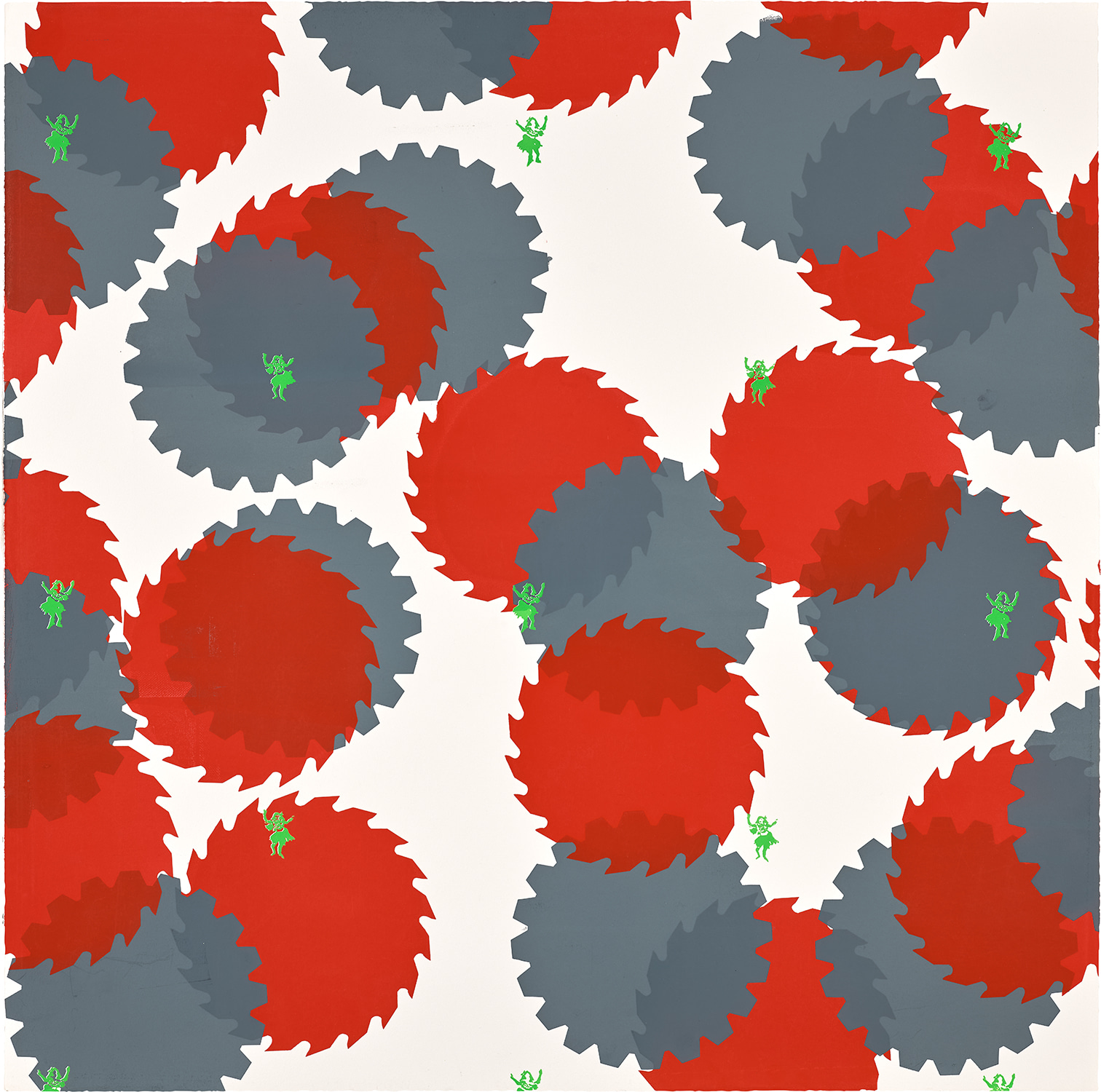
Chris Martin
Wednesday Miles, from Miles Davis at the Gilmore
At a moment when the art world places enormous pressure on artists to consolidate a recognizable brand identity and deliver predictable variations on a signature style, Martin continues to take risks, to allow his paintings to be strange and ungainly and radiant in equal measure. The landscape orientation he has described as underlying even his most abstract work, that insistence on ground and horizon, gives his practice a rootedness in human experience that keeps it from floating into pure aestheticism. His canvases feel inhabited, full of the accumulated presence of a life spent looking, thinking, and making with complete seriousness and complete openness. That is an achievement worth celebrating, and worth collecting.