Charles Demuth
Charles Demuth, America's Most Precise Poet
Artist Spotlight · The Collection Editorial
“John Marin and I drew our inspiration from the same source, French modernism. He brought home the bacon, I brought home the bread.”
Charles Demuth
Picture Lancaster, Pennsylvania in the early twentieth century, a modest city of brick and industry, and imagine a young man quietly absorbing its geometry, its smokestacks, its grain elevators rising against pale skies. That young man was Charles Demuth, and what he saw in the ordinary American landscape would become the foundation of one of the most distinctive and enduring visions in the history of modern art. Today, with major institutional holdings at the Whitney Museum of American Art, the Philadelphia Museum of Art, and the Museum of Modern Art in New York, Demuth's work continues to command the attention of scholars, curators, and collectors who recognize in his paintings a rare synthesis of European sophistication and deeply American feeling. Demuth was born in Lancaster in 1883, into a family with deep roots in the Pennsylvania German community.
Charles Demuth
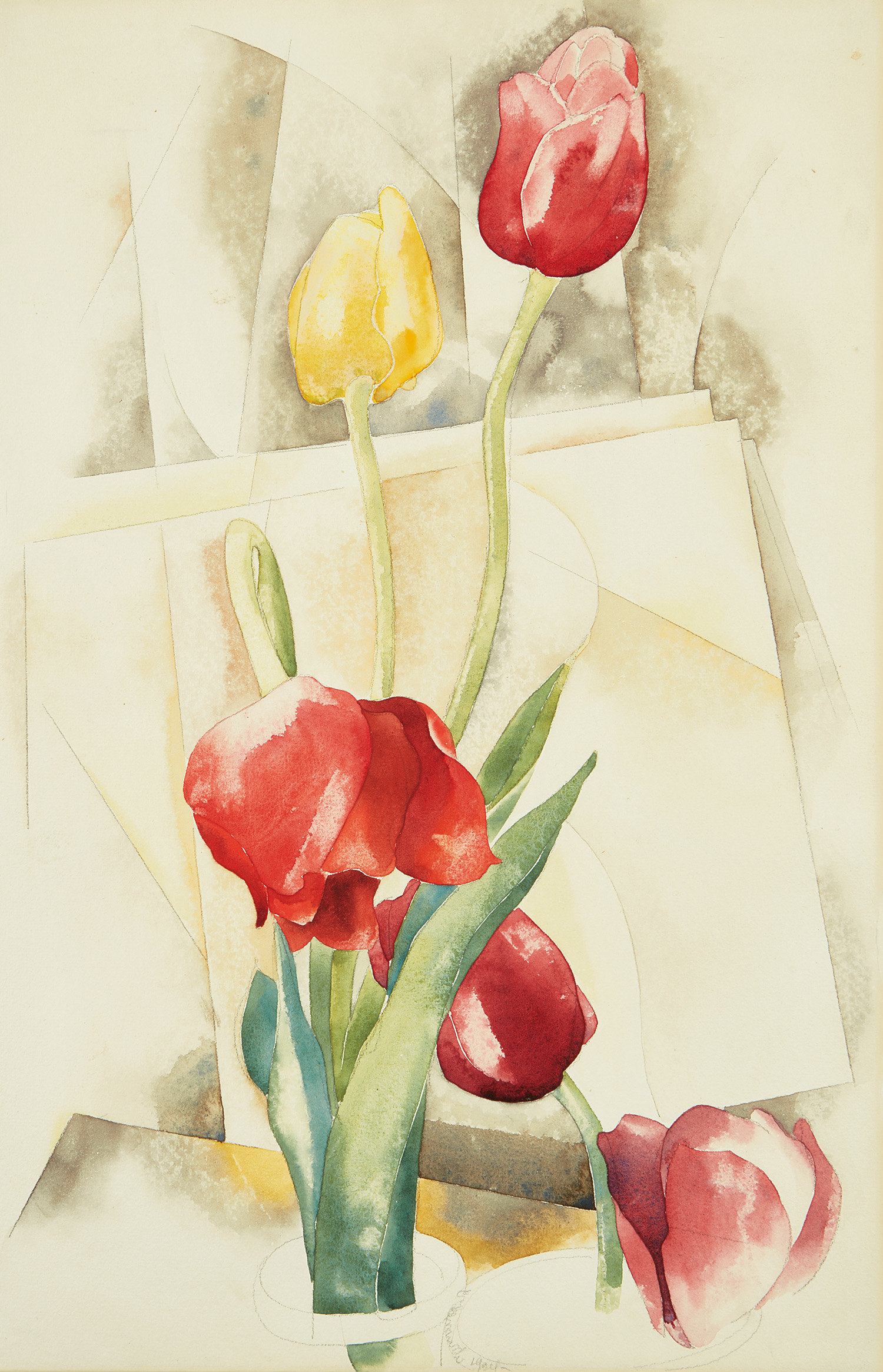
Tulips, 1924
His childhood was shaped by the particular rhythms of a small city that was neither rural nor fully industrial, and from an early age he demonstrated a passion for drawing that his family encouraged. He enrolled at the Drexel Institute in Philadelphia before transferring to the Pennsylvania Academy of the Fine Arts, one of the oldest and most rigorous art schools in the country, where he studied under Thomas Anshutz and William Merritt Chase. These were formative years, grounded in tradition, but Demuth was restless for something more urgent and alive. The pivotal transformation came through his travels to Paris, where he spent time between 1907 and 1914, absorbing the radical energies of Cubism and Fauvism firsthand.
He moved in remarkable circles, befriending Gertrude Stein and encountering the work of Cézanne, Matisse, and Picasso at a moment when European modernism was rewriting the rules of representation. Demuth returned to the United States carrying those lessons with extraordinary care, determined not simply to imitate what he had seen abroad but to translate it into an American idiom. It was a challenge that defined the rest of his career and earned him a central place in the story of how modernism took root on American soil. Back in the United States, Demuth found his most natural home in the orbit of Alfred Stieglitz and the artists who gathered around his legendary 291 gallery and later his American Place gallery in New York.
Charles Demuth
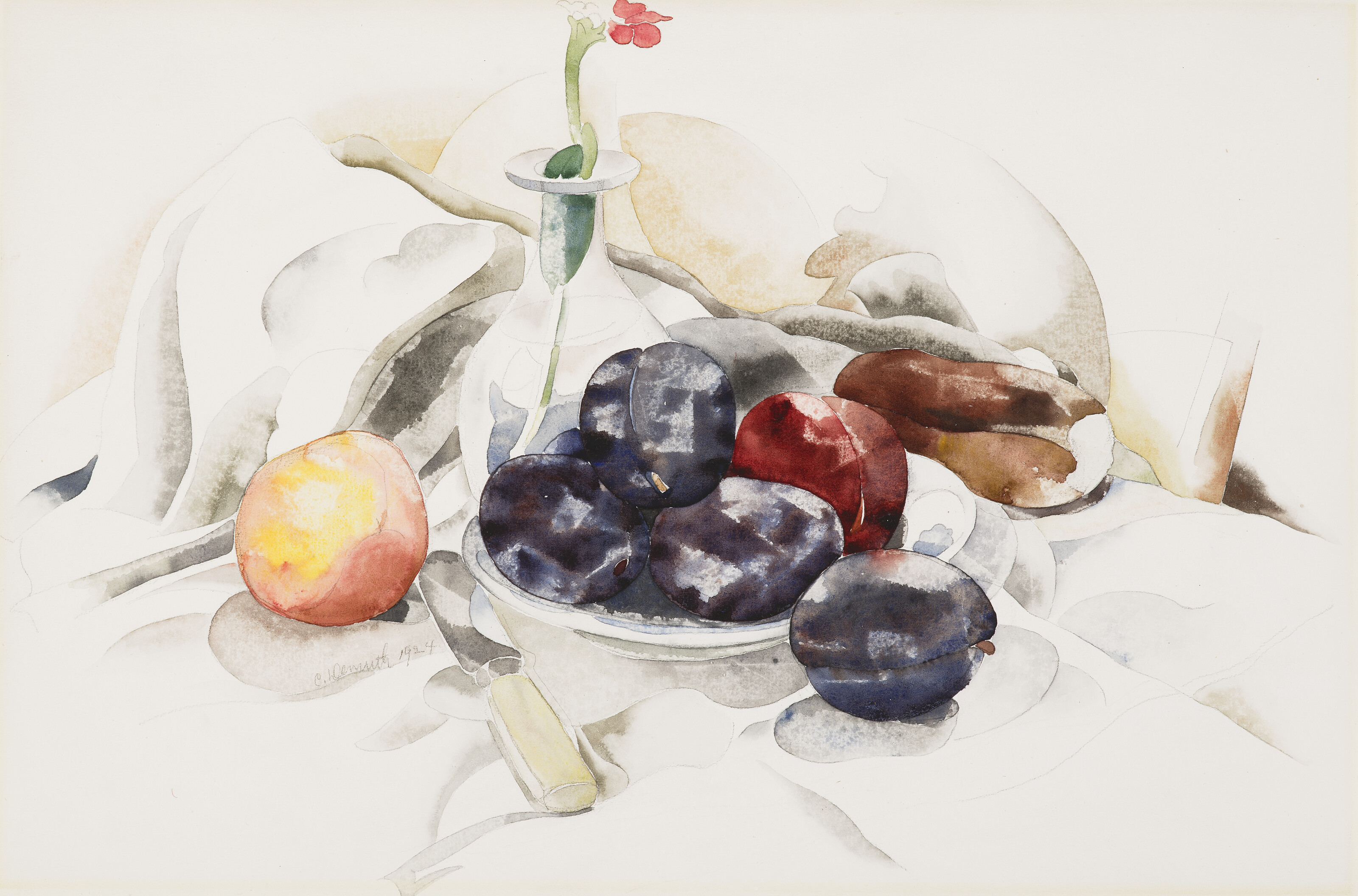
Blue Plums
He became close friends with William Carlos Williams, whose poetry shared his own fascination with the beauty hidden inside ordinary American things, and with Marcel Duchamp, whose wit and conceptual boldness clearly animated Demuth's most ambitious works. It was within this milieu of genuine intellectual friendship that Demuth developed what would become his signature contribution to American art: the Precisionist aesthetic. Precisionism rendered the industrial and architectural landscape in clean, interlocking planes of light and color, finding in factories and water towers a kind of industrial sublime that was neither sentimental nor cold. Demuth's work divides naturally into two magnificent streams, each extraordinary in its own right.
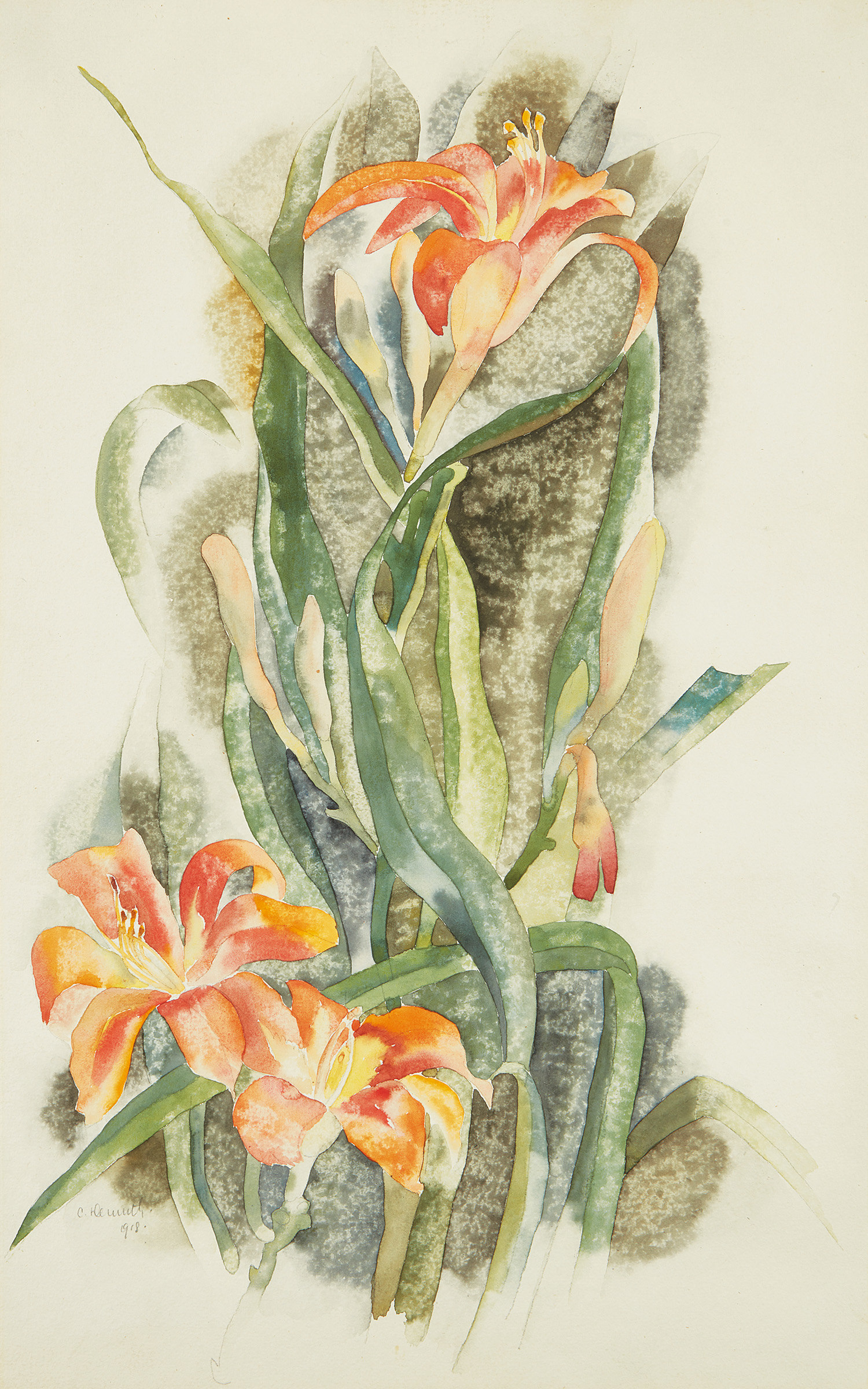
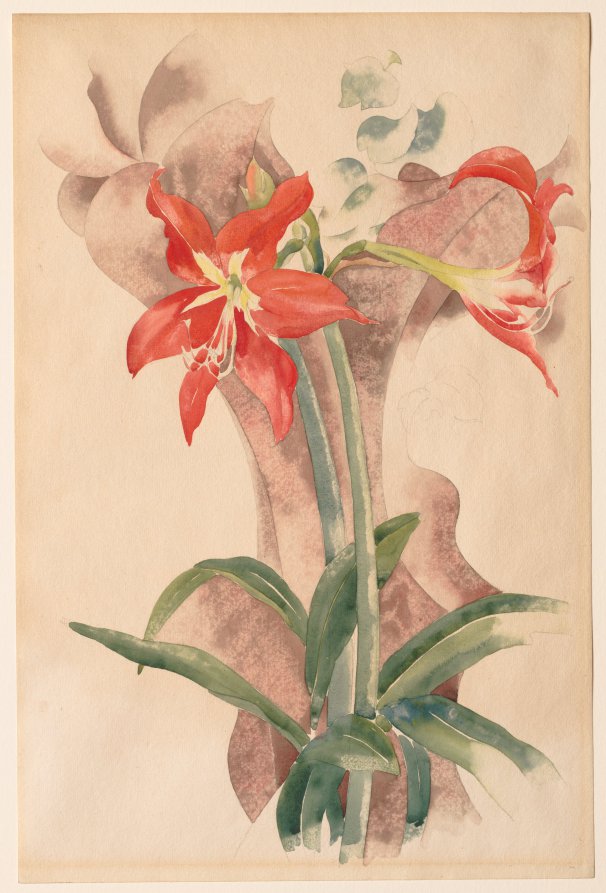
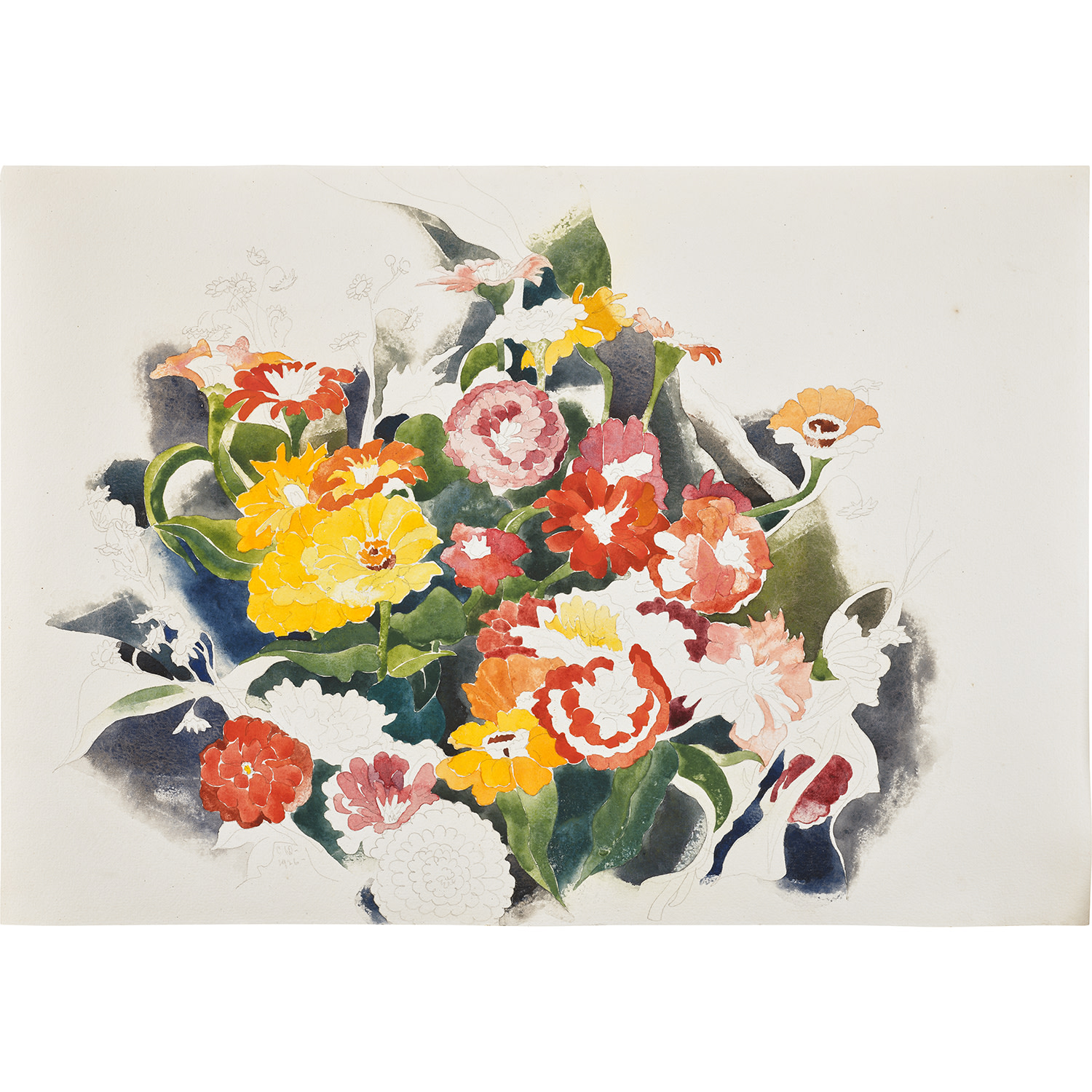
His botanical watercolors, works like Daylilies from 1918, Tulips from 1924, Amaryllis from 1918, and Zinnias from 1926, reveal a sensibility of remarkable delicacy and control. These are not simple nature studies. They are investigations of form and light rendered in washes of luminous color, where the petals and stems seem to vibrate with an inner energy that owes as much to Cézanne as to any botanical tradition. The watercolor medium, demanding and unforgiving, was perfectly suited to Demuth's gifts, and his command of it placed him among the finest watercolorists America has ever produced.
Charles Demuth
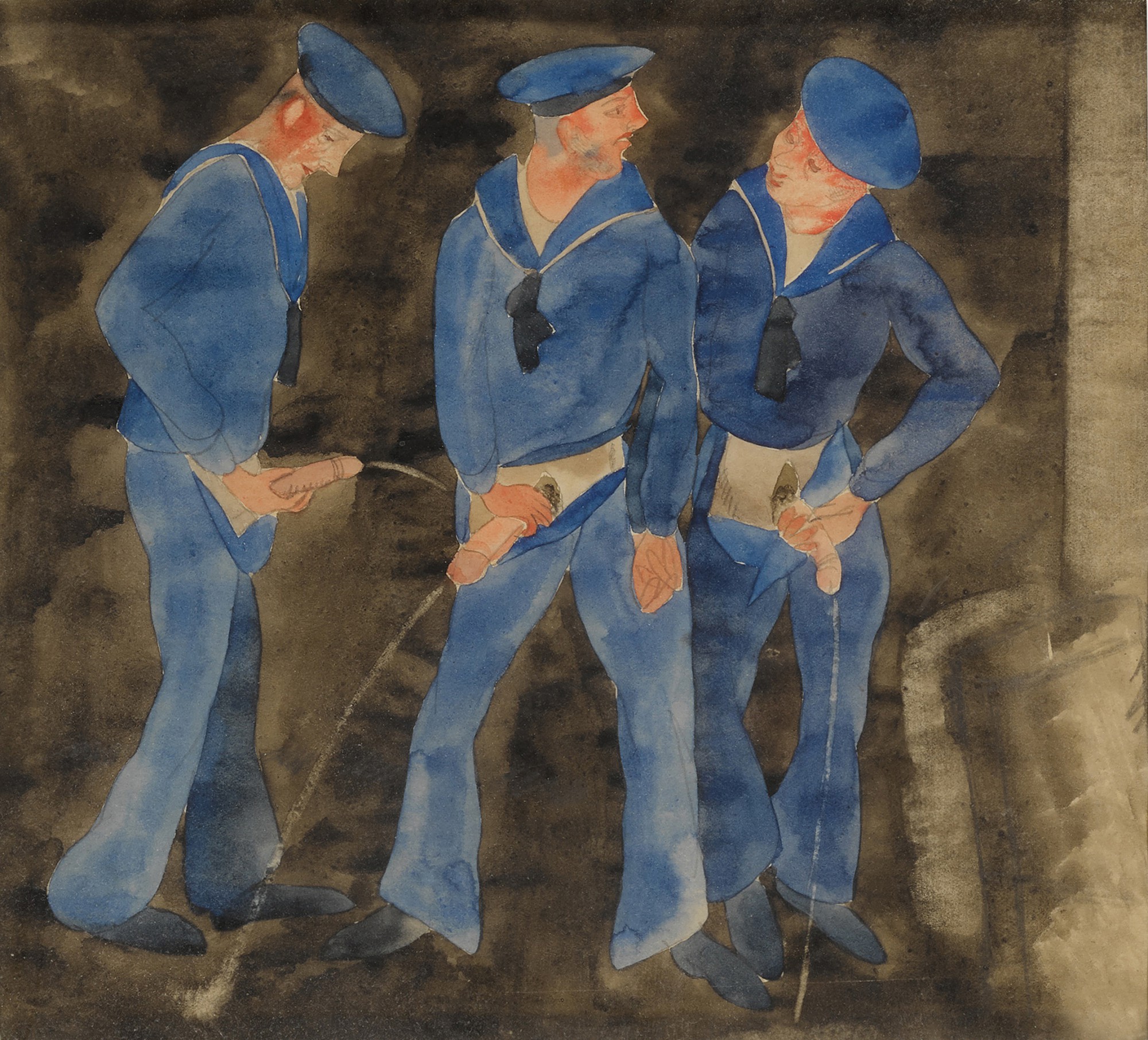
Three Sailors Urinating, 1930
Works like Blue Plums demonstrate his ability to build structure from the most translucent means, layering washes to achieve a solidity that feels almost architectural. Alongside these botanical masterworks, Demuth produced a body of figure studies that are bracingly modern in their candor and their sympathy. Works such as Dancing Sailors from 1917 and Three Sailors Urinating from 1930 document the working class male world of bars, cafes, and waterfronts with an unsentimental affection that anticipates the social openness of later generations. These figure works, rendered in loose, confident strokes of watercolor over graphite, demonstrate that Demuth was not simply a painter of beautiful things but a keen and compassionate observer of human life in all its ordinariness and dignity.
They circulated largely outside the mainstream exhibition circuit during his lifetime and are now recognized as pioneering documents of American queer visual culture. For collectors, Demuth's works on paper represent one of the genuinely compelling opportunities within early American modernism. His watercolors appear at major auction houses including Christie's, Sotheby's, and Bonhams, where fine examples have achieved significant results reflecting the sustained institutional and private demand for his work. The botanical watercolors in particular attract collectors drawn to the intersection of modernist formal rigor and intimate natural beauty, while the figure studies appeal to those interested in the social and cultural history of early twentieth century America.
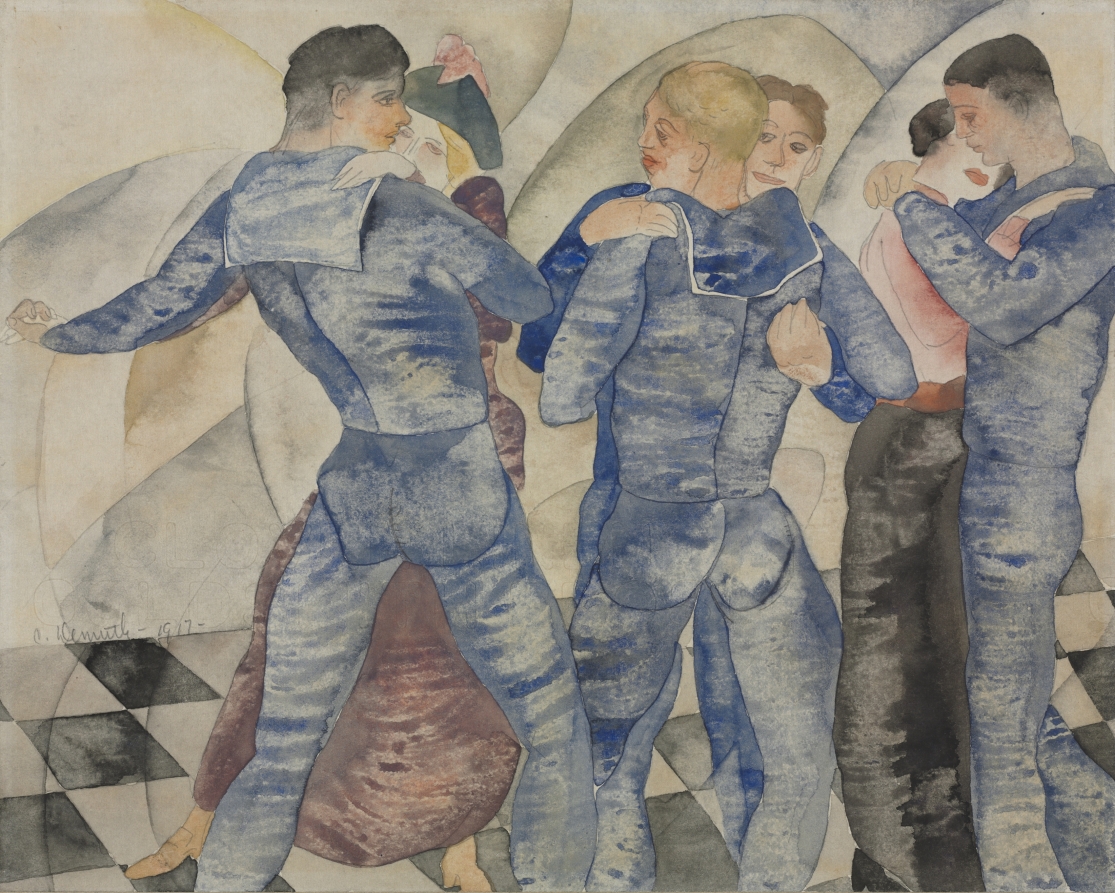
Charles Demuth
Dancing Sailors, 1917
Condition and provenance are paramount considerations when acquiring works on paper of this period, and the most sought after examples are those that retain their full tonal range and can be traced through documented exhibition or collection histories. Demuth sits comfortably within a constellation of American modernists whose work repays close comparison. Georgia O'Keeffe, a fellow traveler in the Stieglitz circle, shared his fascination with natural form pushed toward abstraction, while Charles Sheeler, perhaps his closest stylistic ally, pursued similar industrial subjects with comparable geometric precision. John Marin, another Stieglitz associate, brought a comparable watercolor mastery to landscapes pulsing with modernist energy.
Understanding Demuth within this community of practice, as part of a generation working collectively to define what American modernism could be, deepens appreciation for both the individuality of his achievement and its historical significance. Charles Demuth died in Lancaster in 1935, at the age of fifty one, having lived with diabetes for much of his adult life. The illness curtailed his productivity in later years but never his ambition or his precision. His legacy is secure and growing.
As scholars continue to expand the historical record of American queer culture and as collectors seek out the most refined examples of early modernist works on paper, Demuth's reputation gains further depth and dimension. He was a painter of rare gifts who found poetry in petals and power in industrial silhouettes, and who did so with a formal intelligence that remains entirely compelling nearly a century after his finest works were made.
Featured Works
Explore books about Charles Demuth

Charles Demuth: Behind a Laughing Mask
Betsy Fahlman
Charles Demuth: Modern Master
Barbara Haskell
Charles Demuth: American Master
Karen Stavely
Charles Demuth and Precisionism: The Magic of the Real
Michael R. Taylor
The Complete Paintings of Charles Demuth
Betsy Fahlman