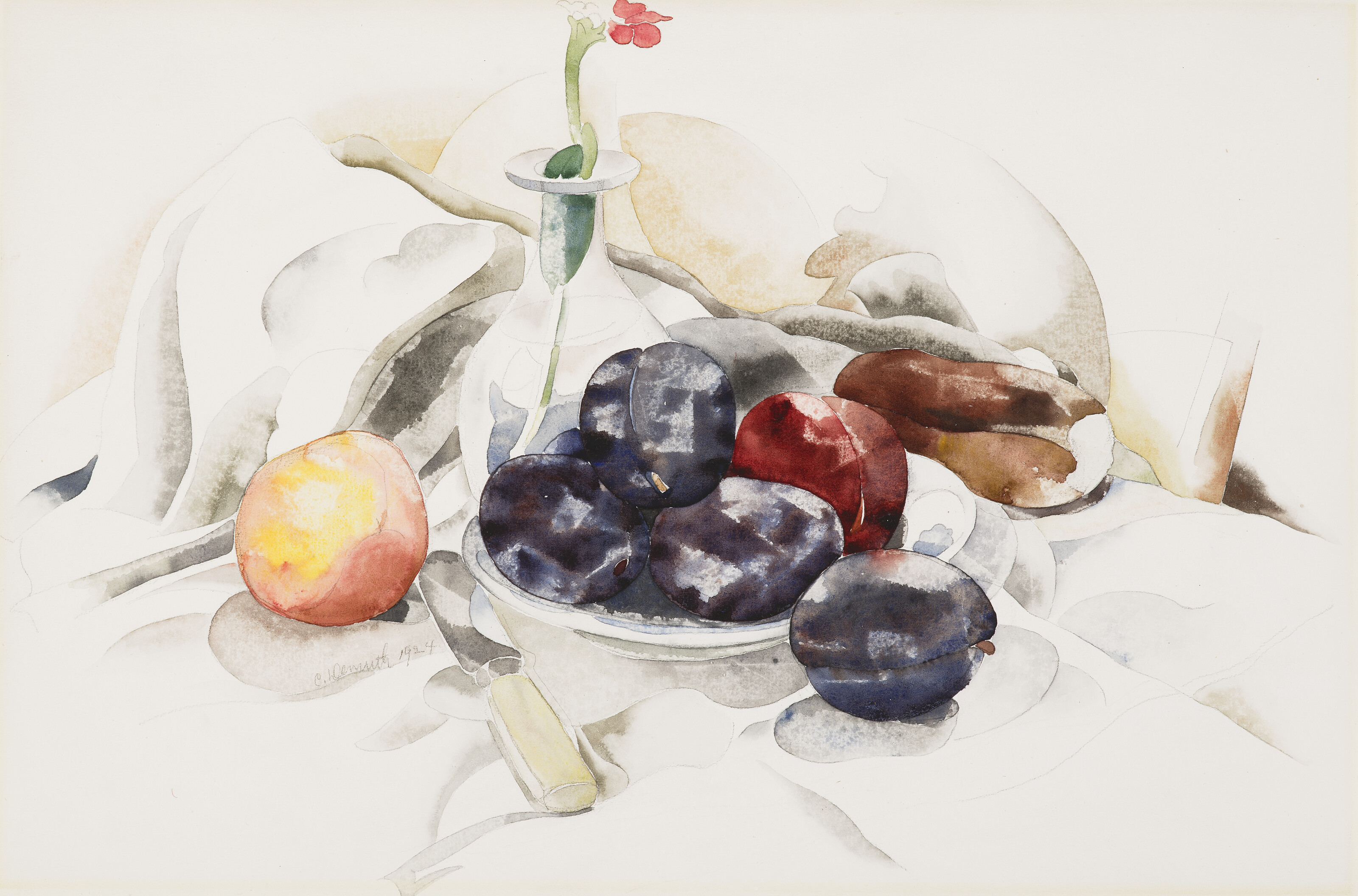
Blue Plums
A still life artwork by American Precisionist artist Charles Demuth featuring blue plums. The work exemplifies Demuth's careful attention to form and color in depicting fruit subjects.
- Signed
- Yes
- Spotted At
- Auction House · Christie's
Notes
LITERATURE Parnassus, vol. V, no. 3, April 1935, p. 4, illustrated. E. Farnham, Charles Demuth: His Life, Psychology and Works, vol. II, Ph.D. dissertation, Ohio State University, 1959, p. 587, no. 445. EXHIBITED Northampton, Massachusetts, Smith College Museum of Art, on loan, n.d. New York, Museum of Modern Art, Fruit and Flower Paintings, March 13-April 7, 1933, p. 2. San Francisco, California, M.H. de Young Memorial Museum; New York, Whitney Museum of American Art, American Art: An Exhibition from the Collection of Mr. and Mrs. John D. Rockefeller 3rd, April 17-November 7, 1976, pp. 224-25, no. 97, illustrated. Conditions of sale Brought to you by Quincie Dixon Associate Specialist, Head of Sale Check the condition report or get in touch for additional information about this QDIXON@CHRISTIES.COM +1 212 636 2141 VIEW CONDITION REPORT LOT ESSAY A member of Alfred Stieglitz’s circle of American Modernists and one of the most prominent Precisionists, Charles Demuth explored his diverse artistic inspirations with a keen attention to draftsmanship, line and color. In the 1920s, around the same time he was executing his famous architectural paintings, Demuth was also fascinated by the sensual, natural beauty to be found within the simplicity of flowers and fruit. Blue Plums is an example of Demuth’s mastery in the watercolor medium, notably acquired by Museum of Modern Art founder Abby Aldrich Rockefeller in 1931 and descending in her family until the present day. In the present work, Demuth creates a picture of vivid beauty, captured with crisp execution and a pure sense of color. During the 20s, he began to more fully explore spatial possibilities, increasingly isolating his still lifes against a white background. Blue Plums exemplifies these progressive methods with which Demuth would extract the essential essence of his subject. Using a wash-and-blotter technique, areas of the carefully delineated plums and peaches have been given texture that allows them to almost shimmer with light, adding a more natural element to the sharp-edged, Precisionist depiction. Additionally, Demuth uses the white of the paper as a forceful element in the painting. Emily Farnham discusses his experimentation with this new artistic device: "Still another factor in Demuth which seems to have affected the New Realism is his frequent use of a pristine, immaculate, antiseptic white ground. It was notably in his watercolor still lifes that he habitually placed exquisitely delineated positive objects (peaches, eggplant, striped kitchen towels) against a luminous unpainted ground. This device has reappeared during the sixties in the works of Californian [Wayne] Thiebaud, who employs pure white grounds behind relief-like human figures as means toward the psychological and technical isolation of his subjects" (Charles Demuth: Behind a Laughing Mask, Norman, Oklahoma, 1971, p. 185). As in his best works, in Blue Plums, Demuth employs his visual vocabulary to convey the nuances of color, atmosphere and the effects of light. As a result, his still-life paintings represent the most immediate and intimate body of his work, and moreover form one of the most important watercolor series of modern American art. READ MORE The collection Mr. and Mrs. John D. Rockefeller 3rd. Photograph courtesy of the consignor. John D. Rockefeller 3rd was a man of great social conscience and dedicated himself to the philanthropic work begun by his father and grandfather, managing the careful distribution of the family’s funds across education, conservation, health and population control, humanitarian concerns, and the arts. Further to studying economics at Princeton, he undertook a world tour, which concluded with an assignment at the Institution of Pacific Relations conference in Japan. This work led him to make a lifelong commitment to improving international relations, particularly those concerning East Asian affairs. Following his participation in the Japanese peace process, he remained active in fostering US-Japanese relations. After reinvigorating the Japan Society in 1952, where he served as chairman of the board until his passing, John D. Rockefeller 3rd founded the Asia Society in 1956, a major institution tasked with fostering greater cooperation between Asia and the United States. Alongside his support for what would become the Asian Cultural Council, these major, lasting, and influential initiatives demonstrate his passionate, multifaceted approach toward fostering cultural exchange. Mrs. John D. Rockefeller 3rd graduated from Vassar with a B.A. in music in 1931, prior to her marriage in 1932. She involved herself with the MoMA as early as 1949 and served as President from 1972-84, following in the footsteps of her mother-in-law, Abby Aldrich Rockefeller, who was a founder of the museum. In the 1950s, at a time when many Americans considered modern art subversive, she supported the European tour of the first major exhibition of Abstract Expressionism and was a prescient early collector of masterworks by Willem de Kooning, Clyfford Still, Sam Francis, and Cy Twombly. During the 1960s, Mr. and Mrs. John D. Rockefeller 3rd became active collectors of both Asian and American art. They saw themselves as temporary custodians, always intending to bequeath their treasured finds. They donated much of their collection of American art, then considered the largest collection in private hands and including masterpieces by Copley, Homer, Eakins, and Andrew Weyth, to the Fine Arts Museums of San Francisco. Mrs. John D. Rockefeller 3rd helped build the Museum of Modern Art’s early collection of American postwar art with her generous gift of many masterpieces, including Clyfford Still’s 1951-T No. 3 (1951), Willem de Kooning’s Woman II (1951), and Cy Twombly’s The Italians (1961). The museum named the second floor Abstract Expressionist galleries and a curatorial position in her honor. Likewise, John D. Rockefeller 3rd donated 300 works of Asian art along with funds to build a new exhibition space to the Asia Society in 1974. The latter is said to “reflect the personalities of the collectors: refined, understated, and elegant.” READ MORE OF THE COLLECTION
🔨 Auction Lot
Modern American Art
April 16, 2026
Estimate: $120,000 – $180,000
Lot 11
Spotted works by Charles Demuth
Start the Discussion
Request access to join the discussion