Chaïm Soutine
Soutine: A Magnificent Force Fully Alive
Artist Spotlight · The Collection Editorial
When the Centre Pompidou mounted its landmark retrospective examining the painters of the École de Paris, the room dedicated to Chaïm Soutine stopped visitors in their tracks. His canvases do not politely request your attention. They seize it, pull you close, and refuse to let go. Decades after his death in 1943, Soutine remains one of the most viscerally powerful painters of the twentieth century, an artist whose influence stretches forward through Francis Bacon, Frank Auerbach, and the entire lineage of expressive figuration that defines so much of what collectors and institutions prize today.
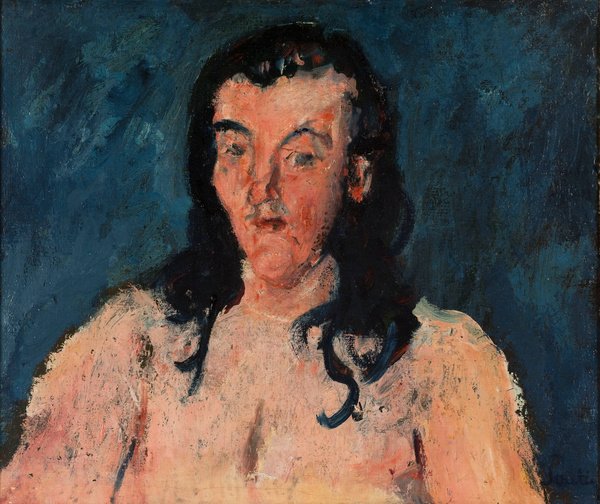
Chaïm Soutine
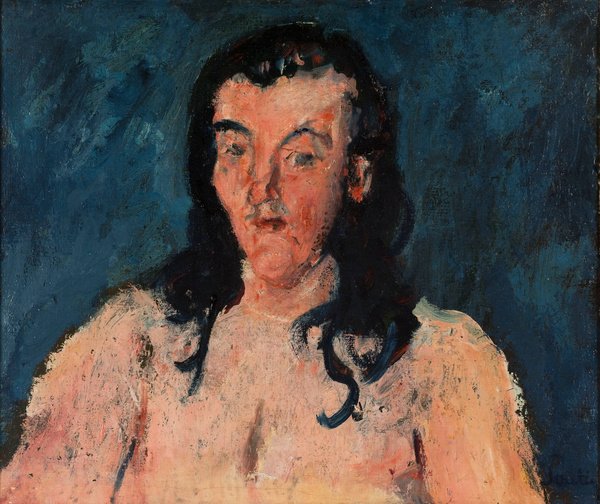
Torse au fond bleu, 1928
Soutine was born in 1893 in Smilovitchi, a small shtetl near Minsk in what is now Belarus. He was the tenth of eleven children in a deeply poor Jewish family, and his path toward painting was shaped by resistance as much as desire. In his community, image making was regarded with suspicion rooted in religious tradition, and the young Soutine reportedly endured punishment simply for wanting to draw. That early friction, the sense of art as something hard won and fiercely personal, never left him.
By the time he arrived in Vilna to study, and then in Paris in 1913, he carried with him an urgency that would define every canvas he ever made. Paris in the years before and after the First World War was a crucible of artistic ambition, and Soutine found his footing in Montparnasse among a community of fellow émigré artists that included Amedeo Modigliani, Marc Chagall, and Jules Pascin. He enrolled at the École des Beaux Arts and studied under Fernand Cormon, but his real education came from the Louvre, where he stood for hours before the works of Rembrandt, Courbet, and El Greco. Those painters showed him that paint itself could carry emotional weight, that a brushstroke was not merely descriptive but expressive, capable of trembling with feeling.
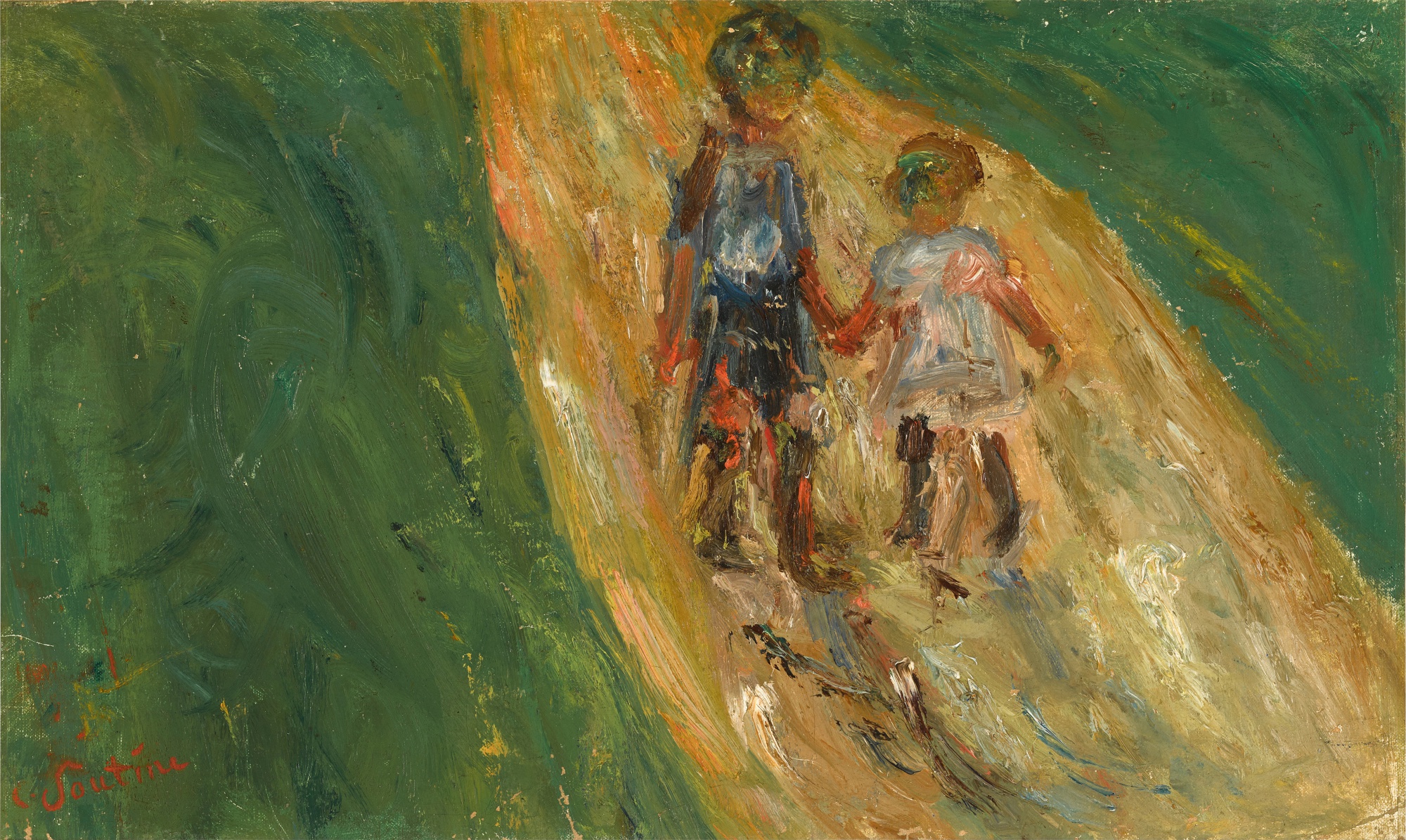
Chaïm Soutine
Deux enfants sur une route, 1942
It was a lesson he absorbed completely and made entirely his own. The turning point in Soutine's life and career came in 1923 when the American collector Albert C. Barnes visited Paris and purchased a significant group of his paintings, reportedly more than fifty works in a single acquisition. Almost overnight, Soutine moved from grinding poverty to a measure of financial security.
Barnes brought those works back to the United States, and their presence in the Barnes Foundation collection in Merion, Pennsylvania helped establish Soutine's reputation on an international scale. The years that followed saw him painting with extraordinary intensity across the south of France, producing the landscapes of Céret and Cagnes sur Mer that seem to writhe with inner life, villages bending as if caught in a gale, roads curving with almost muscular force. It is impossible to talk about Soutine without talking about his surfaces. His impasto is among the most physically dramatic in the history of painting.
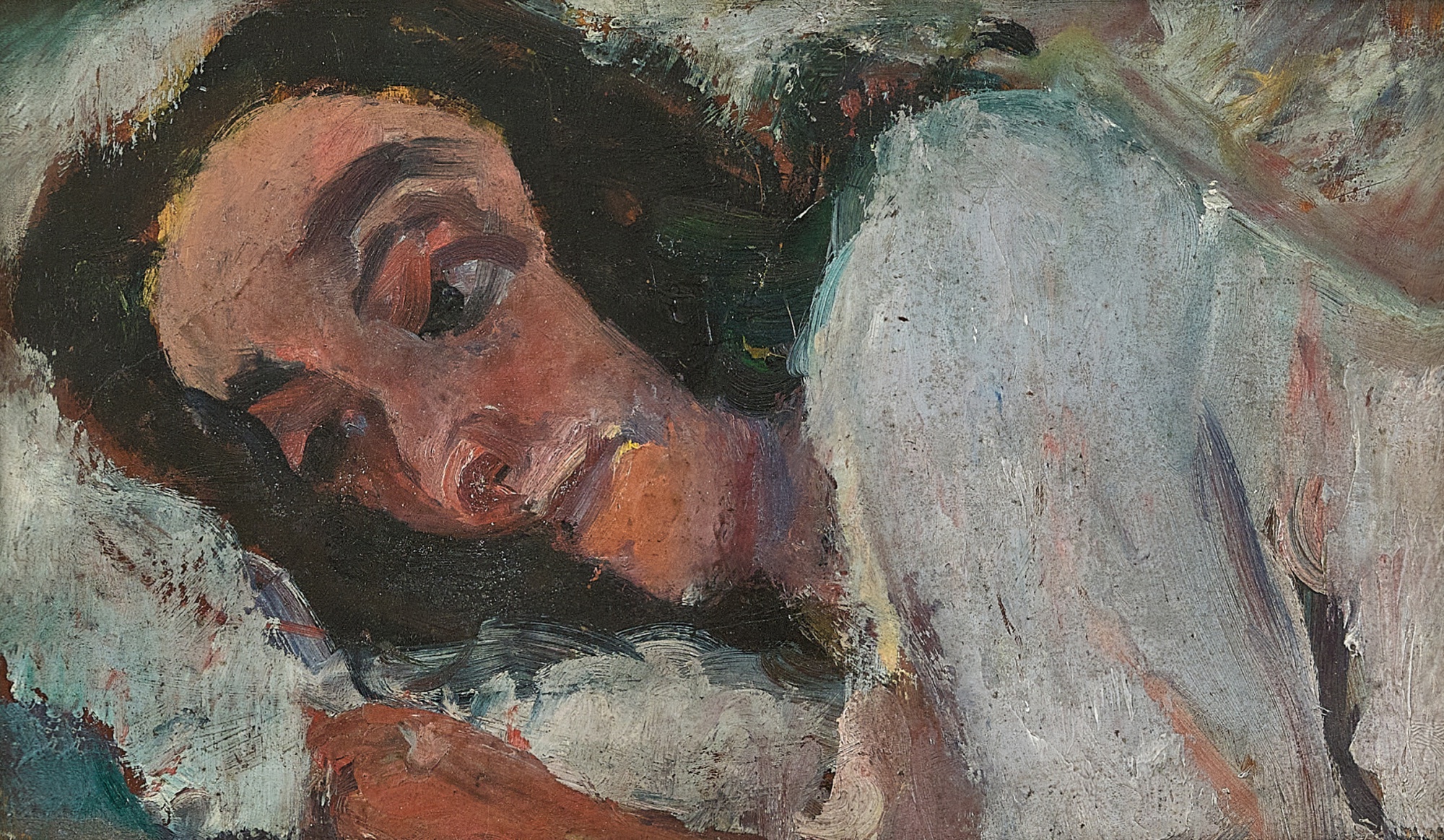
Chaïm Soutine
Femme couchée, 1940
He built up paint in ridges and furrows, scraping back and reapplying, sometimes working and reworking a canvas over many sessions, sometimes painting in a fever of concentration. His portraits from the early 1920s, including the celebrated series of hotel pageboys and pastry cooks rendered in vivid scarlet and crimson uniforms, have a psychological intensity that goes far beyond costume or profession. Works such as Le Groom from around 1925 present their subjects with a searching, almost uncomfortable directness. The figures are not flattered or idealized.
They are observed, and the observation is full of compassion as well as scrutiny. His still lifes of hanging game and fish carry a similar charge, reminding us of the tradition of Chardin and Rembrandt while remaining unmistakably, electrically modern. For collectors, Soutine represents one of the great blue chip propositions of twentieth century European painting. His works appear at auction with a frequency that reflects genuine demand rather than market manufacture, and they consistently perform at the highest levels.
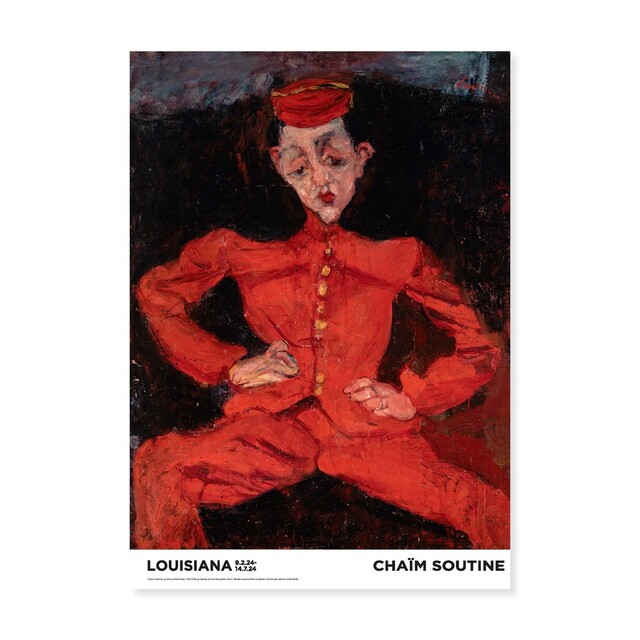
Chaïm Soutine
Le Groom (The Piccolo) 1925, 2024
Major examples have achieved results in the tens of millions at Christie's and Sotheby's, while more accessible works on paper and smaller panel paintings offer entry points for collectors building serious collections. What distinguishes Soutine in the market is the quality of his variation: no two canvases feel quite alike, and condition as well as provenance research reward careful attention. Works from the Cagnes period of the mid 1920s, such as Paysage de Cagnes from 1924, are particularly sought after for the way they synthesize landscape tradition with his most radical formal invention. His figurative works from the late 1930s and early 1940s, including the tender and sorrowful Femme couchée from 1940 and the quietly devastating Deux enfants sur une route from 1942, painted as Europe convulsed around him, show an artist at the height of his powers and speak directly to the moment in which they were made.
To place Soutine within art history is to understand him as a crucial bridge. He connects the emotional directness of Van Gogh and the structural ambition of Cézanne to the postwar explosion of gestural and expressive painting that would define so much of the mid twentieth century. Artists as different as Willem de Kooning, Leon Kossoff, and Lucian Freud have acknowledged his example. He belonged to no formal movement and resisted easy categorisation, but his work touches expressionism, figurative painting, and even the proto abstract in ways that feel remarkably contemporary.
The Neo Expressionist painters who emerged in the 1980s, from Georg Baselitz to Anselm Kiefer, drew on a tradition that runs directly through him. Soutine died in Paris in August 1943 following surgery for a gastric ulcer, a condition he had suffered from for years and which had been worsened by the stress of living under the German occupation, moving from hiding place to hiding place in the French countryside. He was fifty years old. The brevity of his life makes the depth of the body of work he left behind all the more remarkable.
Today, with institutions from the Musée de l'Orangerie in Paris to the Museum of Modern Art in New York holding significant examples of his work, and with a new generation of collectors and curators returning again and again to his canvases for what they teach us about paint, feeling, and the possibilities of the human form, Soutine feels not like a figure to be commemorated but a presence to be celebrated. His paintings are alive in the way that only the greatest art is alive, still generating heat, still asking questions, still insisting on being seen.
Explore books about Chaïm Soutine