Carol Rama

Carol Rama: Life Force in Every Mark
Artist Spotlight · The Collection Editorial
“I have always painted out of need, out of an urgency that I could not explain or contain.”
Carol Rama
In 2003, when the Venice Biennale awarded Carol Rama its Golden Lion for lifetime achievement, many in the international art world were encountering her name for the first time. Yet Rama had been working in Turin since the late 1930s, producing paintings of such raw, unapologetic intensity that they were confiscated from her very first exhibition in 1945 on grounds of obscenity. That belated recognition in Venice was not a discovery so much as an overdue reckoning with one of the twentieth century's most singular and uncompromising artistic voices. She was eighty five years old and had been making art for six decades without the validation she so richly deserved.
![Carol Rama — Smentire il bianco [To Deny White]](https://rtwaymdozgnhgluydsys.supabase.co/storage/v1/object/public/artwork-images/auction-lots/N10722-20210714-lot6.jpg)
Carol Rama
Smentire il bianco [To Deny White], 1977
Rama was born in Turin in 1918 into a family marked by tragedy and instability. Her father, a bicycle and automobile parts manufacturer, went bankrupt and took his own life when she was young. Her mother spent years in a psychiatric institution, and Rama visited her there repeatedly, experiences that left an indelible impression on her understanding of the body, confinement, and psychological extremity. These early encounters with suffering and institutional power over the human form would become central to everything she made.
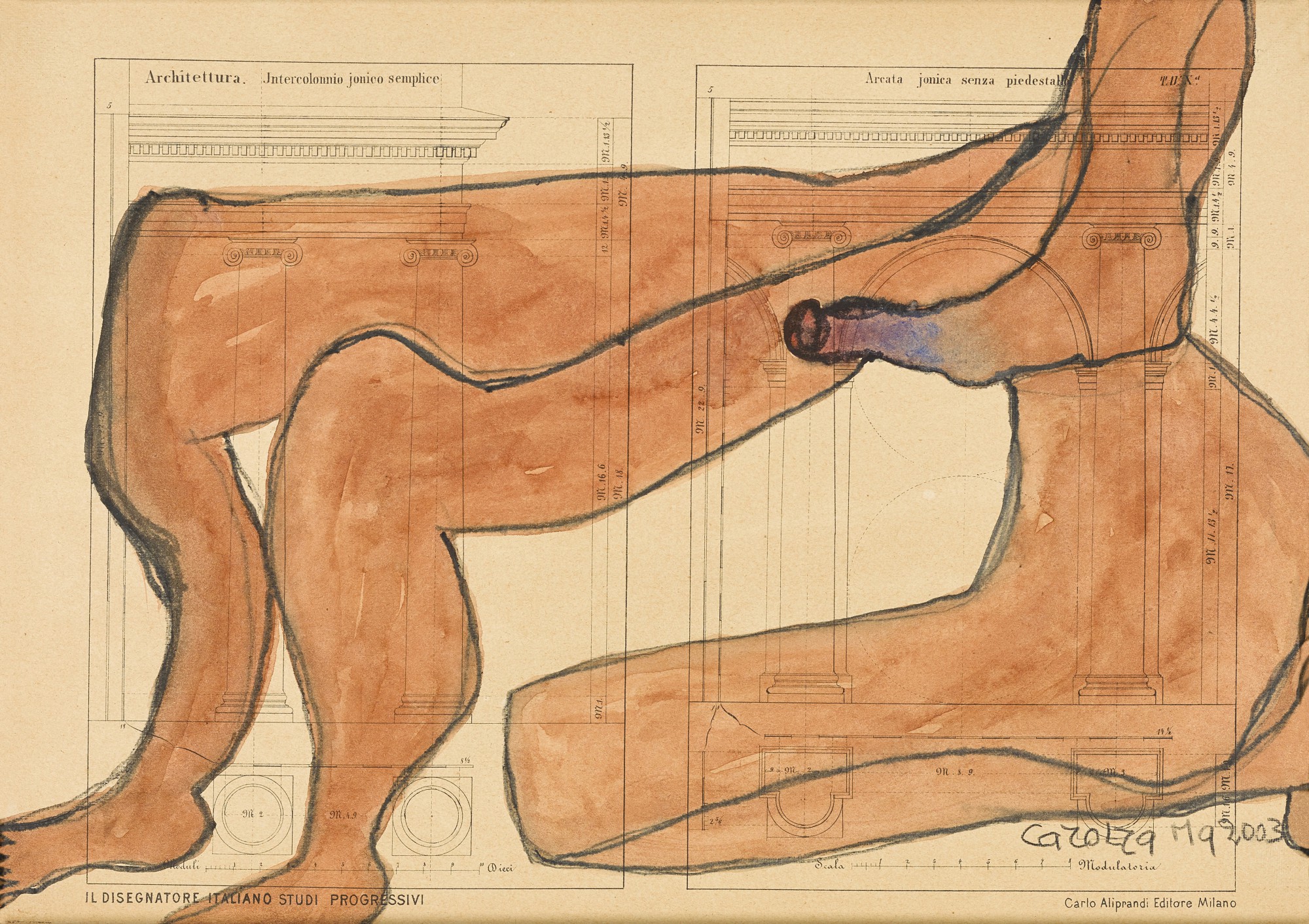
Turin itself, an industrial city with a strong working class character and a deeply embedded intellectual tradition, shaped her sensibility in ways that set her apart from the more fashionable currents of postwar Italian art. Largely self taught, Rama began exhibiting in the mid 1940s, and the immediate scandal of her debut announced what kind of artist she would be. The works she showed were watercolors depicting nude figures, open wounds, amputated limbs, and scenes of sexuality that fused desire with vulnerability in ways that postwar Italian Catholic society was wholly unprepared to receive. Rather than retreat, she deepened her investigation.
Carol Rama
Architettura
Through the 1950s and into the 1960s, she continued to explore the body as a site of both pleasure and trauma, developing a visual language that had no real precedent in Italian art. She was aware of Art Informel and of the broader currents of European modernism, but her work answered to something far more interior and biographical than any movement could contain. The 1960s brought a pivotal shift in Rama's practice as she moved into assemblage and mixed media work, incorporating materials that were industrial, medical, and animal in origin. Rubber bicycle tires, syringes, animal skin, glass eyes, and adhesive tape began appearing in her canvases, transforming painting into a kind of charged physical field.
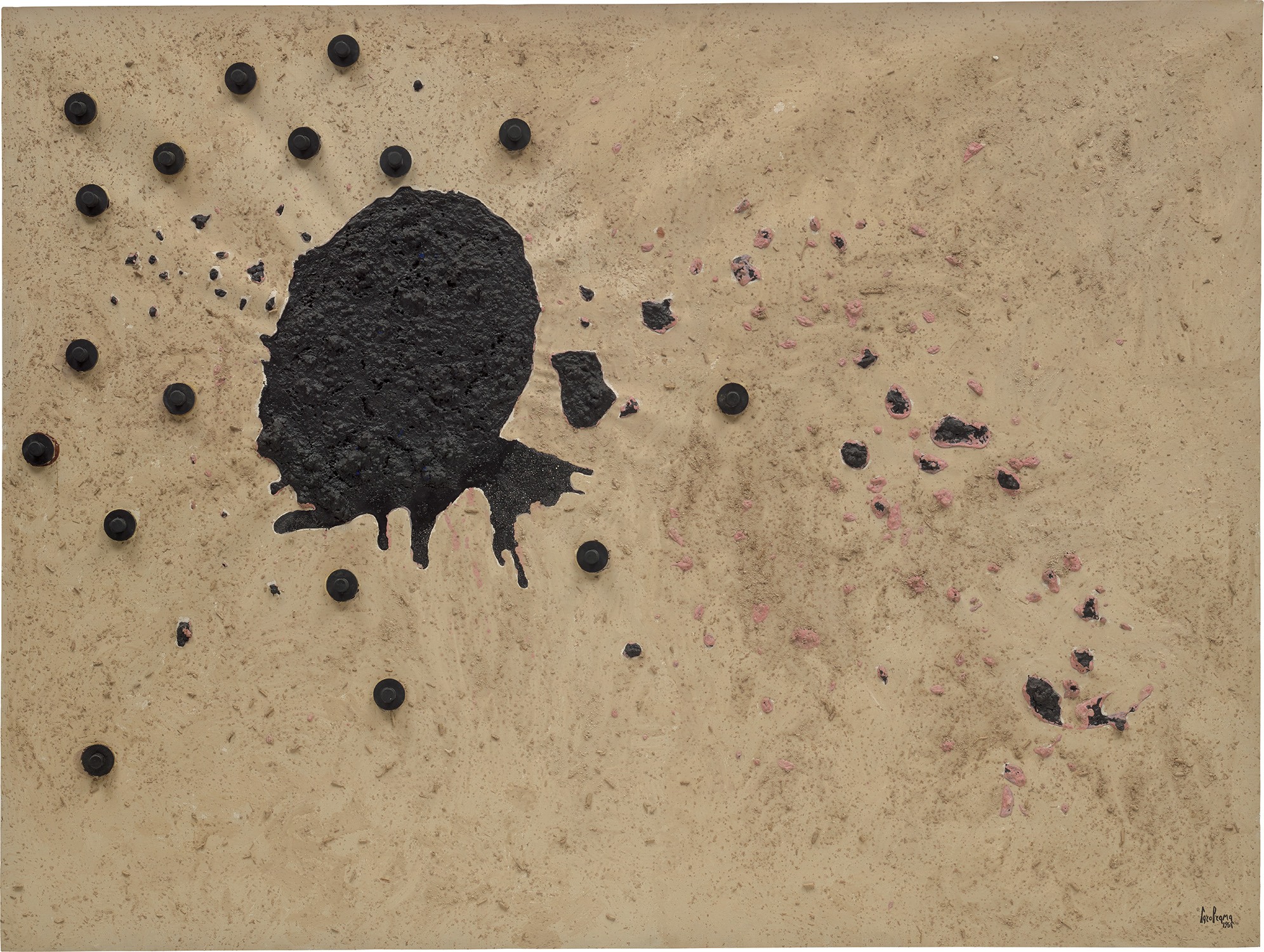
Works such as Pornografia due from 1965 exemplify this period: the canvas becomes a membrane onto which desire, pathology, and industrial modernity are simultaneously pressed. The use of tires in particular became a signature element, carrying biographical resonance through her father's business while functioning formally as a drawing tool, a textural element, and a symbol of cyclical movement and wear. This was not shock for its own sake but an entirely coherent material logic that united her life, her body, and the world she inhabited. Her later work, produced from the 1970s onward, demonstrates a remarkable capacity for reinvention without ever losing her essential self.
Carol Rama
Pornografia due, 1965
Smentire il bianco from 1977 brings tire collage together with oil on canvas in a composition that feels simultaneously gestural and architectonic, the black curves of rubber asserting themselves against a ground that seems to pulse with suppressed energy. Luogo e segni from 1976, made with leather and acrylic on rubber coated canvas, speaks to an ongoing fascination with skin, surface, and the materials of the body extended outward into the world. By the time she was creating works like Rainbow in 2002 and Capricci in 2004, incorporating rope, metal, buckles, stitched fabric, and plastic tyre on canvas, she had arrived at a practice of almost celebratory accumulation, the urgency undimmed, the materials ever more inventive. Altre Seduzioni from 2001, with its watercolour, pastel, graphite, metal, and leather straps on paper, is characteristic of how she could bring sensuality and formal rigor into the same object without strain.
For collectors, Rama presents a compelling proposition on multiple levels. Her market remained relatively modest for much of her career, which means that significant works can still be found at prices that will almost certainly look very modest in retrospect. Since her Golden Lion and the subsequent wave of institutional attention, including retrospectives at major European museums, her critical stature has been firmly established. What to look for is work that demonstrates the full complexity of her material thinking: pieces where the substrate, the medium, and the found or constructed element are working in genuine dialogue.
![Carol Rama — Definizione d'usura [Definition of Use]](https://rtwaymdozgnhgluydsys.supabase.co/storage/v1/object/public/artwork-images/auction-lots/N10638-20210305-lot419.jpg)
Carol Rama
Definizione d'usura [Definition of Use]
Her mixed media and assemblage works from the 1960s through the 1980s represent the core of her achievement, though her later works on paper show a draftsmanship of real distinction. Collectors who appreciate Louise Bourgeois, Maria Lassnig, or the German artist Rosemarie Trockel will find in Rama a figure who shares their commitment to the body and its psychological interior as the primary subject of art. Within the broader arc of art history, Rama occupies a position that is finally being properly mapped. She developed her practice in near isolation from the major international movements of her time, which paradoxically allowed her to pursue a vision of startling consistency and depth.
While Arte Povera was defining Italian art for the international market in the late 1960s and 1970s, Rama was doing something at once more private and more radical. Her feminism was not theoretical but material and bodily, articulated through form long before feminist art theory had the vocabulary to describe what she was doing. In this she anticipates the concerns of body art, of feminist figuration, and of the broader interest in abject materials and unconventional support structures that has shaped so much significant work since the 1990s. Carol Rama died in Turin in 2015 at the age of ninety seven, having lived long enough to see her reputation finally catch up with her achievement.
She worked in the same city where she had always worked, maintaining the same fierce independence that had defined her from the beginning. Her legacy is the proof that a life spent making art on one's own terms, without compromise or capitulation to fashion, can produce a body of work of extraordinary power. For collectors and institutions now building a serious engagement with twentieth century art, Rama is not a footnote or a discovery. She is a central figure whose work rewards the closest and most sustained attention.
Explore books about Carol Rama
Carol Rama: Retrospective
Various authors
Carol Rama: Drawings and Watercolors
Giordana Mari
Carol Rama: An Autobiography
Carol Rama
Carol Rama: Works 1936-1990
Francesca Alinovi

Carol Rama: The Pleasure Principle
Carolyn Christov-Bakargiev