Buckminster Fuller

Buckminster Fuller: Genius Who Redesigned Everything
Artist Spotlight · The Collection Editorial
“You never change things by fighting the existing reality. Build a new model that makes the existing model obsolete.”
Buckminster Fuller
There are figures in cultural history who resist easy categorization, and then there is Richard Buckminster Fuller, a man so thoroughly ahead of his time that the world spent most of the twentieth century catching up to him. The 1967 Montreal World Exposition offered perhaps his most spectacular public moment: the United States Pavilion, a towering geodesic dome nearly two hundred feet in diameter, gleaming like a crystalline planet dropped into the banks of the St. Lawrence River. Visitors stood before it in genuine disbelief.
Buckminster Fuller
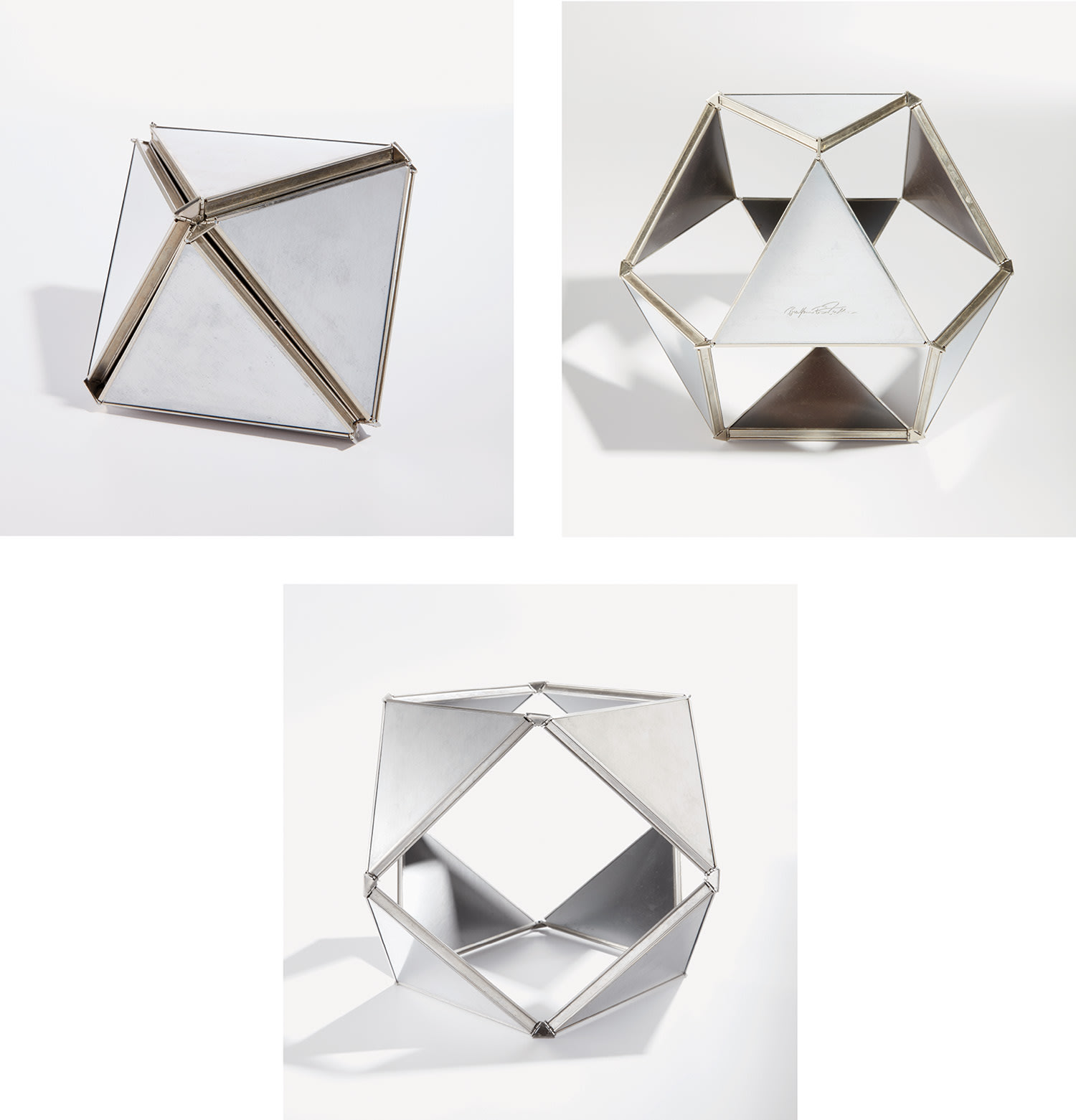
Single-cell Jitterbug
Here was an American architect and thinker announcing, with steel and light, that shelter itself could be reimagined from first principles. Fuller was born in Milton, Massachusetts in 1895, the son of a leather merchant, and he grew up with a restless, almost uncomfortable relationship to conventional thinking. Expelled from Harvard twice, he found his real education in the material world, working in a mill, serving in the United States Navy during the First World War, and absorbing the kind of practical engineering knowledge that no classroom could have offered him. The death of his young daughter Alexandra in 1922, which he attributed in part to inadequate housing and its effects on her health, sent him into a profound crisis that he later described as a turning point.
He made a private compact with himself to spend his life investigating how design and technology could serve all of humanity rather than only the privileged few. The 1920s and 1930s saw Fuller working with furious intensity across disciplines that most people considered entirely unrelated. He developed the Dymaxion House in 1928, a prefabricated, circular dwelling suspended from a central mast, designed to be mass produced and delivered anywhere on earth. The Dymaxion Car followed in 1933, a teardrop shaped vehicle of radical aerodynamic efficiency.

Buckminster Fuller
Closest Packing of Spheres
He was not simply designing objects. He was proposing an entirely different relationship between human beings and their physical environment, one governed by what he called doing more with less, or ephemeralization. Critics found him eccentric. Collaborators found him visionary.
“I am not trying to imitate nature. I am trying to find the principles she uses.”
Buckminster Fuller
He was, characteristically, both. The geodesic dome emerged as his signature contribution to architecture and structural engineering, and its principles grew directly from his lifelong study of geometry and natural systems. Fuller understood that the triangle is the most stable geometric form and that spherical structures distribute stress with extraordinary efficiency, allowing enormous spans to be enclosed with minimal material. The dome at Montreal was the apex of this thinking made manifest, but the principle had been explored in dozens of earlier structures, including a pioneering dome at Black Mountain College in North Carolina in 1948, where Fuller taught alongside figures like John Cage and Robert Rauschenberg.
Buckminster Fuller
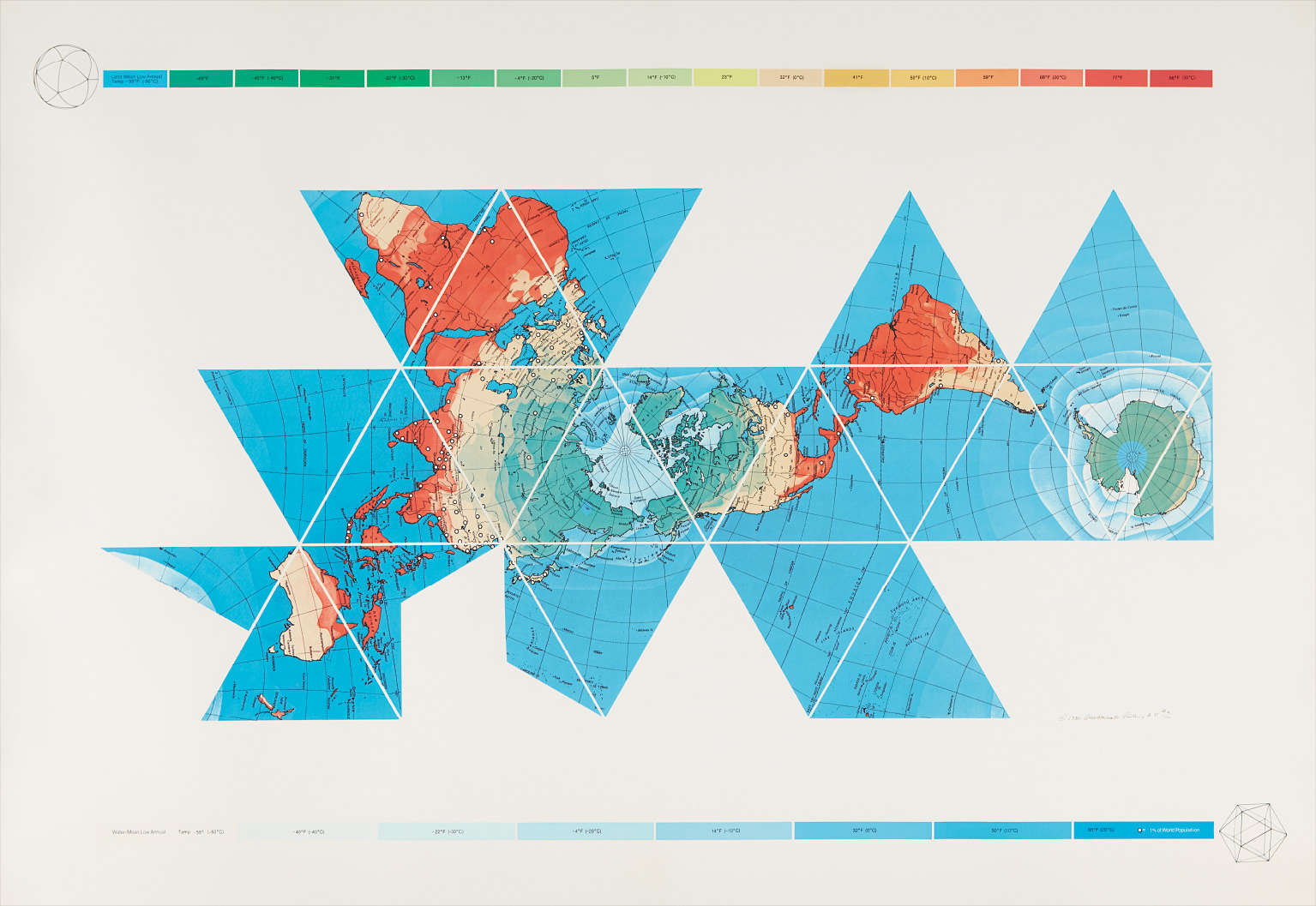
Dymaxion Air - Ocean World Map
That collision of scientific rigor and artistic experimentation proved electrifying for everyone present. The works available through The Collection offer collectors a rare and intimate access to Fuller's thinking as both designer and artist. The Single Cell Jitterbug is among the most poetic expressions of his geometric philosophy: the jitterbug transformation was Fuller's demonstration that a cuboctahedron could be folded and contracted into an octahedron through a continuous motion, revealing the dynamic rather than static nature of structural form. To hold or display such a work is to participate directly in his inquiry.
“God is a verb, not a noun.”
No More Secondhand God, 1963
The Closest Packing of Spheres, realized in chrome plated steel rods with molded thermoplastic connectors and a combination of smoked grey and red acrylic spheres, is at once a scientific model and a deeply compelling sculpture. Its elegance is not decorative. It is the elegance of a proof. The Dymaxion Air Ocean World Map, a screenprint in colors on Arches paper, represents another dimension of his practice entirely.
Published in various editions from the 1940s onward, the map projection Fuller patented in 1946 was a deliberate challenge to the Mercator projection that had defined Western cartography and, he argued, Western geopolitical thinking for centuries. By unfolding the globe onto a flat surface without distorting the relative sizes of landmasses, Fuller proposed that humanity could finally see itself accurately: one continuous island of land surrounded by one continuous ocean, without a fixed north or south, without any nation conveniently enlarged at the center. For collectors, Fuller's works occupy a uniquely compelling position in the market. They sit at the intersection of design history, scientific inquiry, and conceptual art, which means they appeal to a genuinely broad range of serious collectors.
Those drawn to the postwar American avant garde will find in Fuller a peer of Buckminster's contemporaries in art and architecture, figures like Isamu Noguchi, whose own explorations of form and space rhyme beautifully with Fuller's preoccupations. Collectors of design history will recognize the Dymaxion objects as foundational documents. And those who follow the contemporary conversation around sustainability, systems thinking, and ecological design will find in Fuller nothing less than a prophet. His works have appeared at major auction houses and have entered the collections of institutions including the Museum of Modern Art in New York, the Smithsonian Institution, and the Art Institute of Chicago.
The Dymaxion Map in particular has become a touchstone of both design and cartographic history, and fine examples on Arches paper represent genuine documents of one of the most original minds of the last century. The artists closest in spirit to Fuller form a constellation that spans art, architecture, and science. Kenneth Snelson, who studied under Fuller at Black Mountain College, went on to develop tensegrity sculpture into a major artistic practice, giving physical form to principles Fuller had theorized. The Italian designer and architect Paolo Soleri shared Fuller's conviction that architecture could be a moral as well as aesthetic act.
In the visual arts, artists associated with kinetic and constructivist traditions, including László Moholy Nagy and Alexander Calder, explored similar territories of form, motion, and structural logic, though through different means and intentions. Fuller died in Los Angeles in 1983, just hours after his wife Anne, to whom he had been married for sixty six years. He was eighty seven years old and had spent the better part of six decades insisting, in lectures, books, models, and built works, that humanity had all the resources it needed to thrive, if only it chose to use them intelligently. That argument feels not historical but urgent in the present moment, as designers, engineers, and artists across the world grapple with questions of resource scarcity, climate, and the design of equitable systems.
Fuller did not merely anticipate these conversations. He founded them. To collect his work is to hold a piece of one of the most generous and ambitious minds the twentieth century produced, a mind that looked at the whole of human civilization and asked, simply and seriously, how we might do better.
Explore books about Buckminster Fuller
Operating Manual for Spaceship Earth
R. Buckminster Fuller
Critical Path
R. Buckminster Fuller
Synergetics: Explorations in the Geometry of Thinking
R. Buckminster Fuller
The Buckminster Fuller Reader
R. Buckminster Fuller, James Meller (editor)
Buckminster Fuller: A Guide to His Ideas
Lloyd Steven Sieden
Ideas and Integrities: A Spontaneous Autobiographical Disclosure
R. Buckminster Fuller
No More Secondhand God
R. Buckminster Fuller
Buckminster Fuller and Isamu Noguchi: Best of Friends
Alastair Gordon