Bruce Nauman
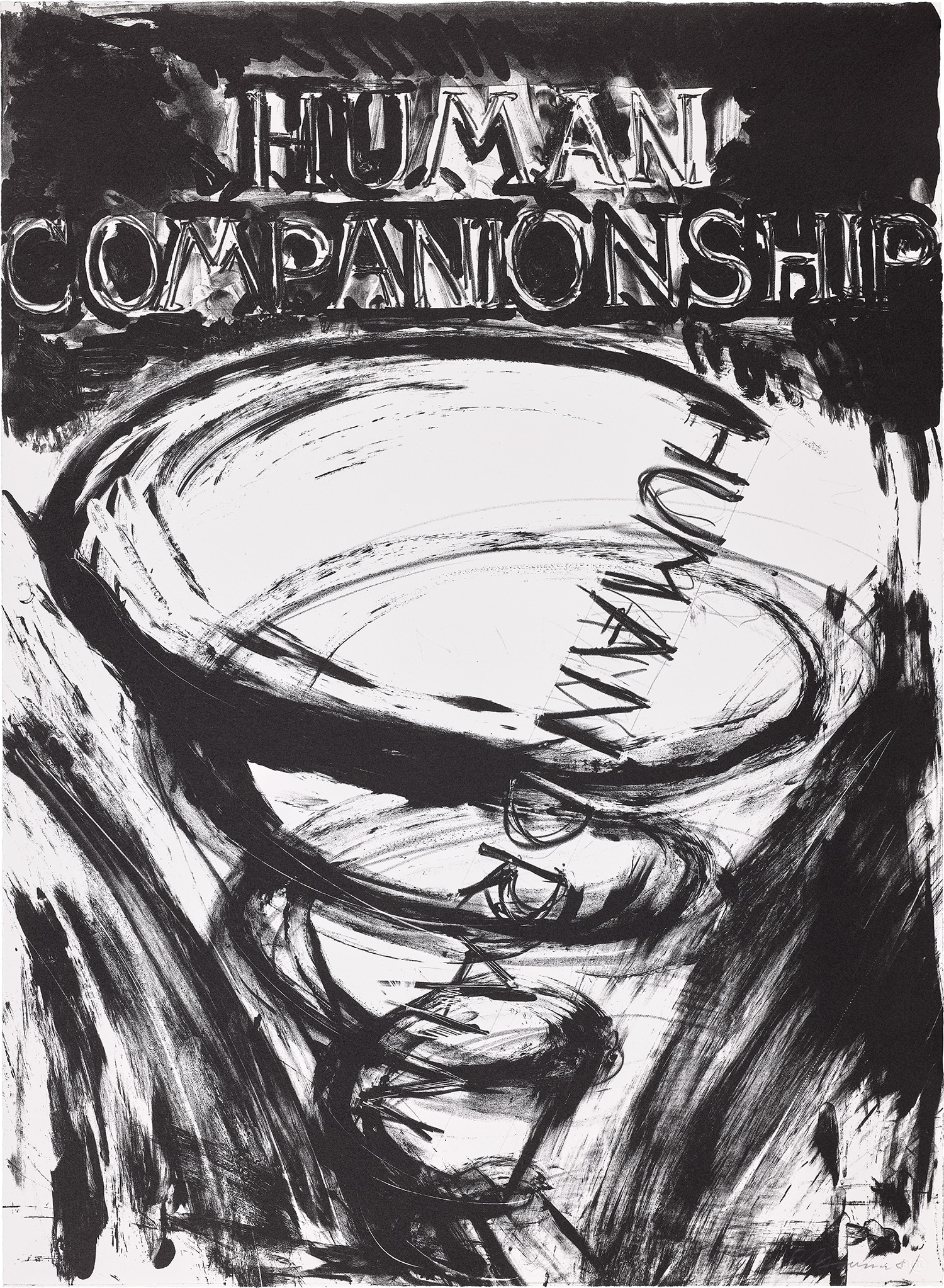
Bruce Nauman: Language, Light, and Liberation
Artist Spotlight · The Collection Editorial
“The true artist helps the world by revealing mystic truths.”
Neon work and oft cited statement, 1967
Few living artists have shaped the grammar of contemporary art as durably or as generously as Bruce Nauman. In 2023, a major survey at Sperone Westwater in New York drew renewed critical attention to his printmaking and works on paper, reminding collectors and institutions alike that Nauman's restless intelligence operates across every medium he touches. His presence in the permanent collections of MoMA, the Tate Modern, and the Guggenheim is not merely honorific. It is a testament to an artist who, for more than five decades, has refused to let his audience settle into comfort.
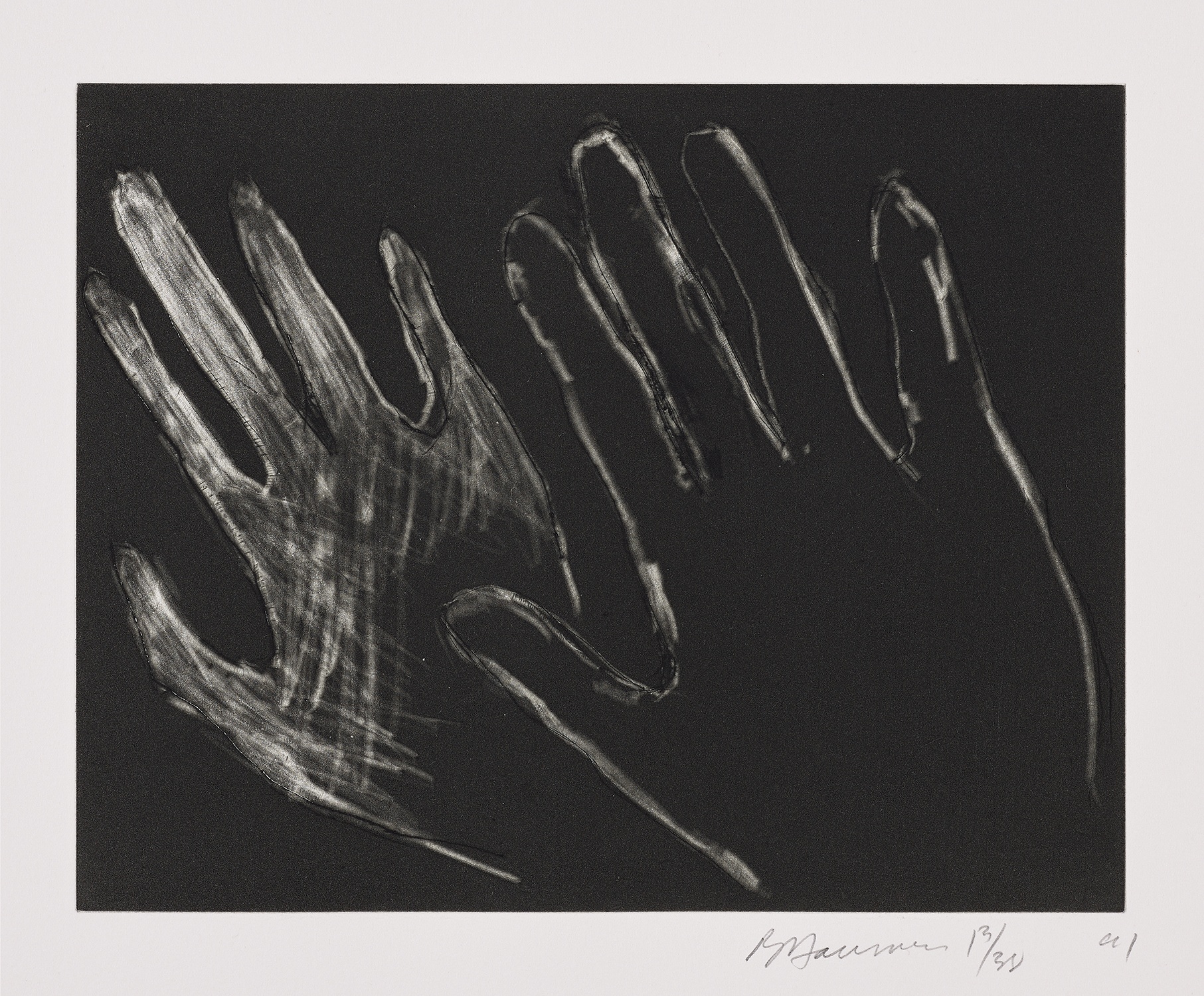
Bruce Nauman
1990-91
Nauman was born in Fort Wayne, Indiana in 1941 and grew up in the American Midwest, a landscape of quiet ordinariness that would quietly inform his fascination with the everyday, the bodily, and the overlooked. He studied mathematics and physics at the University of Wisconsin before turning decisively toward art, completing his MFA at the University of California, Davis in 1966. Davis was a crucible in those years. Nauman worked alongside William T.
Wiley and Robert Arneson, figures who embraced wit, materiality, and an irreverence toward the heroic pretensions of the New York art world. That intellectual freedom left a permanent mark. What happened next was extraordinary in its speed and its originality. Working out of a San Francisco studio in the late 1960s, Nauman began asking a question that sounds simple but opens into genuine philosophical vertigo: if an artist is an artist, what is the artist doing when not making art?
Bruce Nauman
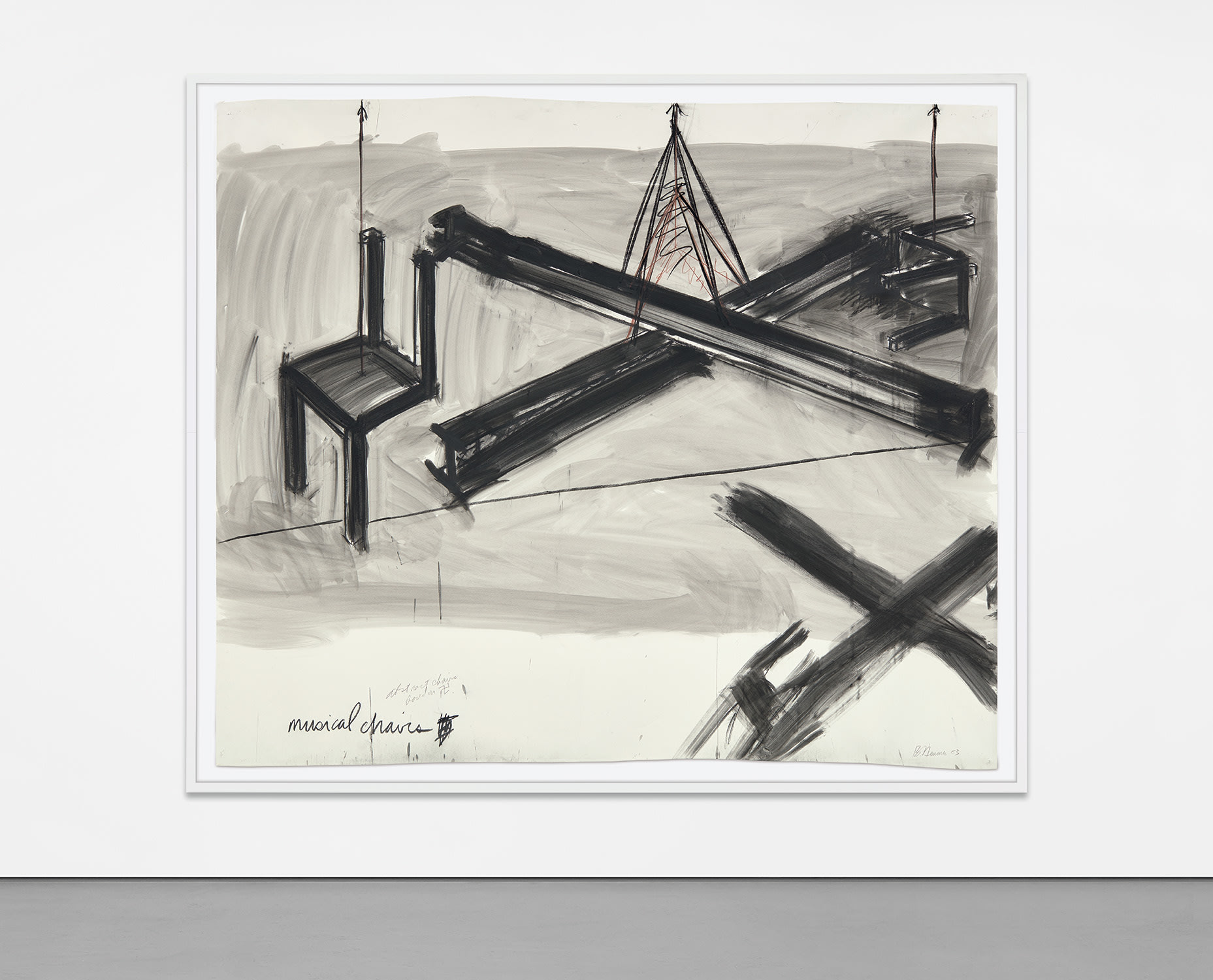
Musical Chair, 1983
His answer was to document everything, to make the studio itself and his own body the subject. Early films and photographs showed him pacing, bending, pressing against walls, drinking coffee. These were not performances in any theatrical sense. They were investigations, carried out with the patience of a scientist and the curiosity of a philosopher.
“If I was an artist and I was in the studio, then whatever I was doing in the studio must be art.”
Bruce Nauman, interview with Chris Dercon, 1985
By the late 1960s and into the 1970s, Nauman had arrived at the forms that would define his public reputation. His neon text works, pieces like "The True Artist Helps the World by Revealing Mystic Truths" from 1967, transformed commercial signage into something simultaneously ironic and earnest. Neon had been the language of diners and casinos. Nauman made it the medium of riddles that could not quite be laughed off.
Bruce Nauman
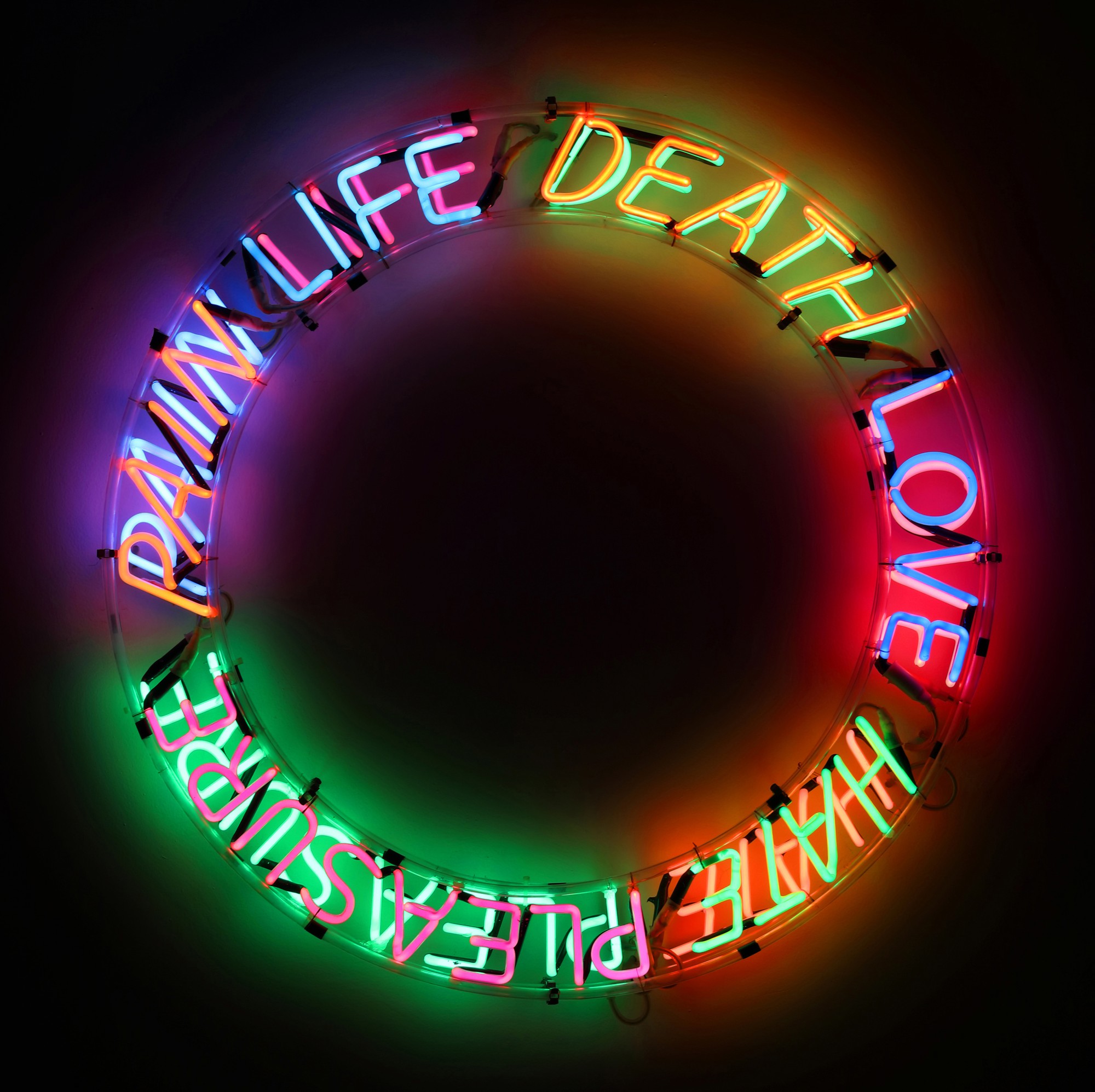
Life, Death, Love, Hate, Pleasure, Pain
His corridor installations, narrow architectural passages designed to induce disorientation and self consciousness, placed the viewer's body under a kind of gentle but insistent scrutiny. You were the subject. You were always already being watched, and you were watching yourself being watched. Language became an increasingly central obsession through the 1970s and 1980s.
Works like "Life, Death, Love, Hate, Pleasure, Pain" arranged fundamental human categories in neon spirals and configurations that suggested both a taxonomy and a trap. The words are ones we think we understand. Nauman arranges them so that they begin to feel strange, looping in on themselves, canceling and amplifying each other. His printmaking practice from this period, richly represented in works available on The Collection including etchings, aquatints, and lithographs produced with extraordinary technical care, shows the same preoccupations translated into the intimacy of paper and ink.
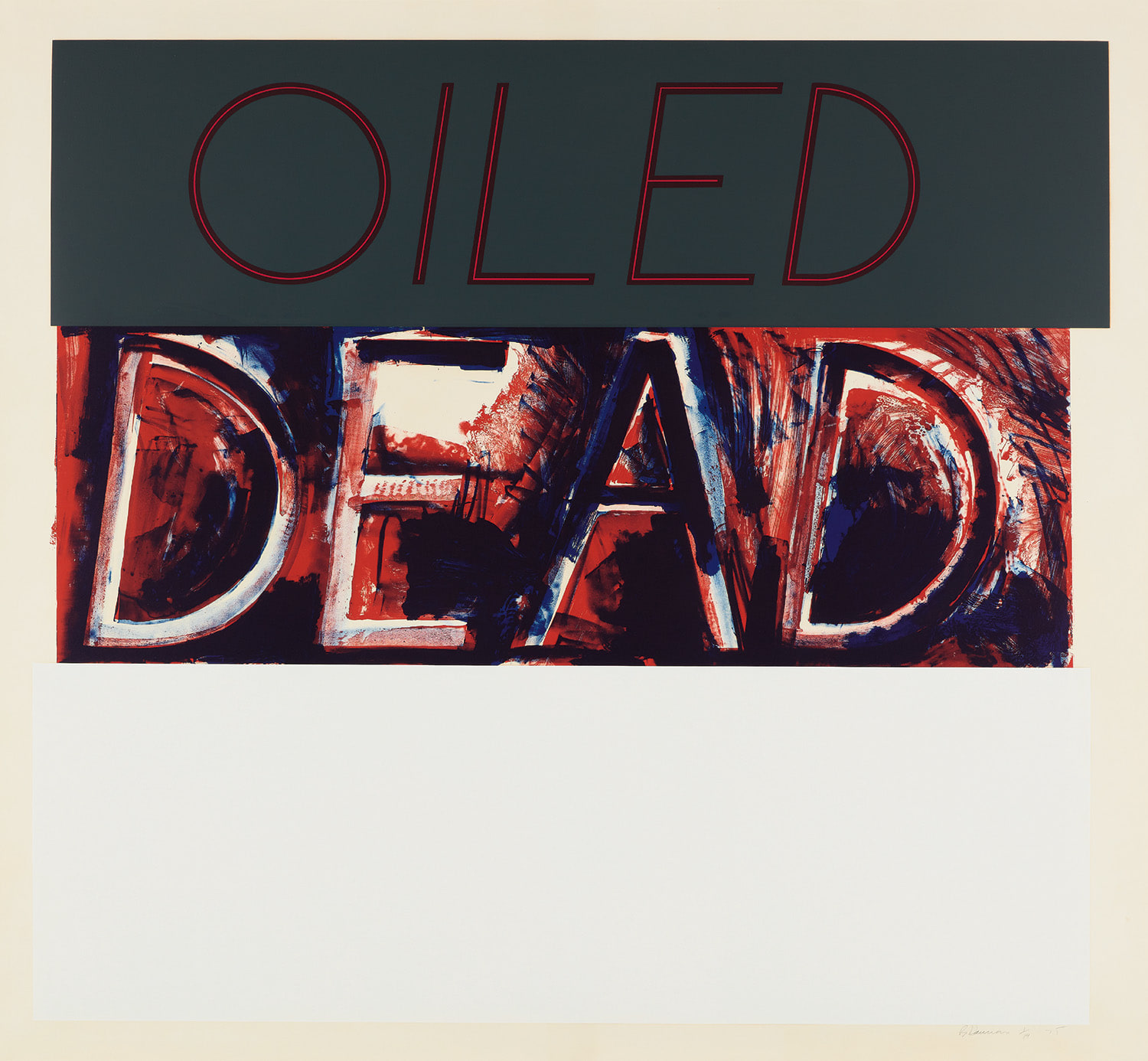
Bruce Nauman
Oiled Dead (State)
Works like "Verso Recto (State I)" and "Oiled Dead (State)" demonstrate how Nauman uses the print medium not as a secondary pursuit but as a genuine laboratory for ideas. The 1985 neon work "Masturbating Man" exemplifies another dimension of Nauman's practice: his willingness to represent the body in states that are neither heroic nor decorative. The work is blunt, even confrontational, but it carries a kind of deadpan seriousness that separates it entirely from provocation for its own sake. Nauman is never simply shocking.
He is always asking what the body means, what it reveals, what it conceals. His 1966 "Modern (Production) Slant Stool," cast in fiberglass and inscribed in his own hand, belongs to an even earlier moment of investigation, when everyday functional objects became the occasion for questions about production, authenticity, and the boundaries of sculpture. For collectors, Nauman presents a genuinely unusual proposition. He is among the most intellectually serious artists of his generation, and yet his works on paper and prints are among the most accessible points of entry into a practice that also commands seven and eight figure sums at auction for major sculptures and installations.
His prints have consistently performed well at Christie's, Sotheby's, and Phillips, appreciated by collectors who understand that Nauman's engagement with printmaking was never casual. Works like "I Learned Helplessness From Rats (cordes 61)" and "Musical Chair" from 1983 reward close looking and reveal, over time, the same compulsive intelligence that animates his largest institutional works. The artist's decision to work repeatedly in series, returning to the same images and phrases with incremental variations, means that individual works carry the resonance of a larger system of thought. Nauman's place in art history is best understood in relation to the generation that surrounded and followed him.
He shares with Donald Judd and Dan Flavin a commitment to the phenomenological, to the idea that art's meaning is generated in the encounter between a body and an object or a space. He shares with Joseph Kosuth and Lawrence Weiner an obsession with language and its limits. And yet Nauman is distinctly his own. Where Conceptual Art could sometimes feel arid or purely cerebral, Nauman's work is always warm with the presence of a human being who is confused, curious, and stubbornly alive.
His Golden Lion at the Venice Biennale in 1999 was a recognition of that singularity, a career achievement awarded to an artist who had never stopped experimenting. What makes Nauman essential today, in a cultural moment saturated with images and language deployed at industrial scale, is precisely his insistence on slowness and difficulty. His works ask you to stay with them. They resist the quick read, the satisfying interpretation that lets you move on.
"Infrared Outtakes," with its eerie documentation of the human form in altered visibility, feels urgently contemporary in an era of surveillance and algorithmic seeing. His neon texts, reproduced endlessly on phone screens and in group chat memes, somehow retain their unresolved quality even in that context. The original objects, glowing and humming in a darkened room, remain experiences that no reproduction can substitute. That irreducible physicality, combined with a conceptual ambition that has never wavered, is what secures Nauman's legacy not just in the history of twentieth century art but in the ongoing conversation about what art is still capable of doing.
Explore books about Bruce Nauman
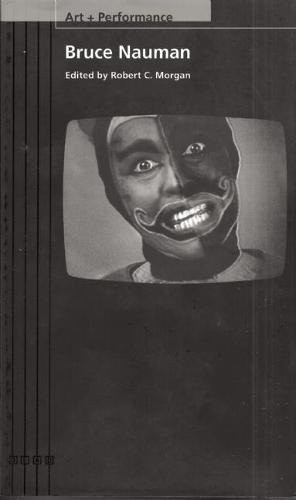
Bruce Nauman
Robert C. Morgan
Bruce Nauman: A Retrospective
Joan Simon
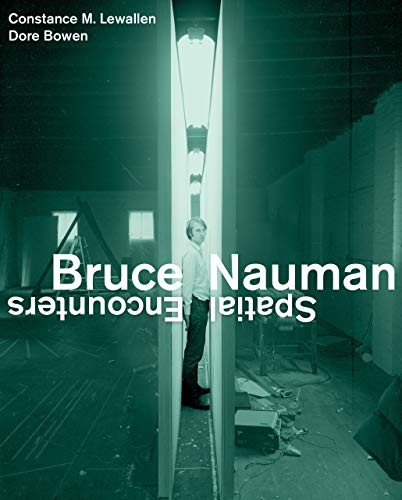
Bruce Nauman: Disappearing Acts
Janet Kraynak
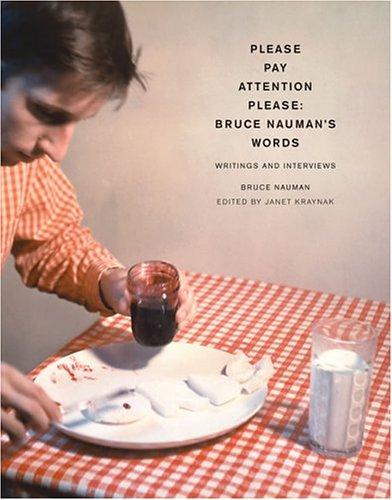
Please Pay Attention Please: Bruce Nauman's Words
Janet Kraynak

Bruce Nauman: Neon
Various authors
Bruce Nauman: Raw Materials
Various authors
Bruce Nauman: Emotional Geology
Various authors