Brad Howe
Brad Howe Sculpts Joy Into Bold Relief
Artist Spotlight · The Collection Editorial
Walk into any room where a Brad Howe sculpture stands and something shifts. The air feels charged, more alive, as if the work is quietly broadcasting on a frequency the rest of the room is only now tuning into. Over the past two decades, Howe has built one of the most distinctive bodies of work in contemporary American sculpture, fusing the visual language of Pop with the formal ambitions of abstract three dimensional construction. His sculptures do not simply occupy space.
Brad Howe
Untitled
They reorder it, flooding their surroundings with color and curved energy that feels both monumental and somehow playful. Born in 1958, Brad Howe came of age in an America saturated with commercial imagery, mass media color, and the lingering afterglow of the 1960s design revolution. Where that visual bombardment might have overwhelmed a lesser sensibility, Howe appears to have metabolized it completely, distilling decades of chromatic noise into something precise and personal. His formation as an artist reflects a deep engagement with fabrication and material process, and the works that have emerged from his studio carry the unmistakable mark of someone who thinks as much with his hands as with his eyes.
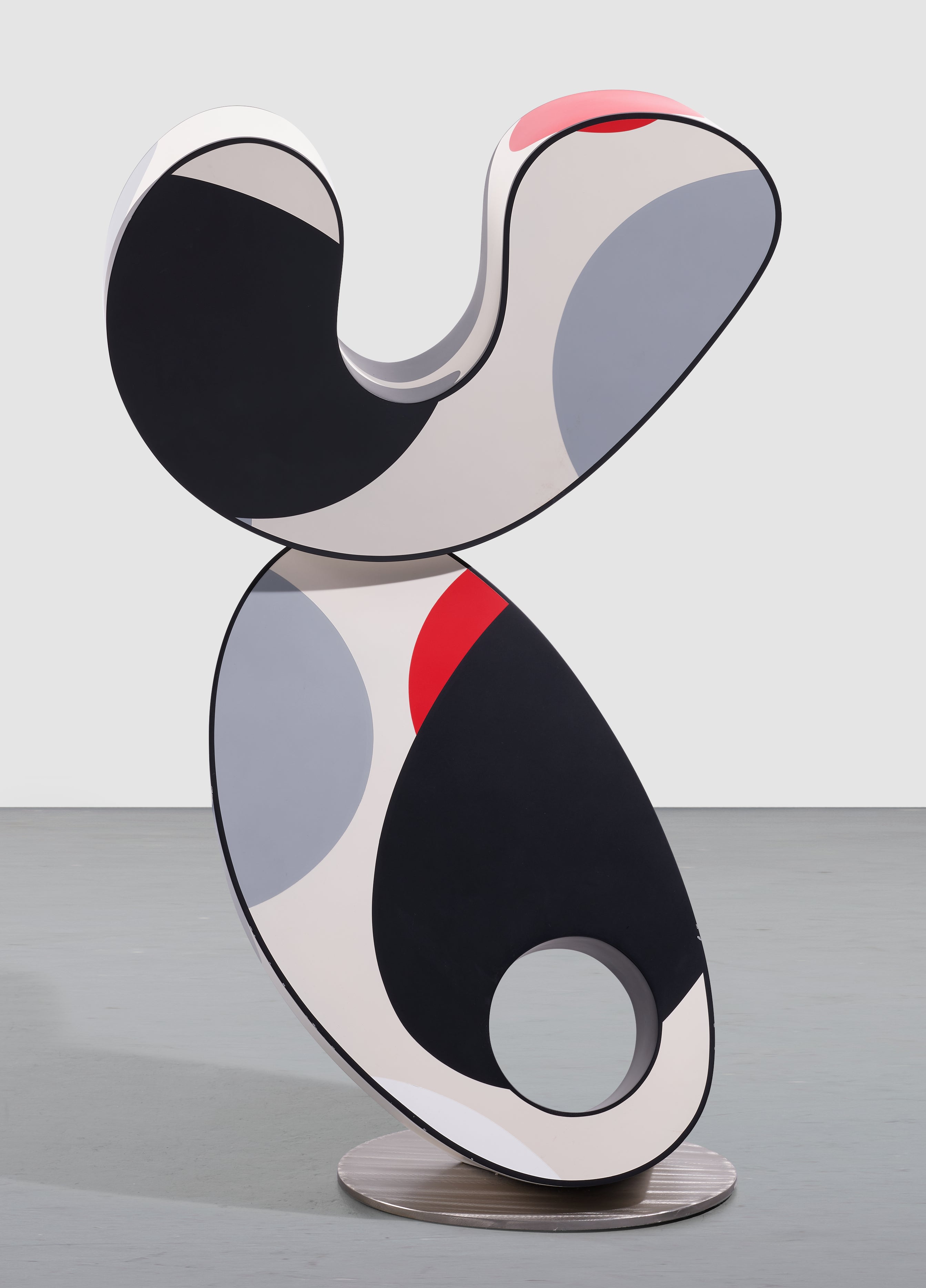
Howe works primarily in stainless steel and polyurethane, and the combination is central to understanding what his art does. Stainless steel gives his sculptures their structural spine, their capacity to read as both object and architecture at once. Polyurethane, applied in high gloss finishes, transforms those steel forms into surfaces that sing. The finish is so refined, so lacquered and luminous, that the works seem to generate light rather than merely reflect it.
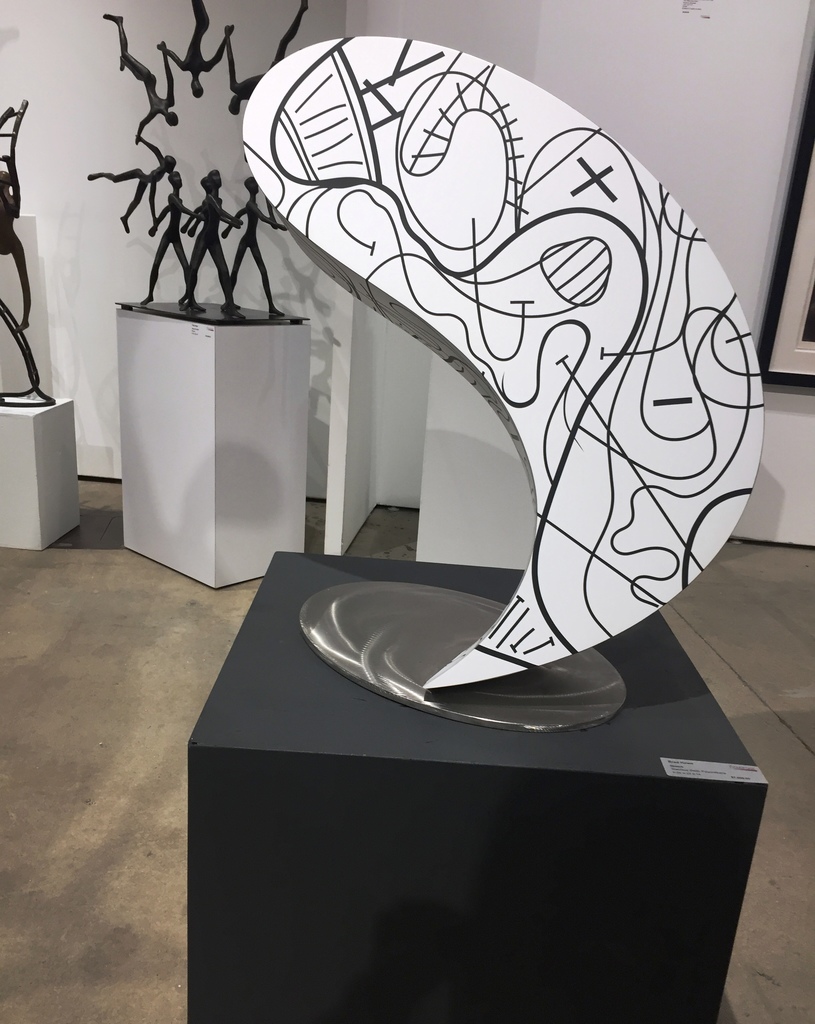
Brad Howe
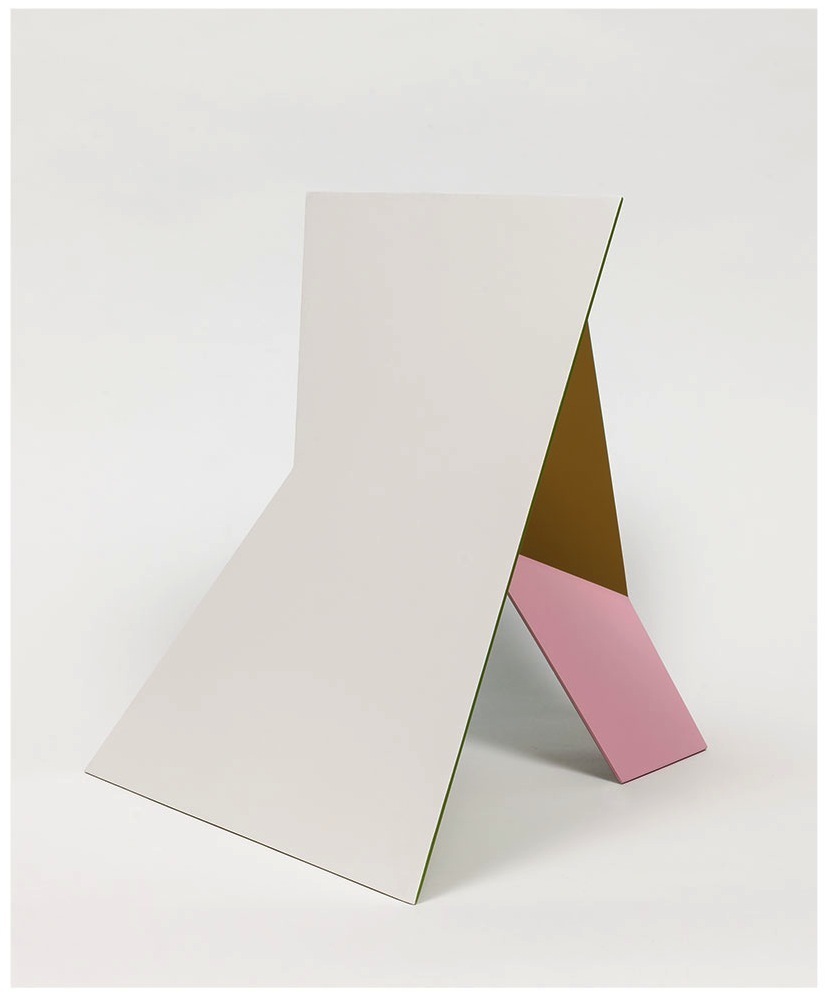
Sketch, 2010
This is not a decorative trick. It is a considered material argument about how color and form can be inseparable, how surface is never merely surface. Look closely at the large rolling sculpture visible in the photographs here and you begin to understand the full ambition of Howe's enterprise. Two massive disc forms anchor either end of a horizontal body, one rendered in warm mauve and black concentric arcs, the other alive with an explosion of blue, red, white, and orange geometric fragments.
Between them, a long body of cobalt blue and vivid lime green holds the composition together. The whole thing suggests a vehicle, a chariot maybe, or some futurist conveyance dreamed up at the intersection of Constructivism and California sunshine. It is enormous, physically commanding, and yet the palette keeps it buoyant rather than heavy. The second sculpture in these photographs pushes in a different direction.
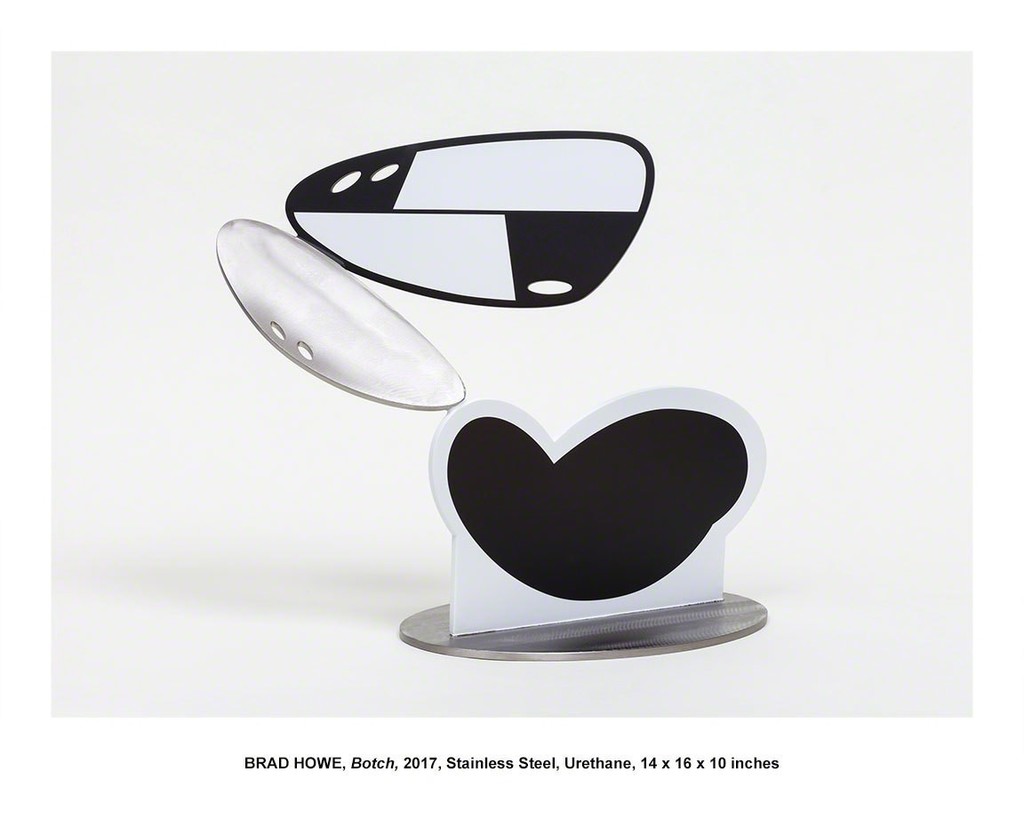
Brad Howe
Botch, 2017
It is ovoid and almost totemic in silhouette, a form that reads as vaguely figural without ever committing to figure. Its surface is an absolute riot of interlocking painted zones: lime green, deep purple, hot red, blush pink, cream, and black, annotated with numerals and looping calligraphic marks that float up through the composition like memories of signage. The numbers 9, 3, 6, and 3 appear, circled or scattered, evoking the graphic systems of vintage sporting equipment, old pool balls, or analog dials. This is Howe at his most maximalist, and the work rewards slow looking.
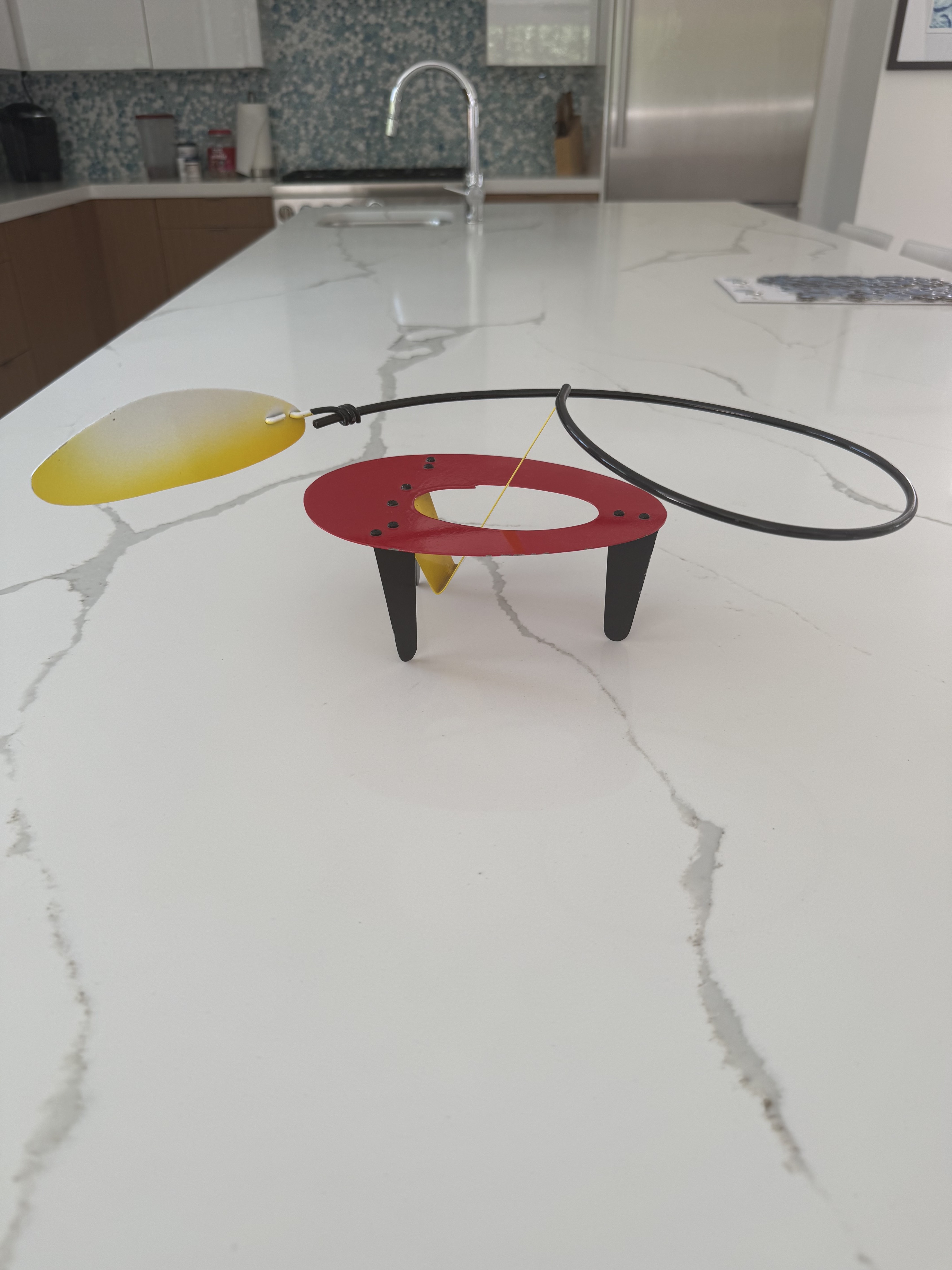
What first reads as chaos resolves, after time, into a tightly controlled surface rhythm. The ceiling mobile visible among Howe's works here offers a quieter counterpoint to those large floor sculptures. Titled Cassiopeia Mobile and completed in 2020, it consists of painted steel discs in red, blue, black, navy, white, yellow, orange, and brown, suspended from a branching wire armature with the delicate engineering of a clockmaker. It is clearly in conversation with the tradition of Alexander Calder, whose mobiles redefined what sculpture could be by introducing air and time as formal elements.
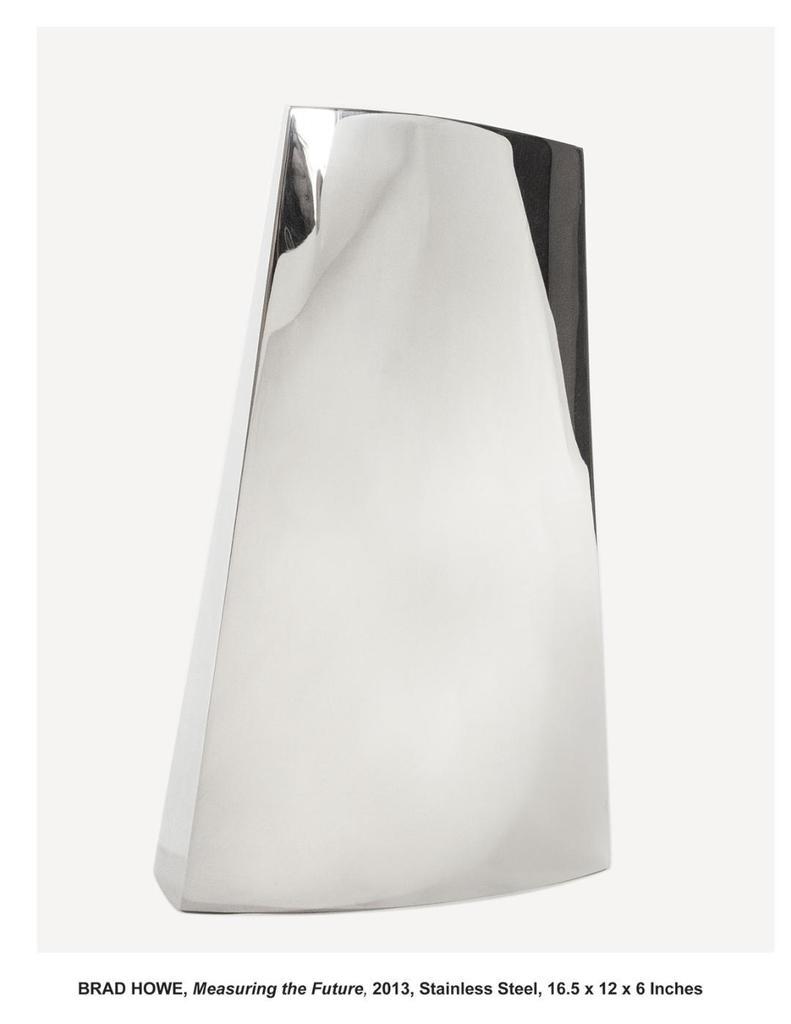
Brad Howe
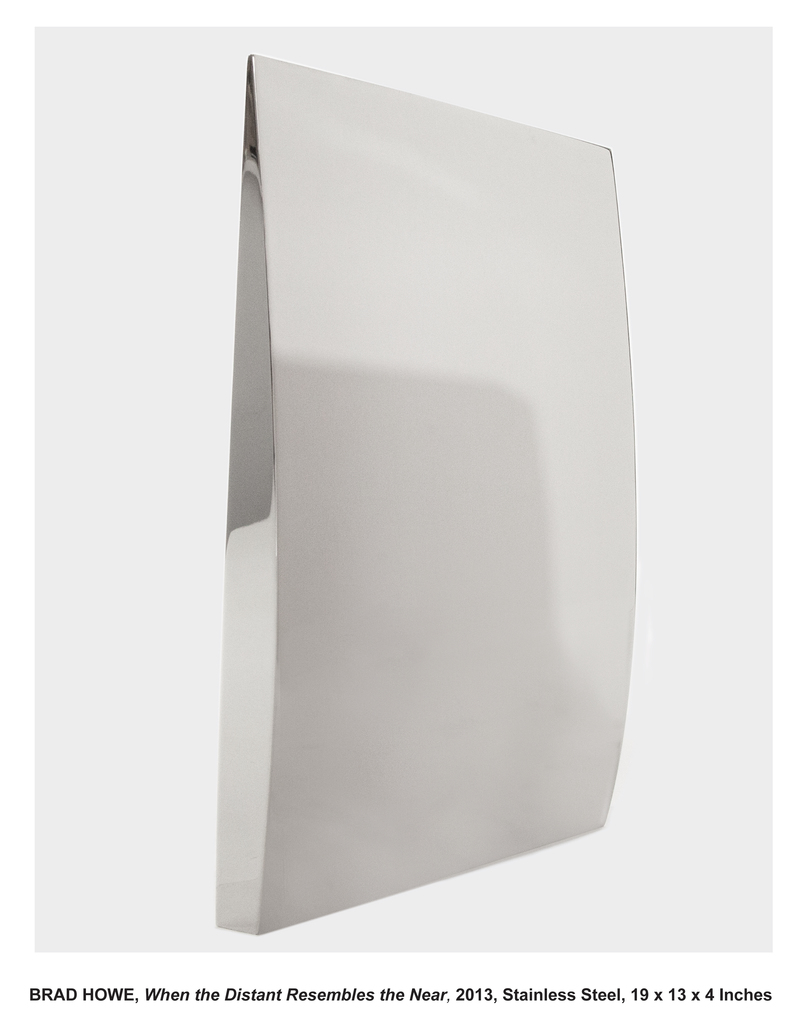
Measuring The Future, 2013
Howe's version has its own character, more intimate in palette and proportion, the discs themselves flatter and more graphic than Calder's biomorphic shapes. It is a work that changes with every shift of air, and its relationship to movement and contingency places it in a distinguished lineage. Howe's signature works, including Geisha from 2007 and the ongoing series that includes Big Data and Floating Farms, demonstrate a consistent formal intelligence across very different emotional registers. Geisha is stainless steel and polyurethane in a largely monochromatic palette, elegant and restrained, a figure that emerges from pure form rather than any literal representation.
Big Data from 2015 arrives with a very different energy, its title alone signaling an engagement with the pressures and textures of contemporary information culture. Across these works, Howe returns again and again to curved silhouettes, to the tension between readable imagery and pure abstraction, and to the transformative potential of industrial materials handled with extreme care. From a collecting perspective, Howe occupies a position that is genuinely rare. His work is serious enough to engage collectors with deep commitments to contemporary sculpture, yet accessible enough in its pleasure and visual generosity to attract first time buyers who simply respond to the joy the work radiates.
The scale of his major pieces means they tend to become anchor works in significant collections, the piece around which a room is organized and a collection comes into focus. Smaller works and editions offer entry points without compromise, and the Cassiopeia Mobile is exactly the kind of work that rewards living with over time, its meaning deepening as its movements become familiar. In the broader context of contemporary art, Howe's practice sits at a productive crossroads. His commitment to fabricated metal sculpture connects him to the legacy of artists like John Chamberlain and Mark di Suvero, though Howe's vocabulary is far more chromatic and graphic than either.
His use of high gloss color and geometric surface patterning places him in conversation with artists working at the intersection of Pop sensibility and sculptural form. What distinguishes him is a consistency of vision across scale, material, and register that speaks to a fully developed artistic intelligence. Brad Howe is an artist whose work insists, generously and without apology, that beauty and rigor are not opposites. His sculptures argue that joy is a legitimate and serious aesthetic ambition, that color can carry formal weight, and that the pleasure a work gives a viewer is not incidental to its meaning but central to it.
In a contemporary art landscape that can sometimes mistake difficulty for depth, that insistence feels not only refreshing but genuinely important. Collectors who have lived with a Howe understand something that takes a moment to fully articulate: the work does not simply hang on a wall or stand on a floor. It changes the temperature of the room.
Featured Works