Bhupen Khakhar
Bhupen Khakhar: India's Boldest Everyday Poet
Artist Spotlight · The Collection Editorial
“I paint what I see around me. The ordinary people, the ordinary life. That is enough for me.”
Bhupen Khakhar
When Tate Modern mounted its major retrospective of Bhupen Khakhar's work, the rooms filled with something rarely felt in a contemporary survey: genuine warmth. Visitors lingered. They leaned in close to read the narrative details tucked into corners of his canvases, the way you might pause over a particularly good short story. The exhibition confirmed what a devoted circle of collectors, curators, and fellow painters had long understood.
Bhupen Khakhar
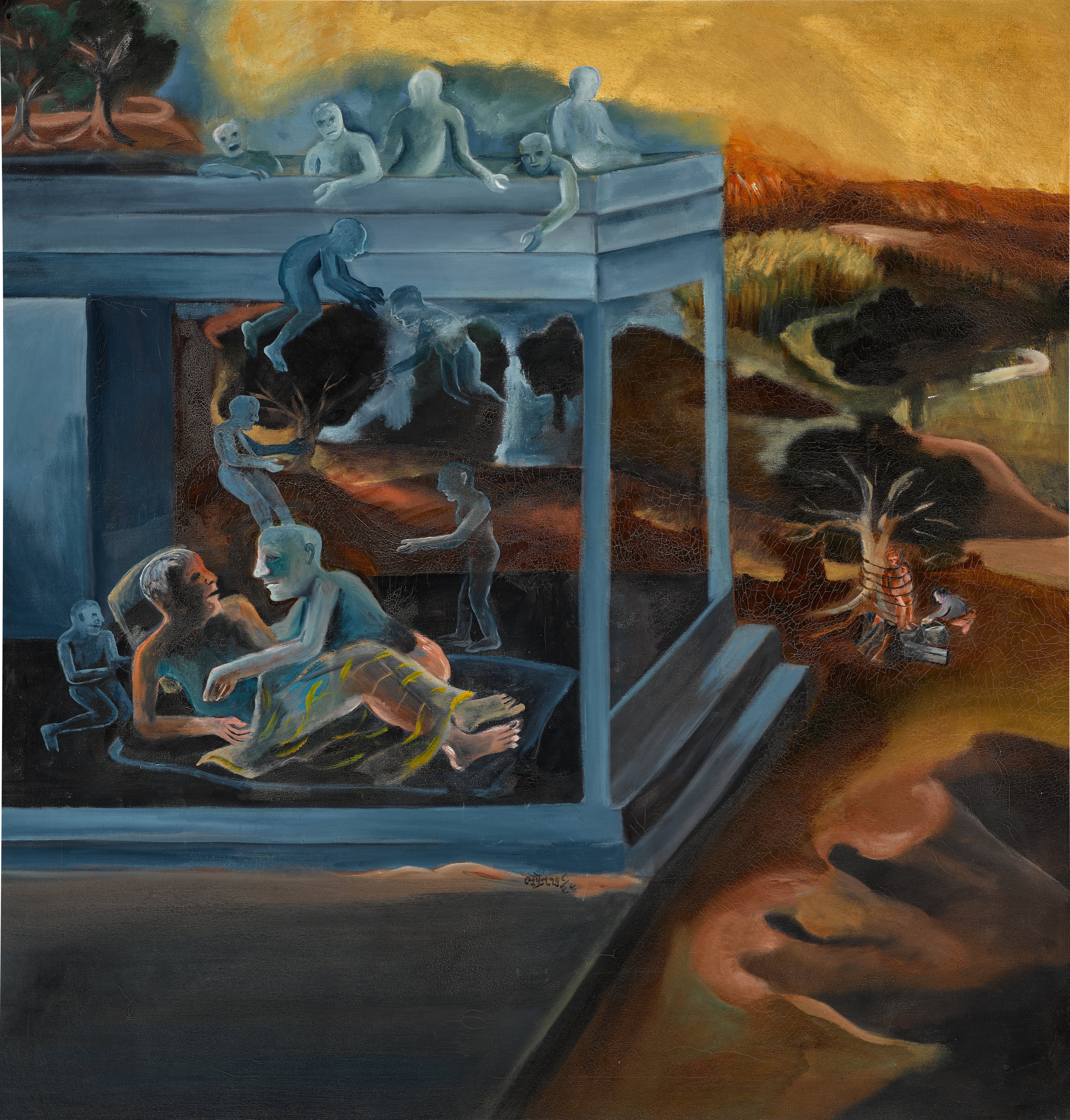
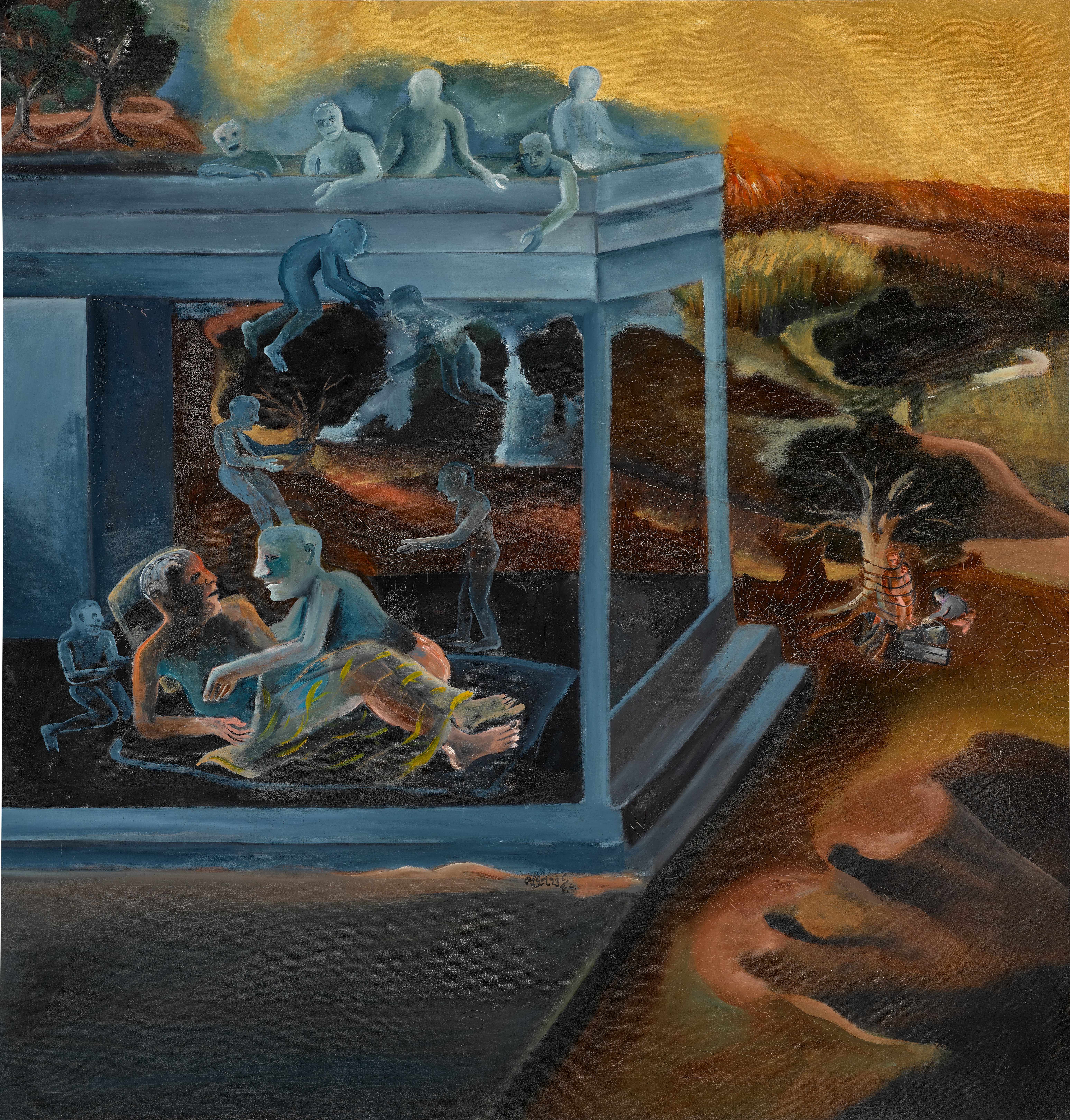
Visitors, 1998
Khakhar was not simply an important Indian modernist. He was one of the most original figurative painters of the twentieth century, full stop. Born in Bombay in 1934, Khakhar came to painting by an unlikely route. He trained as a chartered accountant and worked in that capacity for years, a fact he never treated as embarrassing but rather as a rich source of material.
The clerical world, the world of ledgers and modest ambitions and afternoon tiffin, became the very subject matter he would spend his career illuminating. He moved to Baroda in the 1960s, drawn into the orbit of the Faculty of Fine Arts at the Maharaja Sayajirao University, where friendships with artists and critics such as Gulammohammed Sheikh and the critic Geeta Kapur gave him an intellectual community without erasing his essential outsider sensibility. He was self taught as a painter, and that freedom shaped everything. Khakhar's early work in the 1960s and 1970s drew on the flat, vivid language of Indian popular imagery, from calendar art and bazaar prints to the decorative traditions of his native Gujarat.
Bhupen Khakhar
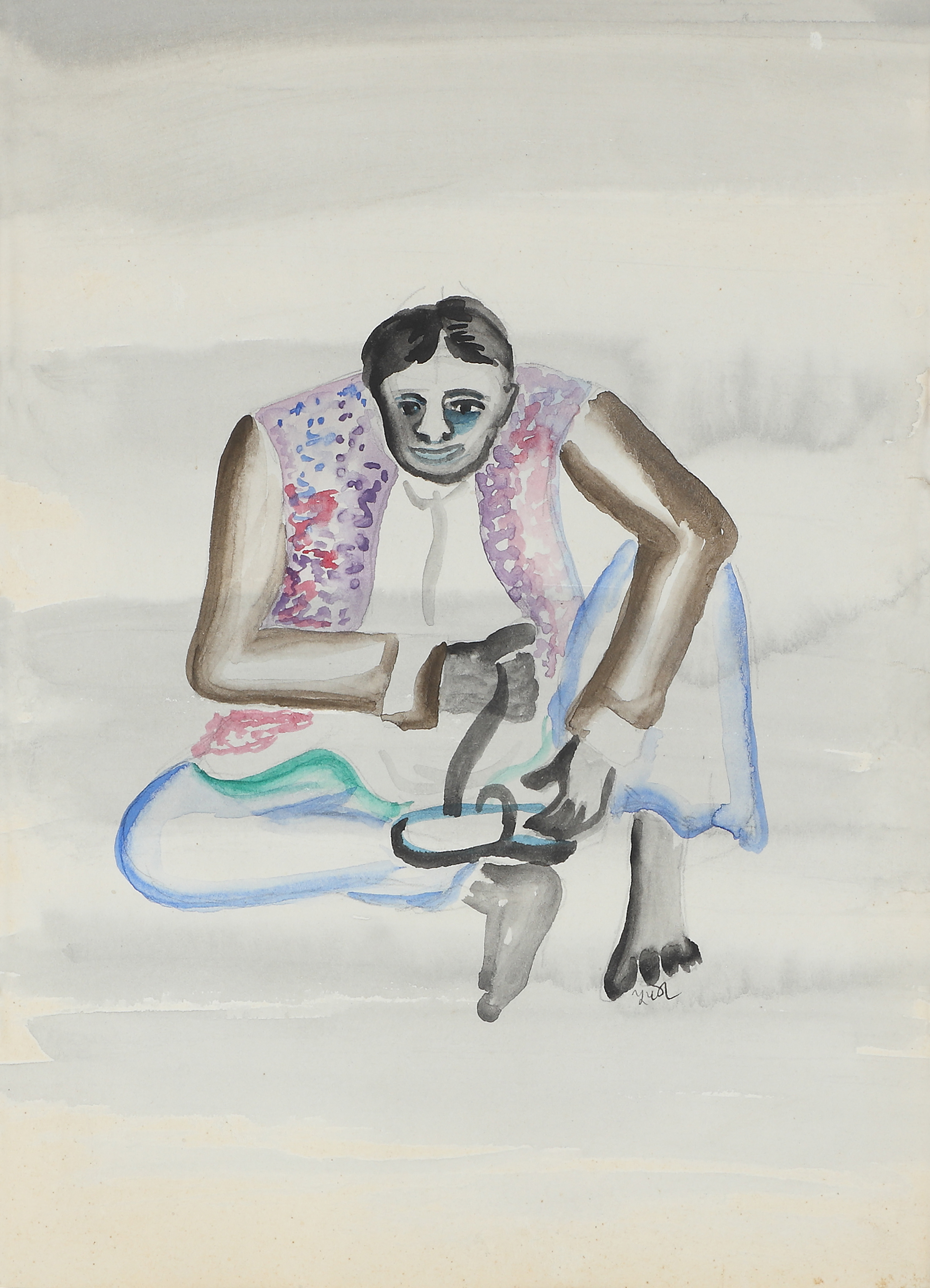
Untitled (Seated Man)
He placed these vernacular sources in conversation with European figurative painting, particularly the narrative directness of artists like David Hockney, with whom he developed a genuine friendship. The result was a style that was immediately recognizable: bright, compressed pictorial spaces populated by men in mundane occupations, bodies arranged with the unselfconscious clarity of folk painting but charged with psychological and emotional specificity. Works from this period, including paintings depicting watch repairmen, barbers, and tax consultants at their daily routines, announced an entirely new grammar for Indian urban painting. The decade of the 1980s brought a deeper and more personal urgency to his practice.
Khakhar began addressing homosexuality with an openness that was radical in India and remarkable in any international context. Paintings such as Two Men in Benares, completed in 1982, depicted male tenderness and desire with the same matter of fact warmth he had always brought to street life and domestic scenes. The bodies were unheroic, aging, utterly human. There was no manifesto in the work, no strident claim, only the quiet insistence that these lives and this love deserved to be painted.
Bhupen Khakhar
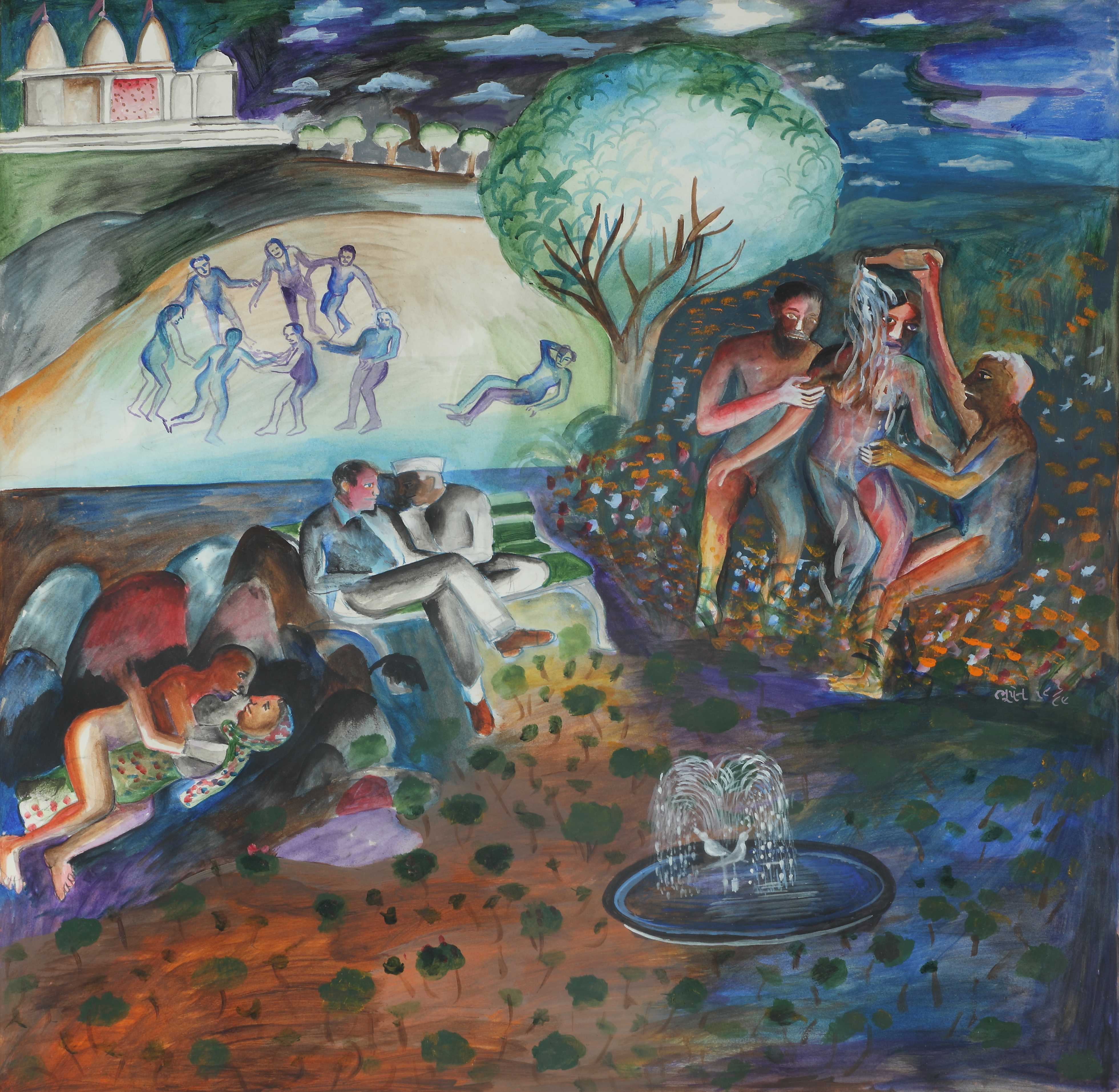
Sakhis in Vrindavan, 1989
The critical response internationally was significant, and works from this period are now recognized as foundational to any discussion of queer visibility in modern art. You Can't Please All, a large painting referencing the Aesop fable with characteristic wit, showed how his personal and allegorical registers could fuse into something at once funny and devastating. The works available on The Collection span Khakhar's career with wonderful range. Visitors, an oil on canvas from 1998, belongs to his late period and carries the luminous, slightly dreamlike quality that marks his final decade.
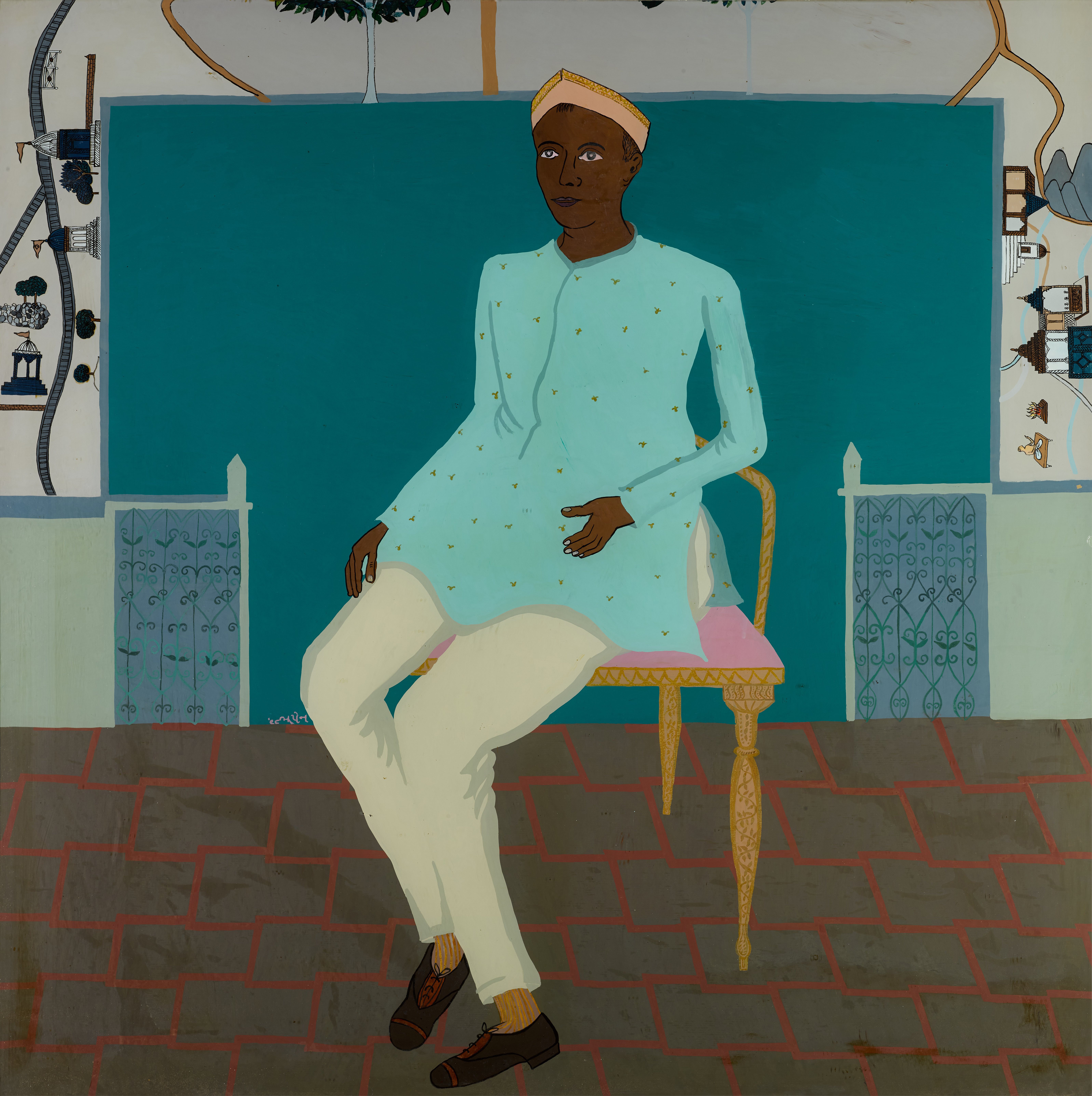
Sakhis in Vrindavan from 1989 demonstrates his deep engagement with devotional traditions and the feminine world of bhakti poetry, finding in those ancient narratives a space for exploring fluid identity and longing. The 1978 reverse painting in acrylic on glass is a rare and technically distinctive object, a nod to the traditional Indian craft of reverse glass painting that Khakhar elevated into fine art practice. In The Coconut Groves, completed in 1993 in oil on printed cloth laid on board, reveals his ongoing appetite for material experimentation and his ability to find sensuality in landscape as readily as in the figure. The Untitled watercolor of a seated man shows his quieter, more intimate register, the image of a solitary body observed with absolute gentleness.
Bhupen Khakhar
Untitled, 1978
For collectors, Khakhar's work occupies a position that is both historically secure and still developing in terms of market recognition outside India. His major retrospectives at Tate Modern and the Museo Reina Sofia in Madrid brought sustained international critical attention in the years following his death in 2003, and works at auction have reflected a growing appetite among both Indian and international collectors. Watercolors and works on paper offer an accessible point of entry and reveal the draftsmanship and observational acuity that underpin even his most ambitious canvases. The reverse glass paintings are particularly coveted for their rarity and their connection to the vernacular traditions that animate his whole practice.
When acquiring Khakhar, condition is paramount given his varied material choices, and provenance tracing to his Baroda or Bombay circle carries particular weight. Khakhar is best understood in dialogue with a broader constellation of figurative painters working against the grain of international abstraction during the second half of the twentieth century. His friendship with David Hockney was one of genuine artistic exchange, and comparisons with RB Kitaj and Leon Kossoff are instructive in terms of how all of them used the figure as a vehicle for cultural and personal autobiography. Within Indian art history, he stands alongside Gulammohammed Sheikh and the Baroda Group as a transformative force, one who insisted that Indian modernity could look inward to its own visual culture rather than simply toward Western abstraction for its forms and legitimacy.
Later generations of Indian painters, from Surendran Nair to the artists who emerged from the Baroda Faculty in the 1990s and 2000s, have all reckoned with his example. Bhupen Khakhar died in Baroda in 2003, having lived long enough to see his work enter major international collections and to know that the conversations he had quietly started were now being conducted at full volume. His legacy is not only artistic but ethical, in the sense that he modeled a way of being an artist that was generous, grounded, uninterested in self mythologizing, and committed to the idea that ordinary life in all its texture and contradiction was more than sufficient subject matter for serious art. To collect his work is to bring into a home or a collection something that looks back at you with humor and care and absolute honesty, which is as much as we can ask of any painting.
Explore books about Bhupen Khakhar
Bhupen Khakhar
Girish Dasgupta
Bhupen Khakhar: You Can't Please All
Geeta Kapur
Bhupen Khakhar: A Retrospective
Catherine David
The Art of Bhupen Khakhar
Ashish Rajadhyaksha
Bhupen Khakhar: Paintings and Drawings
Nalini Malani