Belkis Ayón
Belkis Ayón: A Vision Beyond the Veil
Artist Spotlight · The Collection Editorial
In 2016, the Fowler Museum at UCLA mounted a landmark retrospective of Belkis Ayón's work, bringing together her monumental collographs and drawing an audience that included curators, collectors, and scholars who had long revered her practice from afar. The exhibition was a revelation for many who encountered her imagery for the first time: vast, silvery fields of texture inhabited by elongated figures of otherworldly calm, their eyes often closed or absent, their presence simultaneously ancient and urgent. El Museo del Barrio in New York has since brought her work to East Harlem, cementing a growing institutional recognition that feels less like discovery and more like a long overdue homecoming. Ayón died in Havana in 1999 at just thirty two years old, and yet the world is still catching up to what she left behind.
Belkis Ayón
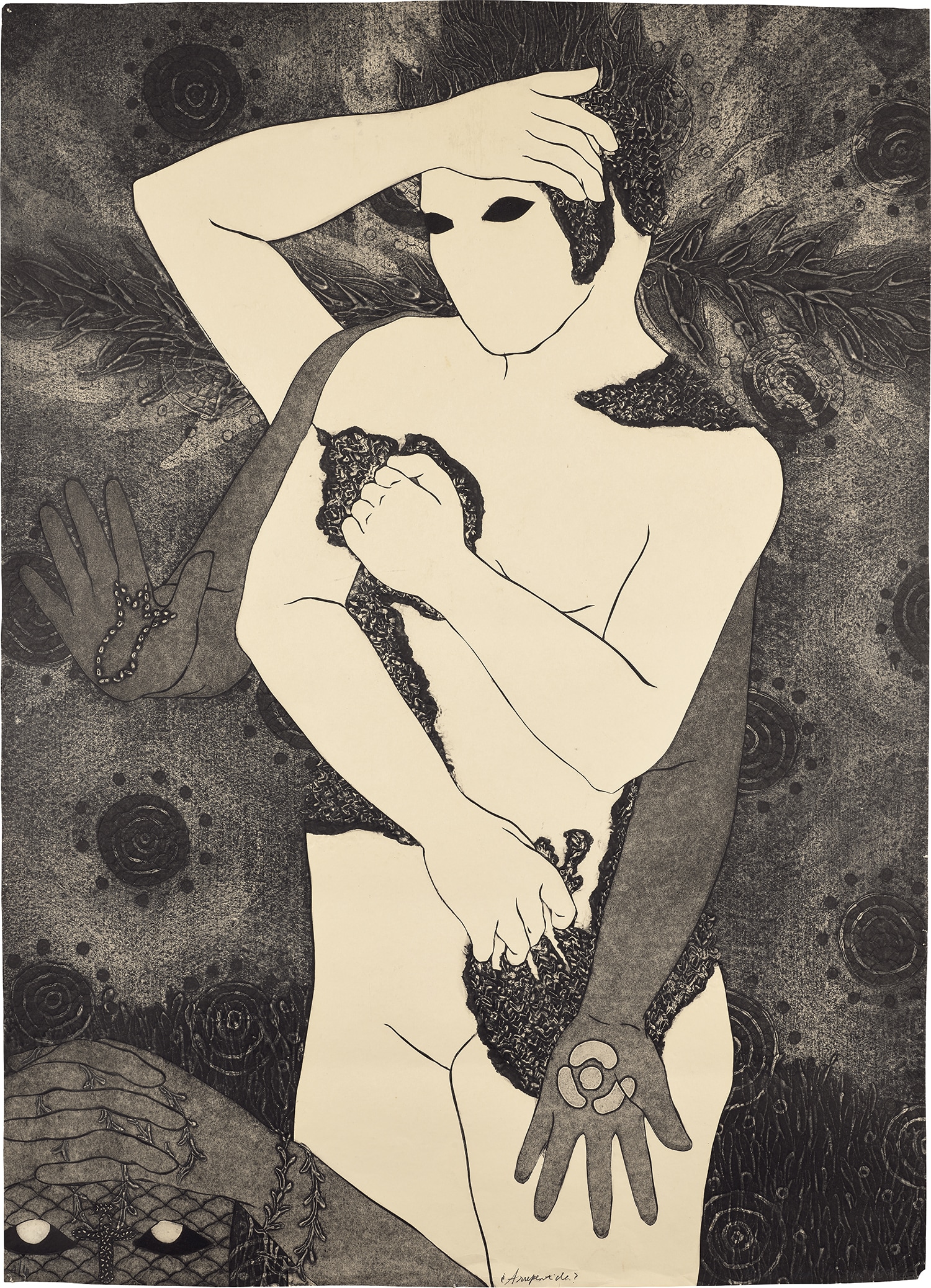
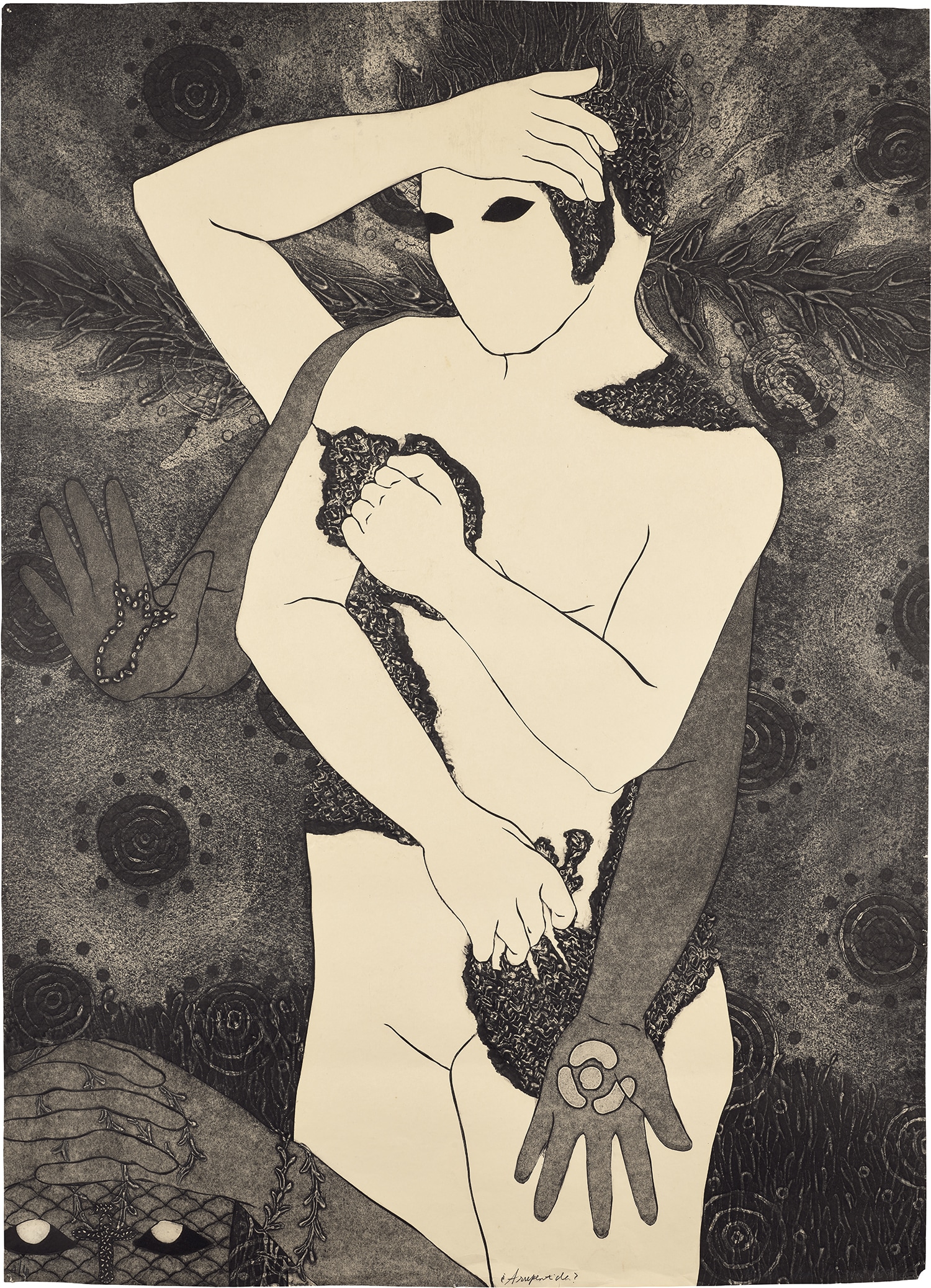
¿Arrepentida? (Repentant?), 1993
Belkis Ayón was born in Havana in 1967, into a city alive with creative contradiction. Cuba in the late 1960s and 1970s was a society simultaneously insular and intensely cultured, and Havana's art schools were producing graduates of extraordinary technical rigor. Ayón enrolled at the Instituto Superior de Arte, the celebrated arts university founded in 1976 on the grounds of a former country club, and it was there that she began the deep, consuming research that would define her entire career. She was not simply a student of printmaking; she was a scholar of mythology, a committed investigator drawn to stories that official culture had long pushed to the margins.
The mythology she chose to explore was that of the Abakuá, an Afro Cuban fraternal society with roots in the Calabar region of West Africa, brought to Cuba through the transatlantic slave trade and sustained in secret across centuries of colonial suppression. At the heart of Abakuá cosmology is the story of Sikán, a young woman who discovered the sacred fish Tanze in a river, inadvertently capturing the divine voice within it. Her accidental transgression and subsequent sacrifice form the founding myth of the brotherhood, a narrative of power, gender, and spiritual consequence that Ayón recognized as both historically resonant and urgently contemporary. No one had ever approached this material with quite her combination of scholarly seriousness and visual daring.
Belkis Ayón
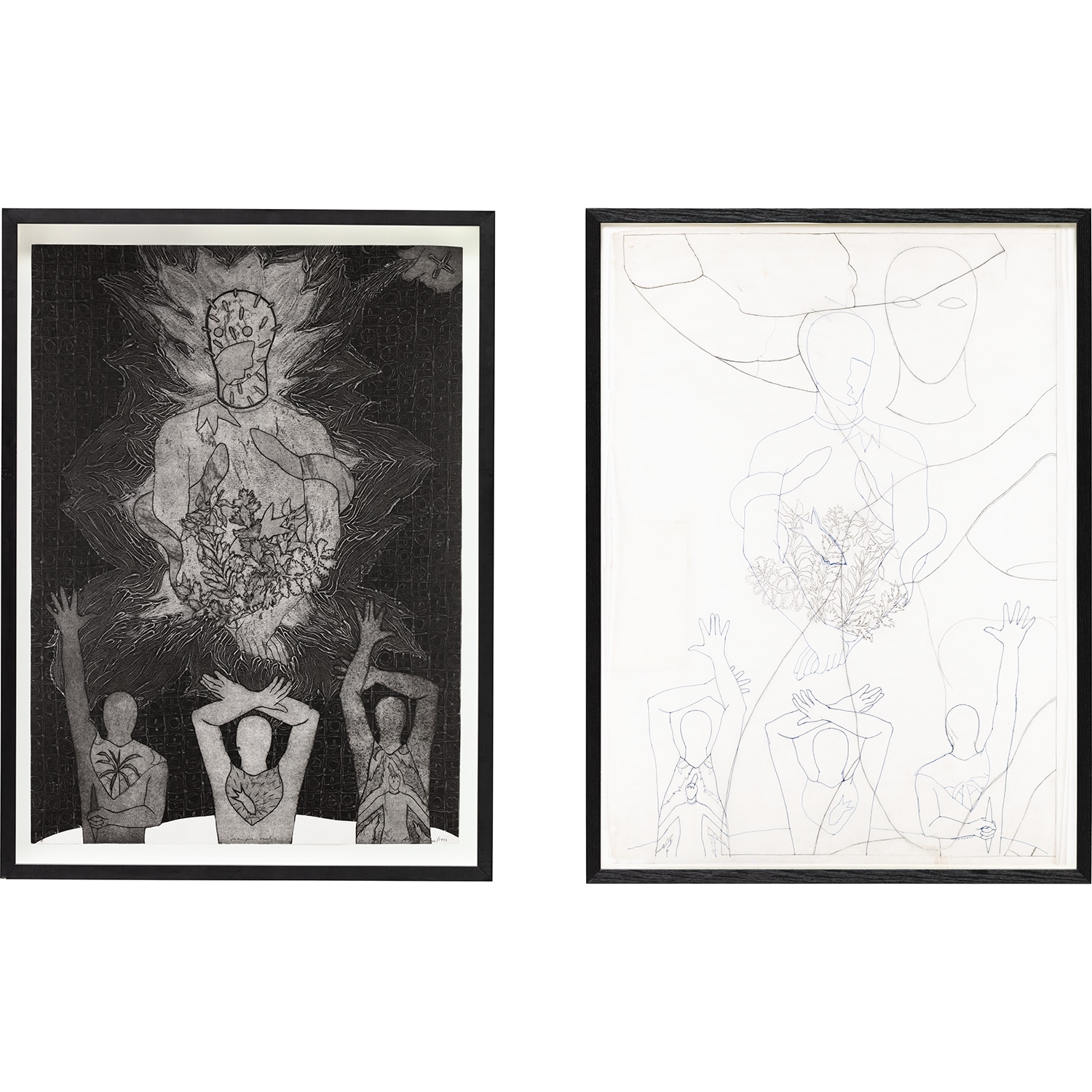
Two works: (i), 1993
Ayón's technical medium was the collograph, a printmaking process in which the artist builds a textured matrix on a plate using a variety of materials, then inks and prints from that surface. In her hands, the technique became capable of extraordinary atmospheric range. She worked almost exclusively in black, white, and grey, a deliberate restraint that amplified rather than diminished the emotional weight of her imagery. Her prints are not illustrations of the Abakuá myth; they are immersions into it.
The figures she created, particularly the recurring presence of Sikán, possess a hieratic stillness that feels drawn from both pre Columbian sculpture and European sacred painting, yet the work belongs entirely to no tradition other than its own. Scale was central to her vision: many of her prints span several meters, demanding a physical engagement that smaller works could never achieve. Among her most celebrated works is "Arrepentida (Repentant?)" from 1993, a question posed through both title and image with characteristic ambiguity.
![Belkis Ayón — Sin título [Es una portrada para la Revista ALBUR] (A. & V. 89.04)](https://rtwaymdozgnhgluydsys.supabase.co/storage/v1/object/public/artwork-images/auction-lots/NY030222-242022-lot1774382441136.jpg)
Belkis Ayón
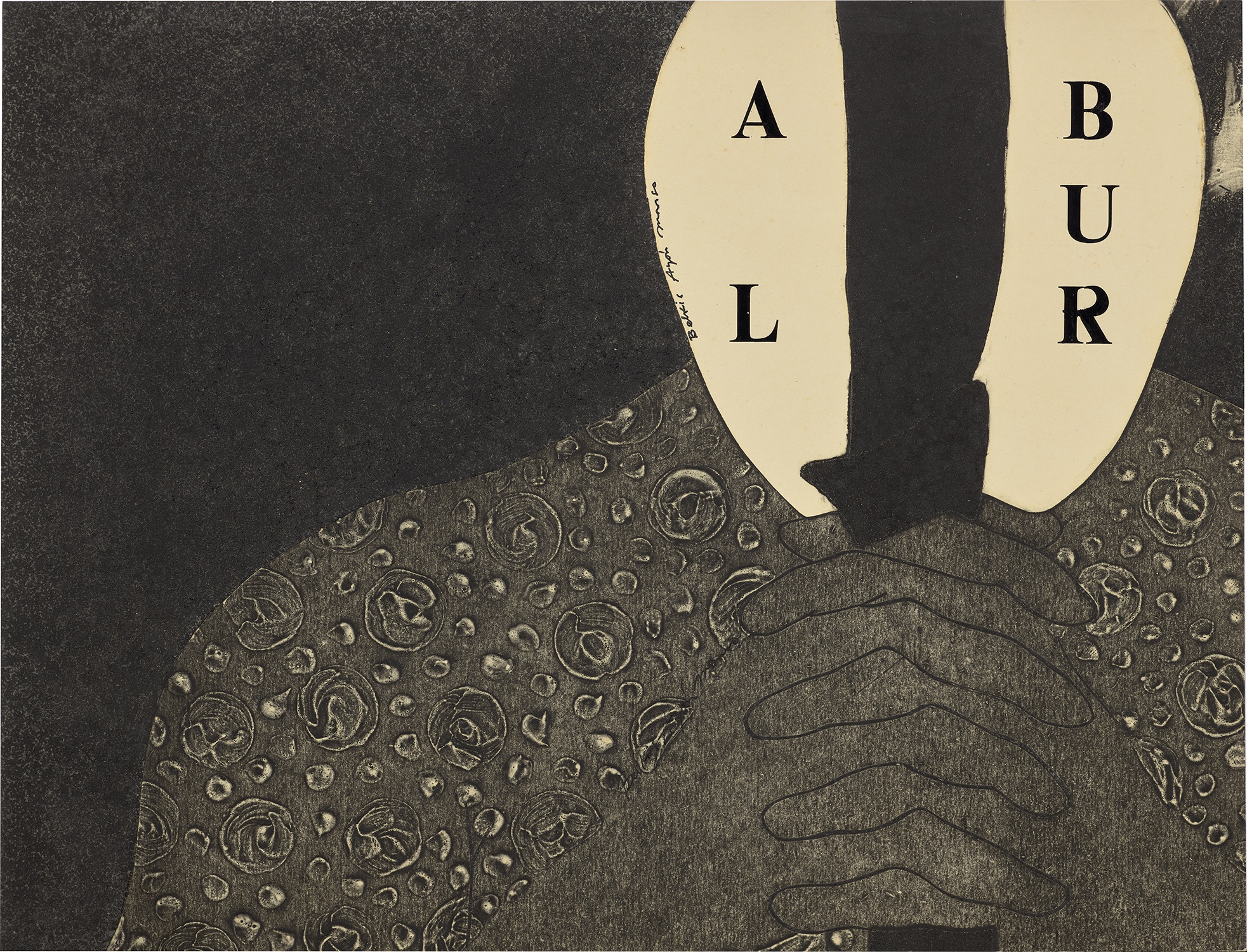
Sin título [Es una portrada para la Revista ALBUR] (A. & V. 89.04)
The work presents Sikán in a state of suspended interiority, neither confessing nor defying, simply existing within the moral architecture of a story that has already decided her fate. Also from 1993 is "Limbo," which situates its figures in a space that is neither punishment nor paradise, a condition of threshold that resonates with the historical experience of Afro Cuban communities navigating identity across centuries of displacement. "Nuestro Deber" (Our Duty), completed in 1994, extends this inquiry into collective responsibility, asking who bears the weight of a sacred transgression and who gets to define it. These works are not merely beautiful objects; they are arguments, made in grey and silence and enormous scale.
For collectors, Ayón's work presents a rare combination of qualities that define the most important acquisitions: a body of work that is finite, deeply researched, institutionally validated, and still growing in international recognition. Works on the market often carry certificates of authenticity issued by the Belkis Ayón Estate, which has been meticulous in its stewardship of her legacy. Signed and numbered editions, such as those published in connection with the landmark survey "Contemporary Art from Cuba: Irony and Survival on the Utopian Island," represent entry points into a practice whose prices have moved steadily upward as museums across Europe and the Americas have added her work to permanent collections. Collectors are advised to look carefully at condition, provenance, and the presence of estate documentation, all of which distinguish the most desirable examples.
Belkis Ayón
Sin título (A. & V. 91.10)
Ayón belongs to a generation of Cuban artists who came of age in the 1980s during the remarkable period known as the Cuban art renaissance, when the Instituto Superior de Arte produced a wave of internationally significant figures working under conditions of material scarcity and creative abundance. Artists such as Kcho, whose large sculptural installations also interrogate Cuban history and collective memory, and Wifredo Lam, whose earlier synthesis of Afro Cuban spiritual imagery with European modernism paved a conceptual path that Ayón both inherited and transcended, offer useful points of context. Within the global history of printmaking, her closest affinities might be with artists who used the medium to address sacred or mythological content at monumental scale, though few have done so with her particular combination of austerity and metaphysical depth. What makes Belkis Ayón matter today, with a force that only increases as years pass, is the clarity of her conviction.
She spent the whole of her brief career asking one set of questions about one story, refusing the temptation to diversify or dilute, and in that focused devotion she produced a body of work that feels inexhaustible. She gave Sikán a face the world had never seen before, and in doing so she gave visibility to an entire cosmology that dominant cultural institutions had long ignored. Her work is a gift to Cuban art history, to the history of printmaking, to the study of Afro Cuban culture, and to any collector or institution wise enough to steward it. The retrospectives at the Fowler Museum and El Museo del Barrio are not conclusions; they are invitations to a conversation that Ayón started and that the art world is only now fully prepared to have.