Antonio Seguí
Antonio Seguí: The City's Irresistible Eternal Witness
Artist Spotlight · The Collection Editorial
When the Musée d'Art Moderne de la Ville de Paris staged a major survey of Latin American modernism, the name Antonio Seguí appeared not as a footnote but as a centerpiece, his canvases crowded with anonymous figures in bowler hats pressing through urban corridors that felt as urgent and alive as the streets outside the museum's windows. That recognition, earned over six decades of relentless production, speaks to something essential about Seguí's place in art history: he was never merely a regional voice or a period curiosity, but a genuinely global painter who found in the human figure a language both personal and universal. His death in 2022 at the age of eighty eight closed one of the longest and most generative careers in postwar art, and the years since have seen institutions, scholars, and collectors return to his work with fresh eyes and deepened appreciation. Antonio Seguí was born in 1934 in Córdoba, Argentina, a city of colonial grandeur and political volatility that would leave permanent marks on his imagination.
Antonio Seguí
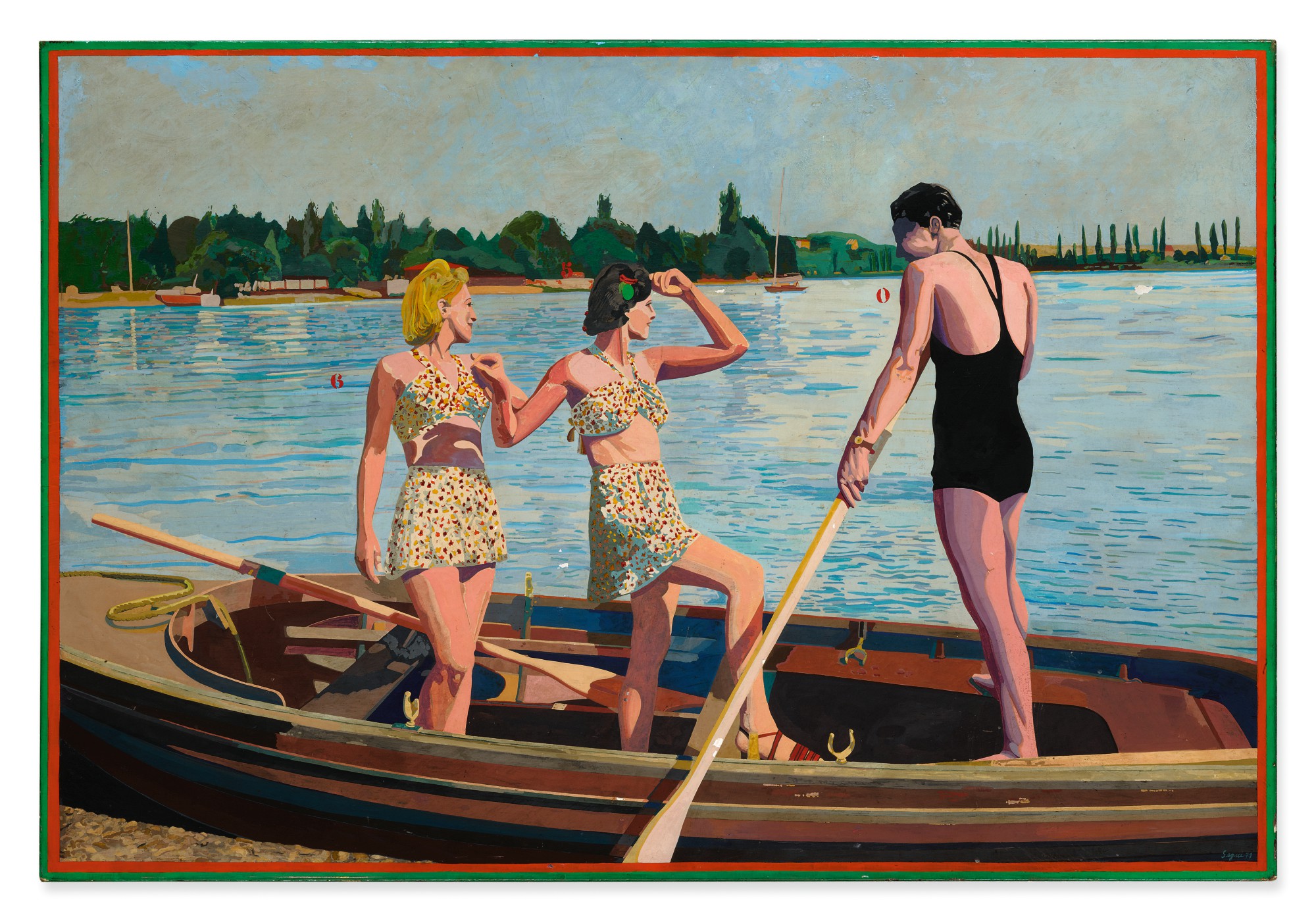
Wish You Were Here
He studied painting and sculpture locally before embarking on the kind of formative wandering that shaped so many Latin American artists of his generation. He spent time in Spain and Mexico during the 1950s, absorbing the lessons of European modernism while remaining alert to the political energies crackling through the postwar world. By the early 1960s he had settled in Paris, a city that would remain his primary home for the rest of his life, and it was there that his mature sensibility crystallized: part Argentine, part French, wholly his own. Paris in the 1960s was a crucible of competing avant gardes, and Seguí moved through that world with characteristic independence.
He was drawn to figuration at a moment when abstraction still commanded enormous prestige, and his commitment to the human form aligned him with a loose international tendency toward narrative and social observation. His work from this period shows the influence of popular illustration, advertising imagery, and the graphic economy of comic strips, sources he shared with the Pop artists working simultaneously in New York and London, though Seguí's relationship to those sources was always more melancholic and more politically charged. Where Pop could be cool and ironic, Seguí was warm and implicating, asking his viewers to feel the weight of the crowds he painted. The figure that became his signature, that small man in a hat moving through an indeterminate urban space, emerged fully formed by the late 1960s and never really left him.
Antonio Seguí
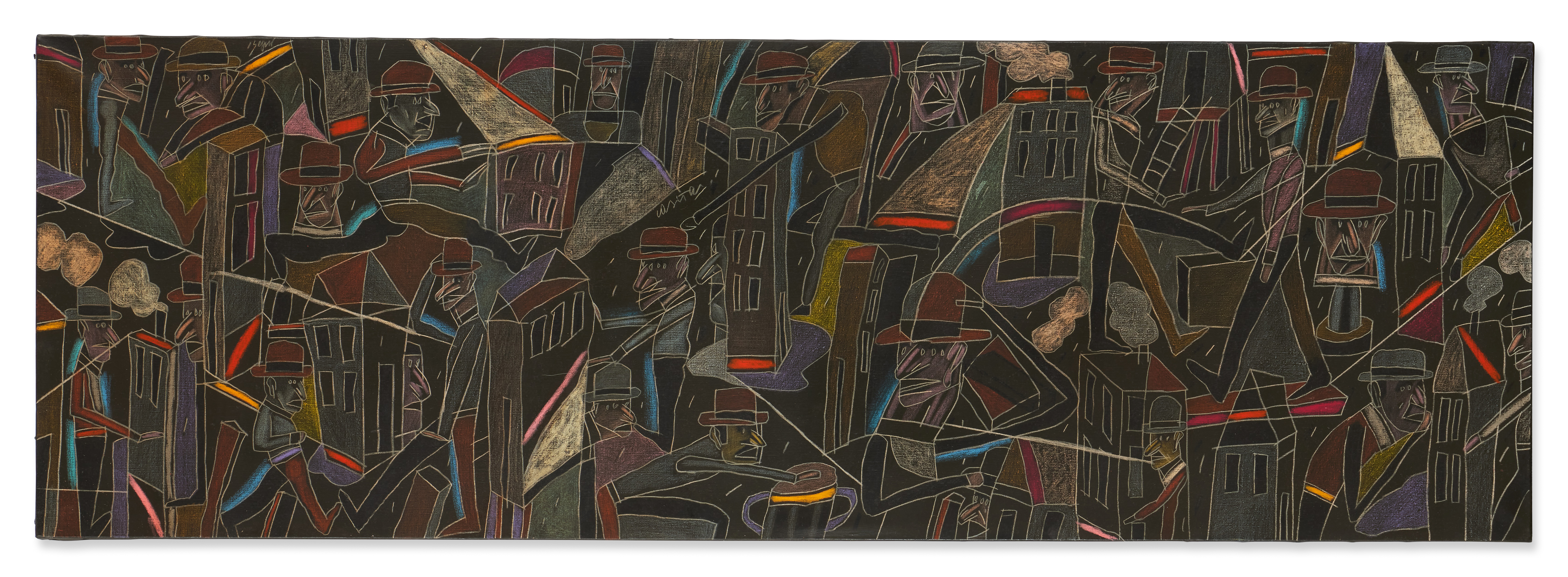
Sans titre, 1989
This anonymous protagonist, sometimes solitary and sometimes multiplied into teeming masses, became one of the most recognizable presences in contemporary Latin American art. The genius of the device is its universality: the figure is legible as an everyman, a commuter, a refugee, a bureaucrat, a dreamer, stripped of individualizing detail so that the viewer projects their own experience onto him. Works like "Sortie" from 1982, with its combination of oil, acrylic, charcoal and varnish on newspaper laid on canvas, demonstrate how Seguí layered his materials and his meanings simultaneously, the newsprint beneath the paint suggesting that history itself is the ground on which private life unfolds. His range of media was extraordinary and reflects a restless creative intelligence that refused to be confined.
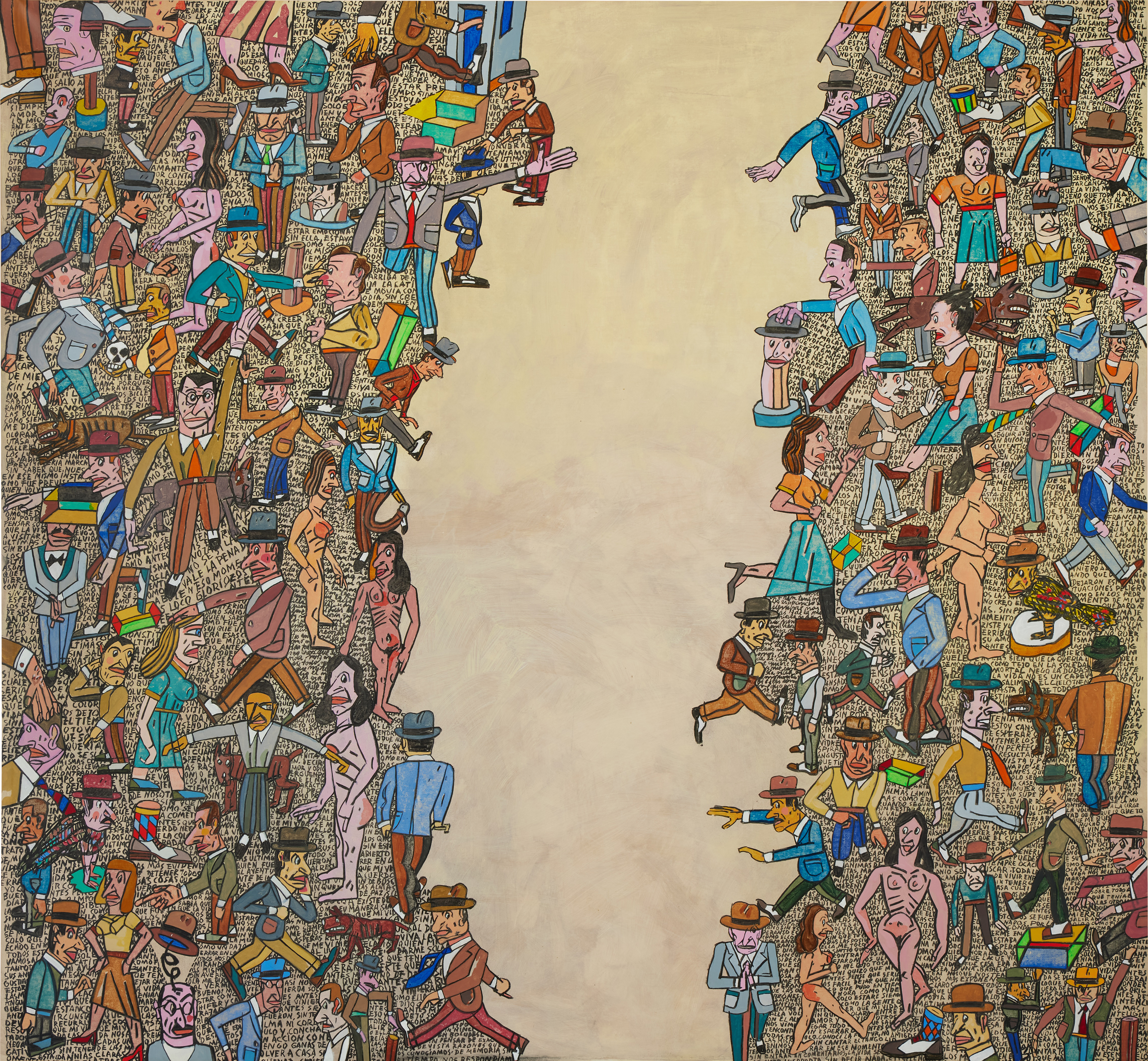
Seguí was an accomplished printmaker whose editions brought his imagery to a wide international audience, and he worked fluidly across oil, acrylic, pastel, and mixed media with equal authority. Works such as "Fractura social" from 2001 and "Caer Parado" from the same year show how his political conscience sharpened in the face of the economic and social crises that convulsed Argentina at the turn of the millennium. The titles alone carry the weight of lived observation: social fracture, falling and landing on one's feet. These are not abstract political statements but images rooted in the emotional texture of crisis, rendered with the formal confidence of an artist at the height of his powers.
Antonio Seguí
Fractura social, 2001
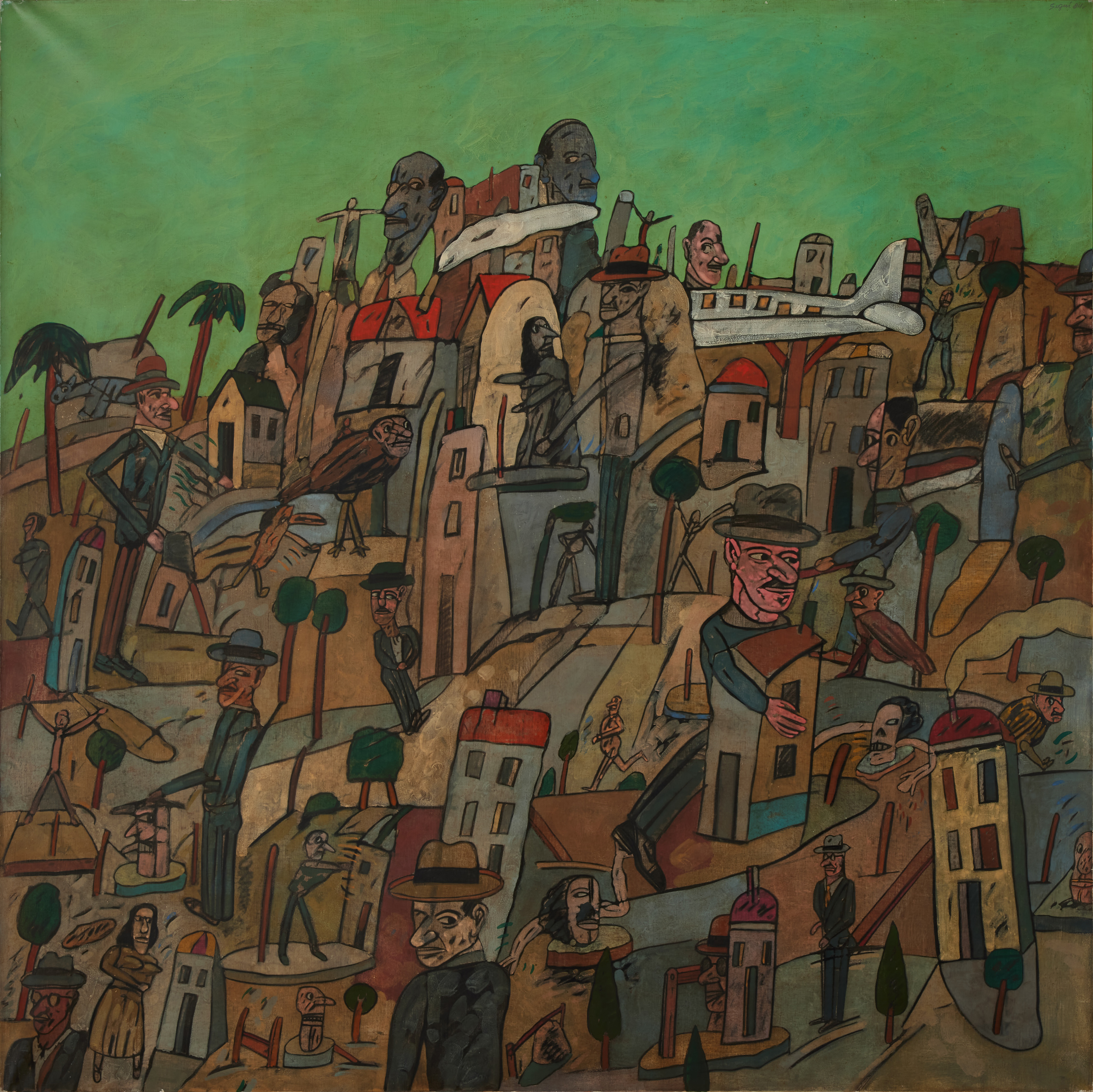
"El champaqui en enero" from 1984 offers a different register, more lyrical and landscape inflected, showing the range of feeling that his practice encompassed beyond the urban theater of his most celebrated works. For collectors, Seguí represents a remarkable convergence of aesthetic pleasure and art historical substance. His works appear regularly at major auction houses including Christie's and Sotheby's, where his canvases attract serious bidding from European, American, and Latin American collections. The mixed media works are particularly prized for their material richness: pieces like "Wish You Were Here," with its oil and glitter on photograph laid down on canvas, show an artist experimenting boldly with surface and appropriation in ways that feel entirely contemporary.
Collectors who have followed his market over the past decade report that demand has strengthened steadily as his reputation has been consolidated by retrospectives and scholarly attention. Works on paper and prints offer accessible entry points for newer collectors, while the major canvases represent genuinely significant acquisitions in any context. In terms of art historical placement, Seguí belongs to a distinguished generation of Latin American artists who made Paris their second home and enriched both traditions in the process. He shares affinities with Jacobo Borges and Alejandro Obregón in his commitment to figuration as social commentary, and his urban sensibility resonates with the Neo Expressionist movements that swept Europe and North America in the 1980s, placing him in productive dialogue with artists like Georg Baselitz and A.
Antonio Seguí
El champaqui en enero, 1984
R. Penck without being reducible to any single tendency. He was also a close observer of and participant in the Parisian art scene that nurtured figuration through decades when abstraction dominated critical discourse, and his longevity gave him a unique perspective on those shifts. The legacy of Antonio Seguí is still being written, and the process is an enlivening one.
His work speaks with remarkable directness to the concerns of our present moment: displacement, urban alienation, political instability, the search for dignity in crowded and indifferent cities. The small man in the hat, navigating a world too large and too fast for easy comprehension, has never felt more like us. Seguí spent nearly sixty years building a body of work that rewards close looking and generous feeling, and the collectors, curators, and audiences who come to his paintings now find an artist whose humanity is as luminous and as necessary as ever.
Explore books about Antonio Seguí
Antonio Seguí
Pierre Restany
Antonio Seguí: Catalogue Raisonné 1963-1983
Damián Bayón
Antonio Seguí
Juan Manuel Bonet
Seguí: Obra Gráfica 1965-1995
Rafael Santos Torroella
Antonio Seguí: Pintor de la Realidad Cotidiana
Germán Rubiano Caballero