Antonio Calderara

Antonio Calderara, Master of Luminous Silence
Artist Spotlight · The Collection Editorial
There is a particular kind of hush that falls over a room when an Antonio Calderara painting enters it. Visitors to the major retrospective organized by the Fondazione Calderara at the Villa Bossi in Vacciago, the lakeside home where the artist spent most of his working life, have described it as something close to a physical sensation: a slowing of the breath, a widening of attention. In recent years, as the international art world has rediscovered the quieter, more meditative currents of postwar European abstraction, Calderara's reputation has grown steadily and with real conviction. Museums across Germany, Switzerland, and Italy have revisited his work with fresh eyes, and a new generation of collectors has come to understand what his most devoted admirers always knew: that these small, radiant panels contain an extraordinary amount of the world.

Antonio Calderara
Attrazione quadrata in tensione orizzontale, 1968
Antonio Calderara was born in 1903 in Abbiategrasso, in the Lombardy region of northern Italy, and his formation as an artist was, by any measure, unconventional. He trained as an engineer, and the precision of that discipline never entirely left him. He was entirely self taught as a painter, which meant that his development followed an inner logic rather than the fashions of any academy or movement. He settled in Vacciago on the western shore of Lake Orta, a small and uncommonly beautiful village, and it was the light of that lake, its particular quality of reflection and diffusion across water and mist and stone, that would shape his vision for the rest of his life.
Working in relative isolation, far from the galleries of Milan and the critical apparatus of Rome, Calderara built a practice that was entirely his own. His early work was figurative, and it showed genuine sensitivity. Through the 1930s and into the 1940s he painted portraits, landscapes, and domestic interiors with a quiet, almost Flemish attention to light and atmosphere. But the transformation came gradually and then decisively.
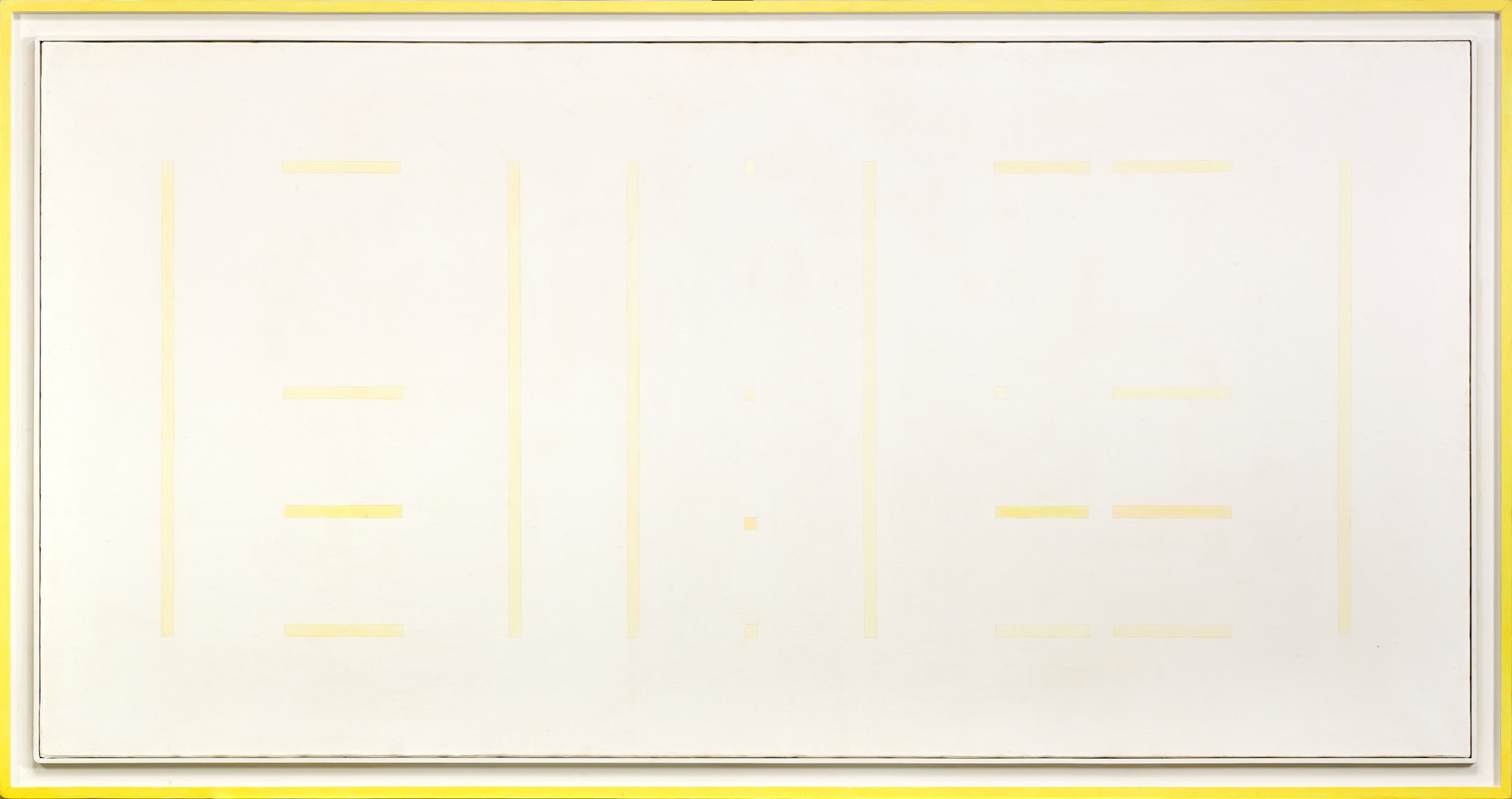
Antonio Calderara
Spazio Luce N° 29
By the late 1950s, Calderara had moved toward pure abstraction, stripping his compositions down to horizontal fields of color, floating rectangles, and barely perceptible gradations of tone. This was not the bold, gestural abstraction that dominated so much of the postwar conversation. It was something more interior and more demanding. The influence of Josef Albers, whose investigations into color relationships Calderara knew and admired, is sometimes noted by scholars, but Calderara's sensibility was always more lyrical, more rooted in the specific experience of natural light than in systematic inquiry.
The works of the 1960s represent the fullest flowering of his mature vision, and they remain the most sought after by collectors today. Paintings such as Attrazione quadrata in tensione orizzontale from 1968 and Orizzonte Pluricromatico al Margine from the same year demonstrate the extraordinary economy of means that defines his achievement. On small wooden panels, often intimate in scale, Calderara arranged geometric forms with a precision that seems effortless but is in fact the result of intense deliberation. The colors are never aggressive.
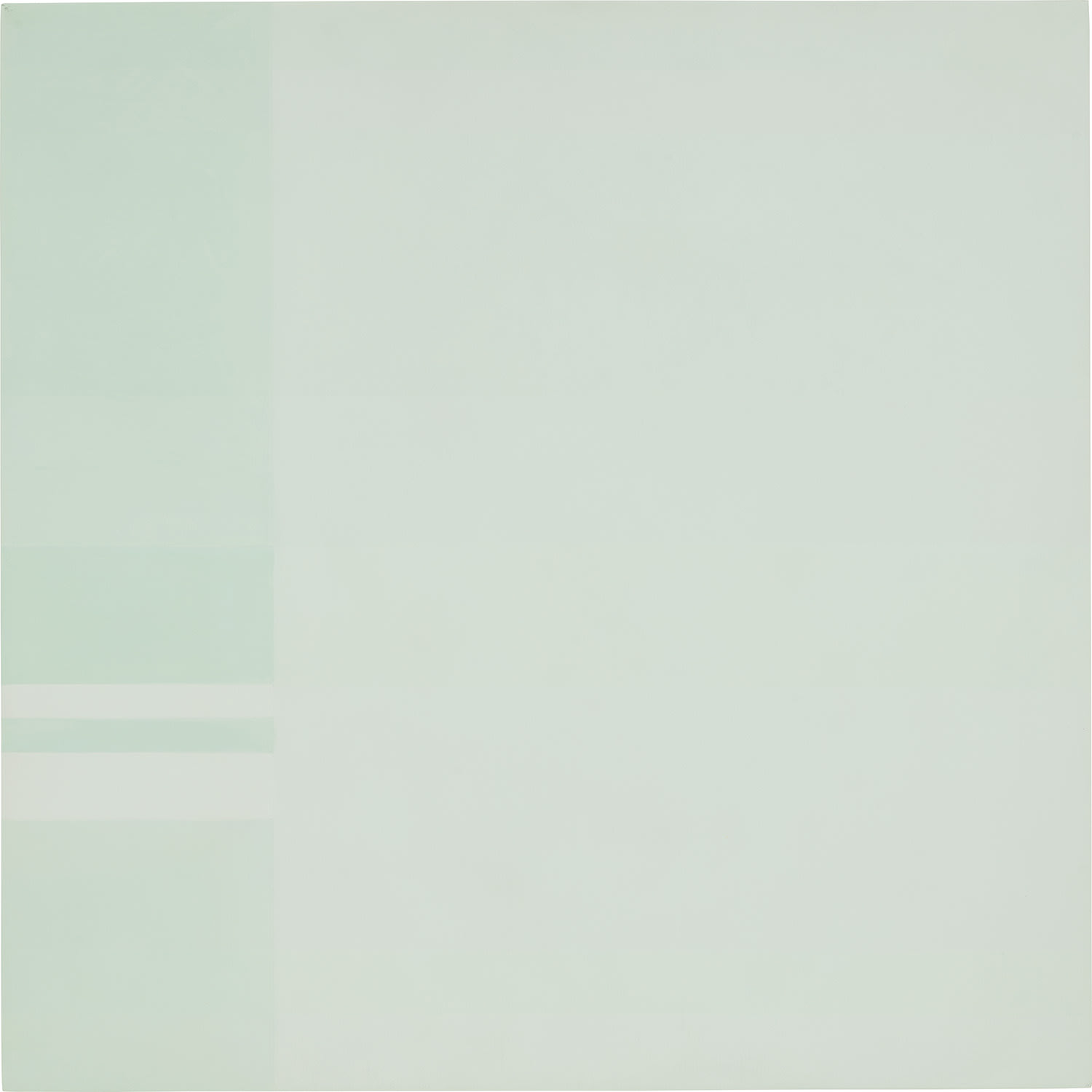
Antonio Calderara
Orizzonte Pluricromatico al Margine, 1968
They whisper, they shimmer, they hold relationships across the surface of the panel with a tensile delicacy that rewards prolonged looking. Works like Costellazione from 1969 and In spazio rettangolare 13 quadrati from 1970 extend this language into a kind of visual poetry, where the placement of simple forms generates what can only be described as emotion. The wooden panel as support was important to him: its warmth, its slight grain, its resistance to the paint all contributed to the final character of the light. Calderara gained significant international recognition in the 1960s, when the Galerie Denise René in Paris, one of the most important platforms for constructive and kinetic art in Europe, exhibited his work alongside figures such as Victor Vasarely, Ellsworth Kelly, and François Morellet.
His inclusion in the Zero movement's orbit, and in exhibitions exploring Concrete and Optical art across Europe, placed him in distinguished company. The German collector and dealer Karl Stroher was among those who recognized his importance early, and collections in Germany have remained among the strongest repositories of his work outside Italy. The Fondazione Calderara, established to preserve his legacy, continues to hold his archive and to support scholarship on his work. For collectors approaching Calderara today, the market offers a genuine opportunity.
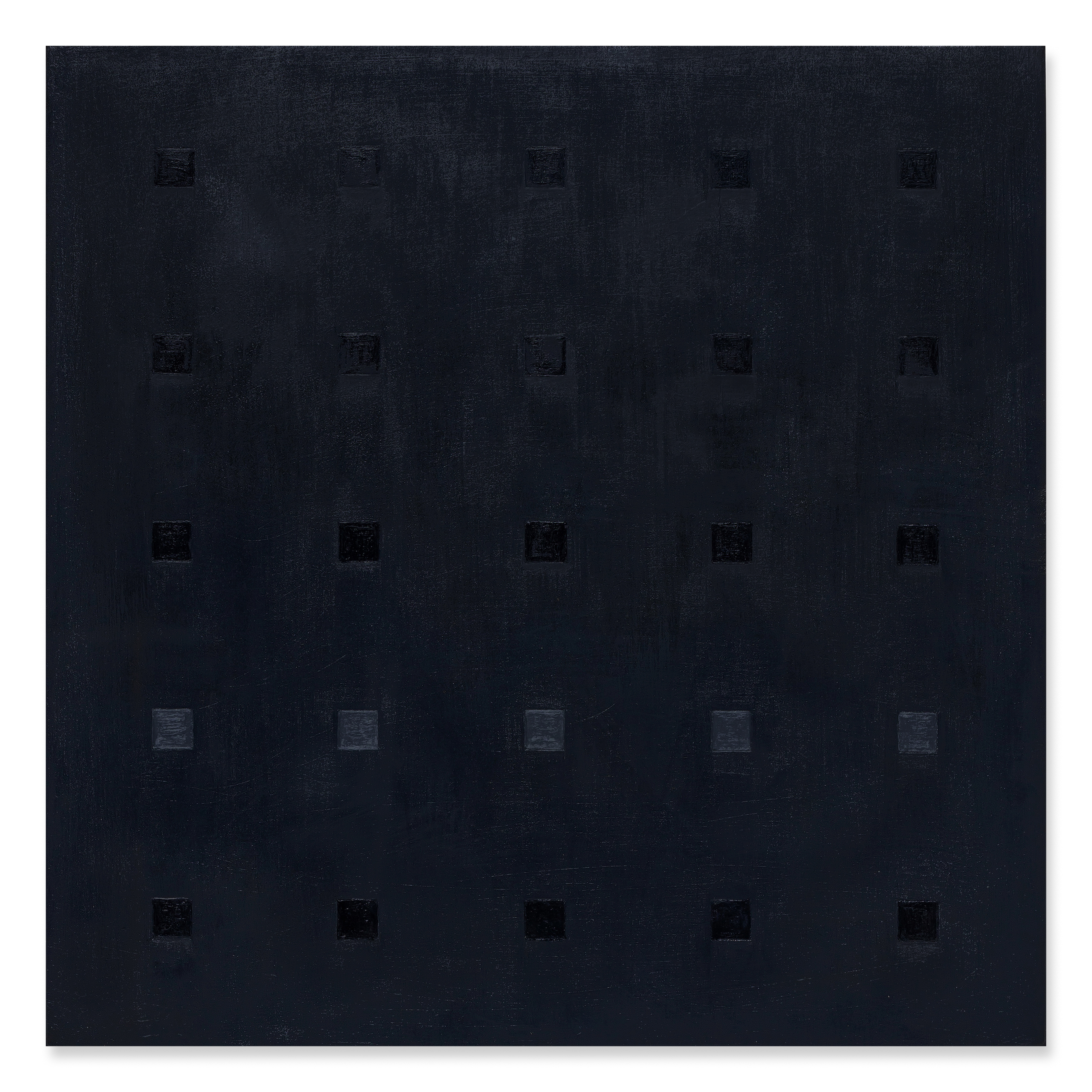
Antonio Calderara
Costellazione, 1969
His work trades at prices that reflect his importance within the specialist community but have not yet reached the levels commanded by some of his more famous contemporaries in geometric abstraction. Works on wooden panel from the late 1960s and early 1970s are particularly prized, both for their physical beauty and for the concentration of his ideas they represent. Condition is an important consideration: the panels, when well preserved, retain a surface luminosity that photographs only partially convey. The intimate scale of most works, typically ranging from a few centimeters to around sixty or seventy centimeters on the longest side, makes them exceptionally liveable, suited to the kind of sustained daily contemplation that Calderara believed was the proper relationship between a painting and its owner.
Within the broader context of postwar art history, Calderara occupies a position that is singular but not isolated. He shares with Albers a devotion to color as the primary carrier of meaning. He shares with Agnes Martin, whose work he could not have known well, a commitment to quiet repetition and the spiritual dimensions of restraint. Italian colleagues such as Enrico Castellani and Giorgio Griffa, who explored similar territories of reduced, meditative form, provide a national context, while the Swiss Concrete painters, particularly Richard Paul Lohse and Max Bill, offer useful points of comparison for his geometric rigor.
Yet none of these comparisons quite captures what Calderara does. His work is less systemic than Lohse, less cool than Bill, more rooted in sensory experience than many of his Concrete contemporaries. Antonio Calderara died in 1978, having spent the better part of five decades building one of the most coherent and quietly radical bodies of work in European modernism. His paintings do not announce themselves.
They do not compete for attention or demand immediate comprehension. What they offer instead is rarer: the experience of looking as a contemplative act, of color and light as a form of sustained thought. In a cultural moment that increasingly values depth over spectacle, and presence over noise, his work feels not merely historical but urgently, beautifully alive.
Explore books about Antonio Calderara
Antonio Calderara
Guido Ballo
Calderara
Franco Russoli
Antonio Calderara: Catalogo Ragionato dell'Opera Completa
Enrico Crispolti
Calderara: Paintings and Drawings
Pierre Restany
Antonio Calderara
Diane Musinovic