Antoni Tàpies

Antoni Tàpies: Matter, Spirit, and Majesty
Artist Spotlight · The Collection Editorial
“All the objects of the world can be transformed into sacred objects, into objects of meditation.”
Antoni Tàpies, writings on art
In the grand salons of the Fundació Antoni Tàpies in Barcelona, housed within a magnificent nineteenth century Montaner i Simon publishing house on Carrer d'Aragó, the life's work of one of postwar Europe's most singular artists continues to draw pilgrims from across the world. The foundation, which Tàpies himself established in 1984, remains one of the most vital artist foundations in Europe, a testament not only to the scale of his achievement but to his profound belief that art carries responsibilities beyond the canvas. To stand before his layered, scarred, monumental surfaces here is to understand why collectors, curators, and fellow artists have spoken of his work with something approaching reverence for more than six decades. Antoni Tàpies was born in Barcelona in 1923 into a cultured, bourgeois Catalan family with deep ties to the intellectual and publishing worlds of the city.
Antoni Tàpies
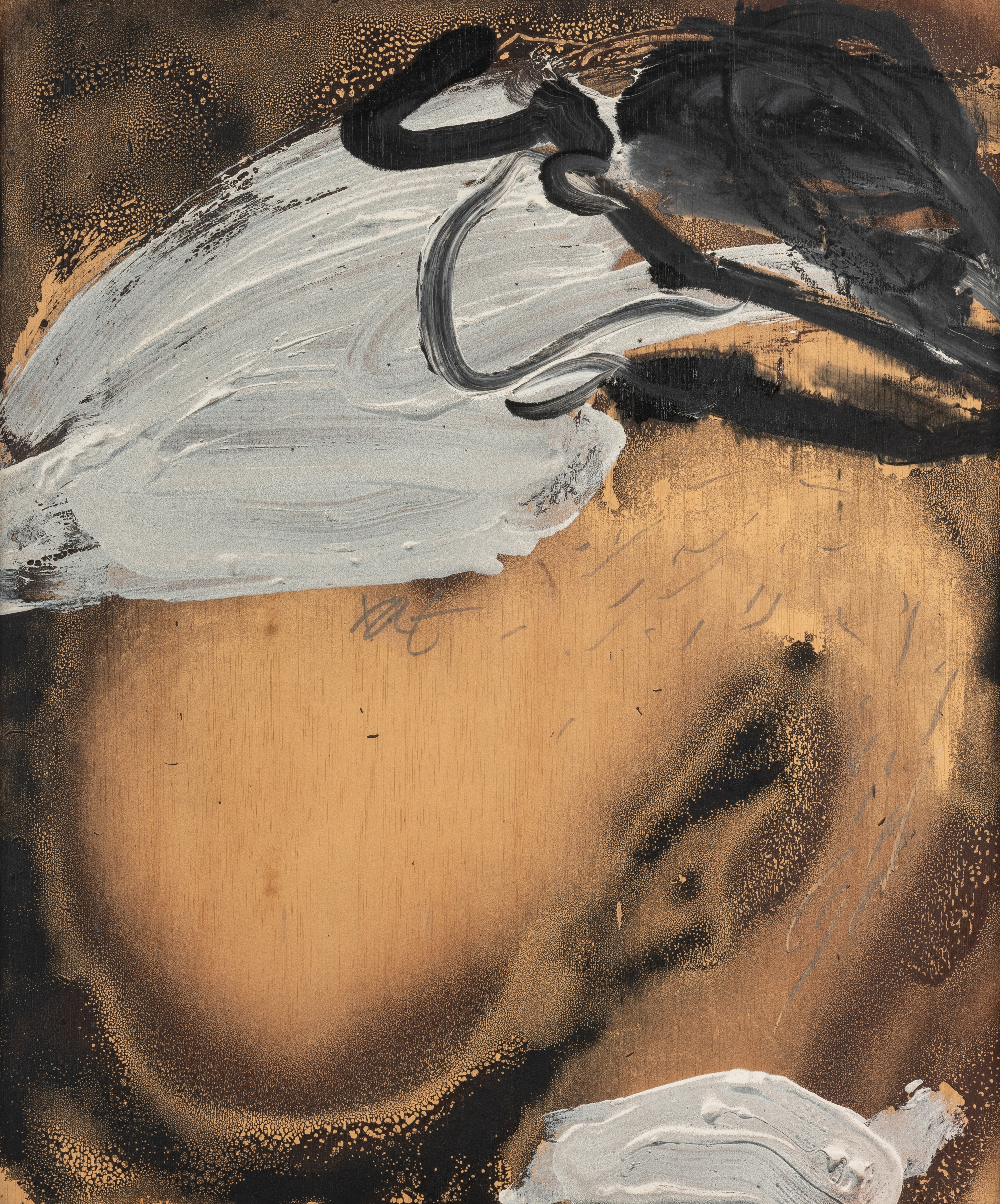
Nu de vernís, 1982
His formative years were shaped by the trauma of the Spanish Civil War, which began when he was just thirteen, and the long grey decades of Francoist repression that followed. These experiences left an indelible mark, turning him toward questions of suffering, resistance, endurance, and identity that would animate his entire career. A serious illness in his late teens forced a prolonged period of convalescence, during which he immersed himself in the writings of Nietzsche, Schopenhauer, and Eastern philosophy, as well as the visual world of Paul Klee, Max Ernst, and Joan Miró. By the time he enrolled briefly at the University of Barcelona to study law, his true vocation had already announced itself.
His early artistic formation moved quickly from surrealist influenced painting toward something altogether more original. In 1948, together with Joan Ponç, Joan Josep Tharrats, and others, he cofounded the group Dau al Set, a Catalan avant garde collective whose magazine became a vital conduit for modernist ideas under the watch of a suspicious regime. By the early 1950s, however, Tàpies had begun to move beyond the group's poetic surrealism toward the radical material experimentation that would make his name. A visit to Paris in 1950, supported by a French government scholarship, brought him into contact with the currents of Art Informel and gestural abstraction sweeping European studios, but Tàpies was never content to simply follow.
Antoni Tàpies
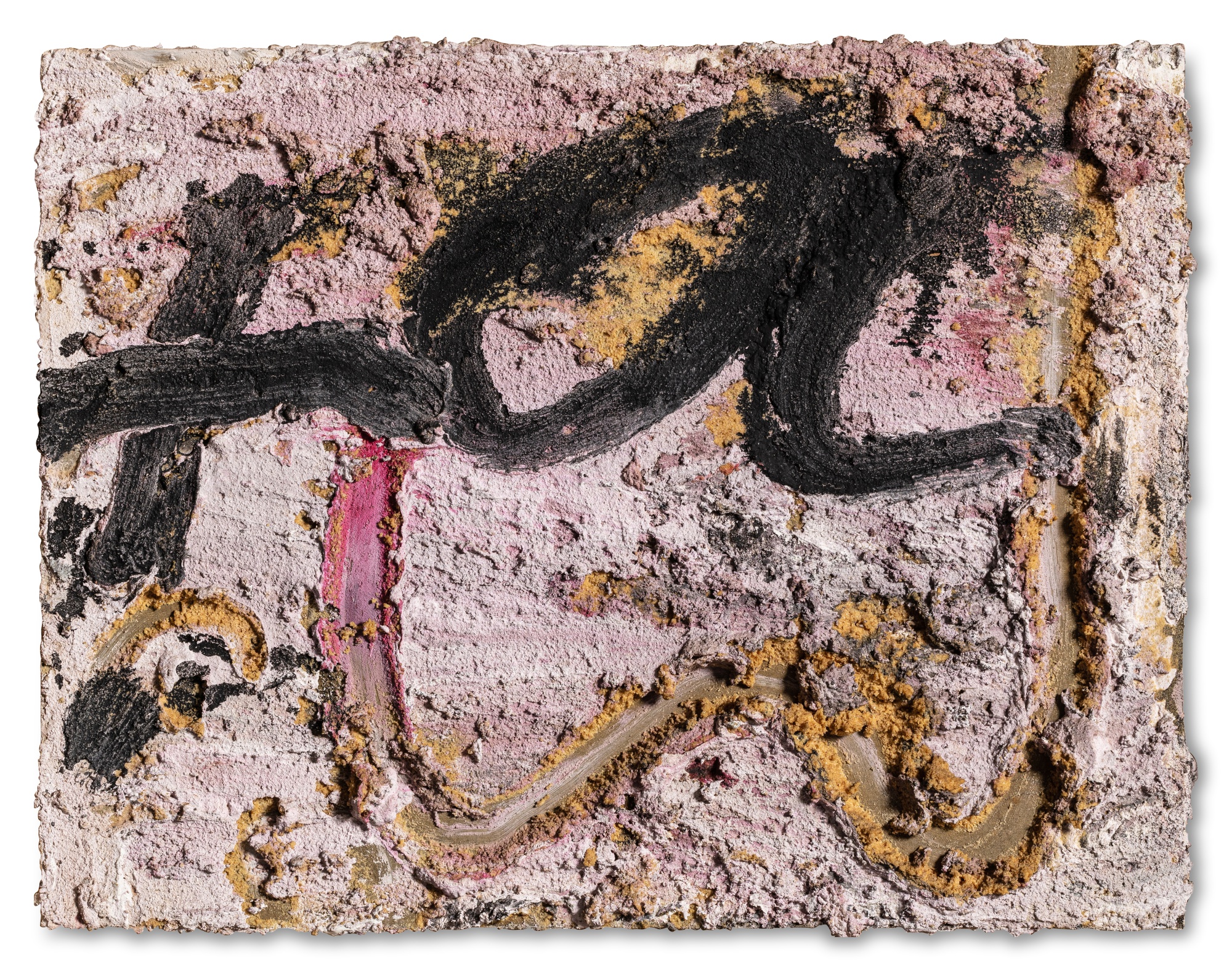
+A, 1991
He wanted to go deeper, into matter itself. The breakthrough came with what he called his matèria paintings, works in which the surface became a landscape of almost geological complexity. He began mixing marble dust, sand, powdered pigments, latex, and diverse found materials into thick grounds applied to canvas or board, creating surfaces that aged, cracked, and breathed like ancient walls. Crosses, handprints, letters, numerals, and bodily traces were pressed, scratched, or incised into these grounds with fierce economy, turning each work into a kind of meditation on presence and absence.
“Matter is full of spirit, and spirit is always expressed through matter.”
Antoni Tàpies
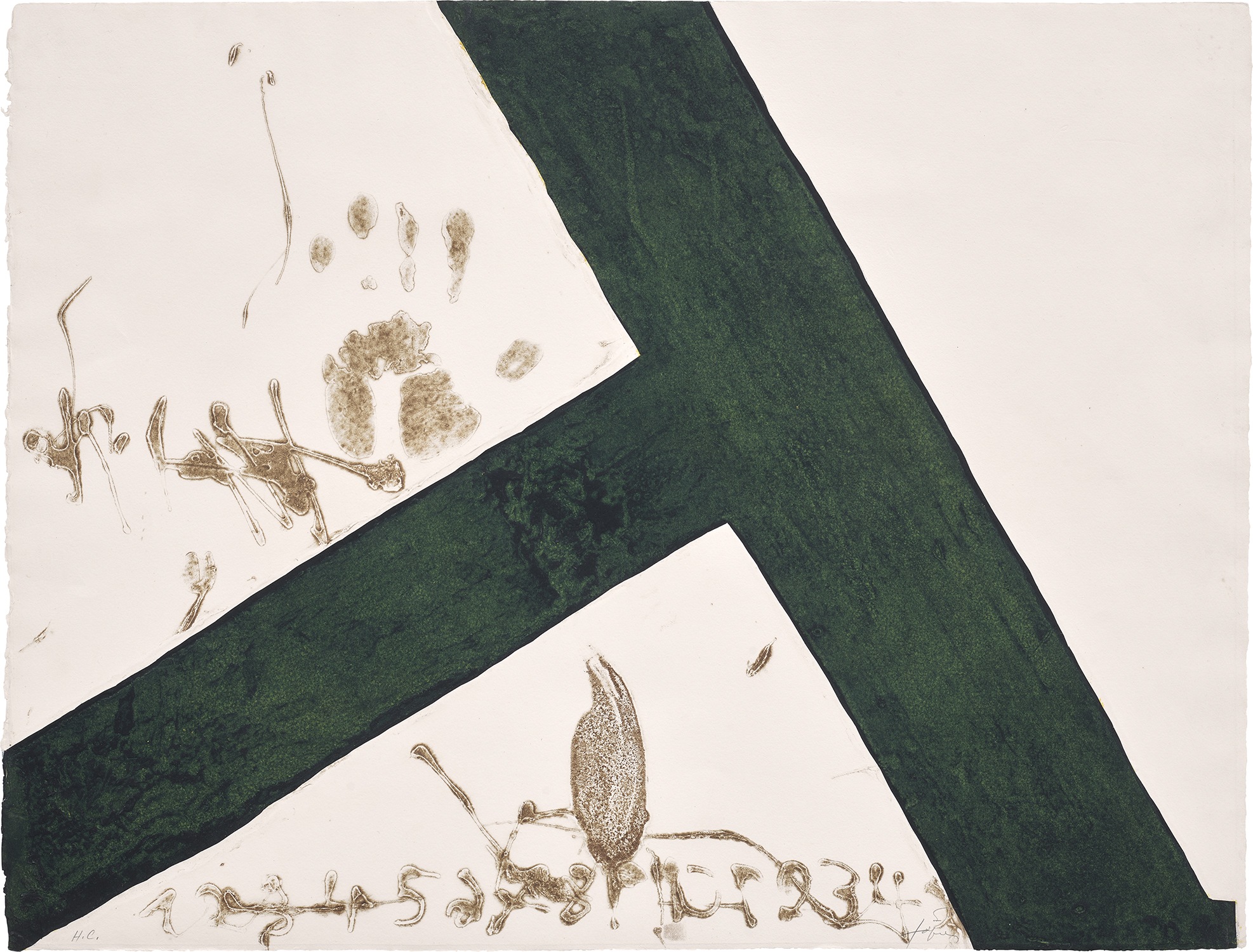
The cross, for Tàpies, was never simply a religious symbol; it was simultaneously a sign of suffering, a formal device, an assertion of existence, and a bridge between the material and the transcendent. His integration of Catalan letters and the letter T, at once a personal initial and a universal mark, gave his iconography a quietly political edge that was never lost on audiences living under authoritarian rule. Among the works that best illuminate the range of his practice, the mixed media panels of the 1980s and 1990s stand apart for their compressed intensity. "Nu de vernís" from 1982 demonstrates his mastery of varnish and layered media on wood, the surface shimmering between opacity and translucence in a way that recalls both lacquerwork and geological strata.
Antoni Tàpies
T inclinada (T Inclined) (G. 293)
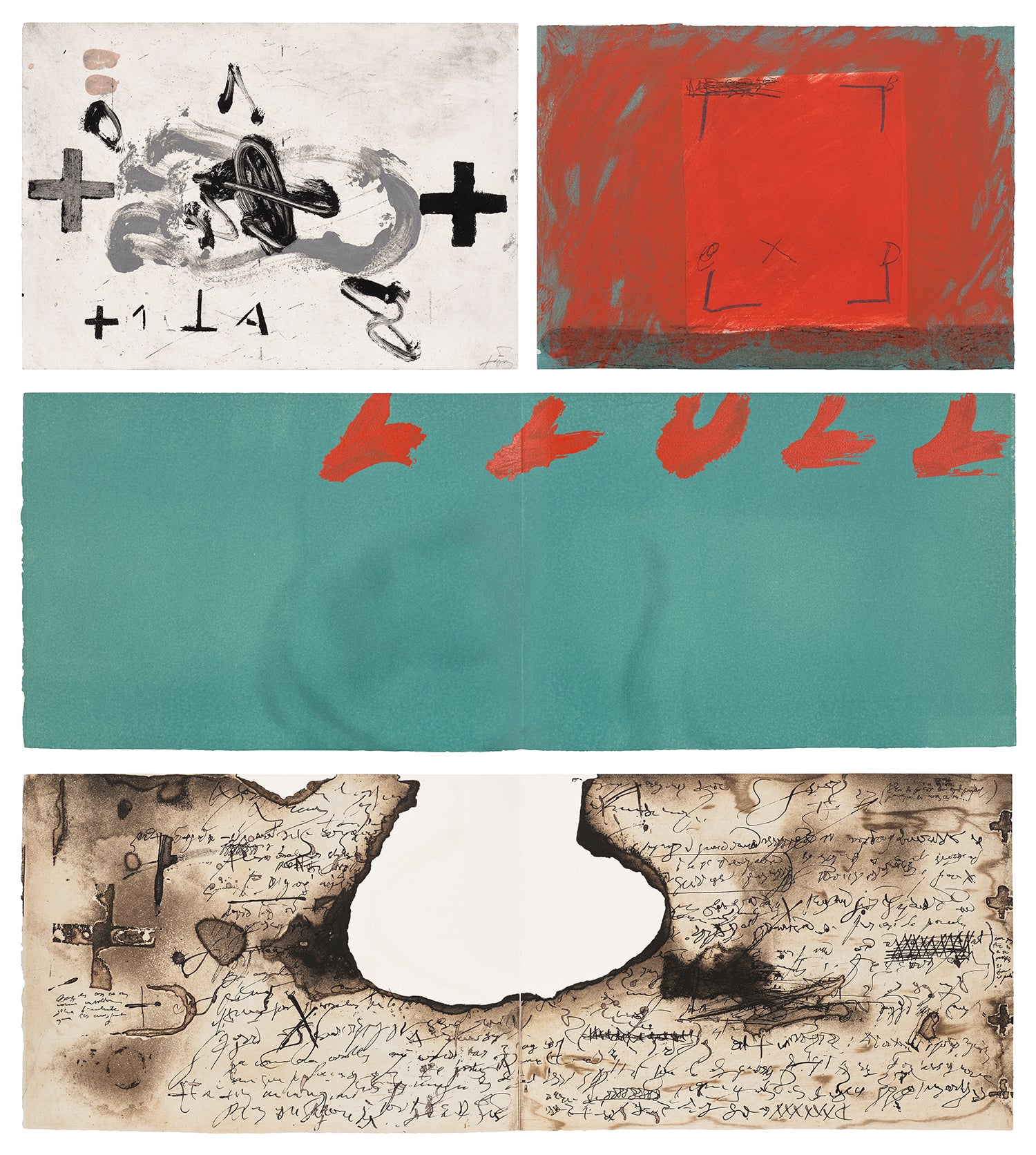
His print practice was equally extraordinary. The collaborative suite "Llull~Tàpies," comprising a monotype and twenty four etchings on Arches paper produced in dialogue with the writings of the medieval Catalan philosopher Ramon Llull, is among the most ambitious artist's book projects of the late twentieth century, a work in which Tàpies found a kindred spirit across seven centuries of Catalan thought. Works such as "Quatre rius de sang" and "Taches et chiffres" reveal his genius for translating the weight and urgency of his painted surfaces into the more intimate register of etching and carborundum, a medium he used with extraordinary authority to build up texture and chromatic depth on paper. On the secondary market, Tàpies occupies a position of considerable strength and enduring desirability.
His paintings have achieved significant results at Christie's, Sotheby's, and Bonhams, particularly works from his mature period spanning the 1960s through the 1980s. Collectors are drawn above all to the authenticity and philosophical seriousness of his practice. Unlike artists whose work can feel decorative at a distance, a Tàpies rewards close and sustained looking. The prints and works on paper offer a compelling entry point for collectors building a collection with depth and art historical coherence.
Antoni Tàpies
Llull~Tàpies (G. 1035-1059)
The carborundum etchings in particular, which achieve a velvety, dimensional quality unique to his hand, are widely regarded as among the finest graphic works produced by any European artist of the postwar generation. To understand Tàpies fully, it helps to situate him within a constellation of peers and predecessors who shared his ambition to make painting a matter of existential weight. He belongs in conversation with Jean Dubuffet, whose Art Brut championed raw material and marginal marks; with Alberto Burri, the Italian artist who burned and sutured sackcloth into surfaces of painful beauty; and with Cy Twombly, whose scarred, scrawled canvases similarly explored writing, memory, and the trace of the body. Closer to home, his debt to Miró and to the Catalan modernist tradition is palpable, but his work extended that tradition into a tougher, more confrontational register shaped by lived historical experience rather than lyrical fantasy.
The legacy of Antoni Tàpies, who died in Barcelona in February 2012 at the age of eighty eight, is secure and still unfolding. As contemporary artists increasingly look to materiality, to process, and to the politics of surface and ground, his investigations feel not merely historical but generative. His work reminds us that painting can be a form of witness, that texture carries memory, and that the most powerful art is often that which trusts the intelligence of its materials. For collectors seeking work that holds its meaning across decades and speaks to the deepest currents of human experience, there are few more rewarding places to look.
Explore books about Antoni Tàpies
Antoni Tàpies: A Life's Work
Barbara Rose
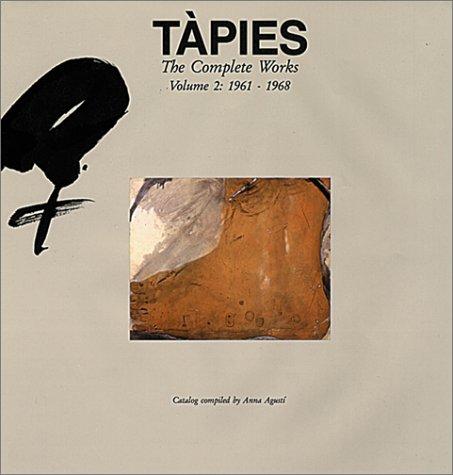
Tàpies: The Complete Works 1943-1960
Anna Marí, Francesc Miralles

Antoni Tàpies: Matter and Material
Joan-Albert Subirana
Tàpies and the Catalan Spirit
Pierre Daix
Antoni Tàpies: Catalogue Raisonné 1943-1984
Francesc Miralles
The Language of Tàpies
Joan-Albert Subirana
Antoni Tàpies: Retrospective
Michael Peppiatt