André Lanskoy
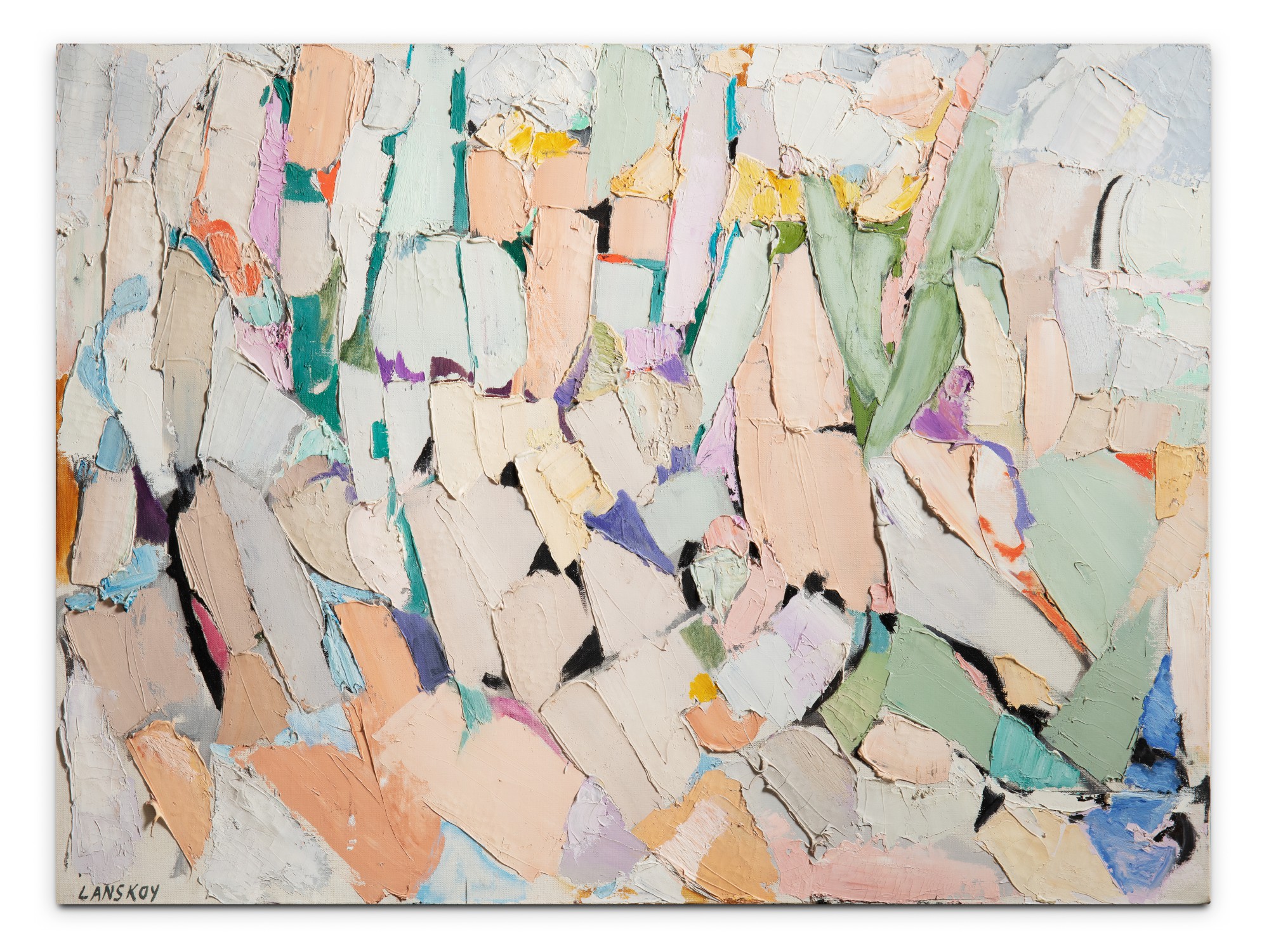
André Lanskoy, A Joyful Master of Color
Artist Spotlight · The Collection Editorial
There is a moment, standing before a large André Lanskoy canvas, when the painting seems less like an object to be observed and more like a climate to be entered. The surface pulses with interlocking patches of cadmium, cobalt, and vermillion, each fragment pressing against its neighbor with the urgency of something alive. It is a sensation that generations of Parisian collectors understood instinctively, and one that a new wave of international collectors and institutions are rediscovering with considerable enthusiasm. Recent years have seen sustained scholarly attention on the postwar École de Paris, with major French institutions revisiting its key contributors and the international auction market responding in kind.
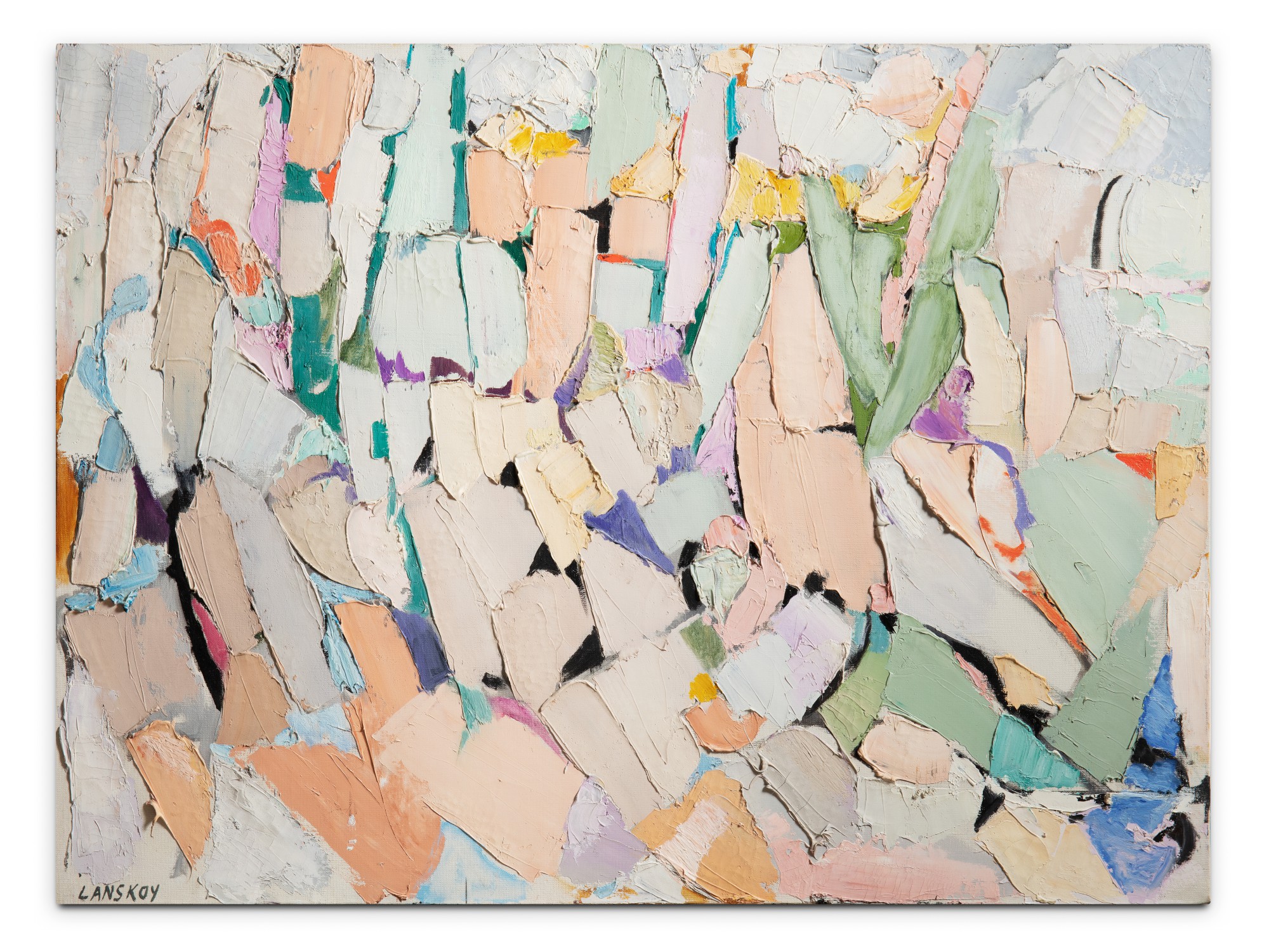
André Lanskoy
Sans Titre
Lanskoy, long cherished by connoisseurs and occasionally overlooked by the broader art world, is emphatically at the center of that reappraisal. André Lanskoy was born in Moscow in 1902 into a family of the Russian nobility. His early years were formed against the turbulent backdrop of a society on the edge of transformation, and the Revolution of 1917 shattered whatever conventional path his upbringing might have suggested. He spent time in Kiev before making his way westward, arriving in Paris in 1921 as part of the great wave of Russian emigration that would so profoundly enrich the cultural life of the French capital across the following decades.
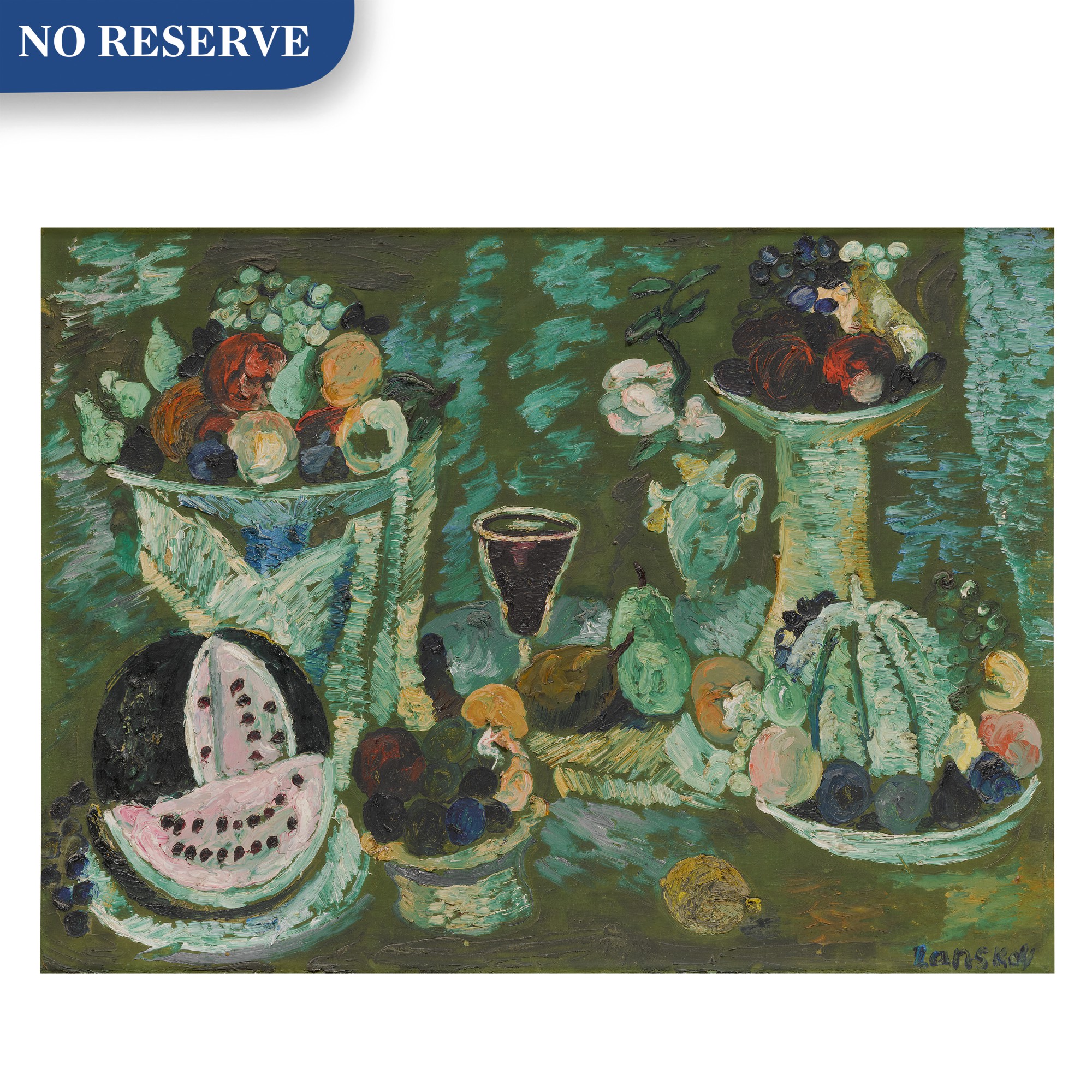
He was nineteen years old, without formal training, and entirely self taught. That absence of academic constraint would prove not a limitation but a liberation. In his early Parisian years, Lanskoy worked figuratively, painting still lifes and interior scenes with a directness and sensual confidence that drew the attention of collectors almost immediately. His 1927 canvas "Le Compotier" stands as an affecting document of this period, a work of warm tonal harmony that reveals an artist already in command of the picture plane, already thinking about color as a structural force rather than a descriptive one.
André Lanskoy
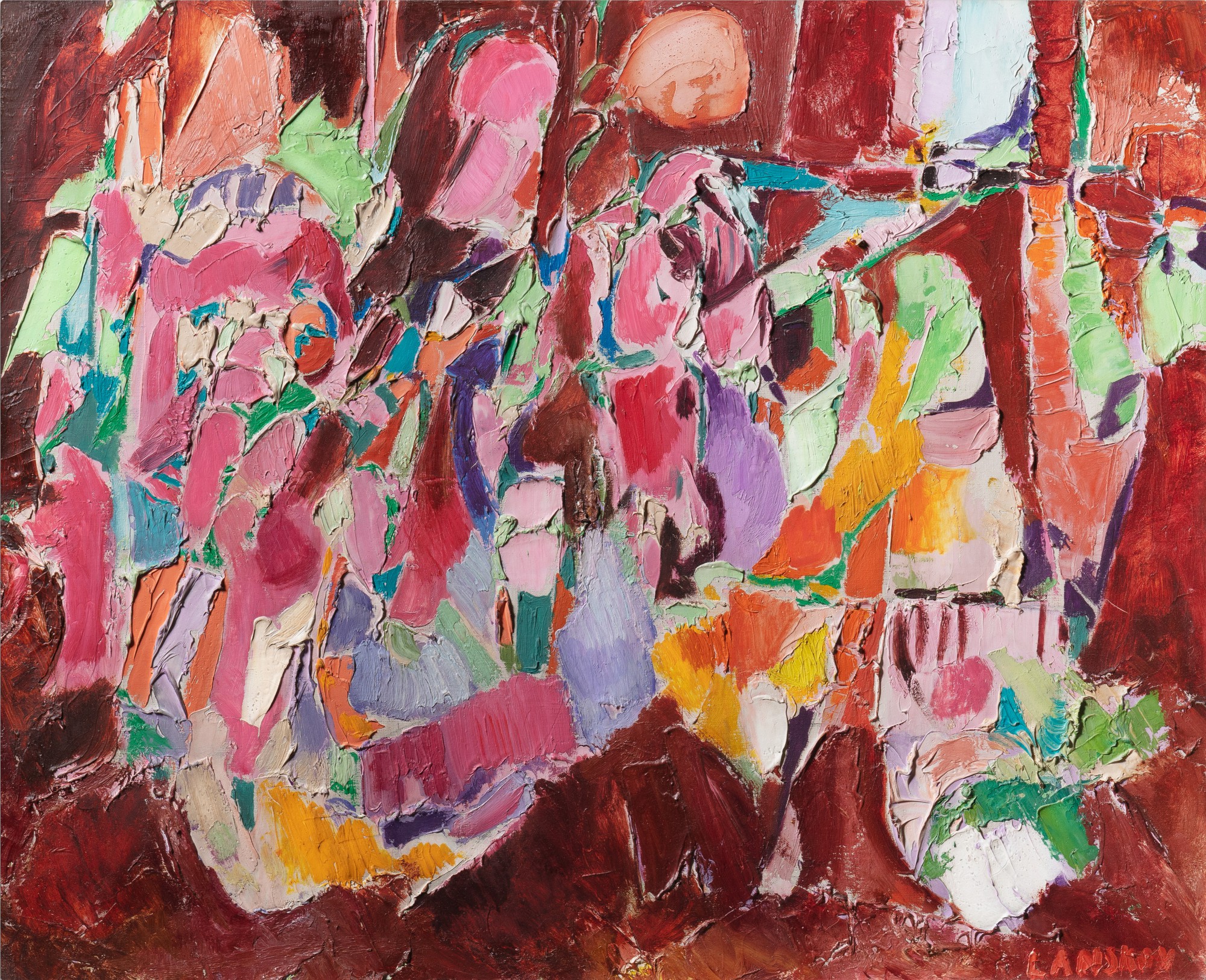
L'Ermitage de l'Ecureuil, 1959
He exhibited at the Salon d'Automne and caught the eye of Wilhelm Uhde, the celebrated German born dealer and collector who had championed Henri Rousseau and was among the first to recognize singular artistic intelligence regardless of pedigree. Uhde gave Lanskoy his first significant platform, and from that point the artist's trajectory was assured. The decisive shift toward abstraction came gradually through the late 1930s and crystallized fully in the 1940s. Lanskoy did not abandon figuration so much as he distilled it, pressing representation inward until only its essential energies remained.
What emerged was a distinctive visual language that art historians would come to describe as lyrical abstraction, a mode that stood apart from both the cooler geometry of concrete art and the rawer gestural intensity of American Abstract Expressionism. Lanskoy's abstractions feel celebratory, almost musical. His signature method involved building the canvas from a mosaic of irregular color zones, each patch distinct yet inseparable from the whole, creating compositions that vibrate with internal rhythm. Works from the 1950s and 1960s represent the full flowering of this approach, and pieces such as "Fruits confits" from 1955 and "L'Ermitage de l'Ecureuil" from 1959 demonstrate the extraordinary range he could achieve within a single formal system.
André Lanskoy
Le Compotier, 1927
"L'Ermitage de l'Ecureuil" in particular rewards extended looking: its dense chromatic surface opens slowly to reveal a spatial complexity that rewards the patient eye. By the 1960s, Lanskoy was producing some of the most exuberant work of his career. Canvases such as "Pourquoi Venise ?" from 1963 and "L'arbre prend ses responsabilités" from 1966 carry an almost theatrical confidence, the color relationships growing bolder and the compositional structure ever more dynamic.
"Le sacrifice" and "Un de ces jours", both from 1967, suggest an artist in full command of his vocabulary and willing to push it toward new intensities. The titles Lanskoy gave his works are themselves a kind of poetry, whimsical and allusive, offering imaginative entry points without constraining the viewer's experience. This quality of generous, open invitation is central to what makes his painting so appealing to live with over time. His recognition within the French cultural establishment was substantial.
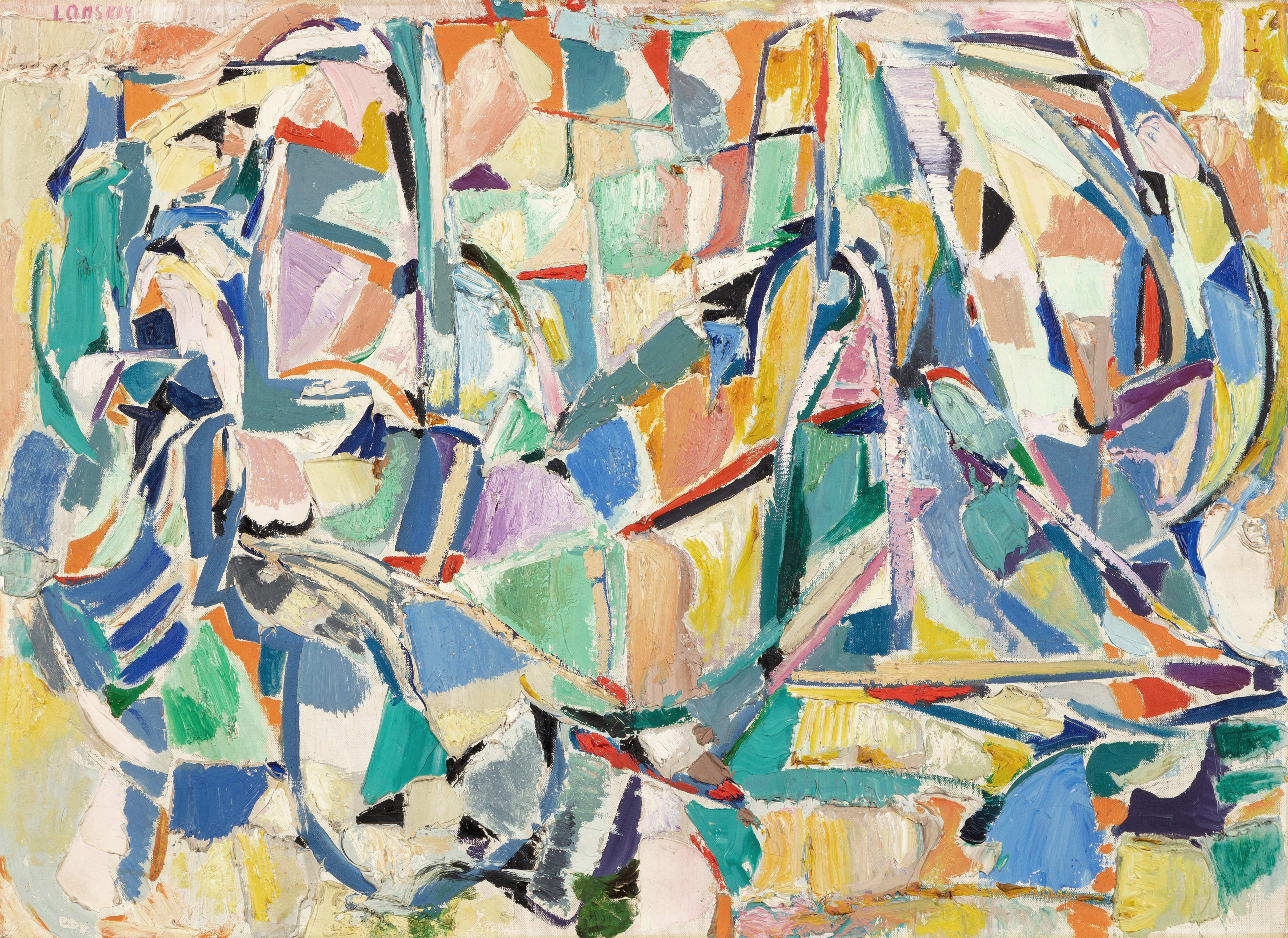
André Lanskoy
La bannière inoffensive
He received the Grand Prix National des Arts, an honor that placed him unambiguously among the most significant painters working in France in the postwar period. He was shown by leading Parisian galleries and collected by serious European collectors who understood his place within a distinguished lineage connecting the Fauves, the early abstractionists, and the vibrant international community of the École de Paris. His peers and contemporaries in that world included Nicolas de Staël, Hans Hartung, Serge Poliakoff, and Jean Bazaine, artists who shared with Lanskoy a belief that abstraction could carry emotional warmth and human presence without resorting to representation. Among this distinguished company, Lanskoy is distinguished by what one might call his irrepressible joy.
Even his most complex or densely worked canvases seem to radiate a fundamental contentment with the act of painting itself. For collectors approaching Lanskoy today, the market presents a genuinely compelling picture. Works on canvas from his mature period, particularly those from the mid 1950s through the late 1960s, represent the core of his achievement and are sought with real determination by collectors who have encountered his work in person. The sheer visual pleasure of a Lanskoy is something that photographs convey only partially; in the room, the layered impasto and the luminosity of his chosen pigments create an experience that is difficult to replicate.
Collectors who have lived with his paintings consistently report that the works reveal new qualities over time, a sign of genuine depth beneath the immediate surface delight. Works on paper and smaller scale pieces offer accessible entry points for those new to the artist, while major canvases from the 1959 to 1968 period represent the most significant collecting opportunity. André Lanskoy died in Paris in 1976, having spent more than half a century transforming his adopted city into the theater of one of the most sustained and personally distinctive painterly achievements of the twentieth century. His legacy is that of an artist who trusted color absolutely, who believed that painting could be simultaneously rigorous and joyful, and who proved through decades of work that abstraction need not sacrifice warmth or humanity.
At a moment when collectors and institutions alike are returning to the École de Paris with fresh eyes, Lanskoy emerges not as a rediscovery but as a revelation: an artist who was always this good, always this rich, and who rewards every act of sustained attention with something genuinely new.
Explore books about André Lanskoy