Alma Thomas
Alma Thomas, Painting Light Into Being
Artist Spotlight · The Collection Editorial
“Color is life, and light is the mother of color.”
Alma Thomas
In 2021, the Smithsonian American Art Museum mounted a landmark retrospective of Alma Thomas's work, bringing her luminous mosaics of color to new generations of admirers and confirming what a growing community of scholars, curators, and collectors had long understood: that Thomas ranks among the most joyful and visionary painters America has ever produced. That same year, her work entered the White House collection under the Biden administration, making her one of the few Black women artists to be represented in those historic halls. The moment felt less like a belated correction and more like a natural homecoming for a painter whose entire practice was a celebration of the world around her. Alma Woodsey Thomas was born in Columbus, Georgia, in 1891, the eldest of four daughters in a prosperous and culturally engaged family.
Alma Thomas
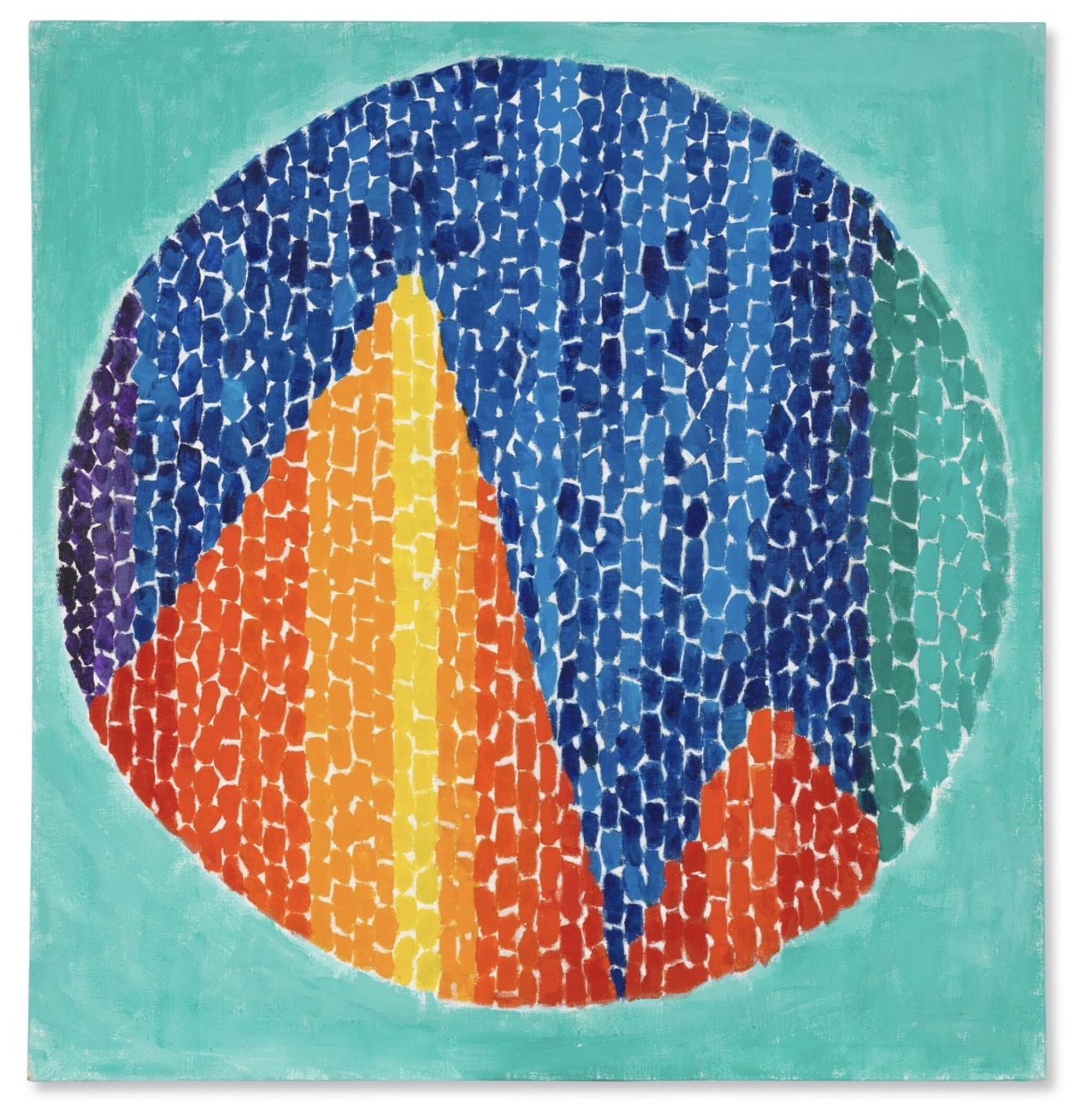
Snoopy Sees Sunrise on Earth
Her parents, who valued education and creative expression, relocated the family to Washington, D.C. in 1907, a move that would prove formative in every sense. Washington offered Thomas access to institutions, teachers, and a vibrant African American intellectual community that nurtured her ambitions.
She enrolled at Howard University, where she became the first graduate of its newly established fine arts department in 1924, a milestone that speaks to both her talent and her determination to claim space in a field that rarely made room for women like her. She later earned a master's degree from Columbia University Teachers College, grounding her practice in both studio art and the pedagogy she would go on to share with students for nearly four decades. For much of her career, Thomas taught art in Washington's public schools while quietly developing her own practice on the side. Those years were not lost time.
Alma Thomas
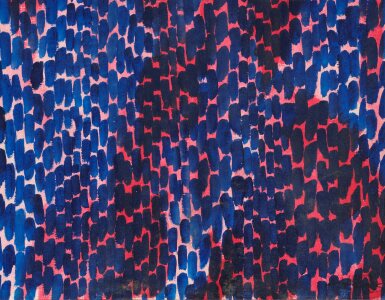
Untitled, 1970
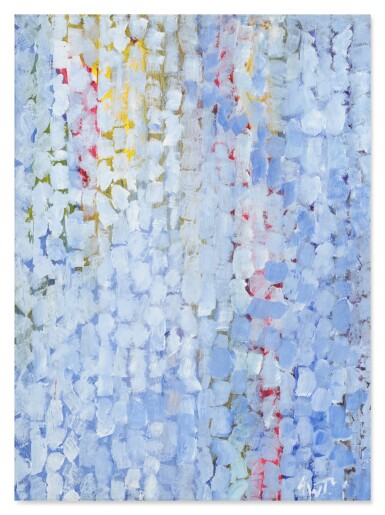
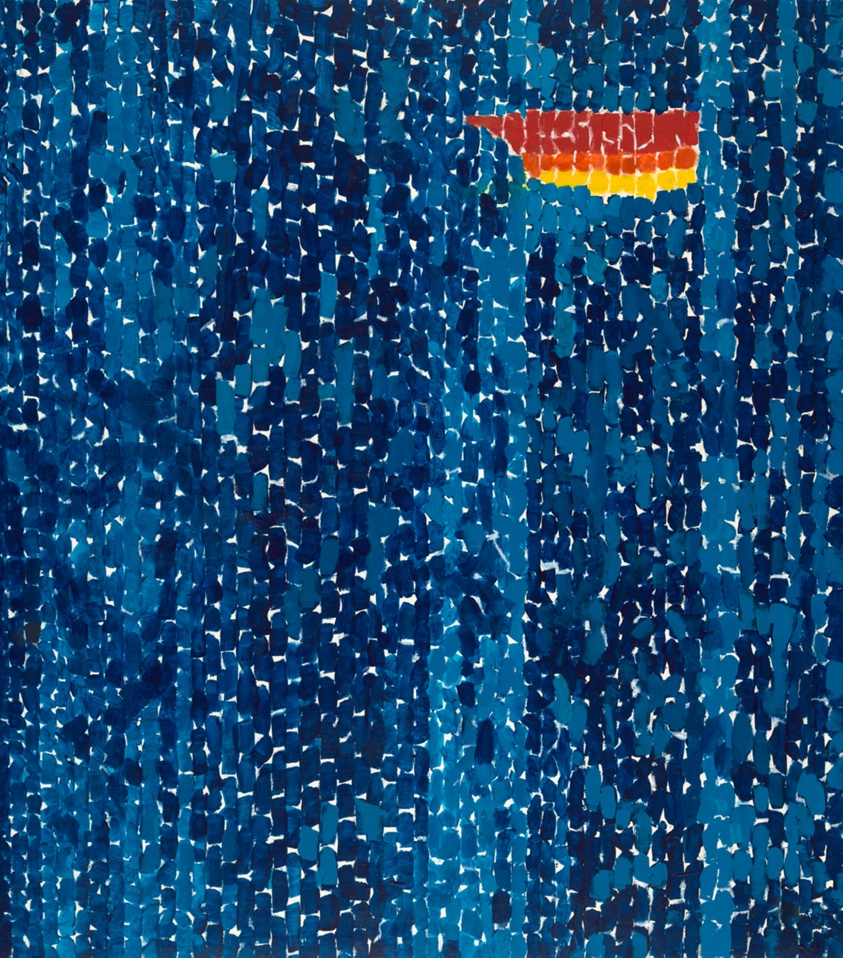
They were years of deep looking, of absorbing the natural world, of studying color theory and the work of artists she admired, including Henri Matisse, whose influence on her later palette is unmistakable. It was not until she retired from teaching in 1960, at the age of 69, that Thomas truly unleashed the body of work for which she is now celebrated. What followed was one of the most extraordinary late bloomings in American art history, a decade and a half of astonishing productivity that resulted in paintings of radical color, rhythm, and formal invention. Thomas developed what became known as the Alma Thomas mosaic technique: small, closely packed dabs of pure, saturated color arranged in concentric rings, arcing bands, or organic clusters that seem to pulse and vibrate across the canvas.
“Through color, I have sought to concentrate on beauty and happiness, rather than on man's inhumanity to man.”
Alma Thomas
Her paintings are deeply rooted in her observation of the natural world, particularly the garden behind her home on 15th Street in Washington, where she spent hours watching light move through leaves, flowers, and seasonal change. Yet her work also reached toward the cosmic. When NASA began sharing images of Earth from space in the late 1960s, Thomas was electrified. Works such as Snoopy Sees Sunrise on Earth and Snoopy Gets a Glance at Mars, painted in 1969, during the era of the Apollo missions, capture the wonder of seeing the planet from the outside, translating that perspective into shimmering fields of color that feel both scientific and deeply personal.
Alma Thomas
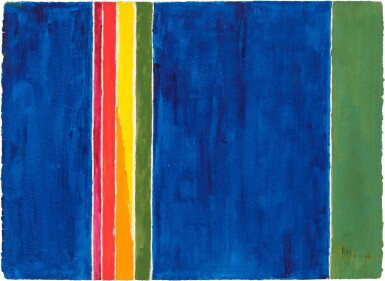
Atmospheric Effect No. 6, 1971
Her 1972 painting Starry Night and the Astronauts extends that dialogue between the terrestrial and the celestial, its swirling formations of color evoking both van Gogh's nocturnal vision and the very real drama of human beings floating through space. In 1972, Thomas became the first African American woman to have a solo exhibition at the Whitney Museum of American Art in New York, a watershed moment in her career and in the broader story of American art. The reception was extraordinary. Critics recognized in her work a synthesis of Color Field painting, as practiced by contemporaries such as Morris Louis and Kenneth Noland, fellow Washington Color School artists whose large scale chromatic canvases were reshaping postwar American painting, and something altogether more personal and rooted in lived experience.
Thomas was connected to that movement through geography and formal sympathy, but her voice was entirely her own. Her art was never cool or detached. It was warm, declarative, and full of what she often described as love for the world. For collectors, Thomas represents one of the most compelling propositions in the market for postwar American art.
Alma Thomas
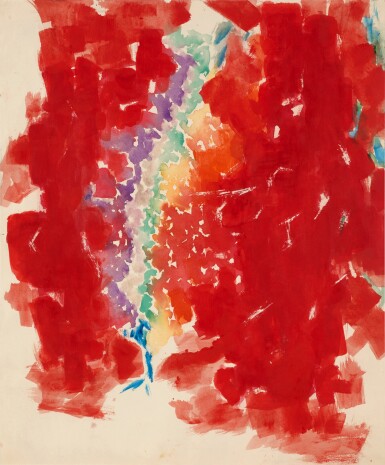
Untitled, 1960
Her works, particularly her acrylic paintings on canvas from the late 1960s and early 1970s, have seen sustained and significant appreciation at auction. Major institutions including the Smithsonian American Art Museum, the National Museum of Women in the Arts, and the Art Institute of Chicago hold her work in their permanent collections, providing the kind of institutional validation that underpins long term market confidence. Works on paper, such as Atmospheric Effect No. 6 from 1972, which combines acrylic, watercolor, and graphite, offer collectors a more accessible entry point into her practice while displaying the same chromatic intelligence that defines her larger canvases.
As the art world continues to reappraise and reposition the contributions of artists who were historically overlooked, Thomas remains a figure whose critical and commercial trajectory points firmly upward. Understanding Thomas fully means placing her within a constellation of artists who were similarly rethinking the possibilities of color and abstraction in postwar America. Her Washington Color School peers, Morris Louis, Gene Davis, and Sam Gilliam, shared her commitment to color as a primary expressive force, while her engagement with pattern and optical vibrancy invites comparison with artists associated with Op Art. Yet perhaps her closest spiritual kin is Henri Matisse, in whose late cut paper works Thomas found permission to pursue a pure, unmediated joy in color.
She also stands in meaningful conversation with contemporary artists such as Sam Gilliam and Howardena Pindell, whose explorations of materiality and identity expanded the language of American abstraction. Alma Thomas died in Washington, D.C. in 1978, but her presence in the cultural conversation has never been more alive.
She is a painter who chose, against every social and institutional pressure of her era, to make art that was luminous, optimistic, and fiercely alive to beauty. Her mosaics of color are not escapes from the world but profound engagements with it, whether she is parsing the light through a dogwood tree or imagining the view of Earth from the moon. To collect Thomas is to bring that spirit into proximity, to live with paintings that ask nothing of you except that you look, and keep looking.
Featured Works
Explore books about Alma Thomas