Alfred Thompson Bricher
Light on Water, Forever and Always
Artist Spotlight · The Collection Editorial
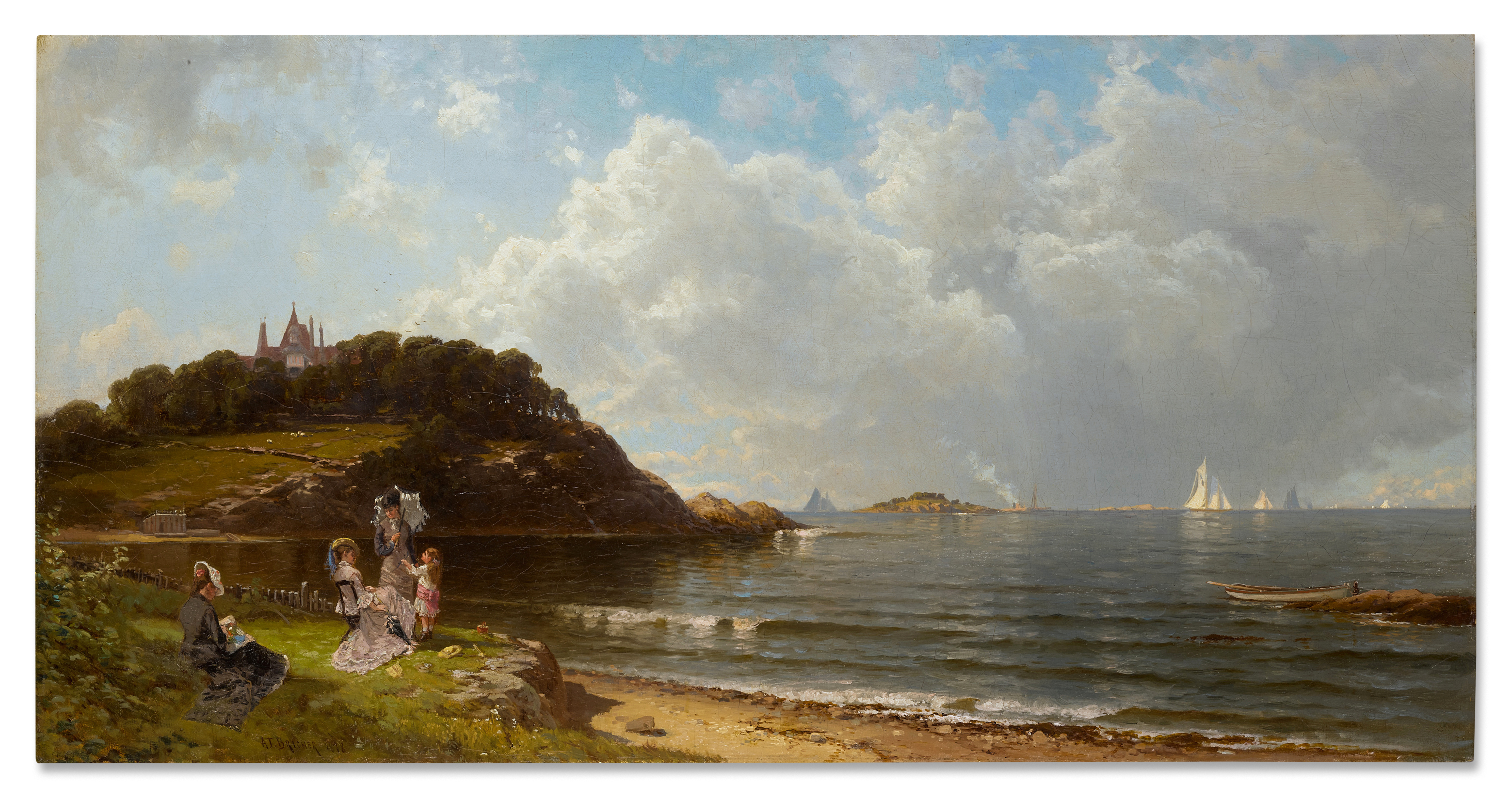
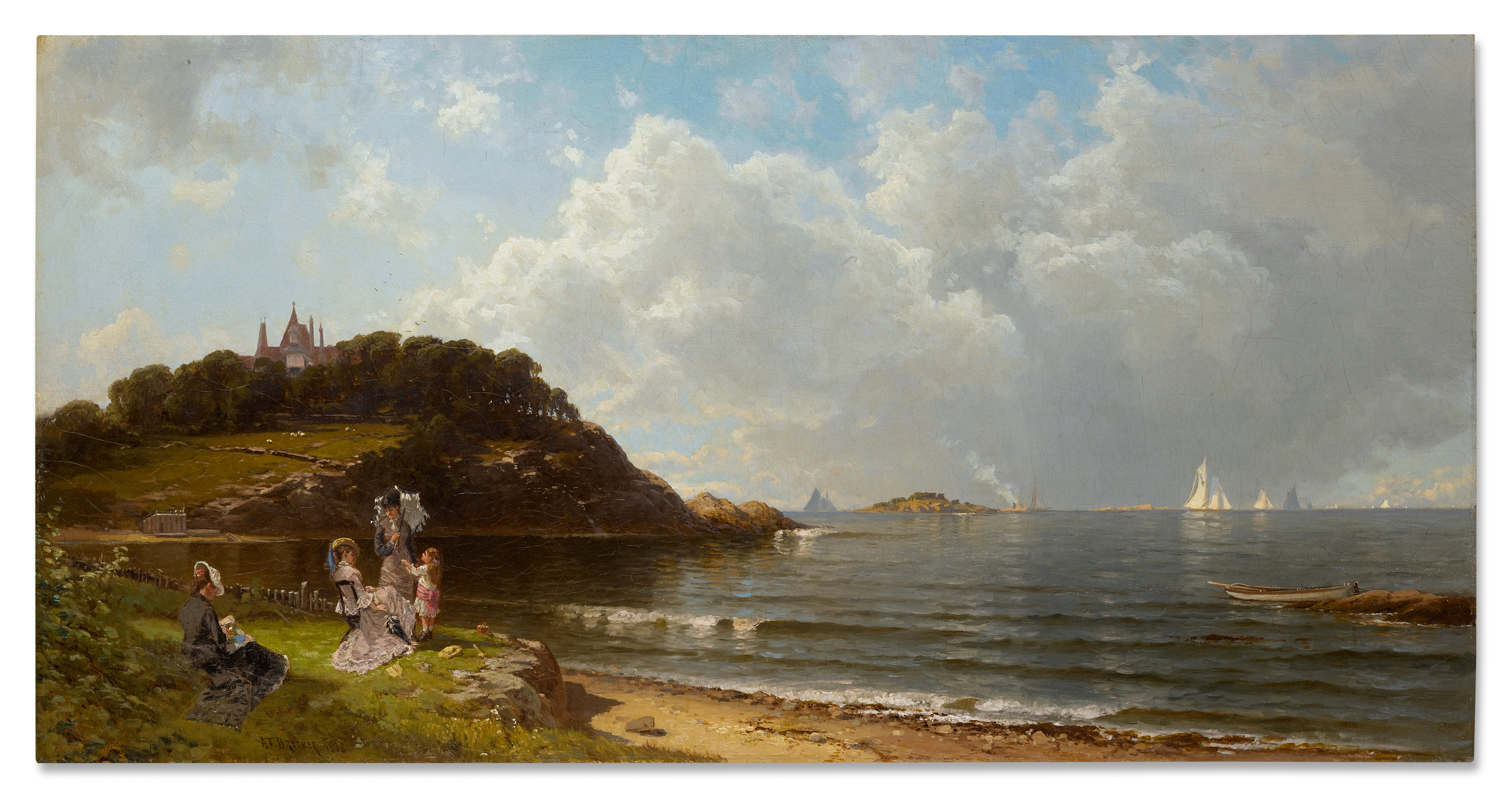
Stand before Alfred Thompson Bricher's "Beverly by the Sea" and something remarkable happens. The painting, completed in 1878 and among the finest examples of his mature work, pulls you into a world of such quiet radiance that the boundary between canvas and coastline seems to dissolve entirely. The sky above the New England shore breathes with pearlescent light, the water below it mirrors that luminosity with uncanny fidelity, and the whole composition settles into a stillness that feels less like a moment captured than a truth revealed. It is the kind of painting that makes you understand, immediately and without argument, why collectors have treasured Bricher for generations and why his work continues to command serious attention in American art circles today.
Alfred Thompson Bricher
Beverly by the Sea, 1878
Alfred Thompson Bricher was born in Portsmouth, New Hampshire in 1837, and his proximity to the Atlantic coastline from his earliest years was formative in ways that would shape every canvas he ever produced. He grew up in Newburyport, Massachusetts, a town whose identity was bound up entirely with the sea, and the rhythms of tidal light and salt air entered his sensibility long before he had any formal training in how to render them. He pursued his artistic education at the Lowell Institute in Boston, where he absorbed the technical foundations of painting while also coming into contact with the broader currents of American landscape thinking that were transforming the art world of his era. Boston in the mid nineteenth century was a city alive with aesthetic debate, and a young painter of Bricher's temperament and intelligence could not have chosen a better place to begin.
Bricher's early career placed him squarely within the orbit of the Hudson River School, that magnificent tradition of American landscape painting whose founding figures, Thomas Cole and Asher B. Durand, had established a language of sublime natural description that defined serious landscape work for decades. Yet Bricher's sensibility was always somewhat quieter than the grandest Hudson River productions. Where Frederic Edwin Church sought the overwhelming and the volcanic, Bricher was drawn to the intimate and the atmospheric.
Alfred Thompson Bricher
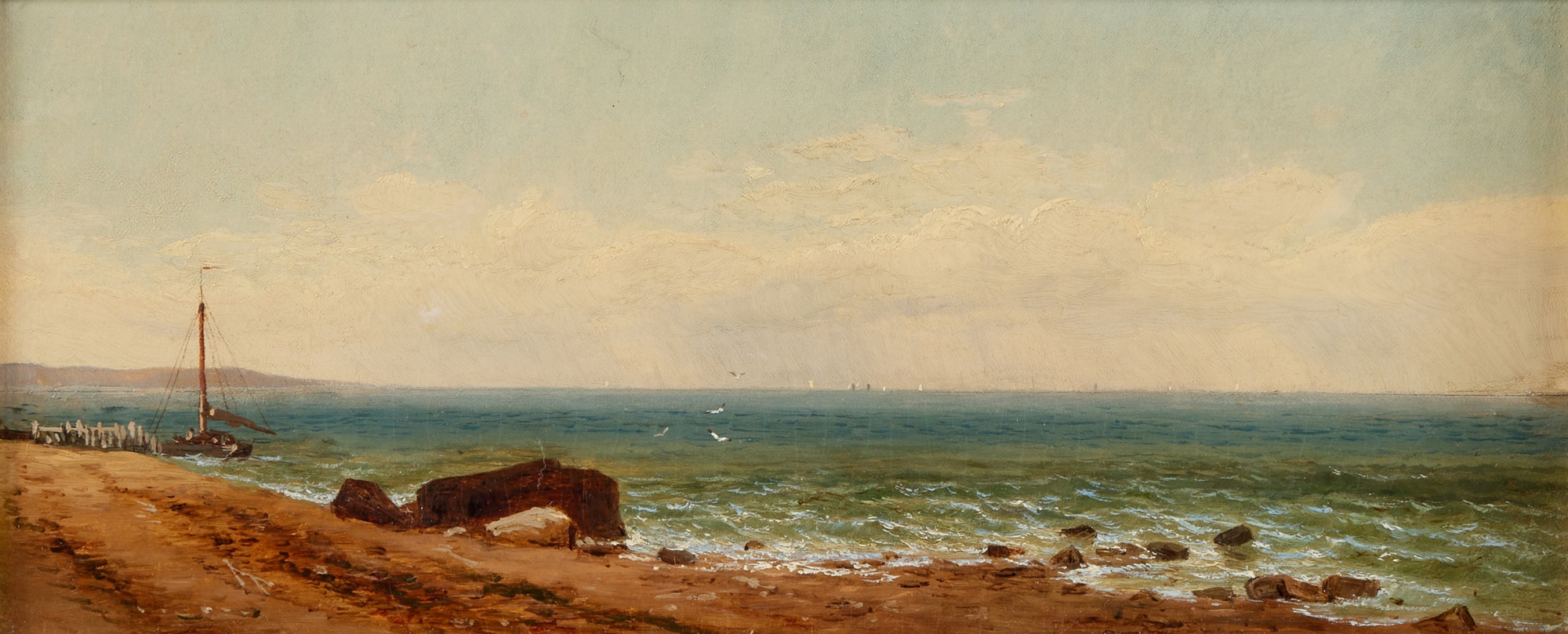
Along the Shore
He shared with Martin Johnson Heade a particular fascination with coastal light, with the way moisture in the air transforms color and softens edges, with the strange emotional charge that settles over a beach at low tide or a harbor in the hour before dusk. These were painters who understood that immensity could be found in restraint. Through the 1860s and into the 1870s, Bricher made extensive painting trips throughout New England and beyond, sketching and working en plein air along the shores of Massachusetts, Maine, and Rhode Island. His 1870 canvas "Mississippi River (Dubuque, Iowa)" reveals a painter willing to extend his vision far beyond the familiar Atlantic coastline, bringing his nuanced understanding of water and sky to the broad, slow grandeur of the American interior.
The work demonstrates the range of his geographical curiosity and his ability to apply a consistent and deeply considered aesthetic sensibility to landscapes of very different characters. That same luminous attentiveness that made his coastal scenes so compelling translated with remarkable ease to the Mississippi's wide and meditative presence. It is the coastal works, however, that define Bricher's legacy and speak most powerfully to collectors today. "Beverly by the Sea," painted in 1878 at the height of his powers, exemplifies everything that made him exceptional.
Alfred Thompson Bricher
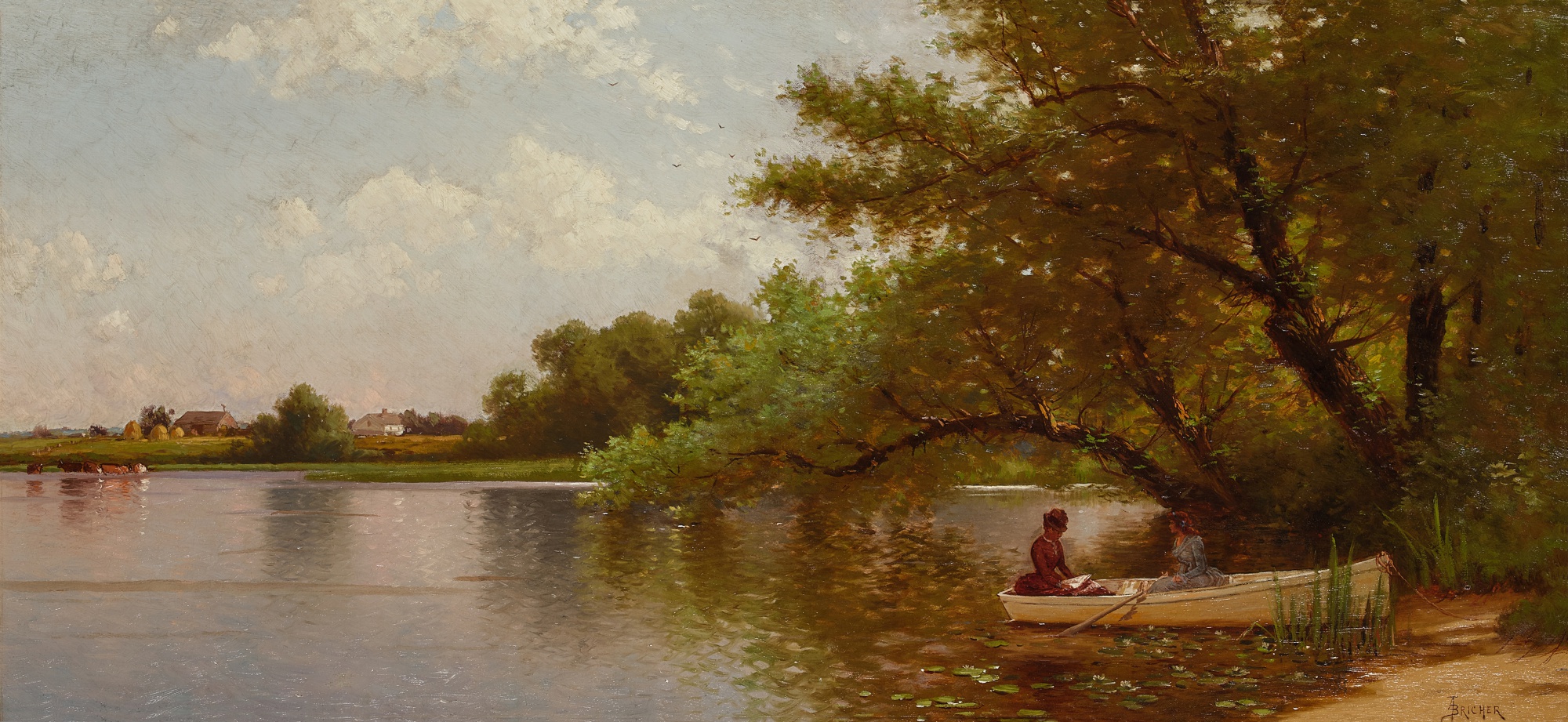
Quiet Haven
The composition is elegantly calibrated, with a low horizon that gives enormous weight and drama to the sky while allowing the foreground water to act as a secondary canvas, reflecting and reinterpreting the light from above. "Along the Shore," rendered in oil on paper laid down on canvas, demonstrates his facility across different supports and his understanding that intimacy of scale could intensify rather than diminish emotional impact. "Quiet Haven" speaks to his almost meditative relationship with sheltered coastal spaces, those inlets and coves where the drama of the open sea gives way to something gentler and more contemplative. Each of these works rewards sustained looking in ways that more immediately spectacular paintings sometimes do not.
For collectors, Bricher occupies a particularly appealing position in the American art market. He is firmly established within the canon of nineteenth century American landscape painting, with a critical reputation that has only strengthened as scholars have given greater attention to the Luminist tendency within the Hudson River tradition. His works appear regularly at the major American auction houses, where strong examples in good condition consistently attract serious bidding from collectors who understand his importance. What to look for, if you are approaching Bricher's work as a collector, is the quality of his sky passages, which in the finest examples have an almost porcelain delicacy, and the relationship between his water surfaces and the light sources above them.
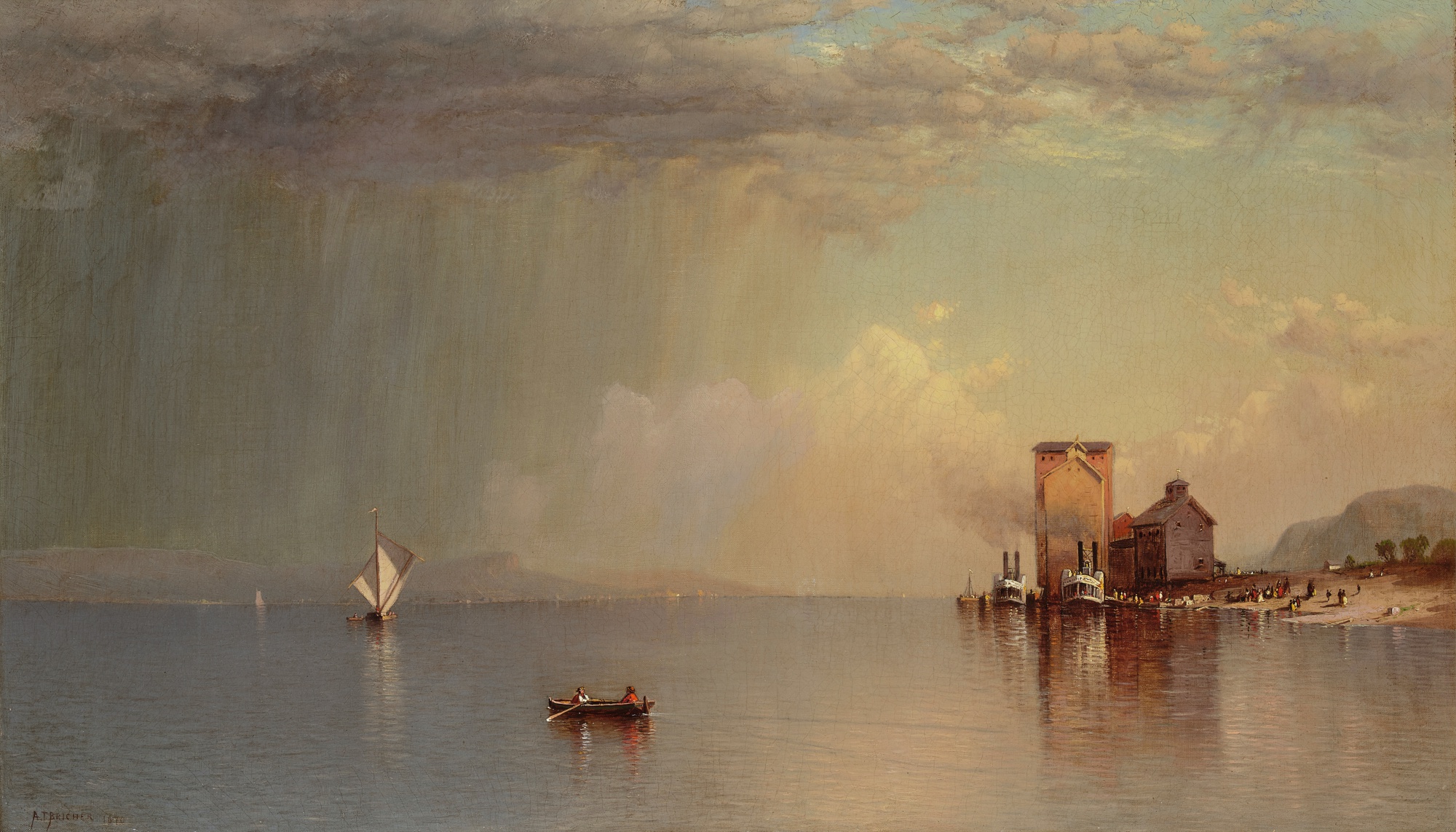
Alfred Thompson Bricher
Mississippi River (Dubuque, Iowa), 1870
Bricher at his best achieves a kind of optical truth that sits alongside the greatest work of his contemporaries. Placing Bricher within art history means acknowledging both his debts and his distinctiveness. He worked in conscious dialogue with the Hudson River School masters and shared with Luminists like Heade and John Frederick Kensett a preference for horizontal compositions, high finish, and the careful observation of natural light at its most fleeting and specific. Yet Bricher developed a personal voice that is recognizable the moment you encounter it.
There is a gentleness in his vision, a quality of absorbed attention that communicates genuine love for the landscapes he painted, that distinguishes him from painters who approached similar subjects with more programmatic intent. Bricher died in 1908, leaving behind a body of work that spans the full arc of American landscape painting's most extraordinary century. He witnessed the transformation of the American relationship to landscape, from the sublime wilderness ambitions of the early Hudson River School through the quieter, more psychological registers of Luminism and into the early stirrings of modernism. That his own vision remained consistent and true throughout all of this speaks to the depth of his original formation and the sincerity of his engagement with the natural world.
To own a Bricher is to hold a piece of that sustained attention, to bring into your home the light of a New England shore on a particular afternoon more than a century ago, preserved with a fidelity and a feeling that time has not diminished in the slightest.
Explore books about Alfred Thompson Bricher
Alfred Thompson Bricher: A Catalogue Raisonné
Jeffrey R. Brown
Alfred Thompson Bricher: Nineteenth-Century American Marine Painter
William H. Gerdts
The Paintings of Alfred Thompson Bricher
American Art Review
Luminist Painter: Alfred Thompson Bricher and New England Seascapes
John Wilmerding
Alfred Thompson Bricher: The Romantic Vision of the American Seacoast
Martha J. Hoppin