After Jean-Michel Basquiat
The Crown Lives On, Gloriously
Artist Spotlight · The Collection Editorial
In the spring of 2023, the Fondation Louis Vuitton in Paris mounted one of the most attended retrospectives in recent memory, drawing hundreds of thousands of visitors to stand before the raw, electric canvases of Jean Michel Basquiat. The queues stretched around the building. People wept. Critics scrambled for new language to describe the sensation of encountering work that, decades after it was made, still feels like it was finished this morning.
After Jean-Michel Basquiat
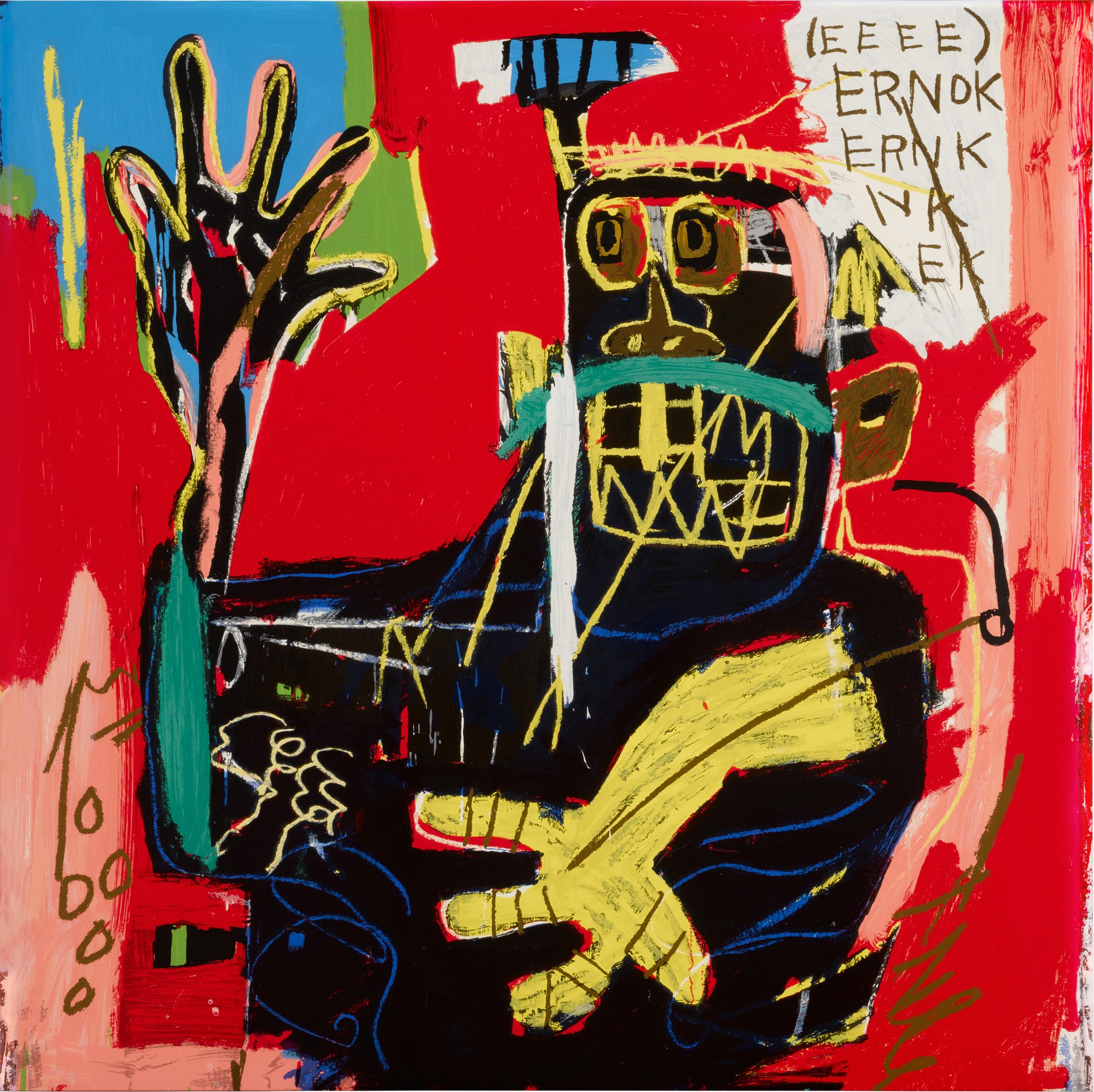
Untitled (Ernok)
That cultural moment, vast and reverberant, did something interesting beyond celebrating a singular genius. It threw into sharp relief an entire ecosystem of work that moves in Basquiat's orbit, work sold at auction under the designation 'After Jean Michel Basquiat,' pieces that carry his visual DNA without carrying his name. These works occupy a fascinating, complicated, and genuinely compelling space in the art market, one that serious collectors are increasingly paying attention to. To understand what 'After Jean Michel Basquiat' means, you must first understand the man himself.
Jean Michel Basquiat was born on December 22, 1960, in Brooklyn, New York, to a Haitian father and a Puerto Rican mother of Haitian descent. He grew up in a household where art, language, and ambition were all present in abundance. His mother, Matilde, took him regularly to the Brooklyn Museum and the Museum of Modern Art, exposing him to the canonical works of Western art history at an age when most children were watching Saturday morning cartoons. A serious car accident at age seven, during which he was struck while playing in the street, left him hospitalized for an extended period.
After Jean-Michel Basquiat
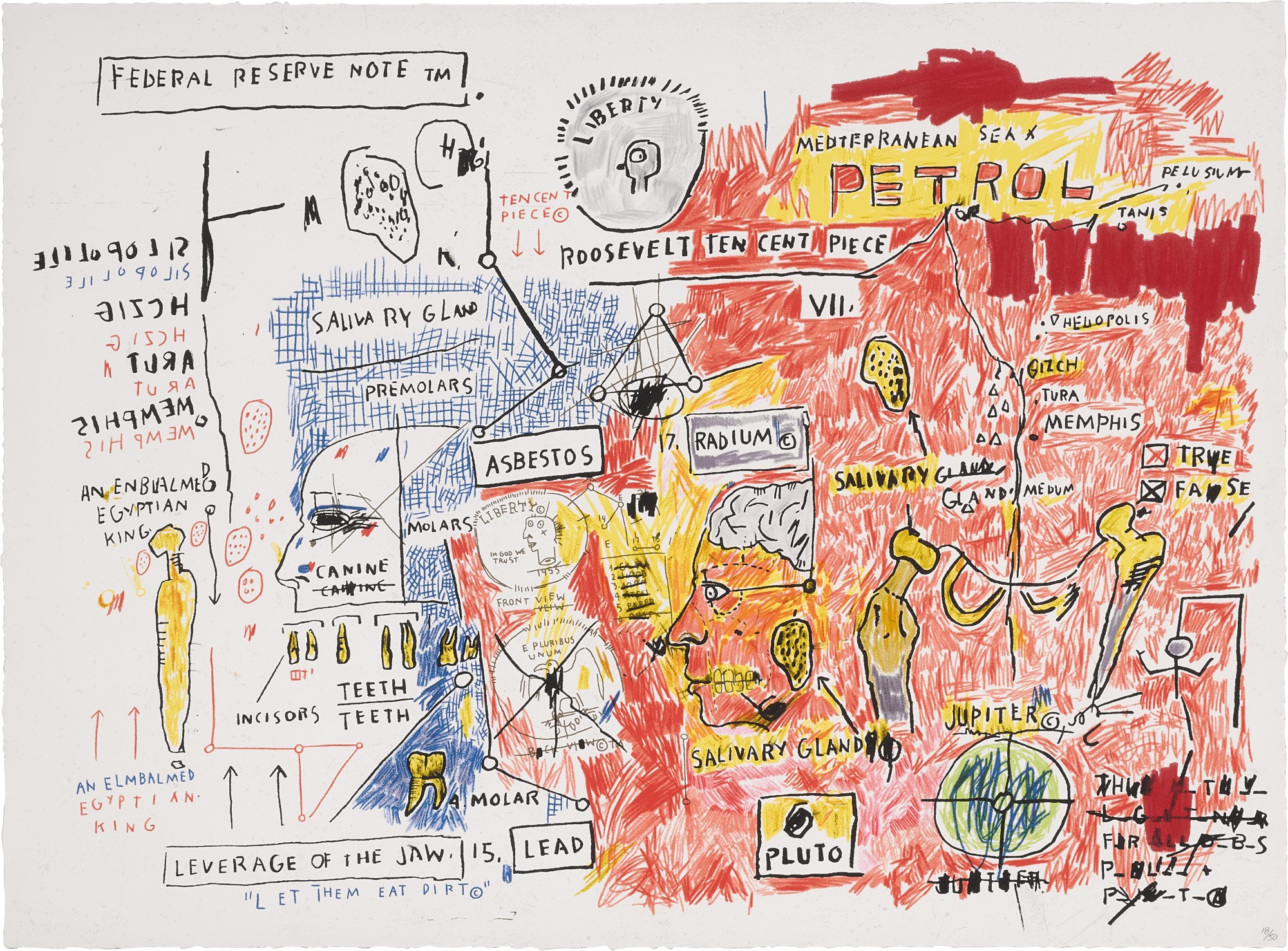
Liberty
His mother brought him a copy of Gray's Anatomy to keep him occupied. The skeletal figures that would later haunt and animate his canvases trace their origin to those convalescent afternoons spent studying the human body rendered in clinical, meticulous illustration. Basquiat dropped out of Edward R. Murrow High School in Brooklyn at seventeen and moved to lower Manhattan, where he slept in Tompkins Square Park and sold handmade postcards and T shirts to survive.
Under the tag SAMO, he and his collaborator Al Diaz began scrawling cryptic, poetic graffiti across SoHo and TriBeCa, pieces that read less like vandalism and more like compressed philosophy. By 1980, he had been included in the Times Square Show, a sprawling group exhibition organized in an abandoned midtown building that introduced the world to a generation of artists working at the intersection of street culture and fine art. By 1981, gallerist Annina Nosei had given him studio space in the basement of her Prince Street gallery. By 1982, at just twenty one years old, he was represented by Mary Boone, showing alongside Julian Schnabel and David Salle, and selling work for prices that astonished the art world.
After Jean-Michel Basquiat
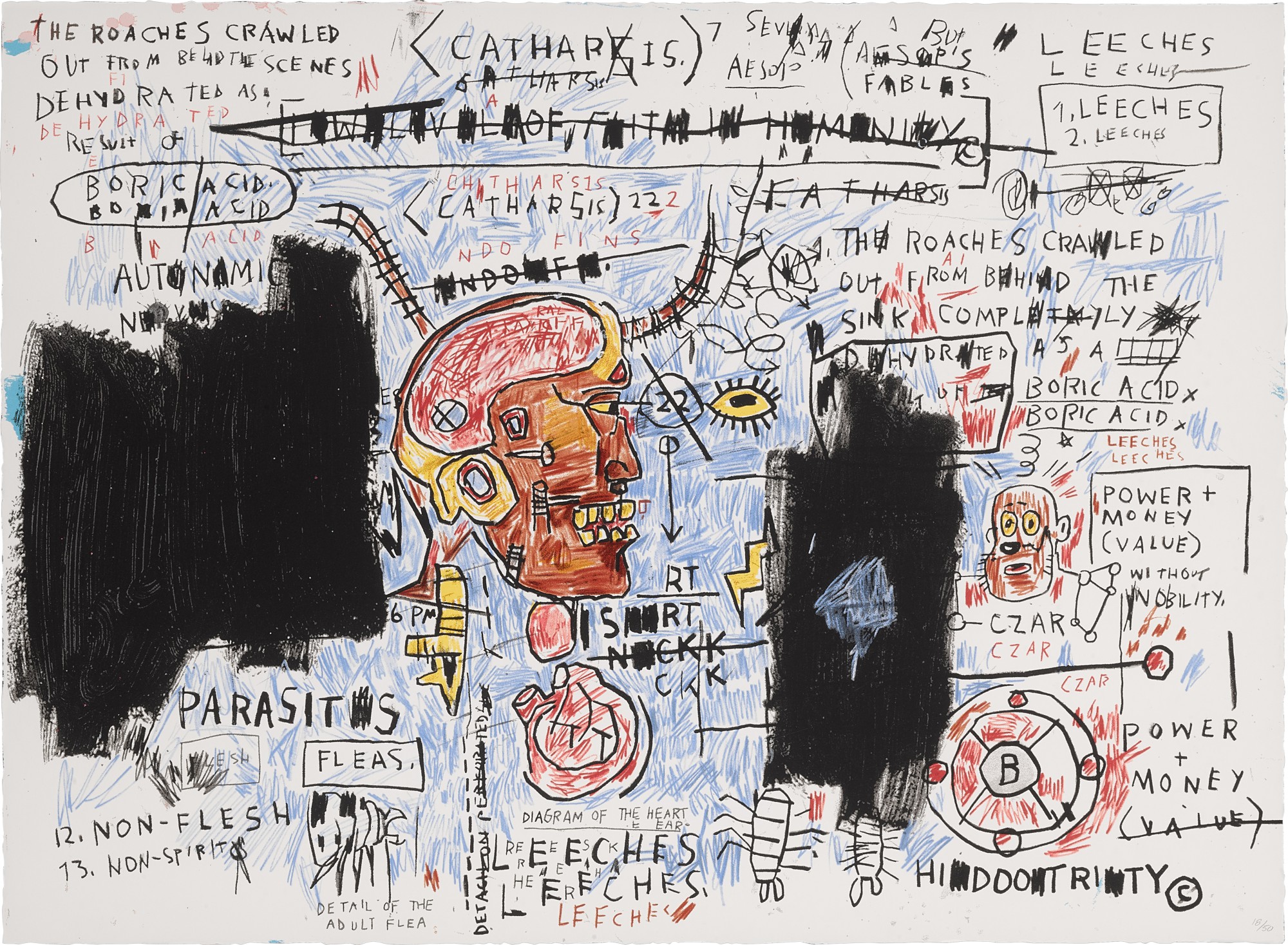
Leeches
His ascent was not merely rapid. It was volcanic. The visual language that Basquiat developed across his abbreviated but staggering career is among the most recognizable in the history of twentieth century art. Crowns appear again and again, sometimes hovering above figures like halos, sometimes rendered as thorns.
Text proliferates across his surfaces, with words crossed out and then rewritten, as if the act of erasure is itself a form of meaning making. Anatomical diagrams, brand names, historical references to Black heroes and athletes, and fragments of poetry all compete for space on canvases that feel simultaneously chaotic and ruthlessly controlled. He worked fast, often completing several large scale paintings in a single session, and he worked in series, returning to subjects like the body, commodity, race, and identity with the discipline of a scholar and the fury of a prophet. His friendship and collaboration with Andy Warhol, which produced a celebrated body of joint works shown at Tony Shafrazi Gallery in 1985, remains one of the great creative partnerships of the era.
It is within this extraordinarily fertile visual tradition that works designated 'After Jean Michel Basquiat' must be understood. These are pieces sold through major and regional auction houses where definitive authorship cannot be established through documentation, provenance, or expert consensus. The designation is not a dismissal. It is, rather, a precise and honest acknowledgment of uncertainty, a practice with deep roots in auction house methodology applied equally to works 'After Rembrandt' or 'After Rubens.
' What these attributions tell us is that someone, at some point, was so deeply immersed in Basquiat's world, so moved by his example, so fluent in his syntax, that they produced work that demands to be considered in conversation with his legacy. The crowns are still there. The skeletal figures still pulse with nervous energy. The text still insists on being read.
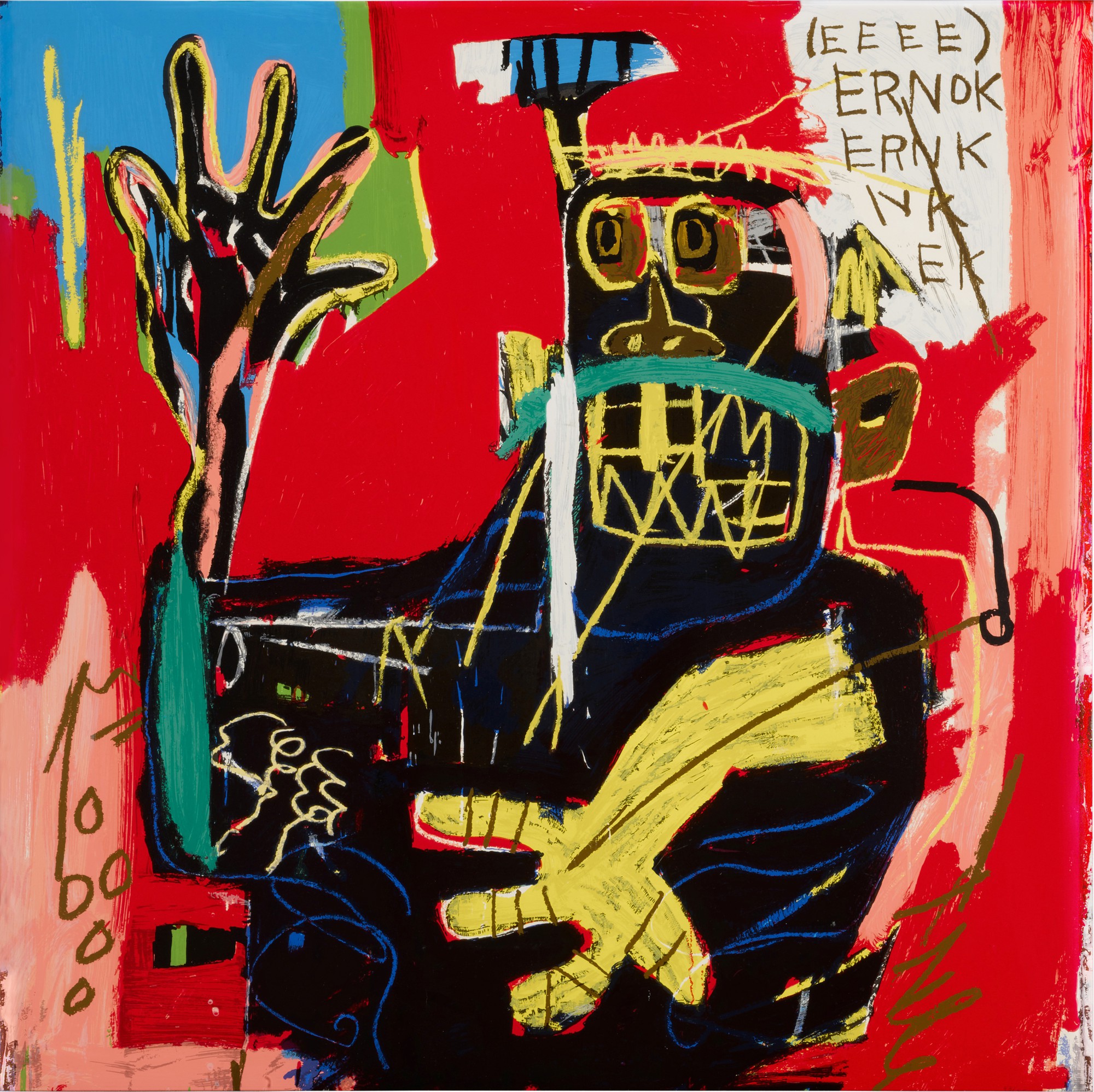
Works such as 'Untitled (Ernok),' 'Liberty,' and 'Leeches,' currently available through The Collection, each carry these hallmarks with a forcefulness that rewards sustained looking. For collectors, works attributed 'After Jean Michel Basquiat' offer a genuinely intriguing proposition. On a purely economic level, they represent access to a visual tradition that, at its authenticated apex, commands some of the highest prices ever achieved in the contemporary art market. Basquiat's 'Untitled' from 1982, depicting a skull rendered in phosphorescent fury, sold at Sotheby's New York in May 2017 for 110.
5 million dollars, making him the highest selling American artist ever at auction at that time. While works carrying the 'After' designation occupy an entirely different tier, their connection to one of the twentieth century's defining aesthetic traditions is undeniable and their visual power is often remarkable. Sophisticated collectors approach them as they would approach any work of uncertain attribution in art history, with rigorous attention to quality of execution, condition, and the sheer force of the object in front of them. The best examples in this category are not consolation prizes.
They are serious works that hold the room. The artistic lineage in which Basquiat worked, and which 'After Jean Michel Basquiat' works extend, connects to a broad and distinguished genealogy. His Neo Expressionist contemporaries include Francesco Clemente, Georg Baselitz, and Anselm Kiefer, all of whom were reclaiming raw emotion and gestural urgency in reaction to the cooler conceptual movements that had preceded them. In the American context specifically, he can be placed alongside Keith Haring, whose own graffiti derived visual language achieved global recognition, and Jean Paul Basquiat's great admirer and sometime interlocutor Andy Warhol, whose engagement with celebrity, commodity, and race inflected both their practices.
The dialogue between the street and the museum that Basquiat pioneered has only deepened in subsequent decades, visible now in the work of artists from Kaws to Kehinde Wiley to Theaster Gates. Basquiat died on August 12, 1988, at his studio at 57 Great Jones Street in Manhattan. He was twenty seven years old. In the thirty six years since his death, his reputation has done nothing but grow.
Major retrospectives at the Brooklyn Museum in 2005 and the Barbican in London in 2017, in addition to the Fondation Louis Vuitton exhibition, have each introduced his work to new generations who find in it an urgency that speaks directly to the present moment. Works designated 'After Jean Michel Basquiat' are, in the most fundamental sense, evidence of that urgency. They are proof that an artist's vision can be so powerful, so generative, so genuinely alive, that it continues to move through the world long after the original hand has stilled. For collectors who want to engage with one of the defining artistic sensibilities of our time, they represent a doorway into something essential and enduring.
Explore books about After Jean-Michel Basquiat
Basquiat: A Quick Killing in Art
Jennifer Clement
Jean-Michel Basquiat
Jennifer Clement
Basquiat
Marc Mayer
Jean-Michel Basquiat: The Radiant Child
Jennifer Clement
Basquiat: King Pleasure
Jennifer Clement
Jean-Michel Basquiat
Dieter Buchhart
Basquiat: The Unknown Notebooks
Jennifer Clement