Aaron Siskind
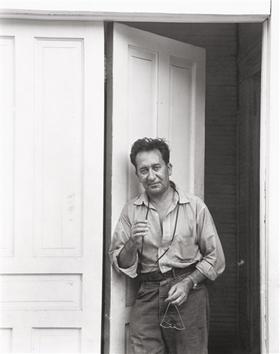
Aaron Siskind: Where the World Becomes Abstract
Artist Spotlight · The Collection Editorial
“I accept the flat plane of the picture surface as the primary frame of reference of the picture.”
Aaron Siskind, "Credo," 1950
There is a moment, standing before an Aaron Siskind photograph, when the eye loses its footing entirely. What reads at first as a painting, a field of cracked pigment or a gesture of ink on paper, reveals itself to be a photograph of a wall, a peeling sign, a stretch of worn pavement. That doubling sensation, that pleasurable disorientation, is precisely what Siskind spent the better part of five decades engineering. Today, with his work held in the permanent collections of the Museum of Modern Art in New York, the Art Institute of Chicago, and the George Eastman Museum in Rochester, Siskind stands as one of the most intellectually alive figures in twentieth century American photography, an artist whose radical pivot from documentary practice to abstract formalism remains one of the great transformative stories in the medium.
Aaron Siskind
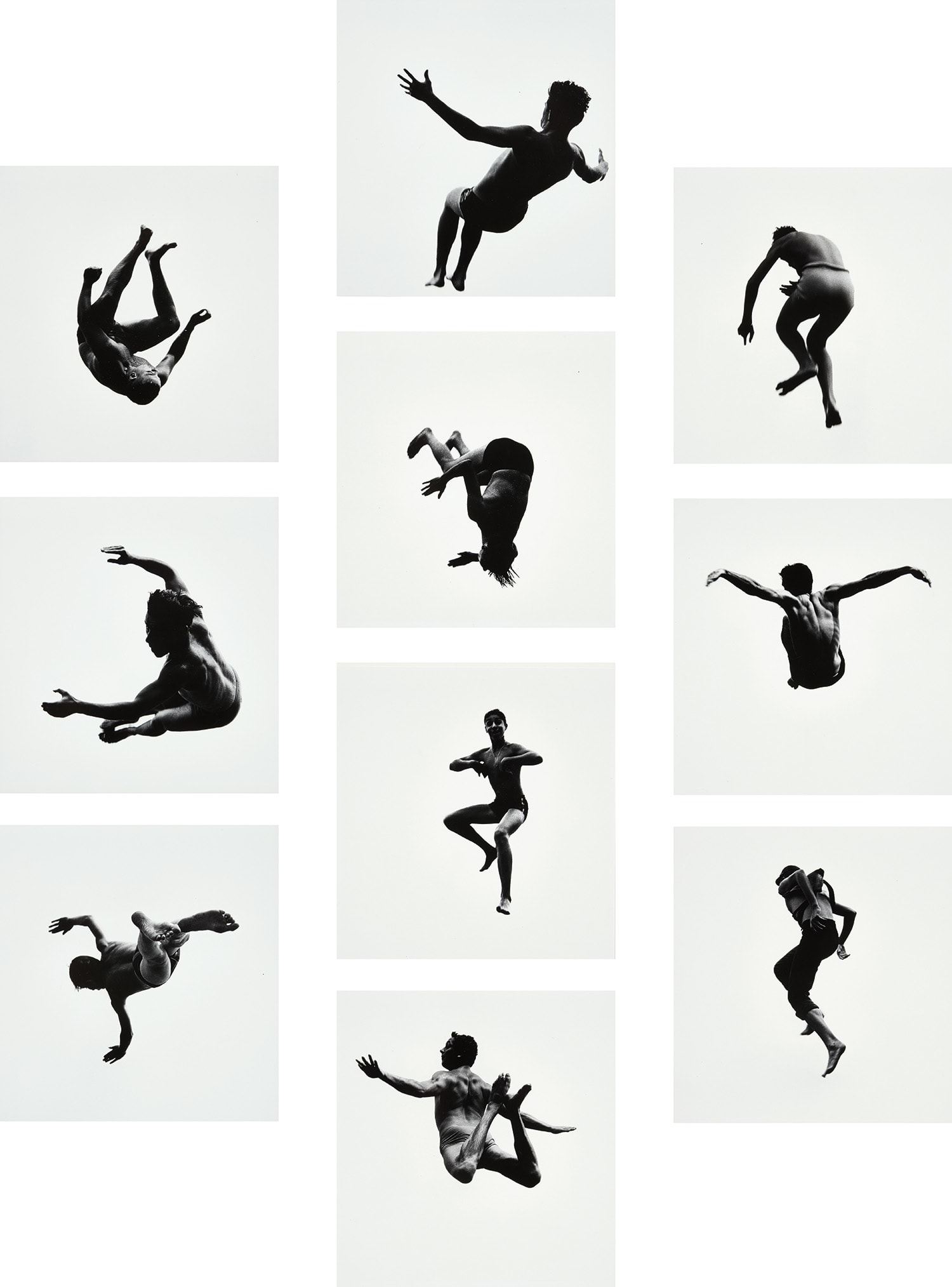
Terrors and Pleasures of Levitation
Aaron Siskind was born in New York City in 1903, the son of Russian Jewish immigrants who had settled on the Lower East Side. He grew up in a household that valued education and culture, and after graduating from the City College of New York in 1926, he worked for years as a public school English teacher in the New York City school system. Photography entered his life almost accidentally in the early 1930s, a gift camera sparking what would become a lifelong devotion. He joined the Film and Photo League in 1932, a left wing collective of photographers committed to using the camera as a tool of social witness, and found there a community of serious practitioners who sharpened his instincts and deepened his ambitions.
Through the 1930s Siskind produced some of the most compelling social documentary work of the New Deal era. His project with the Harlem Document group, a subset of the Photo League, produced a sustained, compassionate portrait of Black life in Harlem across several years in the late 1930s. The resulting body of work, never fully published as a book during the height of its creation, documented tenements, storefronts, churches, street corners and faces with a dignity and formal precision that set it apart from mere reportage. His Selected Images from Harlem Document, available as a suite of twelve gelatin silver prints, remains a foundational artifact of this period, offering collectors a window into a chapter of American social history seen through a genuinely great photographic eye.
Aaron Siskind
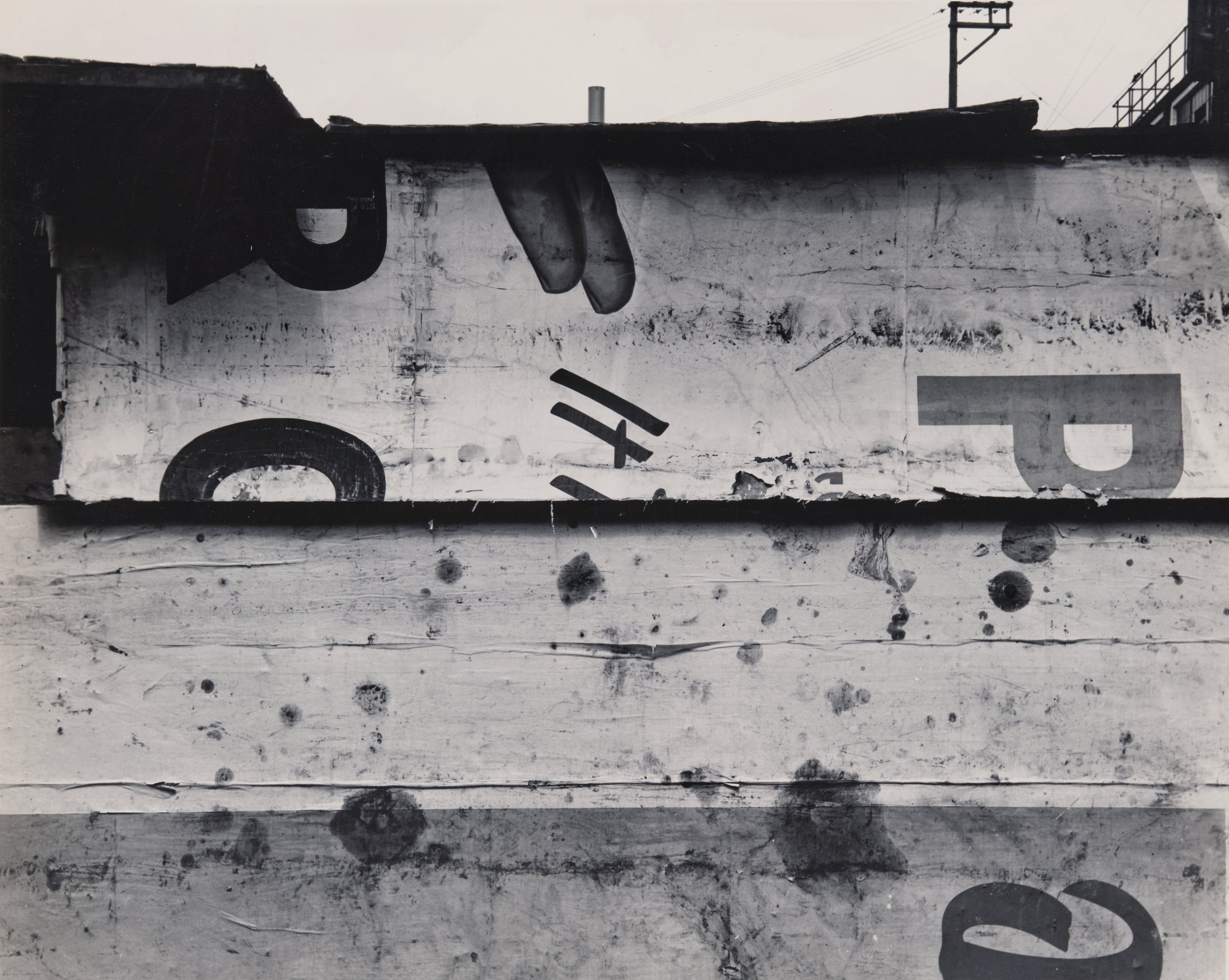
St. Louis 6
The transformation that defines Siskind's legacy came in the mid 1940s, and it was as decisive as any aesthetic rupture in postwar American art. Traveling to Gloucester, Massachusetts, in 1944, he began photographing flat surfaces: weathered wood, painted walls, torn posters, fragments of rope and debris on beaches. He stripped away depth, narrative and social context, focusing entirely on the surface of things and the abstract shapes, textures and tensions that emerged when the camera pressed close. These new images bore an uncanny family resemblance to the paintings being made in New York at exactly the same moment by Franz Kline, Willem de Kooning and Mark Rothko.
“When I photograph, what I photograph is an idea. The picture is an idea.”
Aaron Siskind, interview
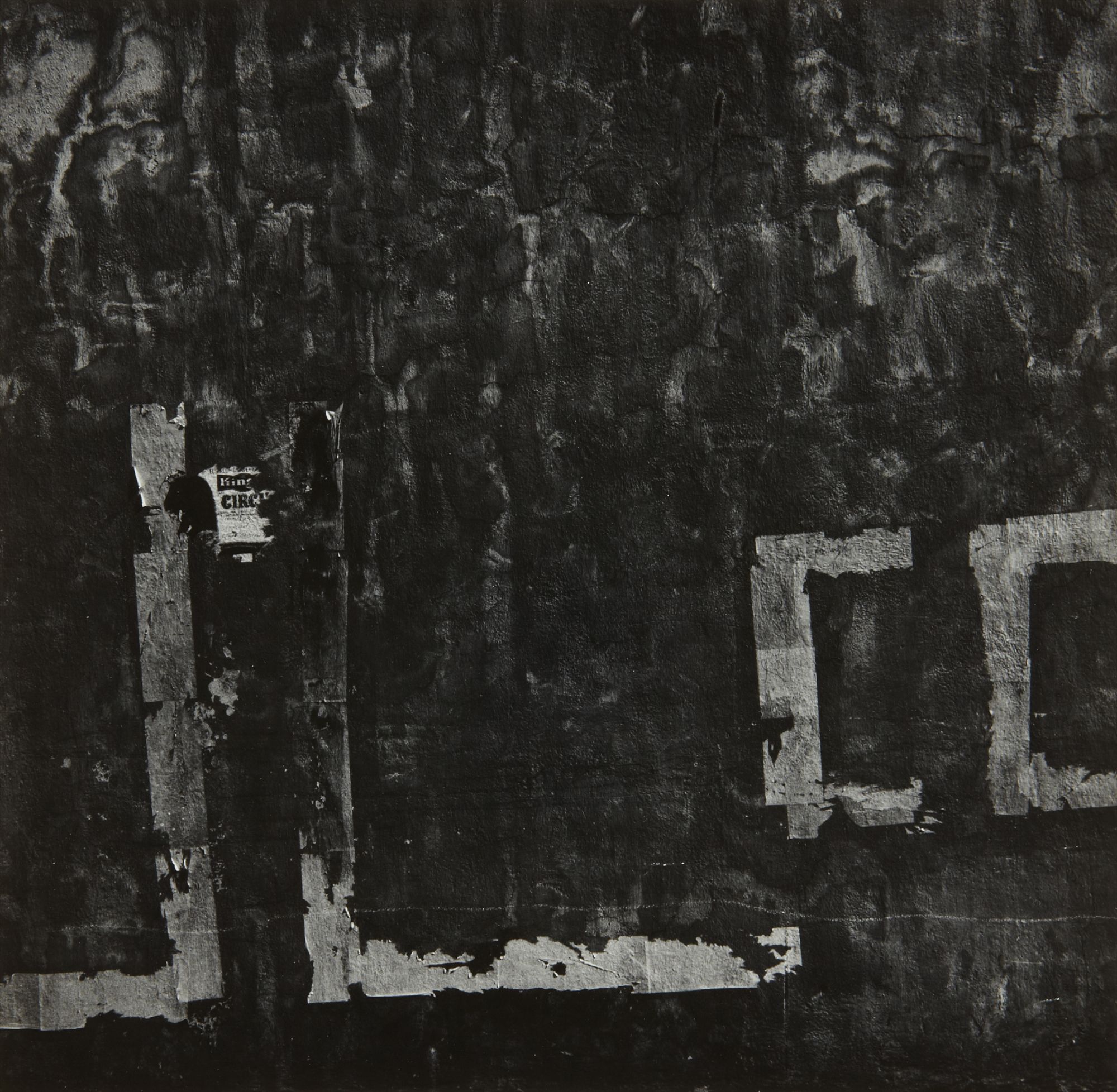
Siskind became deeply embedded in the Abstract Expressionist circle, forming close friendships with Kline in particular, and his photographs were understood by that generation as genuine peers to their paintings rather than records of them. The works from this mature period are the ones that collectors prize most intensely. Chicago 25 and Chicago 200, both gelatin silver prints, exemplify his ability to find within the scarred facades of urban architecture a purely visual language of tension and release. Veracruz 130 and Arizpe Mexico 21 draw on travels through Mexico where Siskind found in indigenous architecture and eroded surfaces an even more elemental vocabulary.
Aaron Siskind
Veracruz 130
St. Louis 6 shows his gift for isolating a fragment of the world and making it feel as complete and self contained as any painted canvas. Perhaps the most theatrical of his projects is Terrors and Pleasures of Levitation, a portfolio of ten photographs made between 1953 and 1961 depicting young men leaping into the air against featureless skies. Issued in an edition of fifteen, with prints signed in pencil on the mount, this portfolio captures a lightness and joy that balances the more austere gravity of his wall and surface work.
For collectors, Siskind offers an extraordinary breadth of entry points. His gelatin silver prints from the 1940s through the 1970s appear regularly at auction at Sotheby's, Christie's and Phillips, where important examples have achieved prices that reflect both his art historical stature and the enduring visual power of individual works. Prints made by Siskind himself carry particular weight, and provenance from estates, institutions or known collections adds meaningful value. Collectors drawn to the intersection of photography and painting find in Siskind a uniquely satisfying figure: someone whose work asks questions that neither medium can answer alone.
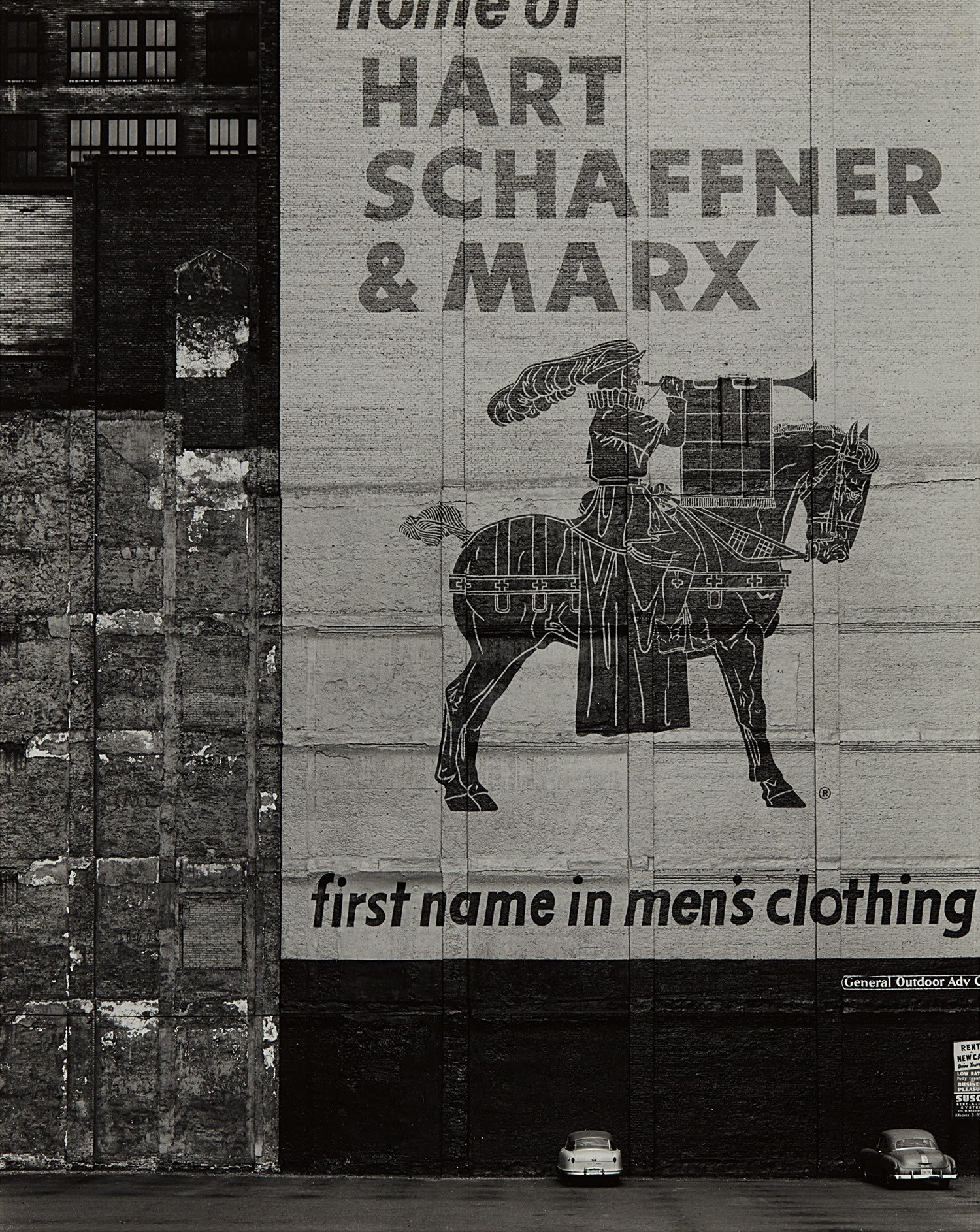
Aaron Siskind
Chicago 200
His Harlem Document prints offer a different kind of rarity, combining historical significance with formal beauty in a combination that serious collections find indispensable. Siskind's place in art history is illuminated by the company he kept and the conversations he sustained. His photographs speak fluently to the work of Harry Callahan, with whom he taught for many years at the Institute of Design in Chicago and later at the Rhode Island School of Design, two of the most influential photography programs in American academic history. His formal concerns connect him to Minor White, whose interest in photographic equivalence explored similar territory by different means.
Internationally, his surface studies resonate with the materialism of Alberto Burri and the gestural investigation of Antoni Tapies, artists working in paint who were reaching toward the same primal textures Siskind found in the physical world itself. Aaron Siskind died in Providence, Rhode Island, in 1991, leaving behind a body of work that has only grown in stature in the decades since. His insistence that a photograph could be a fully autonomous aesthetic object, responsible to no subject beyond itself, helped reshape what photographers understood themselves to be doing. His decades of teaching at the Institute of Design and RISD sent generations of photographers into the world with a more rigorous and open sense of the medium's possibilities.
And his lifelong friendship with the painters of his era served as a living argument that photography deserved a seat at the table where modern art was being defined. To own a Siskind is to hold a piece of that argument in your hands, and to feel, looking at it, the quiet thrill of a world made new.
Explore books about Aaron Siskind
Aaron Siskind: Photographer
Aaron Siskind

Aaron Siskind: City Limits
Aaron Siskind
Aaron Siskind: A Retrospective
Carl Chiarenza
Aaron Siskind: Harlem Document
Aaron Siskind, Charles H. Haskins
Light and Substance: Aaron Siskind's Photographs
David Haberstam
Aaron Siskind: Pleasures and Terrors
Aaron Siskind, Peter C. Bunnell