Join The Collection to save, track, and explore works like this.

Unknown — Signed Saotome Ietada | Edo period, 17th century
Unknown

Signed Saotome Ietada | Edo period, 17th century

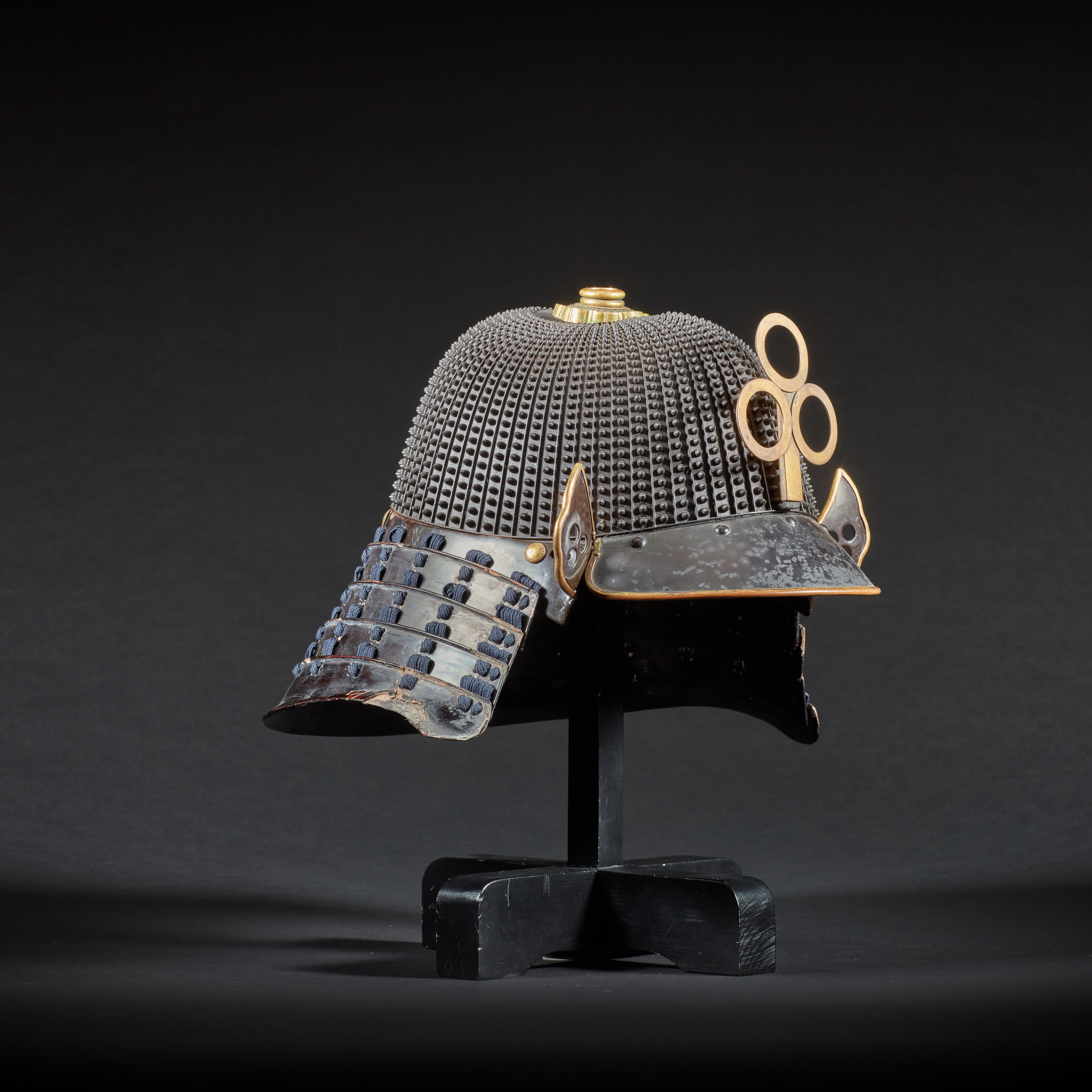
This elaborate samurai helmet, signed by the renowned armor maker Saotome Ietada, represents the height of Edo period craftsmanship with its sixty two iron plates meticulously riveted and finished in russet. The helmet's ornamental components showcase exceptional metalwork, including copper gilt and silver accents throughout the five stage crest, layered neck guards, and distinctive face mask featuring a fierce expression with deep wrinkles and a detachable nose plate. The sophisticated combination of materials, from black and red lacquered elements to blue braid lacing, demonstrates both the functional design and aesthetic refinement demanded of high status warrior equipment in 17th century Japan.

Medium
the sixty-two plate iron bowl with a russet surface, with perfectly formed raised rivets, terminating in a five-stage copper-gilt and silver tehen kanamono, the black lacquer peak with copper-gilt rim, red lacquer underside, the black lacquer turnbacks pierced with three circles, copper-gilt fukurin [ornamental border], the four-tiered black lacquer neck guard with spaced lacing in blue braid, the copper-gilt maedate in the form of three circles, the russet iron mempo [face mask] with deep wrinkles and fierce expression, detachable nose plate, red lacquer interior, three-tiered black lacquer throat protector laced in matching braid

🔨 Auction Lot

Art of Japan

October 29, 2024

Estimate: $15,000$20,000

Lot 42

Start the Discussion

Request access to join the discussion

About this work

Unknown, Signed Saotome Ietada | Edo period, 17th century

This elaborate samurai helmet, signed by the renowned armor maker Saotome Ietada, represents the height of Edo period craftsmanship with its sixty two iron plates meticulously riveted and finished in russet. The helmet's ornamental components showcase exceptional metalwork, including copper gilt and silver accents throughout the five stage crest, layered neck guards, and distinctive face mask featuring a fierce expression with deep wrinkles and a detachable nose plate. The sophisticated combination of materials, from black and red lacquered elements to blue braid lacing, demonstrates both the functional design and aesthetic refinement demanded of high status warrior equipment in 17th century Japan.

Medium
the sixty-two plate iron bowl with a russet surface, with perfectly formed raised rivets, terminating in a five-stage copper-gilt and silver tehen kanamono, the black lacquer peak with copper-gilt rim, red lacquer underside, the black lacquer turnbacks pierced with three circles, copper-gilt fukurin [ornamental border], the four-tiered black lacquer neck guard with spaced lacing in blue braid, the copper-gilt maedate in the form of three circles, the russet iron mempo [face mask] with deep wrinkles and fierce expression, detachable nose plate, red lacquer interior, three-tiered black lacquer throat protector laced in matching braid
Seen at
Sotheby's, New York, London, Hong Kong, Paris

Related themes

17th century Edo period, Elegant and refined aesthetic, Gold and mother-of-pearl embellishment, Saotome school tradition, Functional decorative object, Japanese Artist, Court patronage style, Japanese decorative arts, Lacquerware and inlay technique, Ornamental Design

More works by Unknown

Collected by

Richard Caswell, Sebastián Naranjo, Jonah Handel, Musée d'Art Moderne de Paris, Ethan Elkins, Alex Capecelatro, Mihail Lari, Cleveland Museum of Art