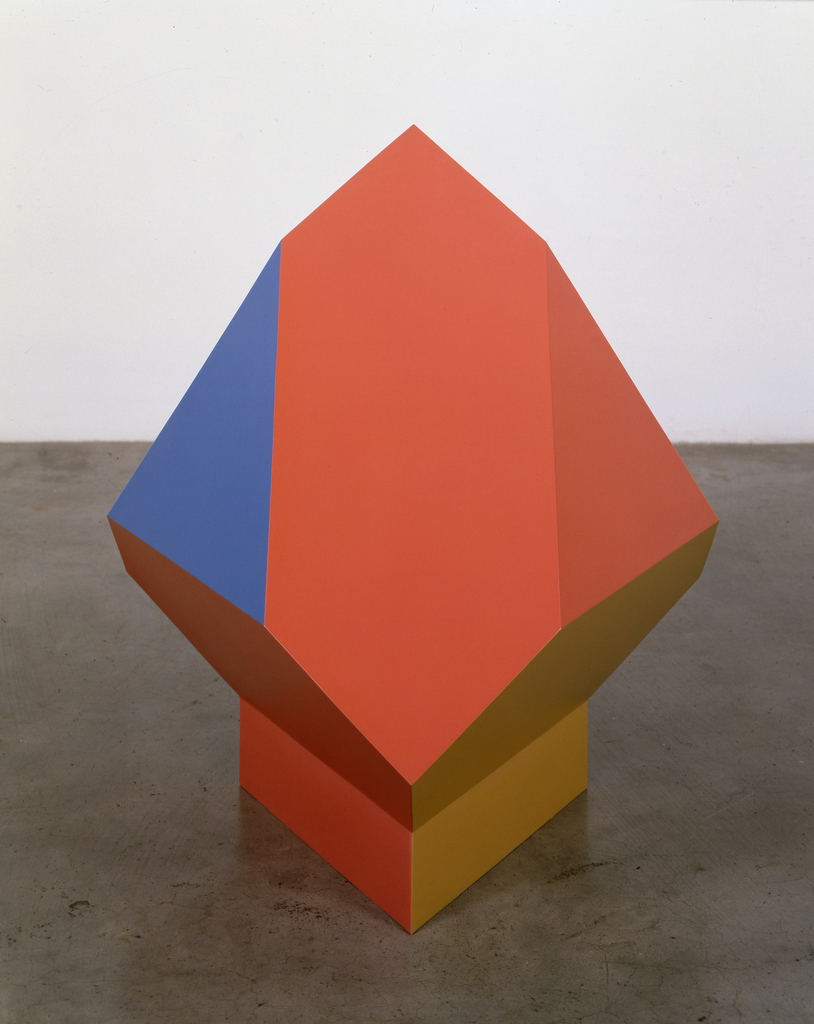
Memphis
1962
Memphis, cast in 1962 and painted in red, blue, and ochre, stands as one of Tony Smith's most formally concentrated explorations of geometric volume and chromatic tension. The sculpture's compact presence, measuring just over eighty centimeters in height, belies the intellectual density packed into its interlocking planar surfaces. Smith's decision to apply color directly to the bronze surface was far from decorative; the triadic palette activates each face of the form independently, encouraging the eye to read the work as a shifting sequence of distinct planes rather than a unified mass. This interplay between structure and surface places Memphis at an intersection of minimalist rigor and a sensory warmth that much pure minimalism deliberately refused. Smith developed his sculptural language through a deep engagement with architecture and mathematical systems, and Memphis reflects that foundation in its precise geometric logic. Yet the work avoids the industrial coolness associated with later minimalist production. The painted bronze surface carries a handmade quality, and the chosen colors retain an earthly, almost ancient resonance that suits the work's title. The reference to the ancient Egyptian and American cities of the same name layers the sculpture with a subtle historical echo without compromising its abstract integrity. Available through Pace Gallery in an edition of six, Memphis represents a pivotal moment in Smith's development and in the broader narrative of postwar American sculpture. Works from this period and at this scale appear with increasing rarity, and the sculpture's strong provenance lineage, compact scale, and visual authority make it well-suited to both private residential settings and institutional display. Collectors acquiring a piece from this edition gain access to a foundational chapter in the history of geometric abstraction.
- Medium
- Bronze, painted red, blue, ochre
- Overall
- Location
- Pace Gallery, New York, NY
- Spotted At
- Gallery · Pace GalleryView on map
Spotted works by Tony Smith

Start the Discussion
Request access to join the discussion