Join The Collection to save, track, and explore works like this.

Henri Lebasque — Le Fils de l'abbesse; Le Fardeau de la liberté
Henri Lebasque

Le Fils de l'abbesse; Le Fardeau de la liberté

1897

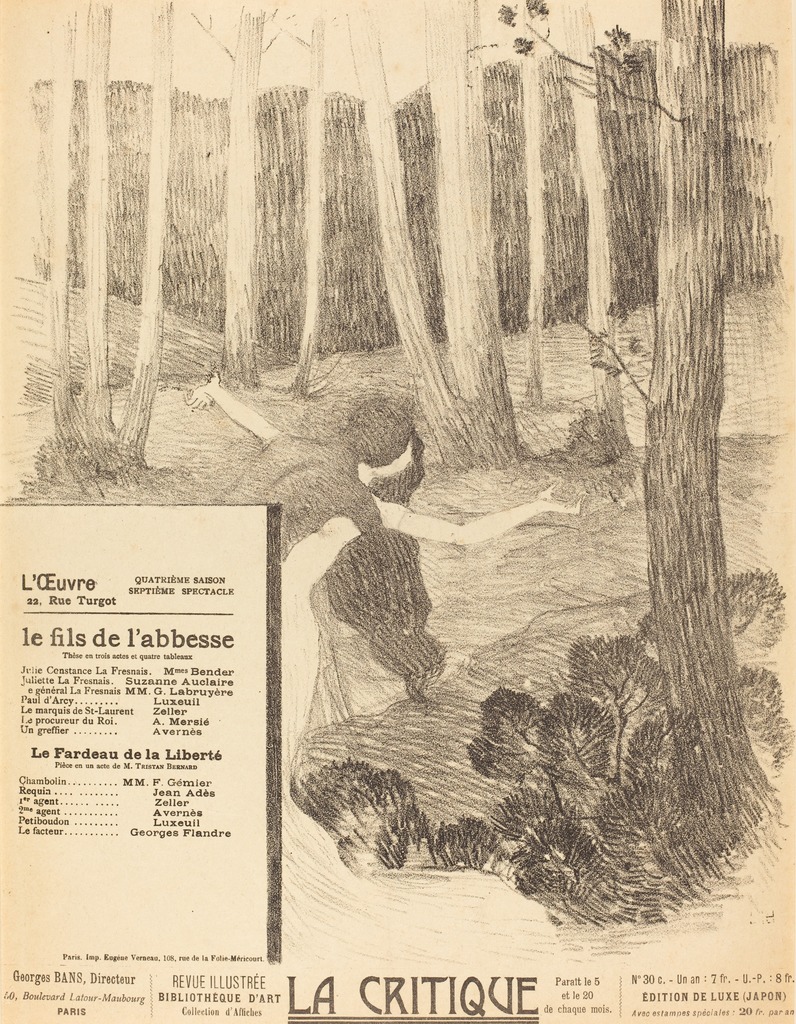
Executed in 1897, this signed lithograph in black on wove paper belongs to a pivotal moment in Henri Lebasque's early career, when the French painter and printmaker was absorbing the social and aesthetic currents circulating through fin-de-siècle Paris. The work's dual title, "Le Fils de l'abbesse; Le Fardeau de la liberté," carries a charged irony characteristic of the period's satirical visual culture, pairing ecclesiastical authority with the weight of freedom in a way that invites sustained reading. Lebasque renders his composition with the economical confidence of a draftsman fluent in the graphic language of the epoch, and the intimate sheet dimensions of 32.1 by 24.4 centimeters concentrate that energy into a focused, quietly confrontational object. Lebasque is celebrated today primarily for the luminous, color-drenched canvases of his Post-Impressionist maturity, which places a work like this in genuinely instructive contrast for collectors seeking a fuller understanding of his range. Printmaking in this period was not a secondary pursuit but a serious vehicle for artistic and political expression, embraced by figures across the Nabis and Symbolist circles with whom Lebasque was contemporaneous. The lithographic medium here allows for a tonal richness that rewards close attention, the velvety blacks of the ink pressing against the texture of the wove paper to produce a surface both direct and nuanced. For collectors drawn to works on paper from the French fin de siècle, this piece offers a rare window into the graphic dimension of a career more commonly encountered through painting. Its signed status adds a layer of personal authentication, and its institutional provenance, with the work held at the National Gallery of Art in Washington, D.C., speaks to its recognized art-historical significance. As a document of a gifted artist engaging seriously with the social imagination of his moment, it holds both scholarly and aesthetic appeal.

Medium
Lithograph in black on wove paper
Sheet
Signed
Yes

Start the Discussion

Request access to join the discussion

Collectors with works by Henri Lebasque

About this work

Henri Lebasque, Le Fils de l'abbesse; Le Fardeau de la liberté, 1897

Executed in 1897, this signed lithograph in black on wove paper belongs to a pivotal moment in Henri Lebasque's early career, when the French painter and printmaker was absorbing the social and aesthetic currents circulating through fin-de-siècle Paris. The work's dual title, "Le Fils de l'abbesse; Le Fardeau de la liberté," carries a charged irony characteristic of the period's satirical visual culture, pairing ecclesiastical authority with the weight of freedom in a way that invites sustained reading. Lebasque renders his composition with the economical confidence of a draftsman fluent in the graphic language of the epoch, and the intimate sheet dimensions of 32.1 by 24.4 centimeters concentrate that energy into a focused, quietly confrontational object. Lebasque is celebrated today primarily for the luminous, color-drenched canvases of his Post-Impressionist maturity, which places a work like this in genuinely instructive contrast for collectors seeking a fuller understanding of his range. Printmaking in this period was not a secondary pursuit but a serious vehicle for artistic and political expression, embraced by figures across the Nabis and Symbolist circles with whom Lebasque was contemporaneous. The lithographic medium here allows for a tonal richness that rewards close attention, the velvety blacks of the ink pressing against the texture of the wove paper to produce a surface both direct and nuanced. For collectors drawn to works on paper from the French fin de siècle, this piece offers a rare window into the graphic dimension of a career more commonly encountered through painting. Its signed status adds a layer of personal authentication, and its institutional provenance, with the work held at the National Gallery of Art in Washington, D.C., speaks to its recognized art-historical significance. As a document of a gifted artist engaging seriously with the social imagination of his moment, it holds both scholarly and aesthetic appeal.

Medium
Lithograph in black on wove paper
Dimensions
sheet: 32.1 x 24.4 cm
Year
1897
Signed
Hand-signed by the artist
Seen at
National Gallery of Art, Washington, D.C.

More works by Henri Lebasque

Collected by

Musée d'Art Moderne de Paris