Join The Collection to save, track, and explore works like this.

George Segal — Appalachian Farm Couple 1936
George Segal

Appalachian Farm Couple 1936

1978

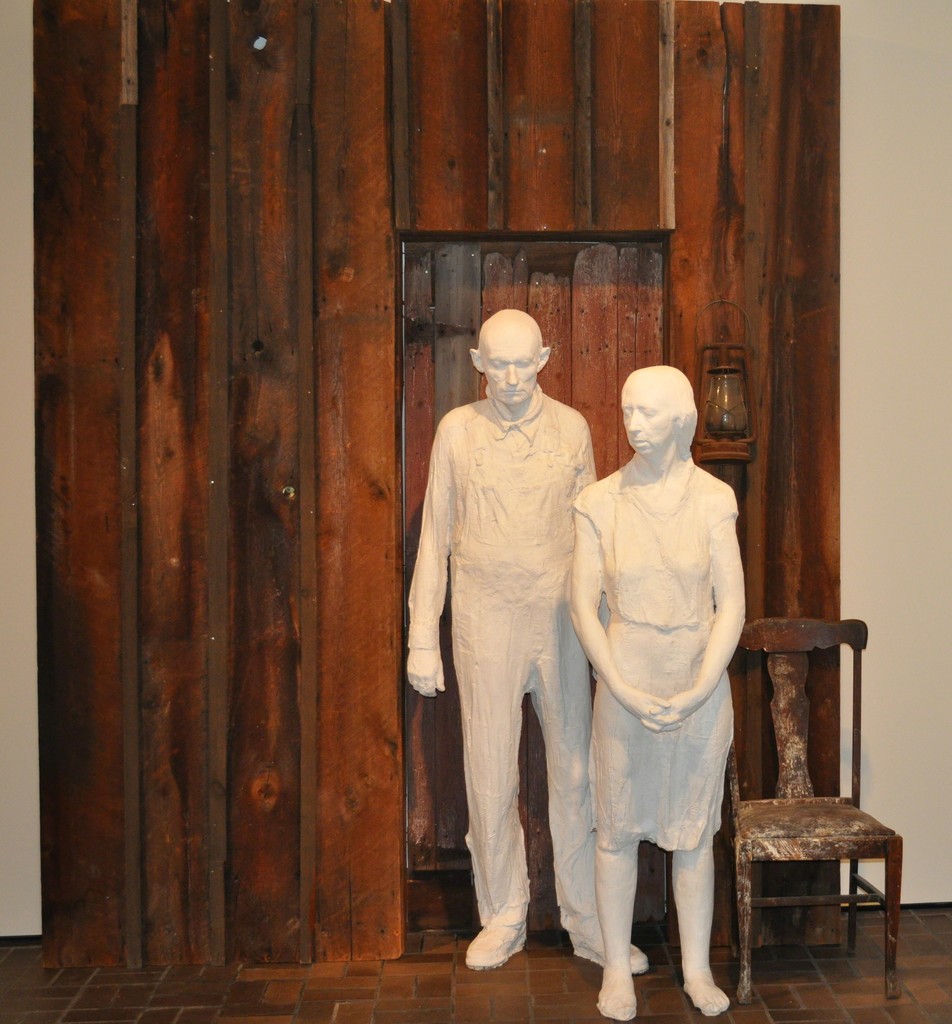
A farmer and his wife stand frozen in plaster before a weathered wooden door, their stillness charged with the quiet dignity of American working life. George Segal completed this monumental work in 1978, drawing on the iconic visual language of Dorothea Lange and Walker Evans to conjure the spirit of Depression-era rural America without replicating any single photograph or document. The piece measures over nine feet in height, and its scale alone commands a physical reckoning, placing the viewer in direct proximity to figures who seem simultaneously present and unreachable, caught between memory and monument. Segal's signature method of casting directly from living subjects gives the plasterwork a bodily intimacy that no modeled sculpture can replicate. Every fold of fabric, every slumped shoulder and set jaw carries the weight of an actual human presence. The wood, metal, and glass elements that frame the figures serve as environmental anchors, grounding the ghostly white forms in the texture of a real agrarian world. The tension between the rawness of the industrial materials and the quiet solemnity of the human forms is central to what makes Segal's practice so enduring. Acquired by the Neuberger Museum of Art at Purchase College, State University of New York through funds provided by the Friends' Acquisition Fund and the Frieda and Milton F. Rosenthal Acquisition Fund, this work has been part of an important institutional collection since 1980. For collectors with an interest in postwar American figuration, works of this ambition and provenance are extraordinarily rare in the private market. The combination of historical resonance, formal integrity, and institutional exhibition history makes this a defining example of Segal's mature output.

Medium
Plaster, wood, metal and glass
Overall
Signed
Yes

Start the Discussion

Request access to join the discussion

Spotted works by George Segal

About this work

George Segal, Appalachian Farm Couple 1936, 1978

A farmer and his wife stand frozen in plaster before a weathered wooden door, their stillness charged with the quiet dignity of American working life. George Segal completed this monumental work in 1978, drawing on the iconic visual language of Dorothea Lange and Walker Evans to conjure the spirit of Depression-era rural America without replicating any single photograph or document. The piece measures over nine feet in height, and its scale alone commands a physical reckoning, placing the viewer in direct proximity to figures who seem simultaneously present and unreachable, caught between memory and monument. Segal's signature method of casting directly from living subjects gives the plasterwork a bodily intimacy that no modeled sculpture can replicate. Every fold of fabric, every slumped shoulder and set jaw carries the weight of an actual human presence. The wood, metal, and glass elements that frame the figures serve as environmental anchors, grounding the ghostly white forms in the texture of a real agrarian world. The tension between the rawness of the industrial materials and the quiet solemnity of the human forms is central to what makes Segal's practice so enduring. Acquired by the Neuberger Museum of Art at Purchase College, State University of New York through funds provided by the Friends' Acquisition Fund and the Frieda and Milton F. Rosenthal Acquisition Fund, this work has been part of an important institutional collection since 1980. For collectors with an interest in postwar American figuration, works of this ambition and provenance are extraordinarily rare in the private market. The combination of historical resonance, formal integrity, and institutional exhibition history makes this a defining example of Segal's mature output.

Medium
Plaster, wood, metal and glass
Dimensions
overall: 274.3 x 228.6 x 91.4 cm
Year
1978
Signed
Hand-signed by the artist
Seen at
Neuberger Museum of Art

More works by George Segal

Collected by

Sharrissa Iqbal