Join The Collection to save, track, and explore works like this.

Frida Kahlo — Self-Portrait on the Border Line Between Mexico and the United States
Frida Kahlo

Self-Portrait on the Border Line Between Mexico and the United States

1932

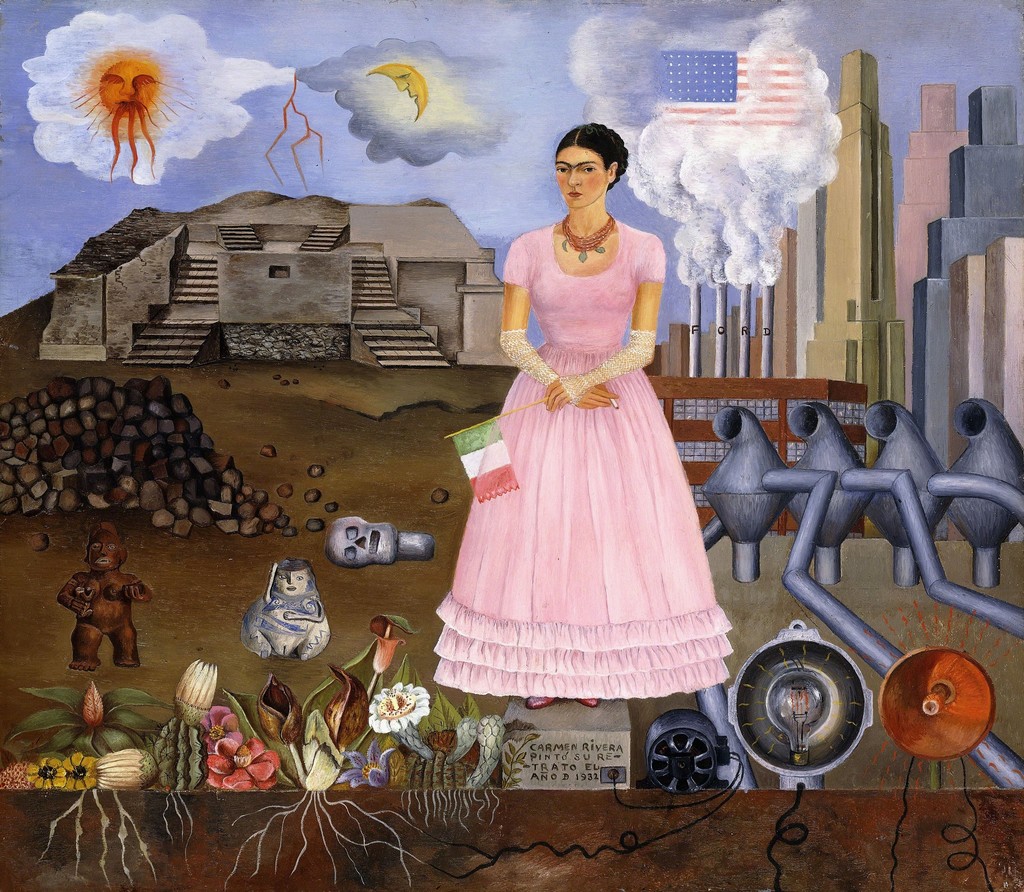
Painted in 1932 during Kahlo's fraught residence in Detroit, this small but commanding oil on metal depicts the artist standing at a literal and symbolic threshold between two worlds. Dressed in an elaborate pink gown, she occupies the center of the composition with quiet defiance, holding a Mexican flag in one hand and a cigarette in the other. To her left, the ancient monuments and fertile earth of Mexico rise alongside pre-Columbian sculpture and indigenous plants rooted in volcanic soil. To her right, the smokestacks and mechanical infrastructure of industrial America loom under a grey, electric sky. The opposition is pointed and deliberate, rendered with the tight, jewel-like precision characteristic of Kahlo's early work on metal support. The painting operates on multiple registers simultaneously, functioning as personal autobiography, political commentary, and cultural self-definition. Kahlo was in the United States accompanying Diego Rivera during his commission for the Detroit Industry Murals, a period she found alienating and physically difficult. Rather than depicting assimilation, she positions herself as an irreducible figure of Mexican identity, untouched by the industrial modernity surrounding her. The sun and moon hang together in the Mexican half of the sky, while electrical current threads back across the border to power the machines of the north, suggesting a complex, if unequal, interdependence between the two nations. Works of this period and subject matter rarely appear outside major institutional holdings, and this painting resides in the permanent collection of the Philadelphia Museum of Art. Its art historical significance is well-established, with the composition appearing in virtually every serious survey of twentieth century Latin American modernism. For collectors building positions in canonical works on paper and works on metal support, understanding the iconographic vocabulary Kahlo developed here is essential, as these symbols recur throughout her most celebrated subsequent paintings, making this piece a foundational reference point in her broader practice.

Signed
Yes
Location
Philadelphia Museum of Art, Philadelphia, PA
Start the Discussion

Request access to join the discussion

About this work

Frida Kahlo, Self-Portrait on the Border Line Between Mexico and the United States, 1932

Painted in 1932 during Kahlo's fraught residence in Detroit, this small but commanding oil on metal depicts the artist standing at a literal and symbolic threshold between two worlds. Dressed in an elaborate pink gown, she occupies the center of the composition with quiet defiance, holding a Mexican flag in one hand and a cigarette in the other. To her left, the ancient monuments and fertile earth of Mexico rise alongside pre-Columbian sculpture and indigenous plants rooted in volcanic soil. To her right, the smokestacks and mechanical infrastructure of industrial America loom under a grey, electric sky. The opposition is pointed and deliberate, rendered with the tight, jewel-like precision characteristic of Kahlo's early work on metal support. The painting operates on multiple registers simultaneously, functioning as personal autobiography, political commentary, and cultural self-definition. Kahlo was in the United States accompanying Diego Rivera during his commission for the Detroit Industry Murals, a period she found alienating and physically difficult. Rather than depicting assimilation, she positions herself as an irreducible figure of Mexican identity, untouched by the industrial modernity surrounding her. The sun and moon hang together in the Mexican half of the sky, while electrical current threads back across the border to power the machines of the north, suggesting a complex, if unequal, interdependence between the two nations. Works of this period and subject matter rarely appear outside major institutional holdings, and this painting resides in the permanent collection of the Philadelphia Museum of Art. Its art historical significance is well-established, with the composition appearing in virtually every serious survey of twentieth century Latin American modernism. For collectors building positions in canonical works on paper and works on metal support, understanding the iconographic vocabulary Kahlo developed here is essential, as these symbols recur throughout her most celebrated subsequent paintings, making this piece a foundational reference point in her broader practice.

Year
1932
Signed
Hand-signed by the artist
Seen at
Philadelphia Museum of Art, Philadelphia, PA
More works by Frida Kahlo