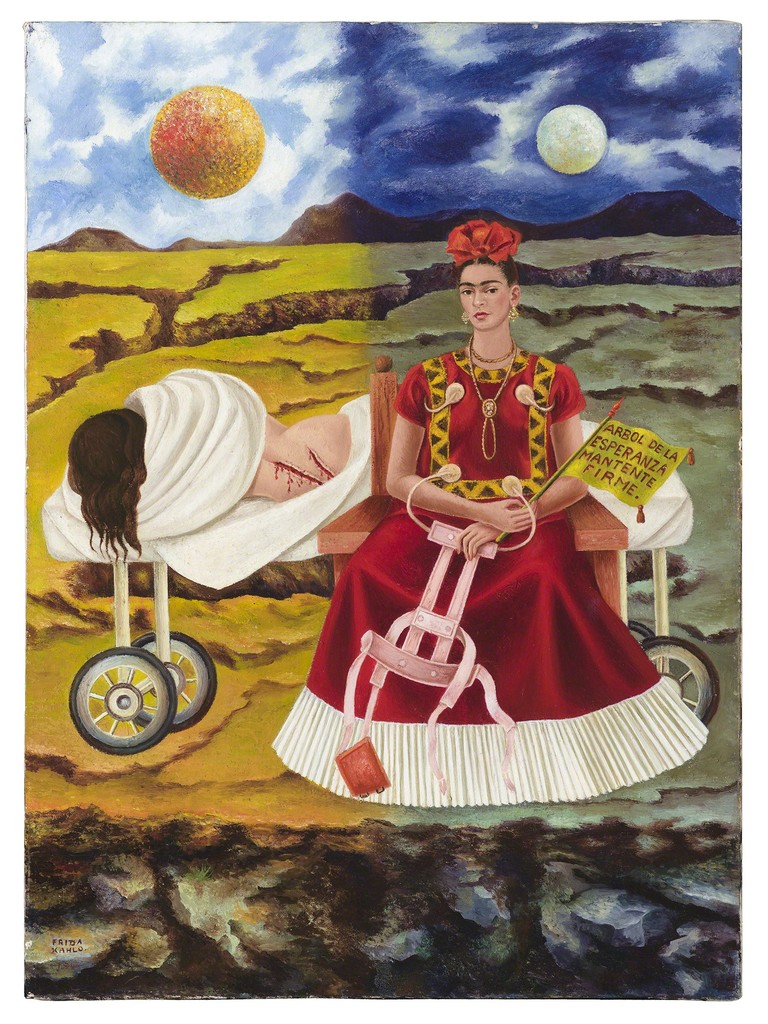
Arbol de la Esperanza (Tree of Hope)
1946
Painted in 1946 during one of the most physically grueling periods of Frida Kahlo's life, "Arbol de la Esperanza" presents a haunting duality rendered in rich, jewel-toned oil on masonite. The composition splits between day and night, depicting two versions of the artist seated and recumbent across a barren Mexican landscape. The wounded figure lies exposed on a medical gurney, her back bearing the scars of spinal surgery, while her upright counterpart clutches a red dress and a banner bearing the work's titular phrase, embodying resilience in the face of profound suffering. Kahlo completed this piece shortly after undergoing a spinal fusion in New York, and the autobiographical intensity embedded in every detail transforms personal trauma into a universal meditation on endurance and self-determination. At just 55.9 by 40.6 centimeters, the work achieves an intimacy that draws viewers into its layered symbolism, from the bifurcated sky evoking the cyclical nature of pain and recovery, to the vibrant costume standing as both armor and assertion of identity. The masonite support lends the surface a particular luminosity, allowing Kahlo's meticulous brushwork to sustain the painting's visual clarity across decades. This small-scale format was characteristic of her practice and heightens the confessional quality collectors respond to so strongly in her output. This is a rare opportunity to consider a work of genuine historical and art historical consequence. Kahlo's paintings number fewer than 150 in total, and works of this thematic weight and biographical directness appear on the market with extraordinary infrequency. Currently held at MCA Chicago, "Arbol de la Esperanza" represents the full convergence of Kahlo's technical mastery, symbolic vocabulary, and personal mythology, qualities that have secured her position as one of the most consequential painters of the twentieth century.
- Medium
- Oil on masonite
- Overall
- Signed
- Yes
- Spotted At
- Gallery · MCA Chicago
Start the Discussion
Request access to join the discussion