Join The Collection to save, track, and explore works like this.

Hans Holbein the Younger — Jean de Dinteville and Georges de Selve ('The Ambassadors')
Hans Holbein the Younger

Jean de Dinteville and Georges de Selve ('The Ambassadors')

1533

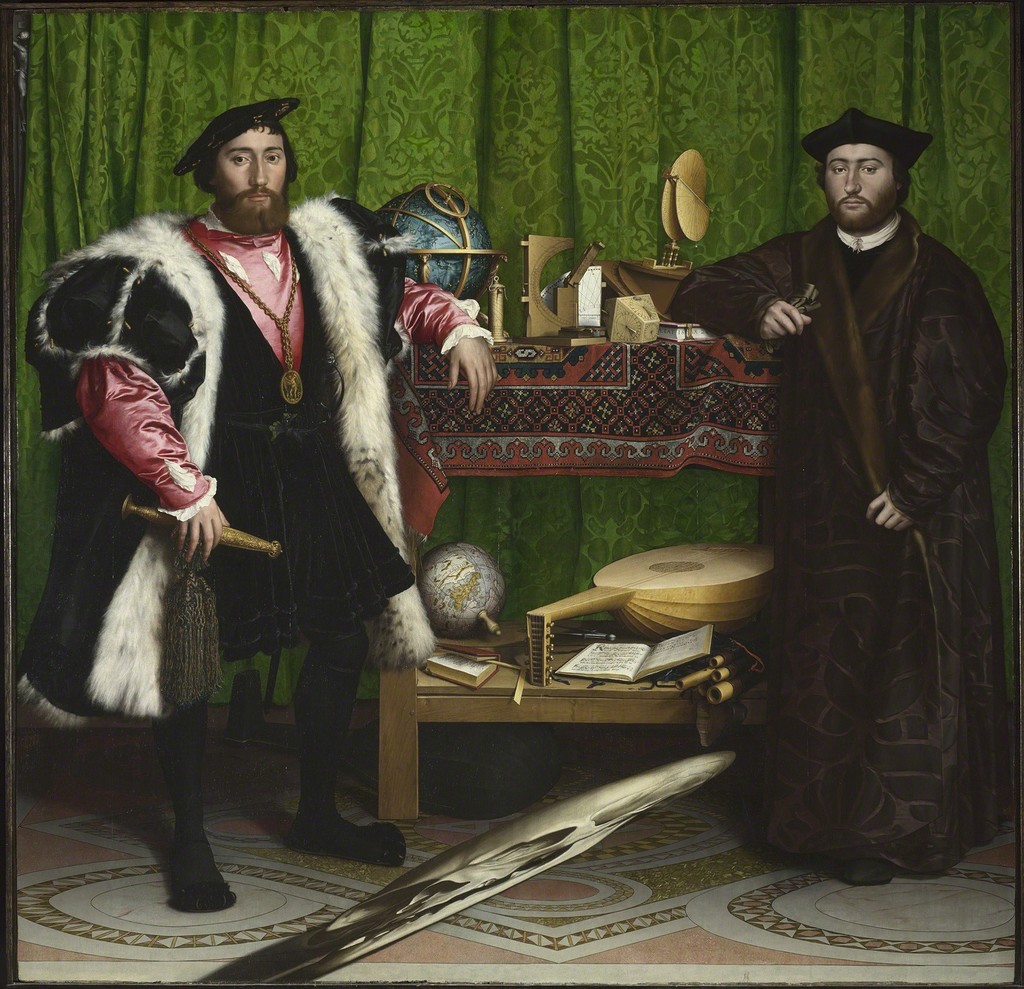
Painted in 1533 and measuring nearly seven feet square, this monumental double portrait presents two young French diplomats at the height of their powers, rendered with a precision that remains staggering nearly five centuries after its creation. Jean de Dinteville, French ambassador to the court of Henry VIII, stands at the left in a fur-trimmed coat, his assured gaze meeting the viewer directly, while his close friend Georges de Selve, Bishop of Lavaur, occupies the right with a quieter but equally commanding presence. Between them, a two-tiered table laden with scientific and musical instruments, including a celestial globe, a lute with a broken string, and an open Lutheran hymnal, constructs an elaborate visual argument about humanist learning, the tension between earthly ambition and spiritual life, and the fragile nature of harmony in a Europe fracturing along religious lines. What elevates this work beyond portraiture into the realm of philosophical painting is the extraordinary anamorphic skull stretched across the foreground, visible in its true form only when the canvas is viewed from a sharp angle to the right. This memento mori, hidden in plain sight beneath all the symbols of wealth and knowledge, insists that mortality is the one certainty no amount of learning or diplomatic power can negotiate away. The broken lute string and the arithmetic book open to a page on division reinforce this undercurrent of discord, suggesting that the world these men inhabit is one of unresolved tensions rather than triumphant mastery. Holbein executed this work during the period of his second stay in England, when his reputation as the foremost portraitist in northern Europe was firmly established, and the technical command on display here reflects that confidence fully. The oak panel support, the extraordinary rendering of textiles and material surfaces, and the disciplined control of light across the composition place this painting in a category occupied by very few works from any era. It is held in the permanent collection of the National Gallery in London, where it has long been regarded as one of the supreme achievements of Renaissance painting north of the Alps.

Medium
Oil on oak
Overall
Signed
Yes

Start the Discussion

Request access to join the discussion

About this work

Hans Holbein the Younger, Jean de Dinteville and Georges de Selve ('The Ambassadors'), 1533

Painted in 1533 and measuring nearly seven feet square, this monumental double portrait presents two young French diplomats at the height of their powers, rendered with a precision that remains staggering nearly five centuries after its creation. Jean de Dinteville, French ambassador to the court of Henry VIII, stands at the left in a fur-trimmed coat, his assured gaze meeting the viewer directly, while his close friend Georges de Selve, Bishop of Lavaur, occupies the right with a quieter but equally commanding presence. Between them, a two-tiered table laden with scientific and musical instruments, including a celestial globe, a lute with a broken string, and an open Lutheran hymnal, constructs an elaborate visual argument about humanist learning, the tension between earthly ambition and spiritual life, and the fragile nature of harmony in a Europe fracturing along religious lines. What elevates this work beyond portraiture into the realm of philosophical painting is the extraordinary anamorphic skull stretched across the foreground, visible in its true form only when the canvas is viewed from a sharp angle to the right. This memento mori, hidden in plain sight beneath all the symbols of wealth and knowledge, insists that mortality is the one certainty no amount of learning or diplomatic power can negotiate away. The broken lute string and the arithmetic book open to a page on division reinforce this undercurrent of discord, suggesting that the world these men inhabit is one of unresolved tensions rather than triumphant mastery. Holbein executed this work during the period of his second stay in England, when his reputation as the foremost portraitist in northern Europe was firmly established, and the technical command on display here reflects that confidence fully. The oak panel support, the extraordinary rendering of textiles and material surfaces, and the disciplined control of light across the composition place this painting in a category occupied by very few works from any era. It is held in the permanent collection of the National Gallery in London, where it has long been regarded as one of the supreme achievements of Renaissance painting north of the Alps.

Medium
Oil on oak
Dimensions
overall: 207 x 209.5 cm
Year
1533
Signed
Hand-signed by the artist
Seen at
The National Gallery, London

More works by Hans Holbein the Younger