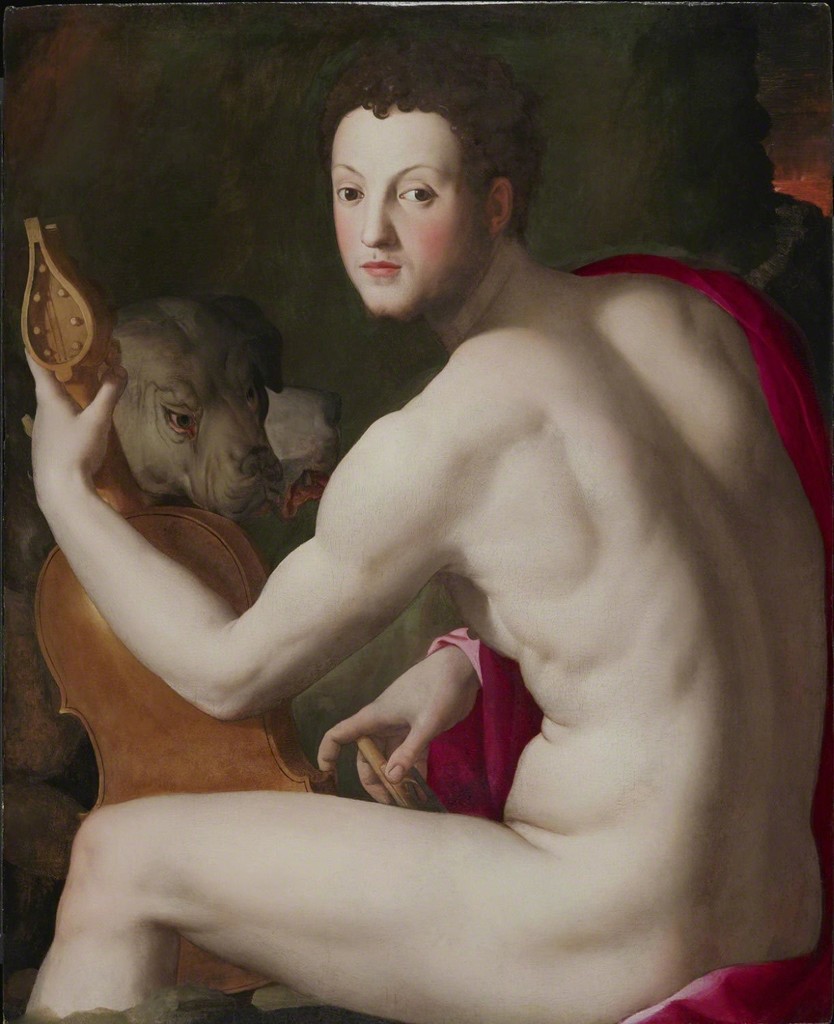
Cosimo d’ Medici as Orpheus
1537
Painted in 1537, this work presents the young Duke Cosimo I de' Medici in the guise of Orpheus, the mythological poet and musician whose song was said to charm all living creatures. Bronzino renders the nude figure with the cool, sculptural precision that defines his mature portraiture, every surface of the duke's body resolved with an almost lapidary clarity. At his feet, Cerberus, the three-headed guardian of the underworld, lies subdued, his ferocity dissolved by the power of Orpheus's lyre. The classical conceit operates on several registers simultaneously: it flatters the new Medici ruler as a sovereign whose authority flows not from brute force but from civilizing eloquence, casting political ambition in the language of Neoplatonic humanism. The painting's layered symbolism rewards sustained looking. The choice of Orpheus speaks directly to Cosimo's cultivation of the arts and letters as instruments of dynastic legitimacy, a project central to Medici self-presentation since the fifteenth century. Scholars have also connected the work to Cosimo's marriage to Eleonora di Toledo in 1539, suggesting it may have been conceived in relation to the festivities surrounding that union, with the myth of Orpheus descending to reclaim Eurydice offering a quietly charged parallel to a young ruler entering into married life. Whether read as allegory of peaceful governance, artistic patronage, or marital devotion, the picture functions as a sophisticated argument rendered in flesh and pigment. Bronzino was at the height of his powers when he completed this commission, and the result stands among the most ambitious portraits of the Italian Cinquecento. The combination of mythological narrative with idealized likeness demanded a painter capable of synthesizing antique sculptural sources with the living presence of a specific individual, and Bronzino achieves that synthesis with remarkable confidence. Held today in the Philadelphia Museum of Art, the work carries a distinguished exhibition history and represents an exceptional opportunity to engage with one of the defining achievements of Florentine Mannerism at its most intellectually refined.
- Signed
- Yes
- Location
- Philadelphia Museum of Art, Philadelphia, PA
Start the Discussion
Request access to join the discussion