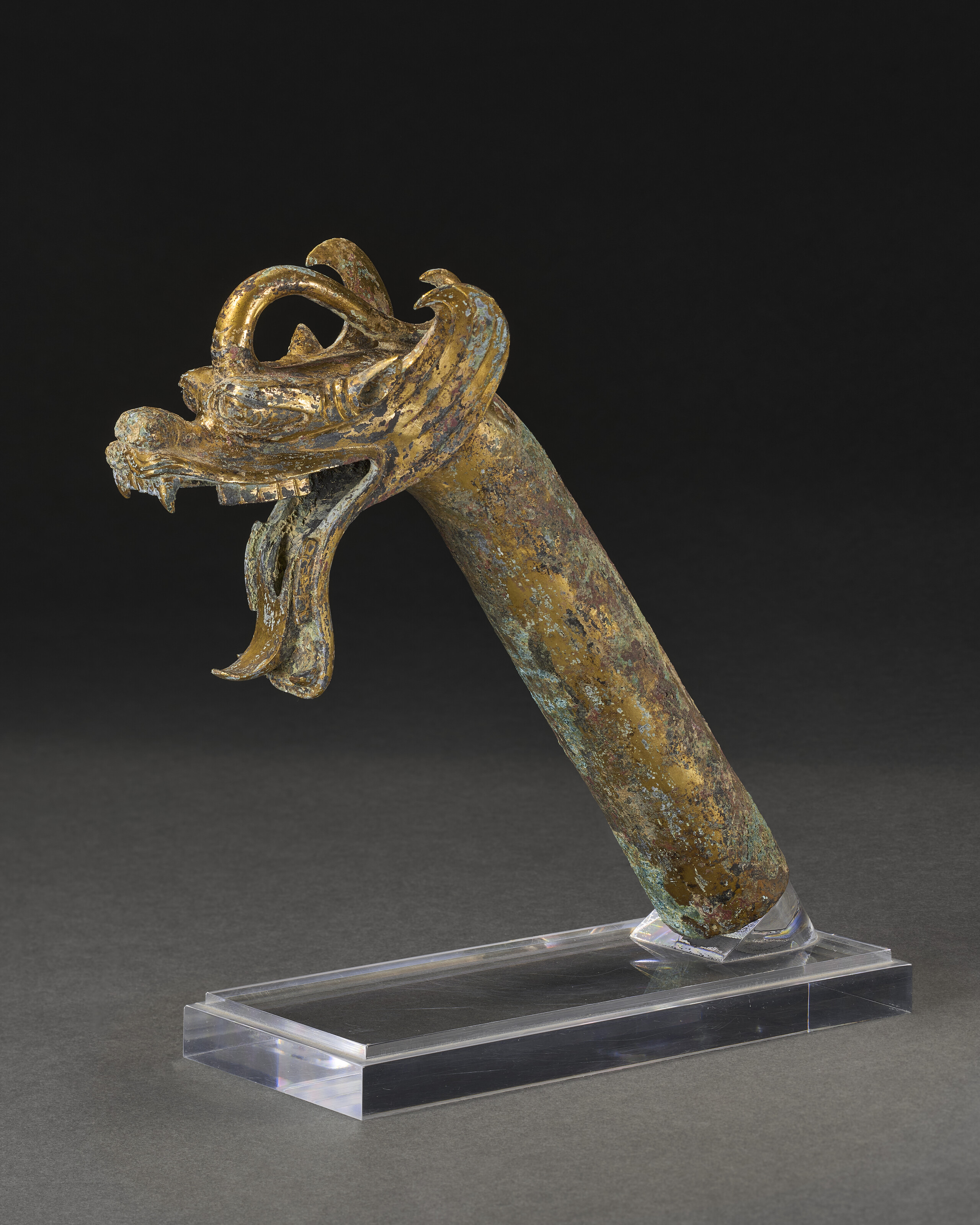
A Very Rare Large Gilt-bronze Dragon-head Finial
HAN DYNASTY-SIX DYNASTIES PERIOD (206 BC-AD 589)
This gilt bronze dragon head finial dates to the Han through Six Dynasties period (206 BC to AD 589), representing a rare and monumental example of Chinese metalwork craftsmanship. The piece likely served as an architectural ornament, crowning a roof ridge or ceremonial object where its fierce expression and precious gilded surface conveyed power and divine protection. The dragon's detailed modeling, with its open mouth and intricate surface decoration, exemplifies the sophistication of bronze casting techniques during this extended period of Chinese cultural development.
- Spotted At
- Auction House · Christie's
Notes
LOT ESSAY The present gilt-bronze dragon finial is impressive and unusual for its large size, powerful casting, and the survival of its tubular receptacle. Closely related dragon finials are typically smaller, often with closed mouths and paired horns, and they usually lack a tubular sleeve. For comparison, see the example in the Metropolitan Museum of Art, illustrated by J. Watt in “The Arts of Ancient China,” The Metropolitan Museum of Art Bulletin, n.s., 48, no. 1 (Summer 1990), pp. 40-1, cat. no. 49. By contrast, the present finial is cast with a single horn and an open, animated mouth, the jaws parted to reveal sharp teeth and a protruding tongue, lending the head a vivid sense of forward motion. The long, slightly tapering tubular element at the rear suggests that the finial was fitted as a terminal—possibly sleeved over a wooden pole or staff—though its precise function remains uncertain. Only one other closely comparable example appears to be recorded: a gilt-bronze dragon finial in the Miho Museum, Koka, Japan, dated to the Six Dynasties period, 6th century. (https://www.miho.jp/booth/html/artcon/00000431e.htm)
🔨 Auction Lot
Important Chinese Art
March 26, 2026
Estimate: $25,000 – $35,000
Sold: $27,940
Lot 673
Start the Discussion
Request access to join the discussion