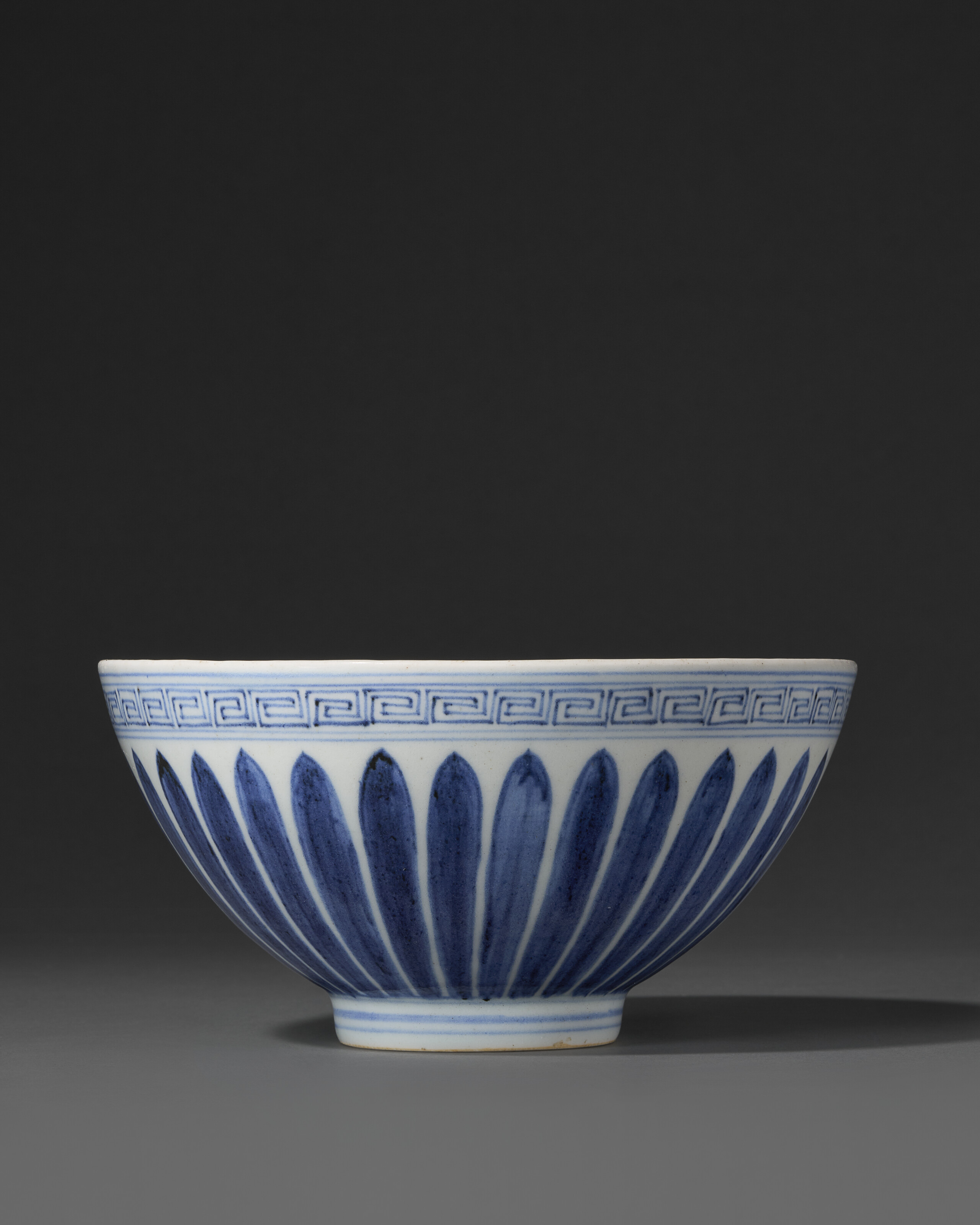
A Rare Large Blue And White ' Lianzi ' Bowl
XUANDE SIX-CHARACTER MARK IN UNDERGLAZE BLUE WITHIN A DOUBLE CIRCLE AND OF THE PERIOD (1426-1435)
This exceptional bowl exemplifies the technical mastery and aesthetic refinement of the Xuande period, one of the most celebrated eras of Chinese porcelain production. The underglaze blue decoration, rendered in the characteristic cobalt that defines Ming ceramics, demonstrates the precise control and sophisticated design sensibilities valued during Emperor Xuande's reign. The presence of the six-character reign mark within a double circle serves as both an imperial signature and a testament to the bowl's quality, as such marks were typically reserved for pieces of the highest caliber produced for court use.
- Spotted At
- Auction House · Christie's
Notes
LITERATURE Spink & Son Ltd., Exhibition of Blue and White Porcelain from the Collection of Mrs. Alfred Clark, London, 1974, no. 12. EXHIBITED London, Spink & Son Ltd., Exhibition of Blue and White Porcelain from the Collection of Mrs. Alfred Clark, 1974. Los Angeles, The J. Paul Getty Museum, The Arts of Fire: Islamic Influence on Glass and Ceramics of the Italian Renaissance, 4 May-5 September 2004. Conditions of sale Brought to you by Rufus Chen (陳嘉安) Head of Sale, AVP, Specialist Check the condition report or get in touch for additional information about this ASIANARTNY@CHRISTIES.COM +1 212 636 2180 VIEW CONDITION REPORT LOT ESSAY Bowls of this form—with gently rounded sides and a slightly tapered foot ring featuring a subtle bulge on the interior—are known as jixinwan, or “chicken-heart bowls.” They are also sometimes referred to as ‘lotus-seed bowls’ (lianzi) due to their resemblance to a lotus seed pod. This type is produced in three standard sizes, the largest measuring approximately 20 cm. in diameter, such as the current bowl. An example of the smaller version, measuring 10 cm., decorated similarly on the exterior but with Islamic-style scroll on the interior, is in the National Palace Museum collection and illustrated in Radiating Hues of Blue and White: Ming Dynasty Blue-and-White Porcelains in the National Palace Museum Collection, pp. 100–01, no. 38. The author notes that the smaller bowls were used as tea vessels. Another example of a small bowl with similar decoration to the present piece is illustrated in Catalogue of the Special Exhibition of Selected Hsuan-te Imperial Porcelain of the Ming Dynasty, Taipei, 1998, pp. 164–65, no. 155. See, also, a bowl from the Cole Collection sold at Sotheby’s London, 8 July 1974, lot 191, and again at Sotheby’s Hong Kong, 8 November 1982, lot 101. A variation of the design of the present bowl with two tiers of petals encircling the exterior is illustrated in the Idemitsu Museum of Art 15th Anniversary Catalogue, 1981, no. 792, and additional examples were included in the Philadelphia Exhibition of Ming Blue and White, Philadelphia, 1949, nos. 55 and 56. Bowls of this design are also found in tianbai (sweet white) glaze; for such an example, see Catalogue of the Special Exhibition of Selected Hsuan-te Imperial Porcelain of the Ming Dynasty, Taipei, 1998, pp. 160–65, no. 153.
🔨 Auction Lot
Important Chinese Art
March 26, 2026
Estimate: $200,000 – $300,000
Sold: $571,500
Lot 648
Start the Discussion
Request access to join the discussion