Join The Collection to save, track, and explore works like this.

Carmen Herrera —  Iberic
Carmen Herrera

Iberic

1949

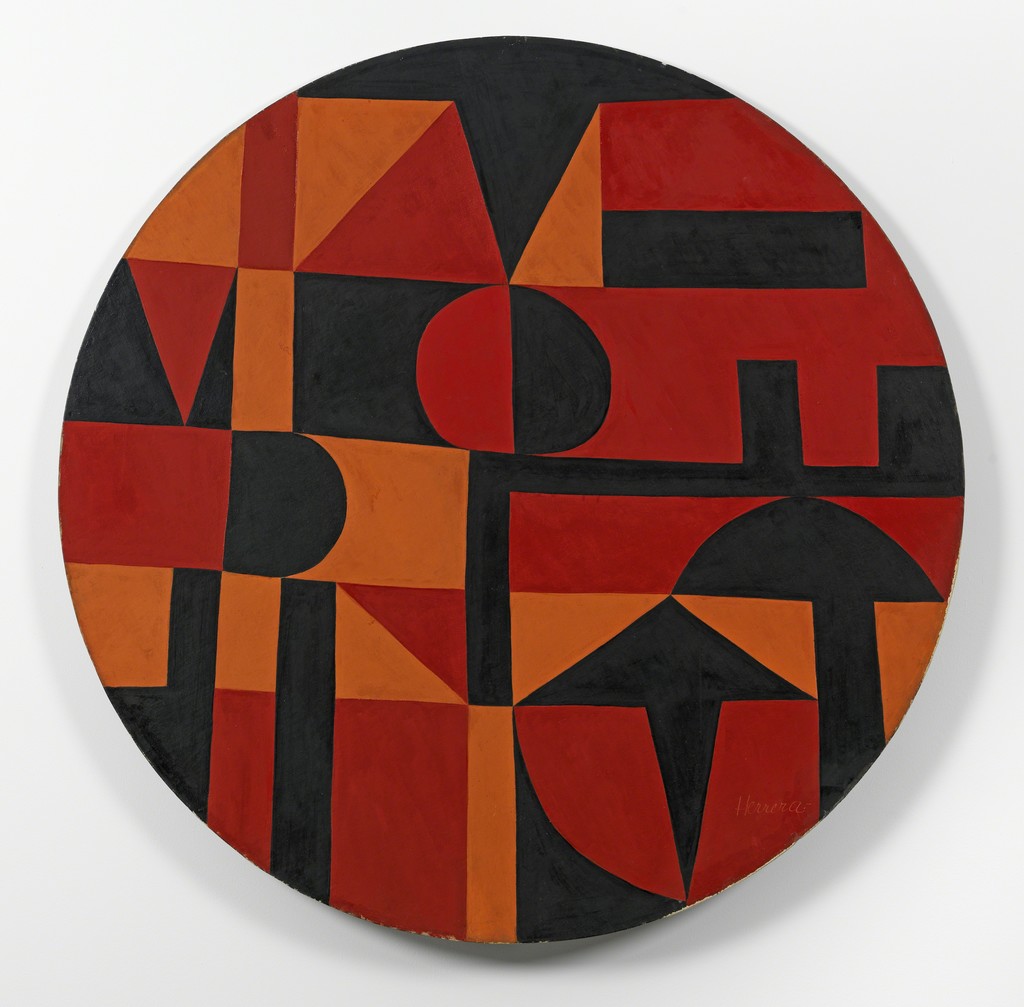
Executed in 1949, "Iberic" presents a circular canvas of striking geometric economy, its tondo format amplifying the taut interplay of form and color that would come to define Carmen Herrera's singular contribution to twentieth-century abstraction. Working within a perfect circle measuring just over a meter in diameter, Herrera deploys bold, cleanly resolved shapes that press against one another with a quiet but insistent tension. The composition achieves a rare equilibrium between dynamism and restraint, reflecting the visual language she was developing during her formative years in Paris, where she absorbed the lessons of European modernism while forging an aesthetic entirely her own. "Iberic" belongs to a pivotal period in Herrera's career, predating by decades the widespread recognition she would eventually receive, and its presence carries the particular weight of work made in committed artistic solitude rather than in response to market or critical expectation. The acrylic on canvas on board construction speaks to her meticulous attention to surface and support, lending the work a physical integrity that rewards close viewing. The title's geographic resonance hints at a cultural rootedness, a meditation on identity and origin filtered through the rigorously non-representational vocabulary she had chosen as her instrument. This work is currently held in the collection of the Whitney Museum of American Art, an institutional affiliation that underscores its art historical significance and the esteem in which it is now regarded. For collectors with an interest in geometric abstraction, Herrera's place in the canon is secure and still deepening, making "Iberic" not only a visually compelling acquisition but a work of genuine scholarly and cultural importance.

Medium
Acrylic on canvas on board
Signed
Yes
Location
Whitney Museum of American Art, Manhattan, United States
Start the Discussion

Request access to join the discussion

Collectors with works by Carmen Herrera

About this work

Carmen Herrera, Iberic, 1949

Executed in 1949, "Iberic" presents a circular canvas of striking geometric economy, its tondo format amplifying the taut interplay of form and color that would come to define Carmen Herrera's singular contribution to twentieth-century abstraction. Working within a perfect circle measuring just over a meter in diameter, Herrera deploys bold, cleanly resolved shapes that press against one another with a quiet but insistent tension. The composition achieves a rare equilibrium between dynamism and restraint, reflecting the visual language she was developing during her formative years in Paris, where she absorbed the lessons of European modernism while forging an aesthetic entirely her own. "Iberic" belongs to a pivotal period in Herrera's career, predating by decades the widespread recognition she would eventually receive, and its presence carries the particular weight of work made in committed artistic solitude rather than in response to market or critical expectation. The acrylic on canvas on board construction speaks to her meticulous attention to surface and support, lending the work a physical integrity that rewards close viewing. The title's geographic resonance hints at a cultural rootedness, a meditation on identity and origin filtered through the rigorously non-representational vocabulary she had chosen as her instrument. This work is currently held in the collection of the Whitney Museum of American Art, an institutional affiliation that underscores its art historical significance and the esteem in which it is now regarded. For collectors with an interest in geometric abstraction, Herrera's place in the canon is secure and still deepening, making "Iberic" not only a visually compelling acquisition but a work of genuine scholarly and cultural importance.

Medium
Acrylic on canvas on board
Year
1949
Signed
Hand-signed by the artist
Seen at
Whitney Museum of American Art, Manhattan, United States
More works by Carmen Herrera

Collected by

Alex Capecelatro