Join The Collection to save, track, and explore works like this.

De Wain Valentine — Circle, Sepia to Rose
De Wain Valentine

Circle, Sepia to Rose

1970

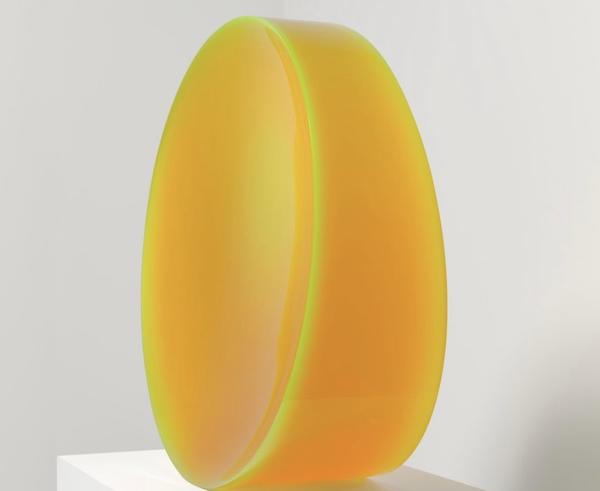
Cast in polyester resin and suspended between sepia and rose, this 1970 work by De Wain Valentine exemplifies the artist's mastery of optical depth within a self-contained geometric form. The circular format, modest in scale at just over 43 centimeters across, belies the visual complexity within: light enters the translucent material and disperses unevenly across its gradient field, creating the impression of luminous interior space rather than solid matter. The result is less a physical object than a lens through which warm, shifting tonalities seem to exist simultaneously on the surface and deep within the resin itself. Valentine was a central figure in the Light and Space movement that flourished in Southern California during the late 1960s and 1970s, and works such as this one demonstrate why his experiments with industrial casting resins earned sustained critical attention. He developed proprietary techniques for pouring and curing large volumes of polyester resin without the cracking and discoloration that plagued conventional methods, allowing him to achieve the smooth, flawless surfaces and controlled color gradients that define his practice. "Circle, Sepia to Rose" represents that technical ambition at an intimate scale, concentrating his signature concerns into a precisely resolved, hand-signed object. For collectors, the work carries both historical significance and immediate sensory presence. It belongs to a pivotal moment when West Coast artists were reconceiving sculpture as an encounter with light and perception rather than mass and form. Offered through Peter Blake Gallery, this piece arrives in excellent condition and represents a rare opportunity to acquire a signed work from one of Valentine's most celebrated series.

Medium
Cast polyester resin
Overall
Signed
Yes

For Sale — $85000

Start the Discussion

Request access to join the discussion

Spotted works by De Wain Valentine

About this work

De Wain Valentine, Circle, Sepia to Rose, 1970

Cast in polyester resin and suspended between sepia and rose, this 1970 work by De Wain Valentine exemplifies the artist's mastery of optical depth within a self-contained geometric form. The circular format, modest in scale at just over 43 centimeters across, belies the visual complexity within: light enters the translucent material and disperses unevenly across its gradient field, creating the impression of luminous interior space rather than solid matter. The result is less a physical object than a lens through which warm, shifting tonalities seem to exist simultaneously on the surface and deep within the resin itself. Valentine was a central figure in the Light and Space movement that flourished in Southern California during the late 1960s and 1970s, and works such as this one demonstrate why his experiments with industrial casting resins earned sustained critical attention. He developed proprietary techniques for pouring and curing large volumes of polyester resin without the cracking and discoloration that plagued conventional methods, allowing him to achieve the smooth, flawless surfaces and controlled color gradients that define his practice. "Circle, Sepia to Rose" represents that technical ambition at an intimate scale, concentrating his signature concerns into a precisely resolved, hand-signed object. For collectors, the work carries both historical significance and immediate sensory presence. It belongs to a pivotal moment when West Coast artists were reconceiving sculpture as an encounter with light and perception rather than mass and form. Offered through Peter Blake Gallery, this piece arrives in excellent condition and represents a rare opportunity to acquire a signed work from one of Valentine's most celebrated series.

Medium
Cast polyester resin
Dimensions
overall: 43.7 x 43.7 x 4.1 cm
Year
1970
Signed
Hand-signed by the artist
Seen at
Peter Blake Gallery

More works by De Wain Valentine

Collected by

Derek Jones