Join The Collection to save, track, and explore works like this.

Frederick Hammersley — Point of Hue
Frederick Hammersley

Point of Hue

1991

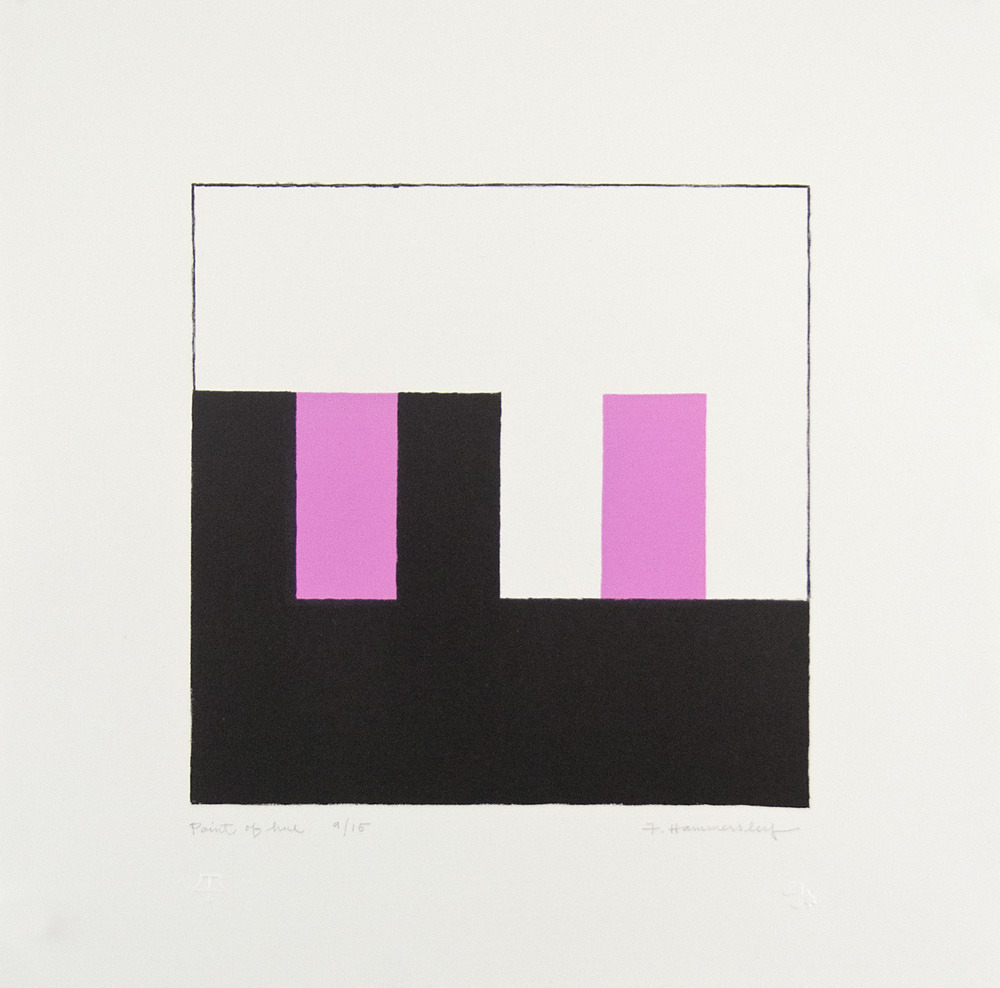
Point of Hue, a two-color lithograph completed by Frederick Hammersley in 1991, demonstrates the quiet precision and conceptual wit that defined his practice across decades of geometric abstraction. Printed in an edition of only fifteen and hand-signed by the artist, the work distills Hammersley's long investment in color relationships and grid-based form into a compact, nearly square sheet measuring 37.2 by 37.2 centimeters. The title itself functions as a lens, offering verbal instruction on how to read the composition, a device Hammersley employed throughout his printmaking to draw the viewer into dialogue with his non-objective arrangements. That interplay between language and image, between the named and the purely visual, gives the work a layered quality rare in hard-edge abstraction. Hammersley's path to prints of this caliber was shaped by an unusually broad education and an openness to working across media. His formation included study at Chouinard Art Institute and the Jepson Art Institute in Los Angeles, as well as coursework at the École des Beaux-Arts in Paris, where he arrived after serving as an Army sergeant during World War II and took the opportunity to visit the studios of Picasso, Brancusi, and Cézanne. He later held teaching positions at Pomona College, the Pasadena Art Museum, and the University of New Mexico before resigning from academic life in 1971 to focus entirely on his art. His New Mexico years were particularly generative for printmaking, and his collaborations at Tamarind Institute produced editions that extended his geometric sensibility into the unique physical and chromatic properties of lithography. Hammersley first achieved wide critical recognition in 1959 as one of the Four Abstract Classicists, alongside Karl Benjamin, Lorser Feitelson, and John McLaughlin, a designation that positioned his work within the rigorous, formally driven tradition of California hard-edge painting. His prints have since entered collections of considerable institutional weight, including the Solomon R. Guggenheim Museum, the National Gallery of Art, the Centre Pompidou, the Los Angeles County Museum of Art, and the Menil Collection, among many others. Point of Hue, refined in edition and intimate in scale, represents an ideal entry point into the thinking of an artist whose influence on postwar American abstraction continues to grow in scholarly and market recognition alike.

Medium
Two-color lithograph
Sheet
Signed
Yes
Location
Tamarind Institute, Albuquerque, NM

For Sale — $3500

Start the Discussion

Request access to join the discussion

Collectors with works by Frederick Hammersley
About this work

Frederick Hammersley, Point of Hue, 1991

Point of Hue, a two-color lithograph completed by Frederick Hammersley in 1991, demonstrates the quiet precision and conceptual wit that defined his practice across decades of geometric abstraction. Printed in an edition of only fifteen and hand-signed by the artist, the work distills Hammersley's long investment in color relationships and grid-based form into a compact, nearly square sheet measuring 37.2 by 37.2 centimeters. The title itself functions as a lens, offering verbal instruction on how to read the composition, a device Hammersley employed throughout his printmaking to draw the viewer into dialogue with his non-objective arrangements. That interplay between language and image, between the named and the purely visual, gives the work a layered quality rare in hard-edge abstraction. Hammersley's path to prints of this caliber was shaped by an unusually broad education and an openness to working across media. His formation included study at Chouinard Art Institute and the Jepson Art Institute in Los Angeles, as well as coursework at the École des Beaux-Arts in Paris, where he arrived after serving as an Army sergeant during World War II and took the opportunity to visit the studios of Picasso, Brancusi, and Cézanne. He later held teaching positions at Pomona College, the Pasadena Art Museum, and the University of New Mexico before resigning from academic life in 1971 to focus entirely on his art. His New Mexico years were particularly generative for printmaking, and his collaborations at Tamarind Institute produced editions that extended his geometric sensibility into the unique physical and chromatic properties of lithography. Hammersley first achieved wide critical recognition in 1959 as one of the Four Abstract Classicists, alongside Karl Benjamin, Lorser Feitelson, and John McLaughlin, a designation that positioned his work within the rigorous, formally driven tradition of California hard-edge painting. His prints have since entered collections of considerable institutional weight, including the Solomon R. Guggenheim Museum, the National Gallery of Art, the Centre Pompidou, the Los Angeles County Museum of Art, and the Menil Collection, among many others. Point of Hue, refined in edition and intimate in scale, represents an ideal entry point into the thinking of an artist whose influence on postwar American abstraction continues to grow in scholarly and market recognition alike.

Medium
Two-color lithograph
Dimensions
sheet: 37.2 x 37.2 cm
Year
1991
Edition
of 15
Signed
Hand-signed by the artist
Seen at
Tamarind Institute, Albuquerque, NM

More works by Frederick Hammersley

Collected by

Richard Caswell, Jonathan Murray