Join The Collection to save, track, and explore works like this.

Maurice Denis — Audi Filia
Maurice Denis

Audi Filia

1890

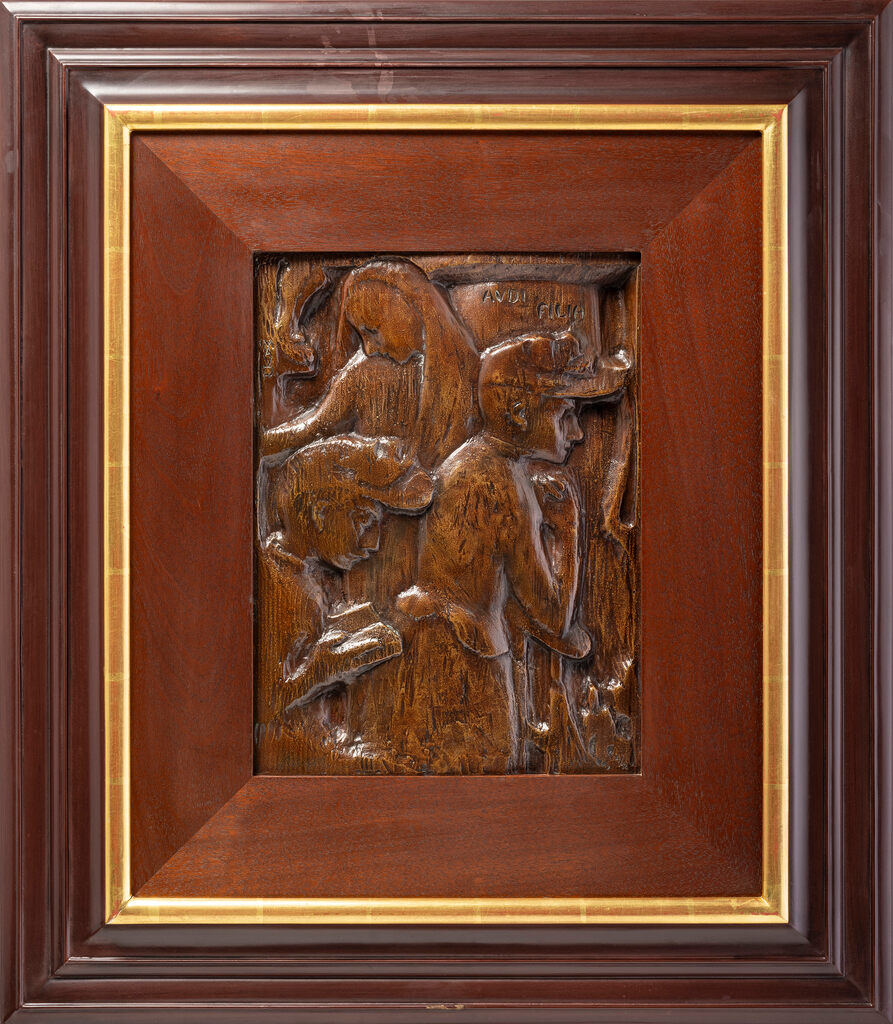
Rendered in bronze with a rich brown patina by the celebrated founder Georges Rudier, this bas relief of 1890 captures the contemplative stillness that defined Maurice Denis at the very outset of his mature practice. The surface treatment is remarkable in its fidelity to the woodcut medium from which the work is believed to have been cast, with Rudier patinating the bronze to evoke the texture and warmth of carved wood rather than the cool luminosity one typically associates with cast metal. Figures rendered with the quiet economy characteristic of Denis emerge from a composition suffused with the silence, purity, and geometric balance that critics have long associated with his illustrations of this period, works described as expressing life observed from a distance on a calm Sunday morning, populated by communicants, praying nuns, and women and children moving through counterbalanced fields of light and shade. The title draws from the opening line of Audi Filia, the celebrated devotional work by the sixteenth-century Spanish priest and reformer John of Avila, whose exhortation, "Listen O Daughter and see; incline your ear," resonates through the composition's mood of reverent attention. Denis consistently approached religious subject matter with a mysticism that connects him directly to Gauguin, Ranson, and Serusier, fellow travellers in the Nabi circle whose shared aesthetic flourished at Pont-Aven and whose engagement with spiritual imagery never descended into sentimentality. Like Gauguin, who carved in wood and whose bronzes are all posthumous casts, Denis and his Nabi contemporaries produced sculpture rarely and with an intimacy more private than commercial, lending each surviving cast an exceptional character. The scarcity of Denis bronzes in the auction record suggests that very few of his woodcut compositions have been translated into this medium, making the present work a genuinely uncommon object. Signed by the artist and presented framed, Audi Filia offers collectors a rare material intersection of Symbolist devotion, the Post-Impressionist woodcut tradition, and the distinguished craft of the Rudier foundry, the same house responsible for many of the most significant bronze editions of the late nineteenth and early twentieth centuries.

Medium
Bronze with rich brown patina, bas relief
Overall
Framed
Signed
Yes

For Sale — $16000

Start the Discussion

Request access to join the discussion

About this work

Maurice Denis, Audi Filia, 1890

Rendered in bronze with a rich brown patina by the celebrated founder Georges Rudier, this bas relief of 1890 captures the contemplative stillness that defined Maurice Denis at the very outset of his mature practice. The surface treatment is remarkable in its fidelity to the woodcut medium from which the work is believed to have been cast, with Rudier patinating the bronze to evoke the texture and warmth of carved wood rather than the cool luminosity one typically associates with cast metal. Figures rendered with the quiet economy characteristic of Denis emerge from a composition suffused with the silence, purity, and geometric balance that critics have long associated with his illustrations of this period, works described as expressing life observed from a distance on a calm Sunday morning, populated by communicants, praying nuns, and women and children moving through counterbalanced fields of light and shade. The title draws from the opening line of Audi Filia, the celebrated devotional work by the sixteenth-century Spanish priest and reformer John of Avila, whose exhortation, "Listen O Daughter and see; incline your ear," resonates through the composition's mood of reverent attention. Denis consistently approached religious subject matter with a mysticism that connects him directly to Gauguin, Ranson, and Serusier, fellow travellers in the Nabi circle whose shared aesthetic flourished at Pont-Aven and whose engagement with spiritual imagery never descended into sentimentality. Like Gauguin, who carved in wood and whose bronzes are all posthumous casts, Denis and his Nabi contemporaries produced sculpture rarely and with an intimacy more private than commercial, lending each surviving cast an exceptional character. The scarcity of Denis bronzes in the auction record suggests that very few of his woodcut compositions have been translated into this medium, making the present work a genuinely uncommon object. Signed by the artist and presented framed, Audi Filia offers collectors a rare material intersection of Symbolist devotion, the Post-Impressionist woodcut tradition, and the distinguished craft of the Rudier foundry, the same house responsible for many of the most significant bronze editions of the late nineteenth and early twentieth centuries.

Medium
Bronze with rich brown patina, bas relief
Dimensions
overall: 40 x 29.8 cm • framed: 125.1 x 67.3 cm
Year
1890
Signed
Hand-signed by the artist
Seen at
Taylor | Graham

More works by Maurice Denis

Collected by

Musée d'Art Moderne de Paris, Cleveland Museum of Art