Yue Minjun
Yue Minjun: The Laugh That Liberates
Artist Spotlight · The Collection Editorial
“I use laughter to explore the psychological state of people living through dramatic social transformation.”
Yue Minjun, interview with Artforum
When Sotheby's Hong Kong brought the hammer down on Yue Minjun's "Execution" in 2007, the painting fetched nearly six million dollars, setting an auction record for contemporary Chinese art and sending a clear signal to the global art world: this was an artist whose vision had permanently altered the conversation around modern China. The moment was not merely a market milestone. It was a recognition that Yue's singular language, built from a single cascading laugh repeated across enormous canvases, had said something essential about a civilization in transformation. Collectors, curators, and critics who had been watching his rise since the early 1990s felt the world finally catching up to what they already knew.
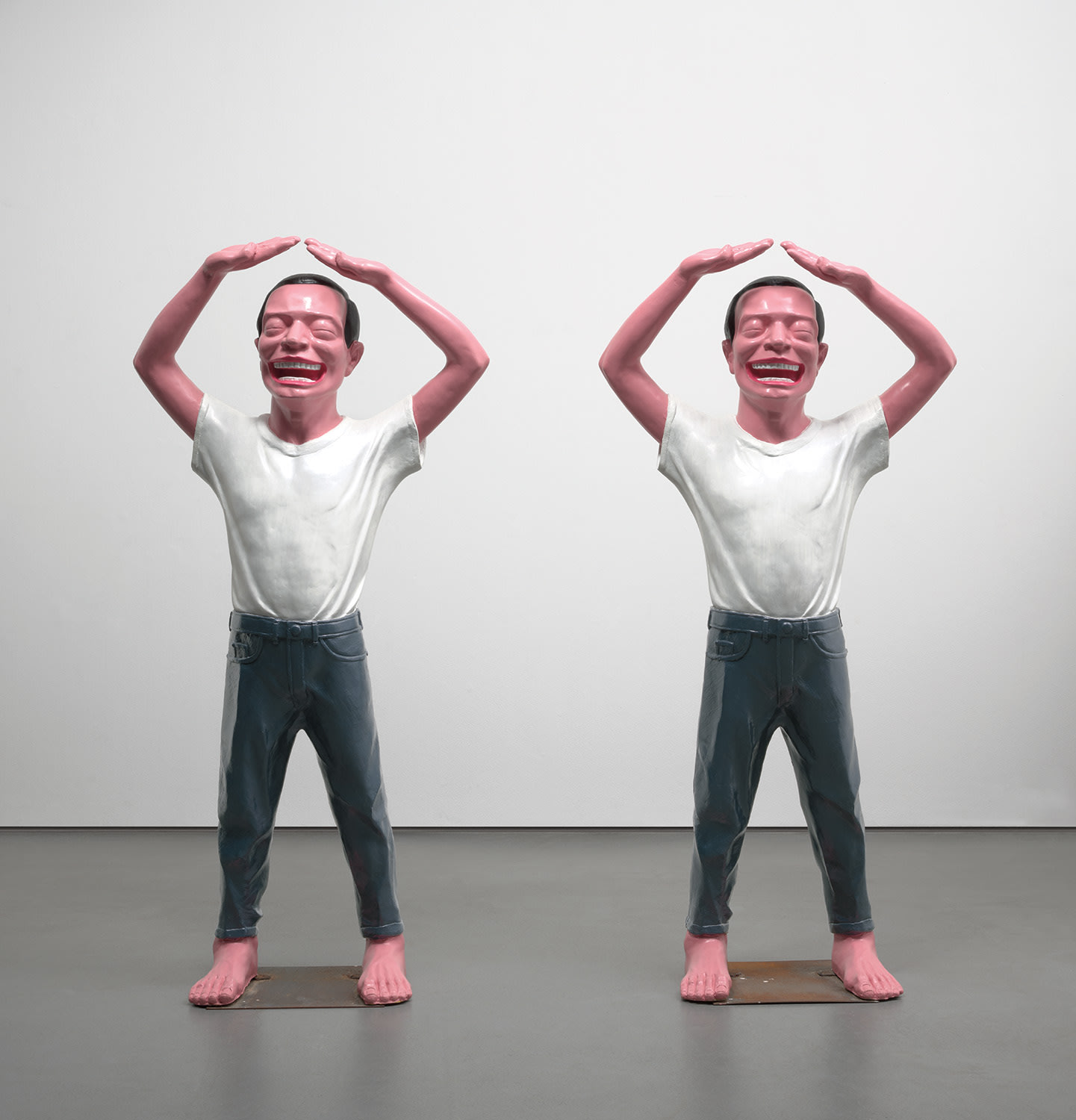
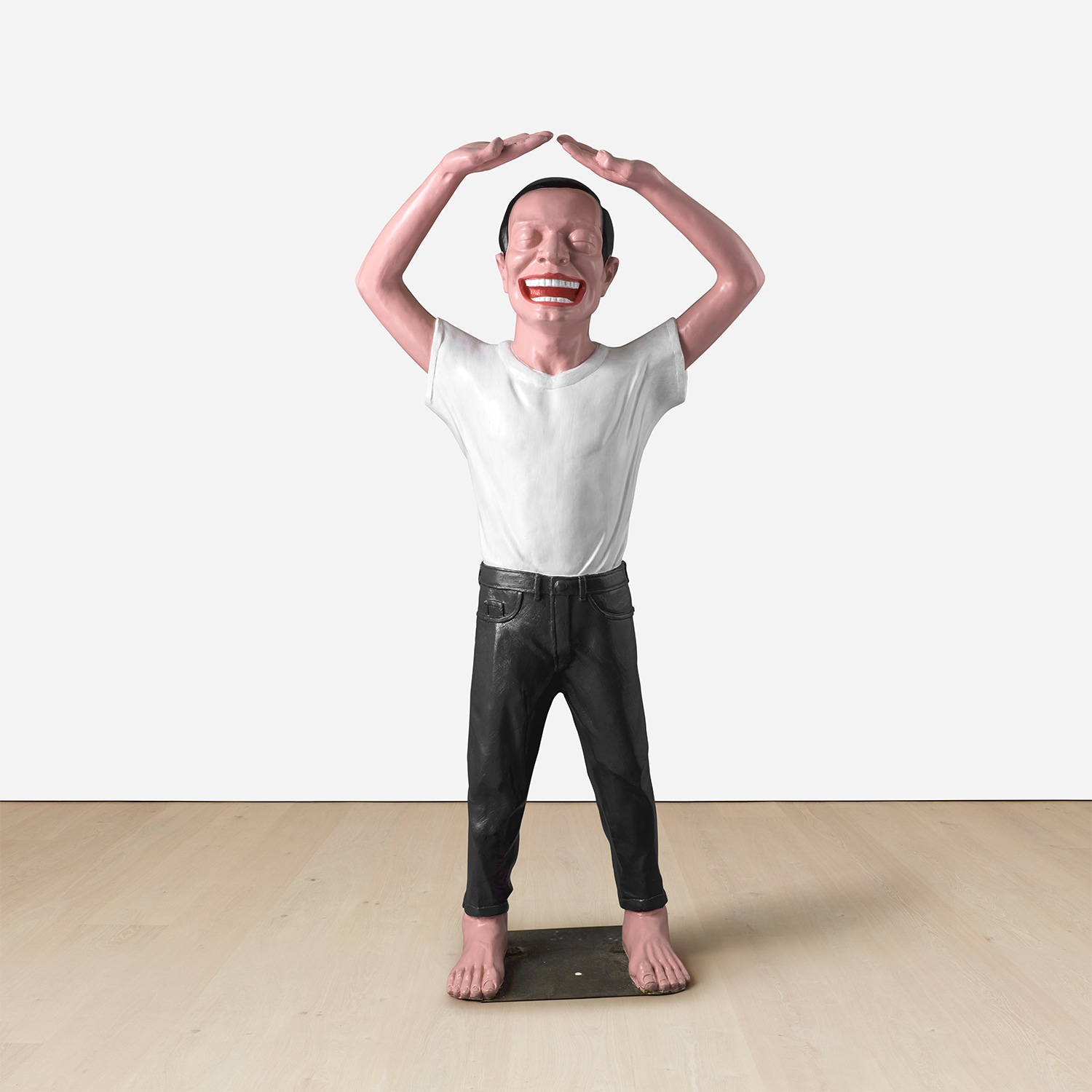
Yue Minjun
Two works: (i), 2003
Yue Minjun was born in 1962 in Heilongjiang province, in the far northeast of China, a region shaped by Soviet industrial influence and the long, cold winters of Manchuria. He came of age during the Cultural Revolution and its aftermath, absorbing firsthand the particular psychological weight of collective life under ideological pressure. He trained in oil painting at Hebei Normal University, graduating in 1989, a year whose significance for Chinese history needs no elaboration. The events of that summer in Beijing haunted an entire generation of artists, and Yue was among those who found that conventional modes of expression felt wholly inadequate to contain what they had witnessed and felt.
After leaving university he moved to the artist village of Yuanmingyuan on the outskirts of Beijing, a loose community of painters, poets, and experimental thinkers who gathered there in the early 1990s. This was the crucible in which Cynical Realism was born, a movement that took the heroic figuration of Socialist Realism and deflated it with irony, absurdity, and self aware theatricality. Alongside contemporaries such as Fang Lijun, whose similarly shaved, blank figures crowd his own canvases, Yue developed a visual philosophy rooted in the gap between official optimism and lived psychological reality. The laughing man, modeled always on Yue's own face, emerged as both confession and strategy: a mask that exposed more than it concealed.
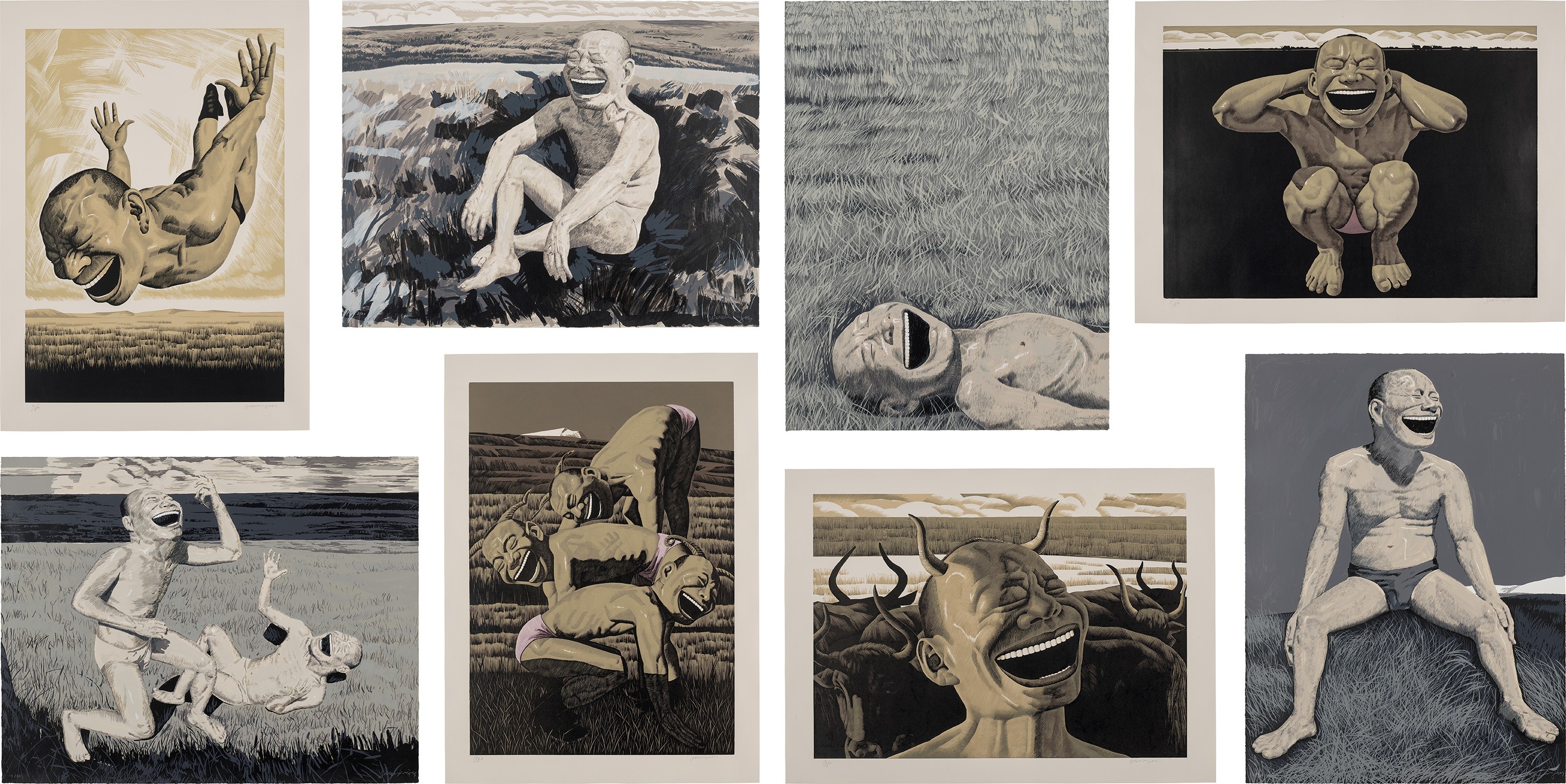
Yue Minjun
Eight works:, 2008
The signature image that defines Yue's practice is disarmingly simple and endlessly resonant. A figure, or a crowd of identical figures, throws its head back in a laugh so extreme it becomes unreadable as joy. The eyes are squeezed shut. The teeth are bared.
The laughter is contagious and yet somehow airless, as though joy and terror have been compressed into a single gesture that can no longer distinguish between them. Yue paints these figures on a monumental scale, often placing them within recognizable art historical settings, riffing on Manet, on Goya, on David, and on the propaganda aesthetics of his own cultural inheritance. The effect is simultaneously funny and vertiginous, like recognizing your own face in a funhouse mirror. His three dimensional work extends this language into sculpture with equal authority.
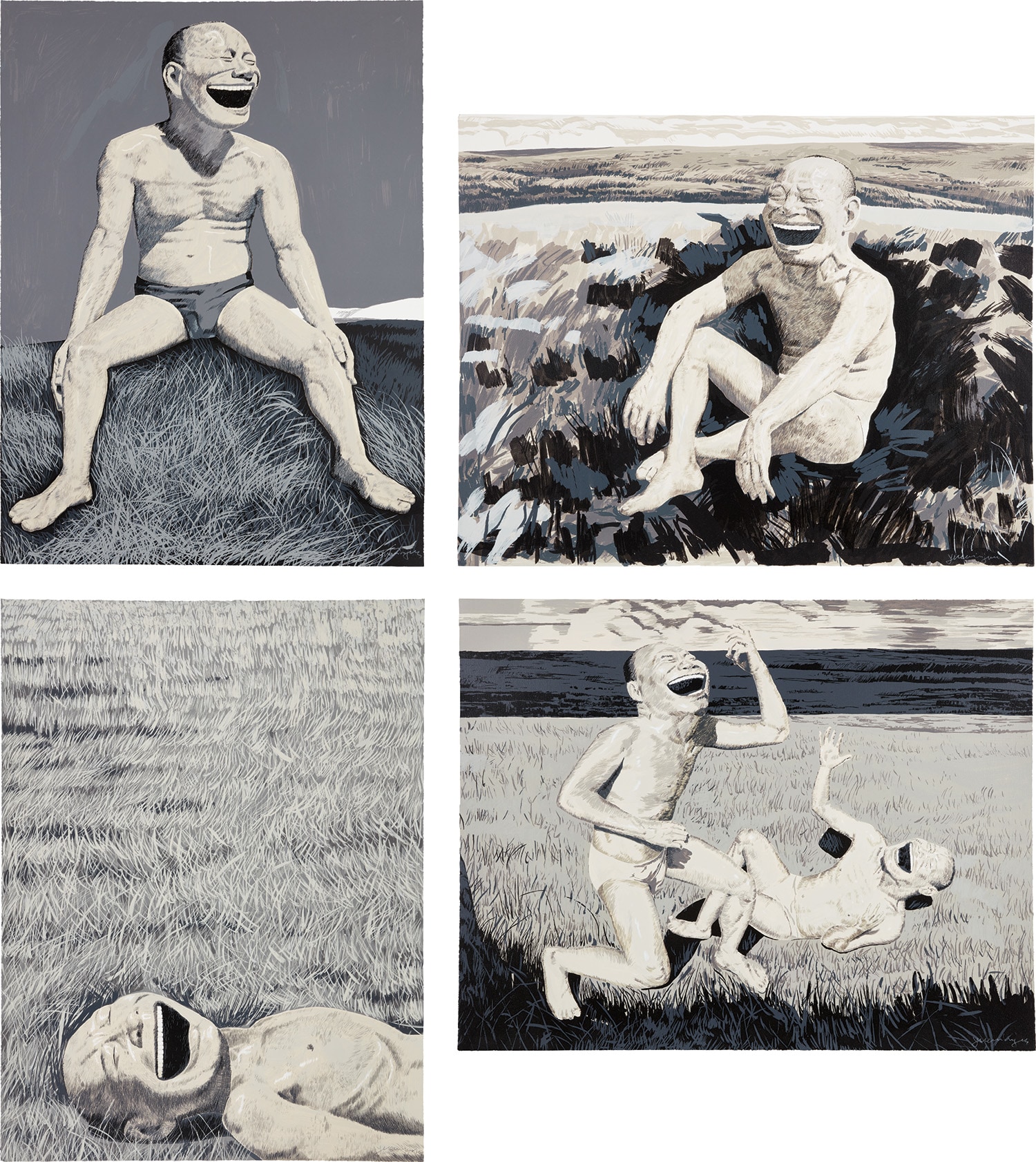
Yue Minjun
The Grassland Series: four plates
The "Contemporary Terracotta Warriors" series, several works from which are available on The Collection, translates the laughing figure into fibreglass and reinforced plastic, creating objects that stand in direct dialogue with China's most iconic ancient monuments. Where the original Terracotta Army was conceived as an instrument of imperial immortality, Yue's warriors laugh their way through eternity, their massed repetition suggesting both the comedy and the claustrophobia of collective identity. First shown in the early 2000s, these sculptures demonstrated that Yue's sensibility was not confined to painting but operated as a coherent philosophical system across all materials and formats. "Mushroom Cloud" from 2002, acrylic on canvas, is among the works that show Yue at his most ambitious in terms of subject matter.
Placing his laughing figures against the billowing aftermath of an atomic detonation, the painting forces its impossible question with characteristic lightness: what does the human face do in the presence of catastrophe? The answer Yue offers is not despair but this same enigmatic, unstoppable laughter. It is a painting about the psychological survival instinct, about the way communities and individuals absorb historical trauma and continue moving. Collectors who have lived with this work describe it as one of those rare objects that changes slightly depending on the mood of the room.
Yue Minjun
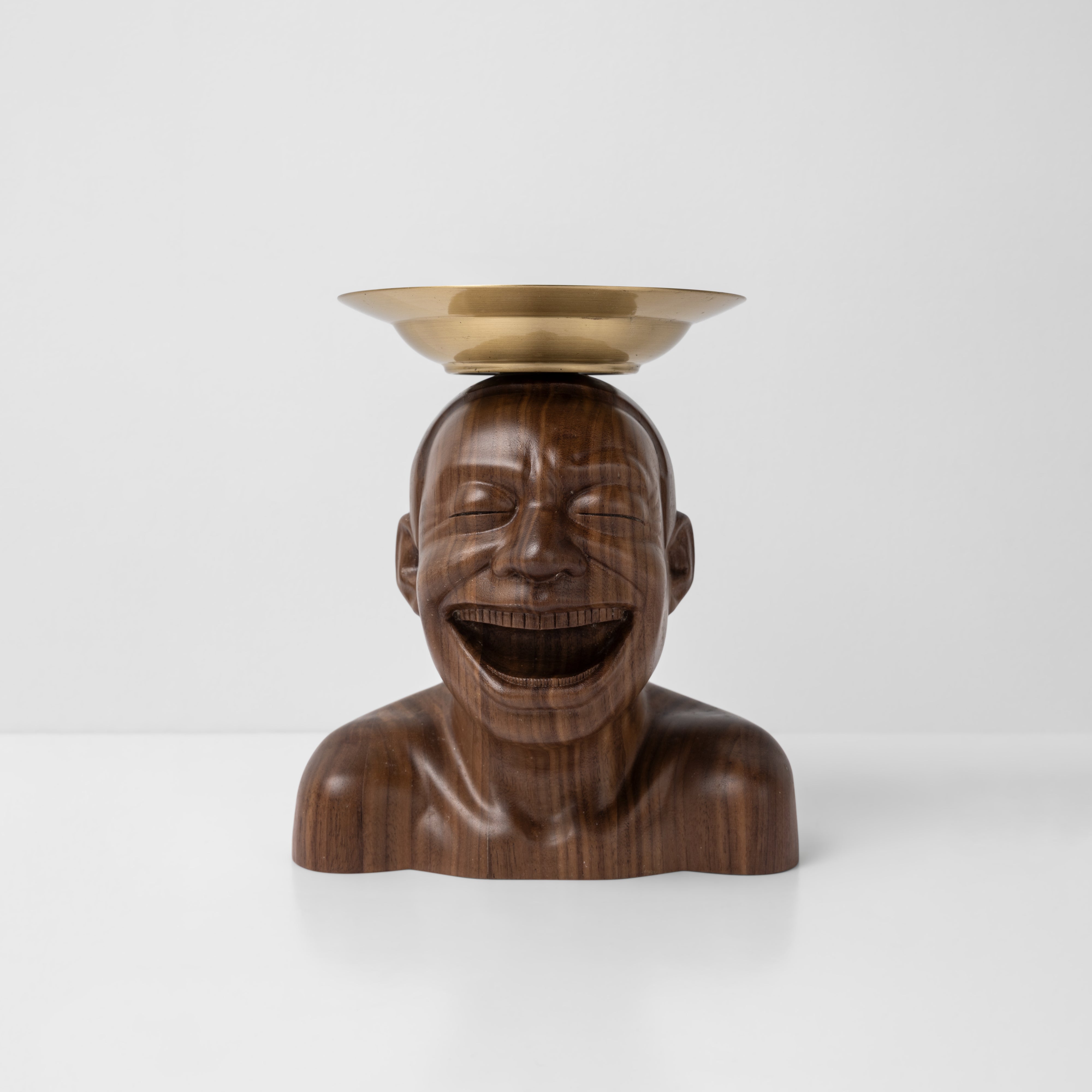
Surplus Value (Brown)
From a collecting perspective, Yue Minjun's market is one of the most legible in contemporary Asian art. His large scale oil paintings on canvas represent the apex of the market and have consistently attracted institutional and major private buyers, with works held by the San Francisco Museum of Modern Art and the Rubell Museum in Miami confirming his place in the permanent canon. For collectors entering at different price points, his editions and multiples offer exceptional access. The "Surplus Value" copper and wood multiples, published by AllRightsReserved Ltd.
in Hong Kong, are among the most thoughtfully produced artist's editions in the secondary market, contained in their original wooden boxes with the care of objects that know their own worth. The Grassland Series prints, published by Pace Editions in New York, carry the institutional imprimatur of one of the most respected print publishers in the world. Both series appear on The Collection and reward close attention. Within the broader context of art history, Yue sits at a genuinely interesting intersection.
His debt to Francis Bacon is audible in the psychological intensity of his faces, while his engagement with art historical quotation connects him to the Pictures Generation and to artists such as Sigmar Polke, who similarly used appropriation and irony as instruments of political thought. In China, his dialogue with Fang Lijun, Wang Guangyi, and Zhang Xiaogang defined a generation that processed the end of the Maoist era through the body, through the face, through the figure rendered strange. These artists together constitute one of the most coherent and historically significant movements to emerge anywhere in the world during the 1990s, and Yue remains its most internationally recognized voice. What makes Yue Minjun matter today, several decades into a career of remarkable consistency, is the way his central image continues to expand its meanings without losing its force.
In a world saturated by performative positivity, by social media expressions of happiness that may or may not correspond to inner states, the laughing man feels more contemporary than ever. He is not a figure of nihilism but of endurance, of the human capacity to process overwhelming experience through a gesture that holds everything at once. To collect Yue Minjun is to bring into your space a work of genuine philosophical seriousness dressed in the most immediately accessible visual language imaginable. That combination is extraordinarily rare, and it is why his audience continues to grow.