Yoshida Hiroshi
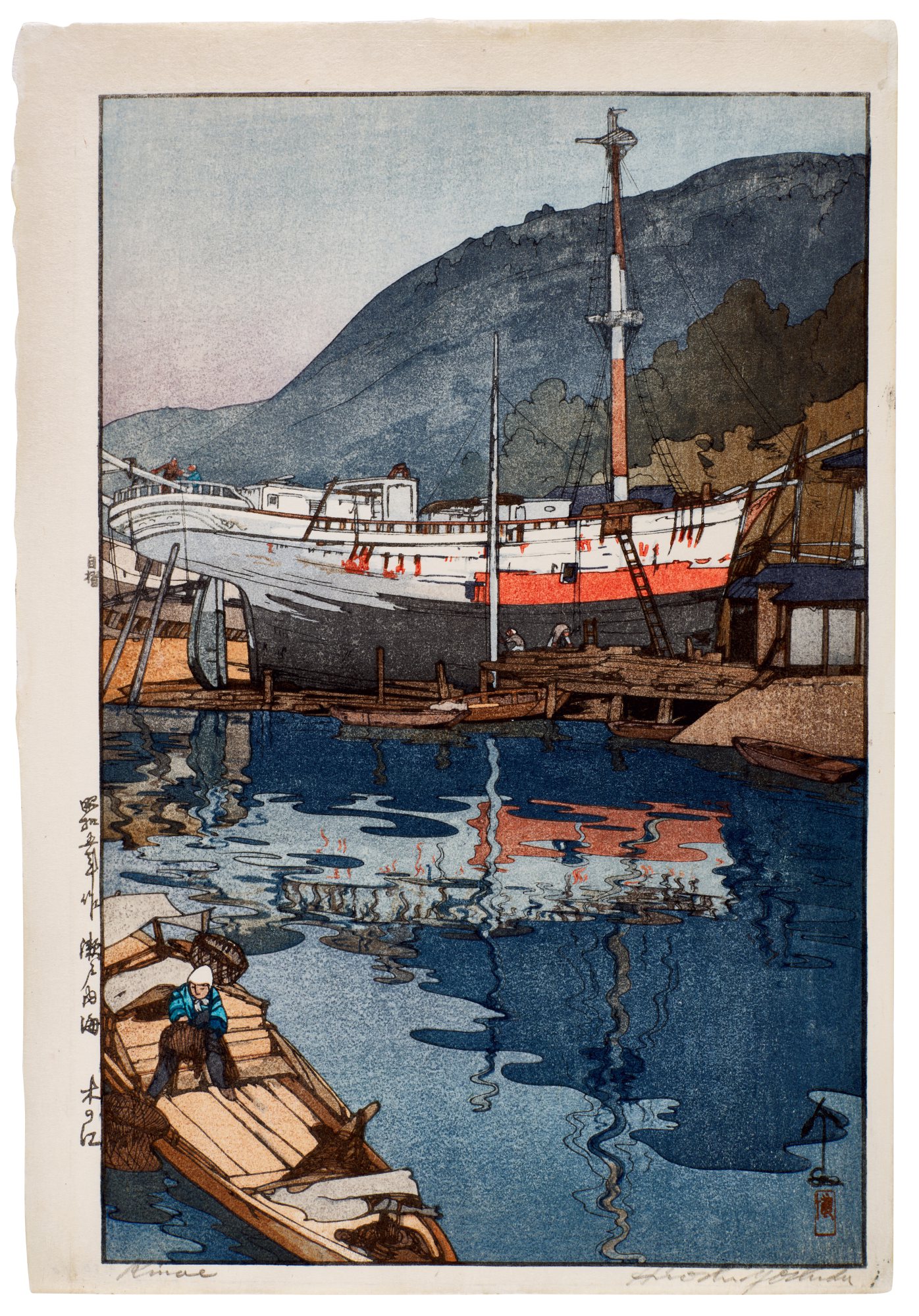
Yoshida Hiroshi: Where East Meets Infinite Sky
Artist Spotlight · The Collection Editorial
Stand before one of Yoshida Hiroshi's woodblock prints long enough and something remarkable happens. The image does not simply sit there on the paper. It breathes. Light shifts across a mountain pass.
Yoshida Hiroshi
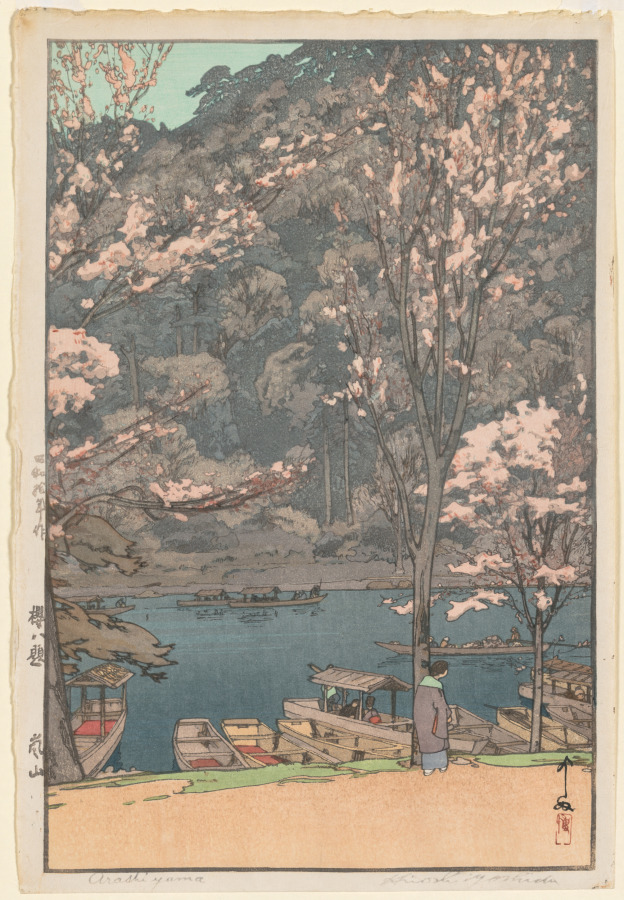
Eight Scenes of Cherry Blossom: Arashiyama, 1935
Mist gathers above temple eaves. Cherry blossoms seem on the verge of releasing from their branches. This is the singular achievement of an artist who spent a lifetime learning how to hold stillness and atmosphere together within the precise geometry of a woodblock print, and whose work, more than a century after it was first created, continues to stop viewers in their tracks in museum galleries from Tokyo to New York to London. Yoshida Hiroshi was born in 1876 in Asakura, in Fukuoka Prefecture, into a Japan that was remaking itself with extraordinary speed.
The Meiji Restoration had set the country on a course of rapid modernization, and the cultural conversation of the period was alive with tension between inherited tradition and the rush of Western influence. He was adopted as a young man by the painter Yoshida Kasaburo, who recognized his talent early and guided his initial formation. This foundational relationship gave Hiroshi not only a family name but also an entrée into the serious world of Japanese fine art at a pivotal historical moment. He trained first in Western style oil painting, studying under Tamura Soryu and eventually exhibiting his oil works to considerable acclaim, which distinguishes him from many of his contemporaries who remained rooted in a single tradition from the outset.
Yoshida Hiroshi
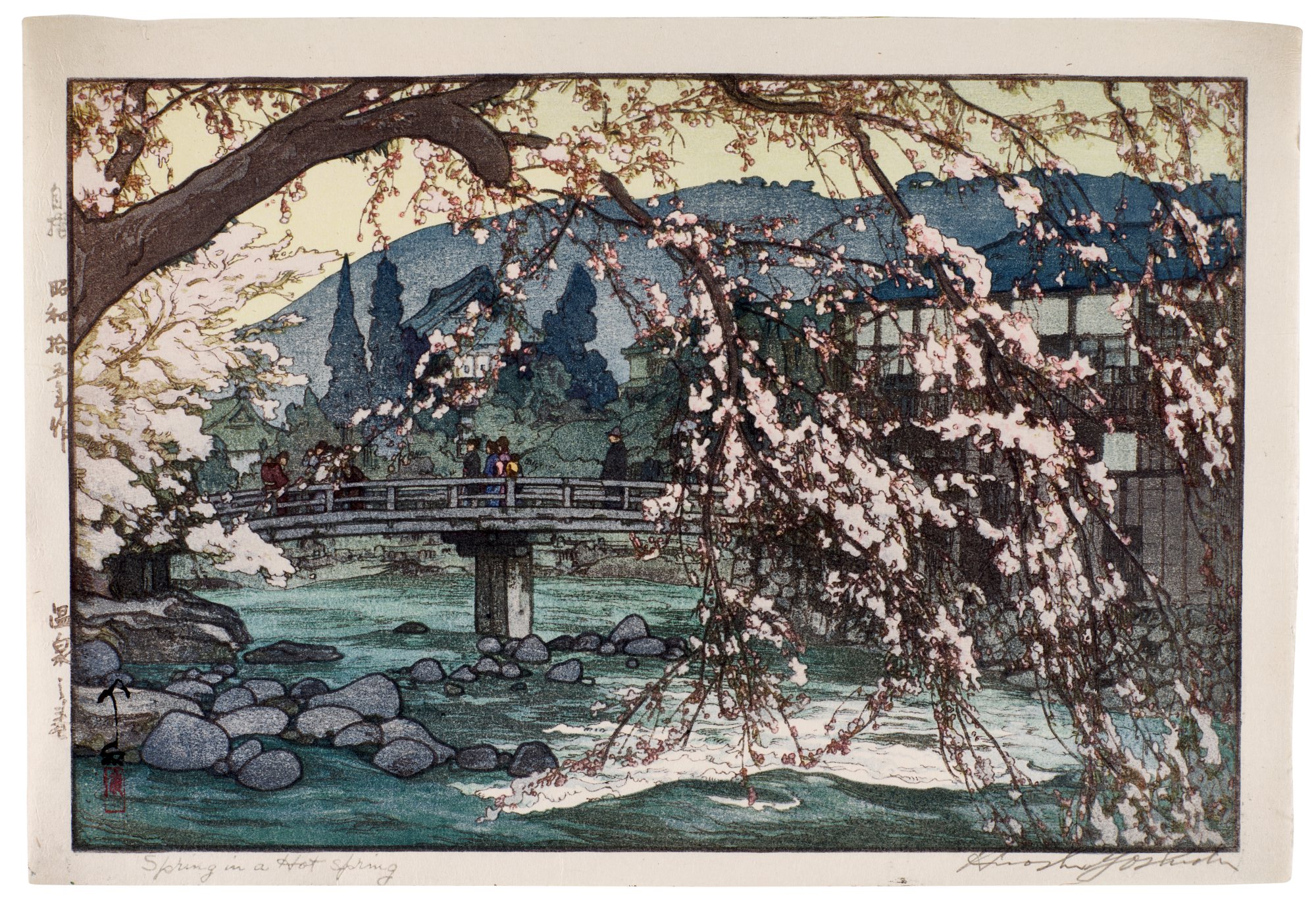
Spring in a Hot Spring (Onsen no haru) | Showa period, 20th century
His early career as a painter took him abroad, and his travels to the United States and Europe in the late 1890s and early 1900s proved formative in ways that would ripple through everything he made afterward. He exhibited successfully in American cities and absorbed the influence of Western landscape traditions with the attentiveness of someone who was always also thinking about what he would bring home. But it was his encounter with the landscape print tradition of Japan, revisited through fresh eyes and with a painter's understanding of light and composition, that ultimately defined his artistic identity. Around 1920 he committed himself fully to woodblock printing, and the work he produced in the decades that followed represents one of the great bodies of achievement in the history of the medium.
Yoshida worked within the shin hanga movement, a term meaning new prints, which sought to revitalize the traditional ukiyo e woodblock print for a modern audience while preserving the collaborative craft process in which the artist worked alongside skilled carvers and printers. Yet he was also drawn to the ideals of the sosaku hanga movement, in which the artist controlled every stage of production independently. This tension between collaboration and personal control became a creative engine for him. He developed an extraordinary technical vocabulary, most notably his practice of printing multiple states of a single image, capturing different times of day or atmospheric conditions, which he labeled with the notation jizuri, meaning self printed.
Yoshida Hiroshi
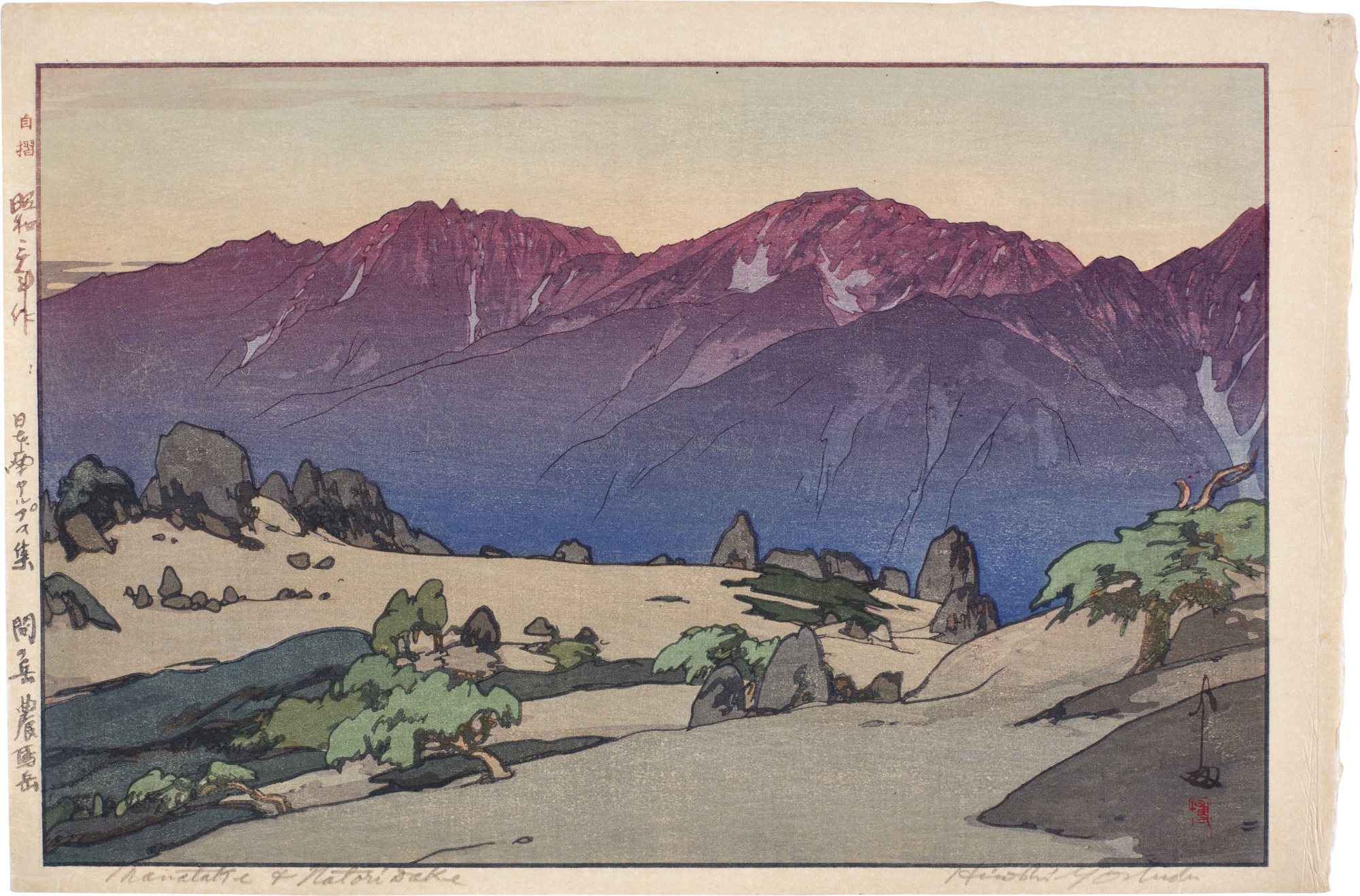
Manotake and Notoridake (Manotake, Notoridake) | Showa period, 20th century
These variant editions allowed him to explore the same landscape across a spectrum of light and mood, transforming the woodblock print from a fixed object into something closer to a meditation on perception itself. Among the works that best exemplify his mastery, the 1935 woodblock print Eight Scenes of Cherry Blossom: Arashiyama stands as a particular achievement. The Arashiyama district outside Kyoto, with its mountainous backdrop and the famous cherry trees along the Oi River, offered Hiroshi a subject of enormous historical resonance in Japanese culture, and his treatment of it demonstrates how thoroughly he had internalized both the weight of that tradition and his own capacity to see it anew. His prints of Japanese mountain landscapes, including works depicting Manotake and Notoridake, reveal his command of elevation and scale, the way a summit can be simultaneously majestic and intimate depending on how light is distributed across the composition.
Works such as Misty Day in Nikko show his sensitivity to weather as a subject in its own right, not merely a backdrop but a presence with its own emotional register. His travels beyond Japan produced prints of remarkable range, including the Taedong Gate in Pyongyang, evidence that his observational gift was not confined to the landscapes of his homeland. For collectors, Yoshida Hiroshi represents one of the most compelling opportunities within the field of Japanese printmaking from the early twentieth century. His prints appear regularly at major auction houses, and while his most celebrated works command prices that reflect his standing as a canonical figure, the breadth of his output means that dedicated collectors at various levels can find their way into the work.
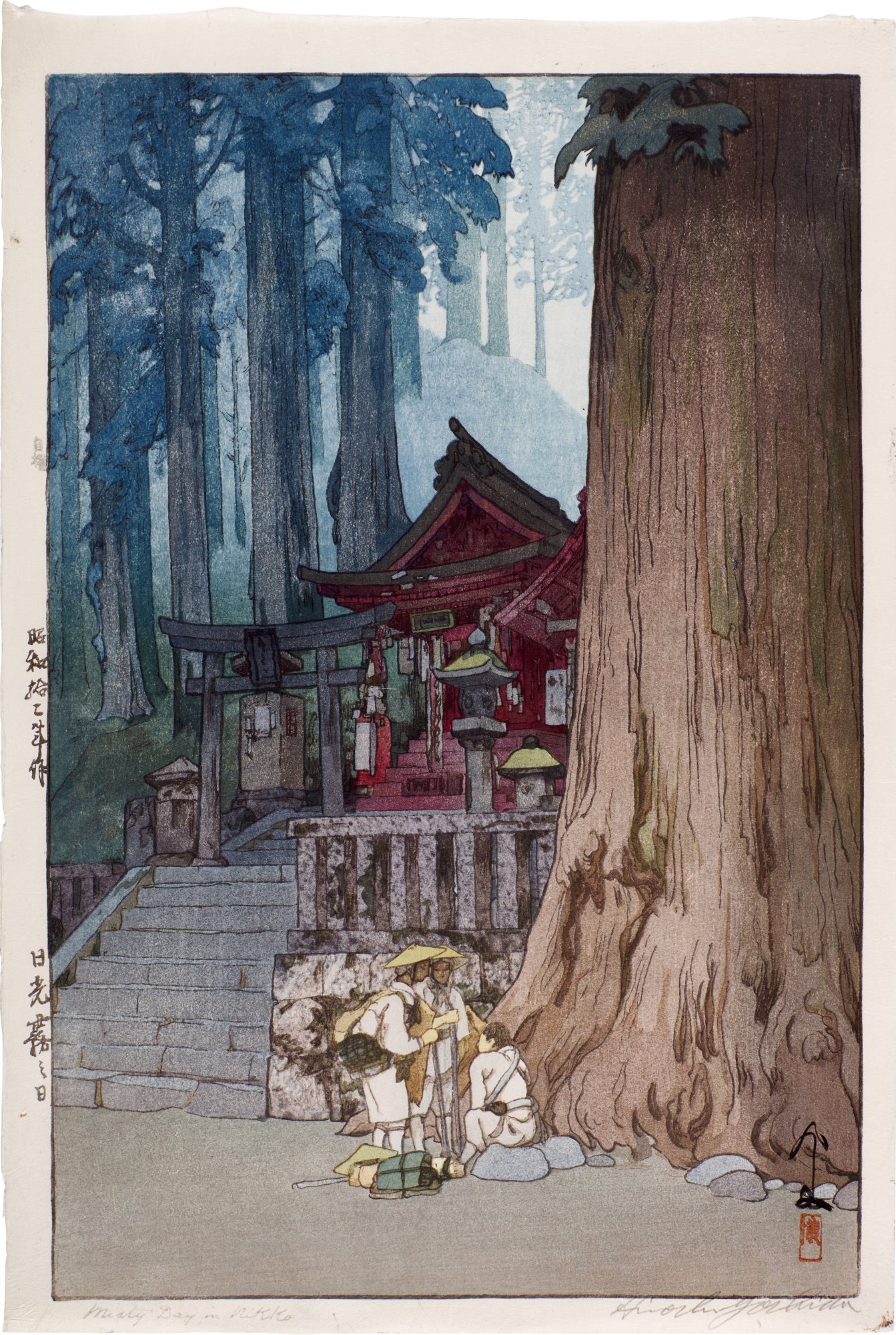
Yoshida Hiroshi
Misty Day in Nikko (Nikko kiri no hi) | Showa period, 20th century
The jizuri editions are particularly prized, as they offer a window into his personal engagement with a composition and carry the additional rarity of direct artistic intervention. When evaluating a Yoshida print, condition is paramount, as his characteristic use of layered color and atmospheric gradation, achieved through a technique called bokashi, is exquisitely sensitive to light exposure and handling over time. Works from the Showa period, which dominated much of his most productive decades, are widely available and offer collectors a strong introduction to his vision. Earlier Taisho period works, such as Snow Grouse and Dicentra Flowers, demonstrate his range beyond pure landscape and are especially rewarding to seek out.
Within the broader landscape of Japanese printmaking, Yoshida occupies a position alongside such figures as Kawase Hasui, Hiroshi Ohara, and Tsuchiya Koitsu, all of whom worked within the shin hanga tradition and shared a commitment to capturing the poetic textures of Japanese daily life and landscape. But Yoshida's grounding in Western painting technique gives his work a particular spatial depth and tonal range that sets it apart. He traveled to the Himalayan peaks, to the American Southwest, to the ancient sites of Asia, carrying his printer's sensibility into terrain that no Japanese woodblock artist had depicted before him. This internationalism was not a departure from tradition but an expansion of it, a demonstration that the vocabulary of the woodblock print was capacious enough to hold the whole world.
The enduring relevance of Yoshida Hiroshi's work lies in something that resists easy explanation but is immediately felt. In an era of saturated digital imagery, his prints offer a counterexperience: the quiet authority of a hand made image in which every mark was a decision, every gradation of color the product of extraordinary skill and intention. Museums including the Art Institute of Chicago and the Museum of Fine Arts Boston hold significant examples of his work in their permanent collections, testaments to how thoroughly he crossed cultural boundaries during his lifetime and after. His prints are not relics of a vanished Japan but living objects, capable of holding a viewer's attention with the same generosity they offered when they were first pulled from the block.
To live with a Yoshida is to have a daily conversation with one of the twentieth century's most thoughtful and gifted interpreters of the natural world.
Explore books about Yoshida Hiroshi
Yoshida Hiroshi: The Art of the Japanese Woodblock Print
Kendall H. Brown

Yoshida Hiroshi: Master of Japanese Prints
Patricia J. Graham

The Japanese Print: A Historical Guide
Andrew Pekarik

Yoshida Hiroshi: Catálogo Razonado de Estampas
Roger Keyes

Modern Japanese Prints: Meiji to Showa
Laurence P. Roberts