William Walcot
William Walcot: Architecture Dreamed Into Print
Artist Spotlight · The Collection Editorial
There is a particular pleasure in discovering an artist whose work feels simultaneously of its moment and completely timeless. William Walcot occupies this rare position with quiet authority. His etchings of classical ruins, imperial cityscapes, and the industrial arteries of early twentieth century Britain have been attracting renewed collector attention, as a generation of print enthusiasts rediscovers the extraordinary technical ambition that defined his practice across four decades. To stand before one of his large architectural plates is to experience something close to archaeology: the sensation of a lost world made present through the finest possible network of incised lines.
William Walcot
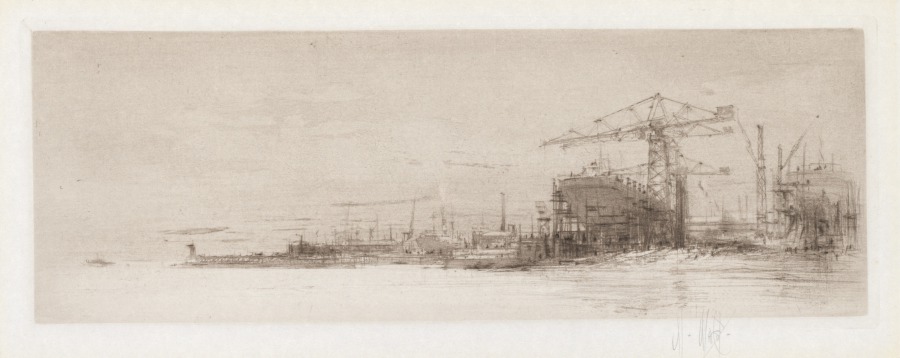
The Clyde from the series The Arteries of Great Britain, 1922
Walcot was born in 1874 in the Russian Empire, a biographical detail that already signals the cosmopolitan complexity of his formation. He trained as an architect, studying in Odessa and later in Paris, and this professional grounding in the built environment would prove decisive for everything that followed. Where other printmakers arrived at architecture as subject matter from a painterly tradition, Walcot came to it from the inside, understanding load, proportion, and spatial logic in ways that gave his images a structural intelligence impossible to fake. By the time he settled in London in the early years of the twentieth century, he carried within him an unusually broad visual education shaped by classical antiquity, Beaux Arts discipline, and the raw energy of a rapidly modernising Europe.
His architectural career in Britain was genuinely distinguished. He worked as an architectural renderer of considerable reputation, producing visionary drawings for some of the most ambitious building projects of the Edwardian era. These renderings, often published and widely circulated, built his public profile and refined his extraordinary capacity for atmospheric perspective. But it was his turn to etching and printmaking that revealed the full depth of his imaginative life.
William Walcot
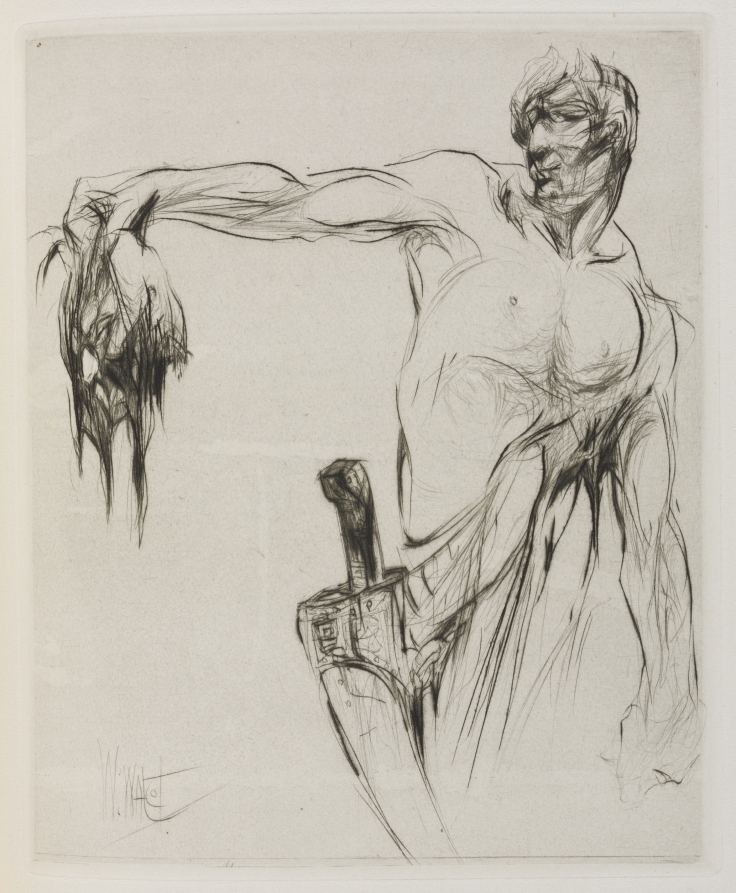
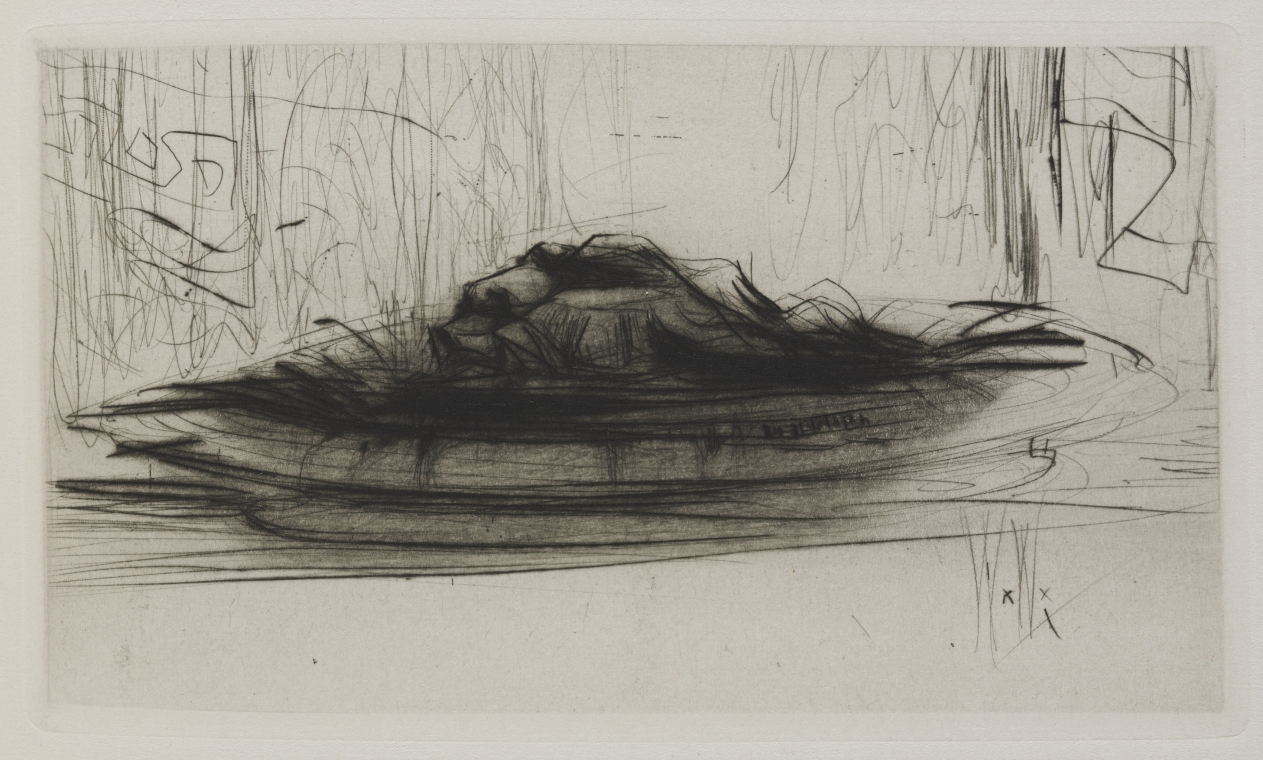
Herodias: Page 55, Cul-de-lampe, 1928
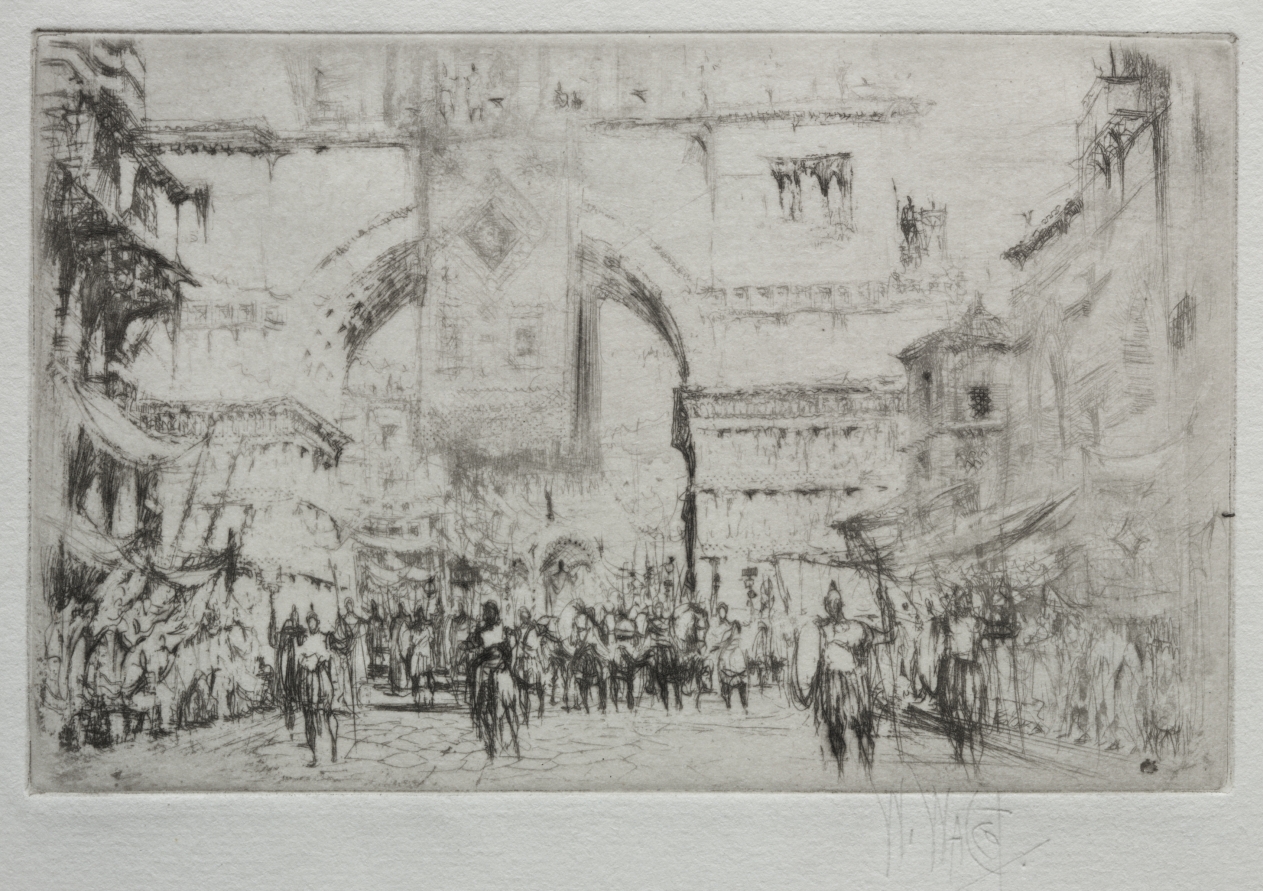
The print allowed him something that professional architectural work could not: freedom to conjure worlds that existed only in his mind, reconstructions of ancient Rome and Greece rendered with the same technical precision he brought to contemporary commissions, but infused with a romantic grandeur that was entirely his own. The early 1910s and 1920s represent the high watermark of Walcot's printmaking achievement. His series of etchings depicting the ancient world, including scenes set in Rome, along the Nile, and in the great cities of the classical Mediterranean, established him as one of the most distinctive voices in British printmaking of the period. Works like Hadrian Entering Salonica, produced in 1918, demonstrate his ability to people vast architectural spaces with figures that feel genuinely historical rather than costumed.
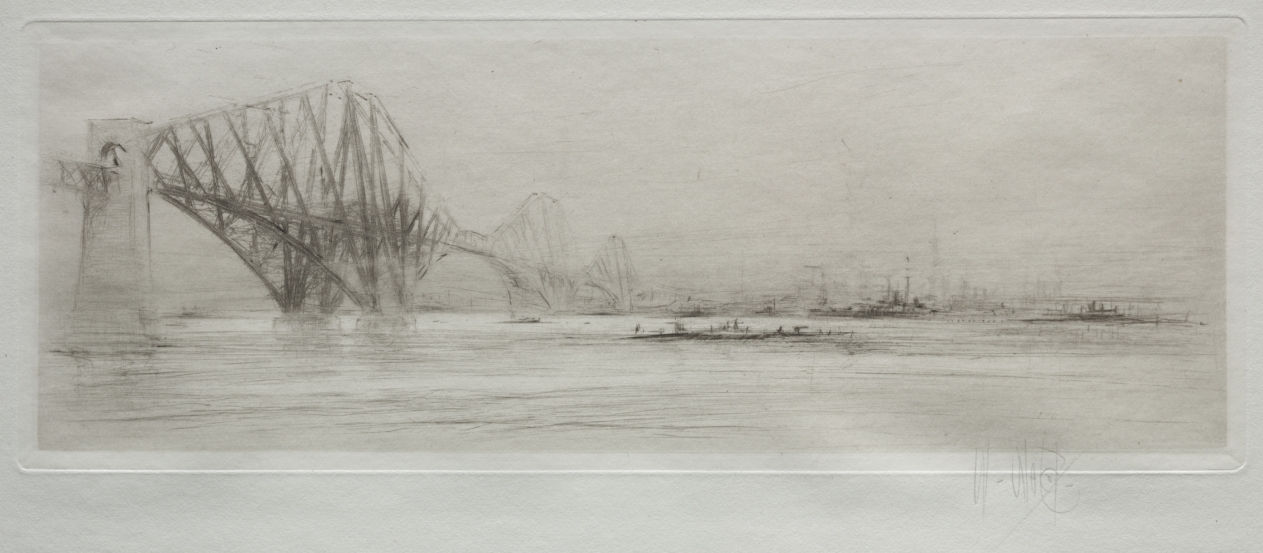
The composition draws the eye across colonnaded distances with a confidence that only an architect could sustain. The Villa Quintillii from 1921, rendered in etching and drypoint, shows him equally at home with ruin and decay, finding beauty in the slow reclamation of stone by time and vegetation. The series titled The Arteries of Great Britain, produced in 1922, represents a fascinating pivot in his practice. Works such as The Clyde and The Forth, the latter executed in drypoint, turn his classical sensibility toward the industrial landscape of contemporary Britain with unexpectedly moving results.
William Walcot
Hadrian Entering Salonica, 1918
The great rivers and their attendant infrastructure, the bridges, dockyards, and shipping lanes that were the circulatory system of an imperial economy, receive the same reverential attention he gave to the Forum Romanum. There is no irony in this. Walcot appears to have genuinely believed that the engineering achievements of his adopted country deserved to be commemorated with the same grandeur traditionally reserved for antiquity. The result is a body of work that captures a specific historical moment, Britain at the apex and the beginning of the slow decline of its industrial power, with remarkable emotional intelligence.
His London subjects form another essential chapter. Trafalgar Square from 1924, rendered in etching, drypoint, and aquatint, is a tour de force of urban atmosphere, the square rendered in a soft complexity of tone that makes the familiar monumental. Westminster Abbey from 1919 and the brown toned London plate of 1920 demonstrate his mastery of plate tone as a compositional tool, using the residual ink left on the copper surface to create atmospheric effects that feel almost painterly while remaining entirely within the discipline of printmaking. His contribution to the illustrations for Herodias in 1928, a series of etchings including the frontispiece and several interior plates, shows him working with literary subject matter and theatrical imagination to produce images of Flaubertian intensity.
William Walcot
Arteries of Great Britain: The Forth, 1922
For collectors, Walcot's work presents an exceptionally compelling proposition. His prints appear regularly at specialist print sales at houses including Christie's and Bonhams, where strong examples of his architectural and London subjects have demonstrated consistent collector appetite. The combination of genuine rarity, distinguished technical accomplishment, and rich art historical context makes him a figure whose works reward serious study. Collectors drawn to the British etching revival of the late nineteenth and early twentieth centuries will find Walcot in natural conversation with artists including Frank Brangwyn, Muirhead Bone, and D.
Y. Cameron, all of whom shared his ambition to elevate printmaking to a medium of genuine cultural weight. Like those artists, Walcot understood that the etched line could carry the full complexity of a civilisation's relationship with its own past. Walcot died in 1943, having lived through two world wars that fundamentally reshaped the world his prints had so lovingly documented.
His legacy rests on a body of work that holds, in suspended permanence, a vision of human achievement across centuries and continents. The classical reconstructions feel no less urgent now than they did when he made them; if anything, the distance of another century gives them an additional layer of poignancy. He was an artist who believed, without reservation, that the great buildings of human history deserved to be celebrated and mourned with equal passion. That conviction lives in every plate he made, and it is what draws collectors back to his work with such steady loyalty.
Explore books about William Walcot