William Nicholson
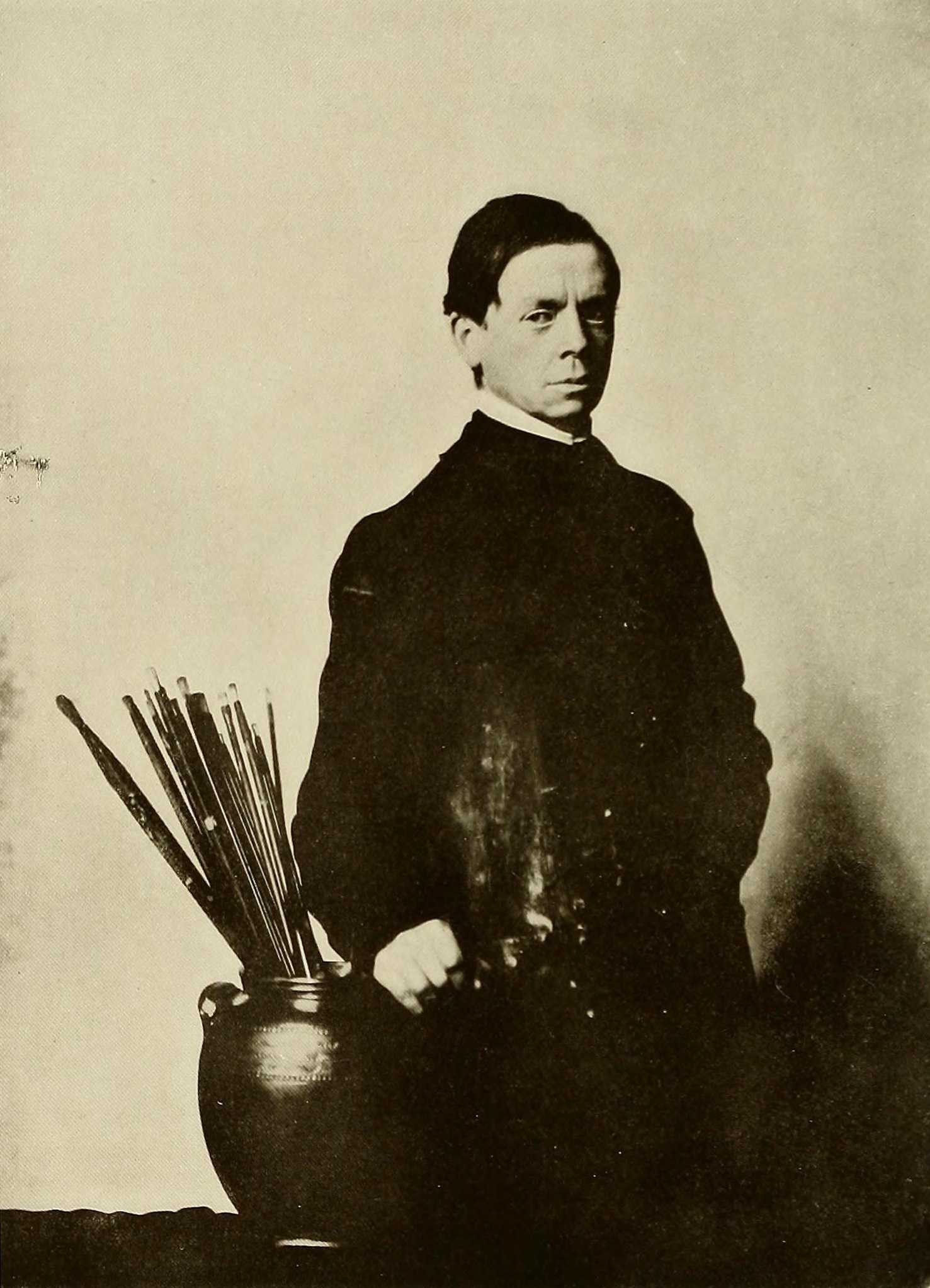
William Nicholson, Master of the Printed Page
Artist Spotlight · The Collection Editorial
There is a particular kind of pleasure that comes from standing before a William Nicholson print and feeling, quite suddenly, that the world has been clarified. His images arrive with the confidence of someone who has already thought through everything you are still working out. In the closing years of the nineteenth century, Nicholson and his brother in law James Pryde, working together under the name the Beggarstaff Brothers, rewrote the visual language of British graphic art. That collaboration produced some of the most celebrated poster designs of the age, but it was Nicholson's solo output that would ultimately reveal the full depth of his gifts: a painter of still lifes, portraits, and landscapes whose spare, luminous canvases continue to astonish, and a graphic artist whose woodcuts and color lithographs remain among the finest produced in Britain.
William Nicholson
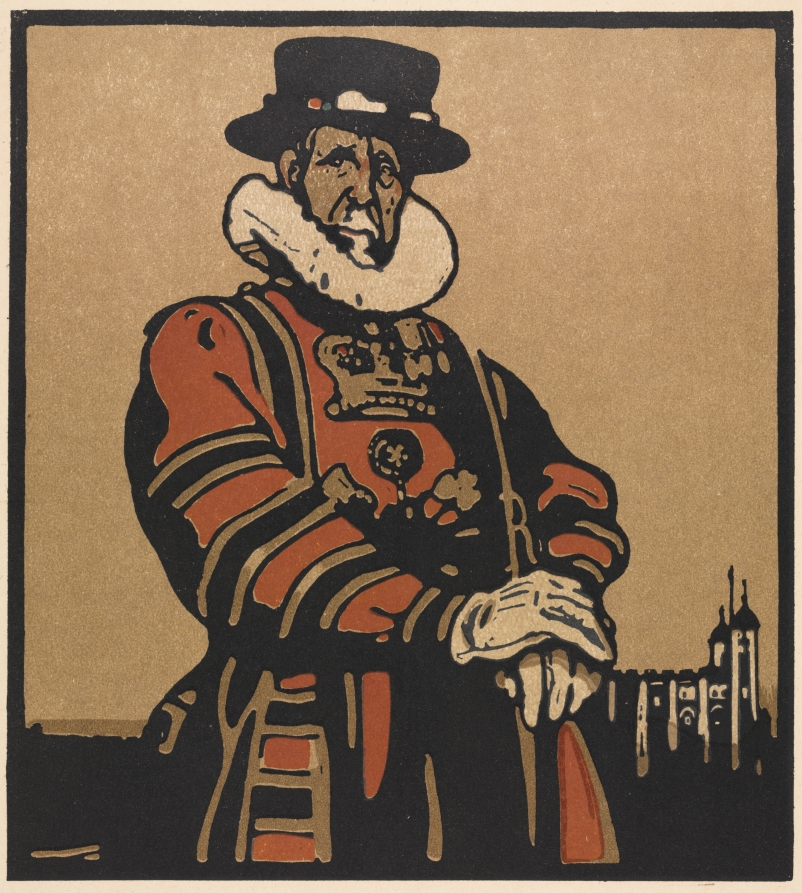
London Types: Beefeater, 1898
William Nicholson was born in Newark on Trent in 1872, the son of a prosperous industrialist. His early education pointed toward a conventional life, but the pull of art proved irresistible. He studied at the Hubert Herkomer School of Art in Bushey before traveling to Paris, where he enrolled at the Académie Julian. Paris in the early 1890s was electric with new ideas: the influence of Japanese woodblock printing was everywhere, the flat planes and bold outlines of Paul Gauguin and the Nabis were reshaping how painters thought about composition, and the commercial poster had been elevated to a form of high art by Henri de Toulouse Lautrec and Jules Chéret.
Nicholson absorbed all of it with remarkable speed and translated what he learned into an unmistakably British idiom. Returning to England, Nicholson married Mabel Pryde in 1893 and soon entered the collaboration with her brother James that would define his early reputation. The Beggarstaff Brothers produced theatrical posters of radical simplicity, stripping imagery down to its barest silhouette and trusting flat color to do the work that most designers still assigned to elaborate detail. The partnership was short lived but enormously influential, and its reverberations can be traced through British graphic design well into the twentieth century.
William Nicholson
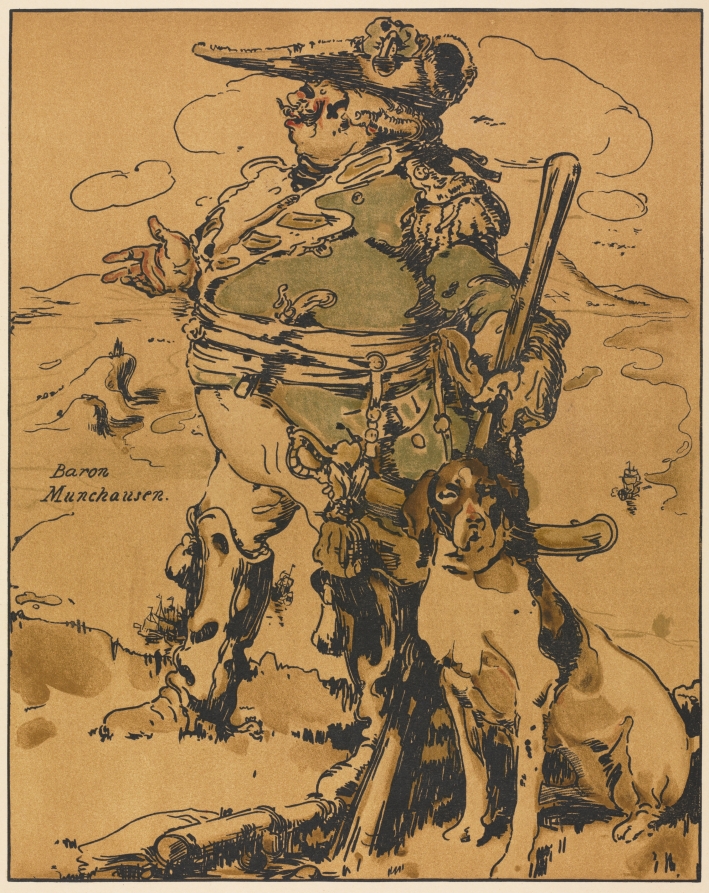
Characters of Romance: Baron Muchausen, 1900
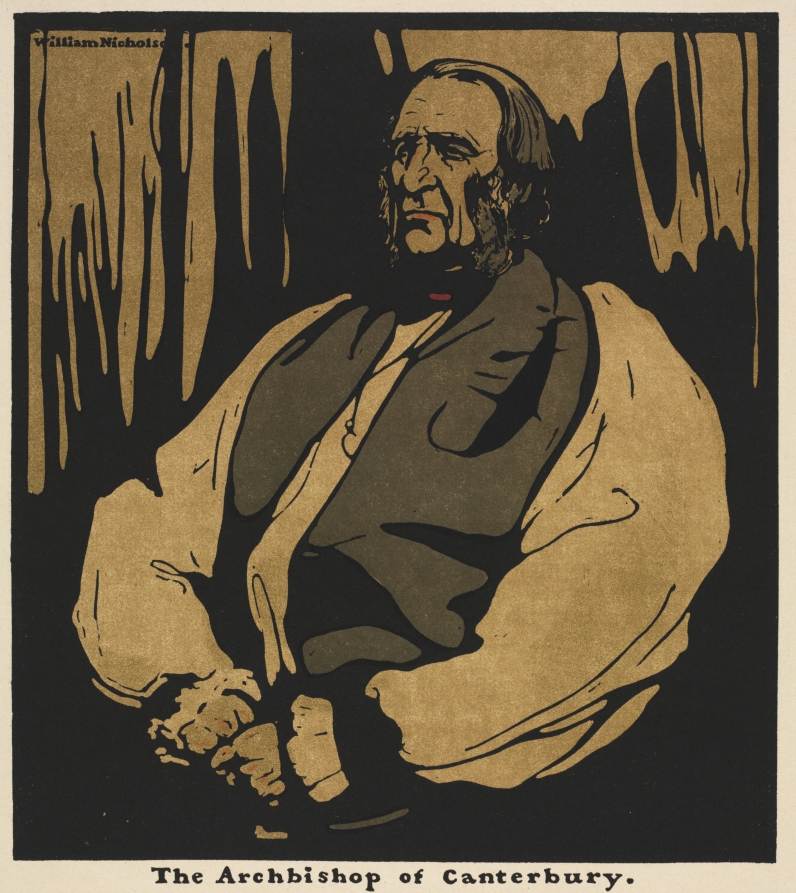
Nicholson, however, was already developing ambitions that reached beyond the poster. By the mid 1890s he was producing his celebrated series of prints: the woodcut and lithograph collections that would cement his place in art history. The works that represent Nicholson most vividly on The Collection date from a concentrated and extraordinarily productive period between 1897 and 1898. His Twelve Portraits series, which included likenesses of Queen Victoria, Rudyard Kipling, the Prince of Wales, and the Archbishop of Canterbury, demonstrated his ability to distill a public figure into something both iconic and intimate.
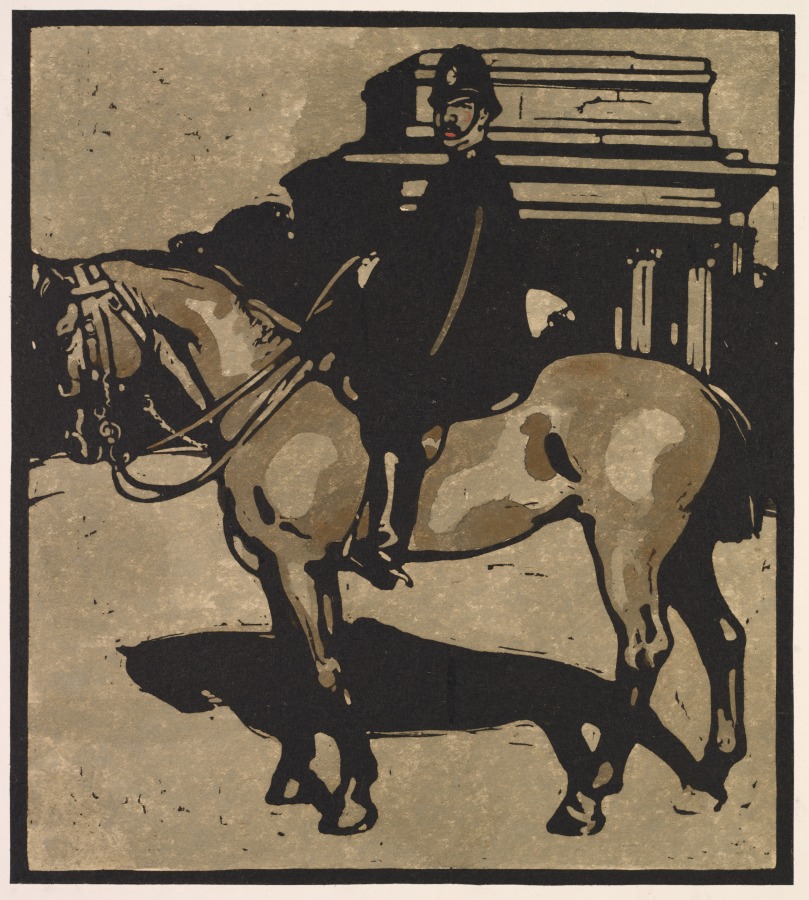
Each image is rendered with an economy that borders on the audacious: bold outlines, flattened forms, and a color palette of deliberate restraint that nonetheless feels entirely alive. The London Types series, which included the Guardsman rendered as a woodcut hand colored with watercolor and the Bluecoat Boy as a color lithograph, extended the same method to the social landscape of the city itself. These are not mere illustrations. They are portraits of a culture at a particular moment, caught with wit, affection, and genuine formal intelligence.
William Nicholson
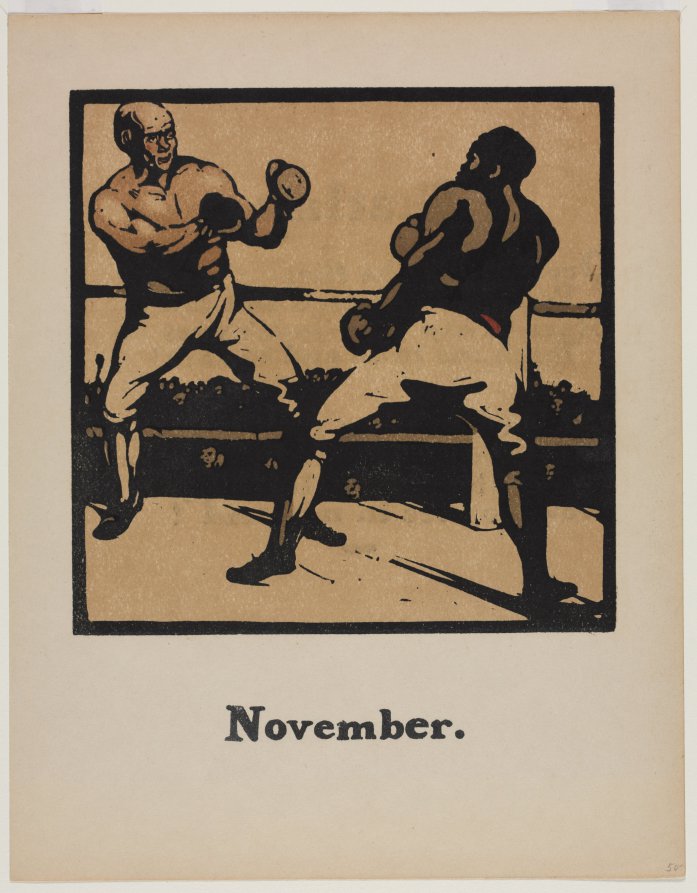
An Almanac of Twelve Sports: Boxing, 1897
The Almanac of Twelve Sports and the Alphabet series completed during the same years further demonstrated Nicholson's range: he could move between satire, celebration, and pure visual delight within a single year's work. Nicholson's transition into painting, which deepened through the early decades of the twentieth century, revealed yet another dimension of his talent. He became one of the finest still life painters of his generation, placing modest objects, a silver mug, a pair of boots, a single flower, against grounds of extraordinary sensitivity and allowing light to do its quiet work. His portraits, too, carried a directness that was all his own.
He painted Rudyard Kipling, whom he had already captured in print, as well as a wide circle of writers, artists, and social figures. His son Ben Nicholson would go on to become one of the defining figures of British modernism, and it is tempting to see in Ben's careful attention to surface and form something that began in his father's studio. The two inhabited quite different aesthetic territories, but the seriousness with which both approached the made object connects them across generations. For collectors, Nicholson occupies a position of considerable interest.
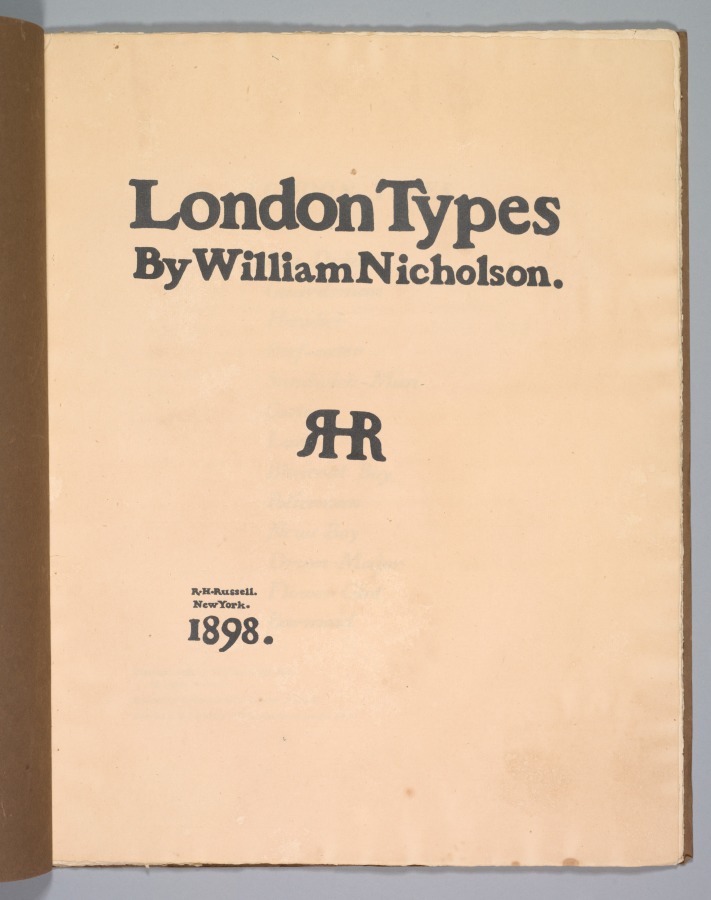
William Nicholson
London Types: Quatorzains, 1898
His graphic works from the 1890s represent a moment when British art was genuinely in conversation with the most advanced continental practice, and their quality is difficult to overstate. The Twelve Portraits and London Types prints in particular have attracted sustained attention from collectors of Victorian and Edwardian graphic art, and fine impressions in good condition are increasingly sought. His paintings, especially the still lifes, have performed well at auction across major British houses, with the best examples drawing serious competition from institutional and private buyers alike. Those new to Nicholson's work would do well to begin with the prints: they are the most immediate introduction to the clarity of his vision and the elegance of his hand.
Collectors already familiar with the work of Aubrey Beardsley, Walter Sickert, or the Scottish Colourists will find in Nicholson a natural companion, someone working at the same intersection of decorative intelligence and painterly seriousness. Nicholson's place in art history is secure, though he has sometimes been overshadowed by the longer critical shadow cast by his son. That neglect, such as it is, has always seemed an injustice to those who know the work well. His graphic art anticipated the visual economy of twentieth century design by decades, and his paintings, at their best, belong in the same conversation as those of Walter Sickert and Philip Wilson Steer.
He died in 1949, leaving behind a body of work that spans woodcut and oil, portraiture and landscape, the commercial and the purely personal, with a consistency of quality that few artists achieve across such varied forms. To encounter his prints today is to be reminded that clarity is itself a form of ambition, and that the decision to do more with less demands not simplicity of mind but extraordinary discipline of eye. Nicholson possessed both in abundance.
Featured Works
Explore books about William Nicholson

William Nicholson: A Study
Margot Eates
The Graphic Work of William Nicholson
Campbell Dodgson
William Nicholson 1872-1949
National Portrait Gallery
Nicholson: Artist and Designer
Timothy d'Arch Smith
William Nicholson and the Beggarstaff Brothers
Alastair Grieve
The English Poster: Design and Art 1895-1914
Vladimir Poliakov