William Morris Hunt
William Morris Hunt, America's Visionary Champion
Artist Spotlight · The Collection Editorial
“In painting, you must give the reality of things, but above all, you must give the poetry of them.”
William Morris Hunt, Talks on Art, 1875
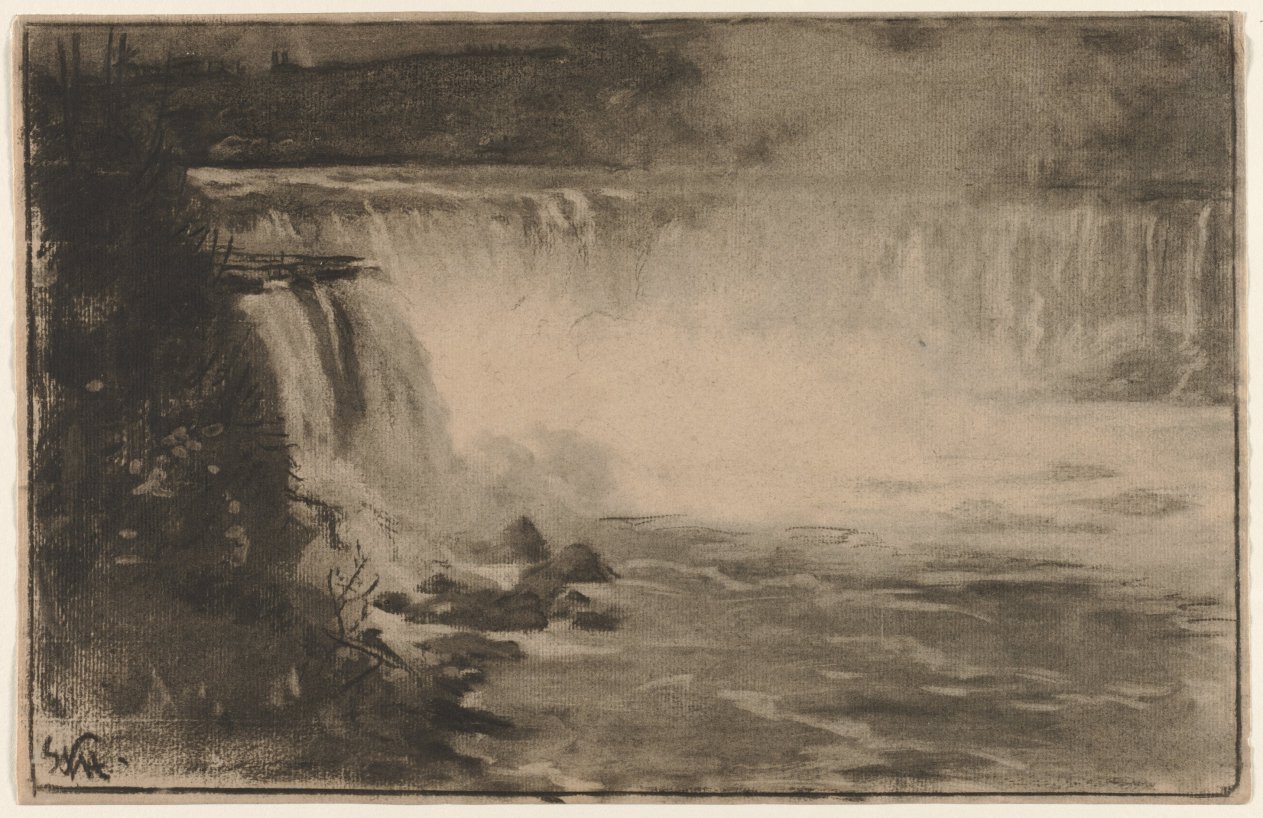
Stand before William Morris Hunt's sweeping 1878 charcoal study of Niagara Falls and you feel immediately the force of a mind that refused easy answers. The falls churn and mist with a raw, almost trembling energy, rendered not in the crisp topographical detail favored by Hudson River School contemporaries but in broad, atmospheric strokes that dissolve the boundary between observation and feeling. It is a work that arrives, even now, with the full weight of a revelation. Hunt spent the final years of his life distilling everything he had learned across two continents into images of exactly this quality, and what he left behind remains one of the most underappreciated bodies of work in all of nineteenth century American art.
William Morris Hunt
Niagara Falls, 1878
Hunt was born in Brattleboro, Vermont, in 1824, into a cultivated New England family that gave him access to European travel and education at a young age. He studied briefly at Harvard before departing for Europe, where his real formation began. In Paris and Düsseldorf he moved through the academic circuits of the day before a decisive encounter with Thomas Couture, the celebrated French painter whose atelier welcomed ambitious students from across the world. Under Couture, Hunt absorbed a fluency with paint, a commitment to tonal richness, and a seriousness about the act of seeing that would never leave him.
But the more transformative friendship was still to come. It was through his time in Barbizon, the forest village south of Paris that had become a gathering place for painters devoted to working directly from nature, that Hunt encountered Jean François Millet. The two men formed a profound artistic bond. Millet's devotion to rural labor, his monumental peasant figures, his willingness to find dignity and grandeur in the simplest human scenes, reshaped Hunt's entire sense of what painting could do.
William Morris Hunt
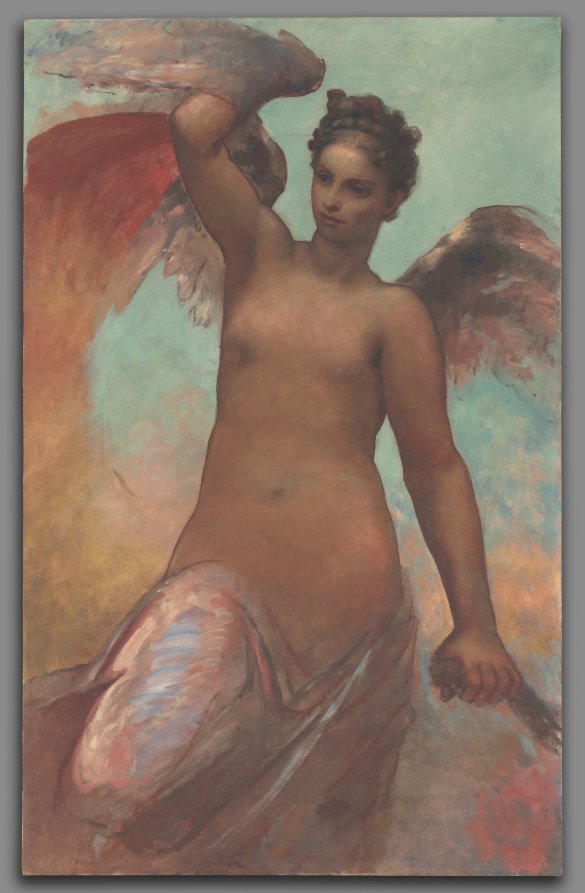
Winged Fortune, 1878
Hunt became not merely an admirer but a genuine disciple, and when he returned to the United States in the 1850s he brought with him a passionate commitment to French Realism that American audiences were wholly unprepared for. He also brought a collection of Millet's works, which he helped place with Boston collectors, effectively introducing one of the great figures of European modernism to the American public. Boston became Hunt's adopted home and his primary stage. He established a studio and a school, and through sheer force of personality and conviction he reshaped the taste of the city's collecting class.
“Draw what you see, not what you know.”
William Morris Hunt, Talks on Art, 1875
His teaching was legendarily generous and unorthodox, insisting that students loosen their grip on academic convention and trust their own perceptions. He welcomed women students at a time when most ateliers excluded them, and several of his most devoted pupils went on to significant careers of their own. His portrait practice flourished among Boston's leading families, and his ability to capture psychological presence alongside physical likeness made him one of the most sought after portraitists of his generation. Works such as His First Model, Miss Russell from 1868 demonstrate this gift with particular clarity, the sitter rendered with an intimacy that feels genuinely observed rather than performed.
William Morris Hunt
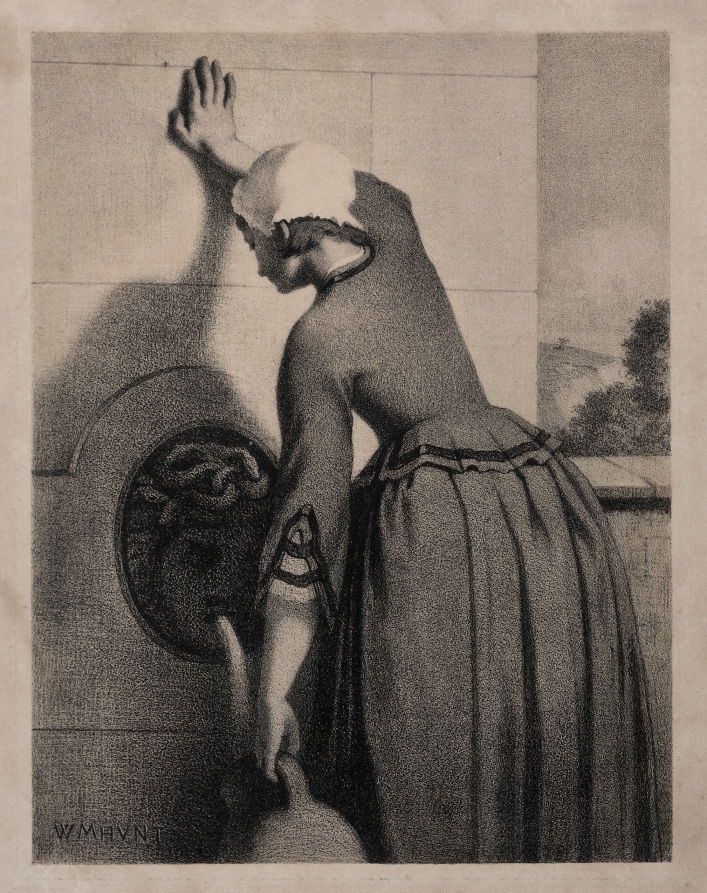
Women at a Well, 1857
The breadth of Hunt's ambition is visible across the works he left behind. Women at a Well, his 1857 lithograph, shows the Millet influence fully absorbed and transformed into something distinctly his own: a quiet monumentality, a tenderness toward ordinary life, a compositional sureness that makes the image feel inevitable. The Gypsies' Parlor from 1877 radiates warmth and narrative intelligence, its figures arranged with a relaxed theatricality that rewards slow looking. His landscapes, including the remarkable North Easton, Massachusetts from the same year, balance observation and mood in ways that anticipate the tonal impressionism that would flower in American art a generation later.
And then there is Winged Fortune, the oil on canvas he completed in 1878, a work of allegorical sweep and painterly confidence that stands as one of his most fully realized statements. For collectors, Hunt presents a genuinely compelling proposition. His market has historically operated well below that of his European contemporaries and even some of his American peers, which means that quality works remain accessible to a range of serious collectors. What to seek out: the drawings and charcoals, which showcase his most immediate and spontaneous thinking, are among his most beautiful productions and tend to offer exceptional value relative to their art historical significance.
William Morris Hunt
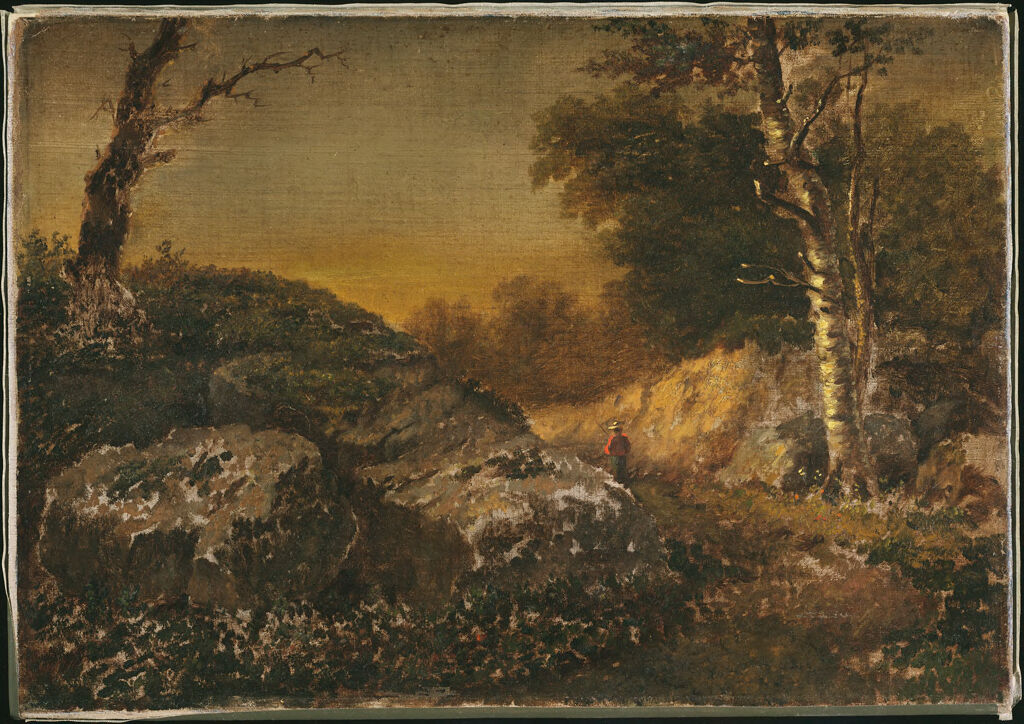
Autumn Landscape with Man Fishing
His oils range from intimate genre scenes and portraits to larger allegorical and landscape compositions, and the best of them hold their own against comparable European Barbizon works from the same period. Provenance connected to Boston collections of the late nineteenth and early twentieth centuries is a meaningful signal of quality, as Hunt's closest admirers were often also his most sophisticated early patrons. To understand Hunt's place in art history, it helps to situate him within the broader transatlantic conversation of his era. His deep ties to Millet and Couture connect him to the lineage that runs through Barbizon realism toward Impressionism.
His championing of French art in Boston helped create the conditions that later led Isabella Stewart Gardner and other great collectors to pursue European modernism with such commitment. Artists such as John La Farge, who moved through some of the same Boston circles, and George Inness, who pursued a similar tonal and spiritual vision of landscape, help frame the world Hunt inhabited. His influence on younger American painters, passed through his school and his example, ripples quietly through the history of late nineteenth century American painting in ways that have rarely been fully traced. Hunt died in 1879 on the Isles of Shoals off the New Hampshire coast, at only fifty five years old, leaving behind a legacy that has never quite received the sustained attention it deserves.
The great Albany murals he completed for the New York State Capitol, monumental works depicting Flight of Night and The Discoverer, were damaged by water and faded over the following decades, depriving later audiences of what may have been his grandest achievement. Yet the paintings, drawings, and charcoals that survive make an eloquent case for his importance. In Hunt we encounter an artist who spent his career building bridges, between Europe and America, between academic tradition and the new vision of realism, between the world of professional art and the broader public who needed to be shown what painting could truly feel like. That project remains as vital and as moving as ever.
Explore books about William Morris Hunt
William Morris Hunt: A Memorial Exhibition
Museum of Fine Arts, Boston
William Morris Hunt and His Circle
Martha J. Hoppin
William Morris Hunt: American Painter
Swallow, Penelope T.
Talks on Art
William Morris Hunt
William Morris Hunt: Philanthropist, Reformer and Art Pioneer
Hoppin, Martha J.