William Merritt Chase
William Merritt Chase, America's Radiant Master
Artist Spotlight · The Collection Editorial
“I have always believed that drawing is the most important thing. Color is secondary.”
William Merritt Chase
There is a moment in the Metropolitan Museum of Art's permanent collection galleries where light seems to behave differently. It pools across the floor of a painted room, catches the silk of a woman's sleeve, and animates a space that is simultaneously intimate and grand. That quality of luminous, confident presence is the signature of William Merritt Chase, and it is a quality that continues to stop visitors mid stride more than a century after his death. As major American institutions from the Smithsonian to the Art Institute of Chicago maintain significant holdings of his work, and as the market for Gilded Age American painting continues to attract serious collectors worldwide, Chase endures not as a historical footnote but as a living argument for the power of painterly ambition.
William Merritt Chase
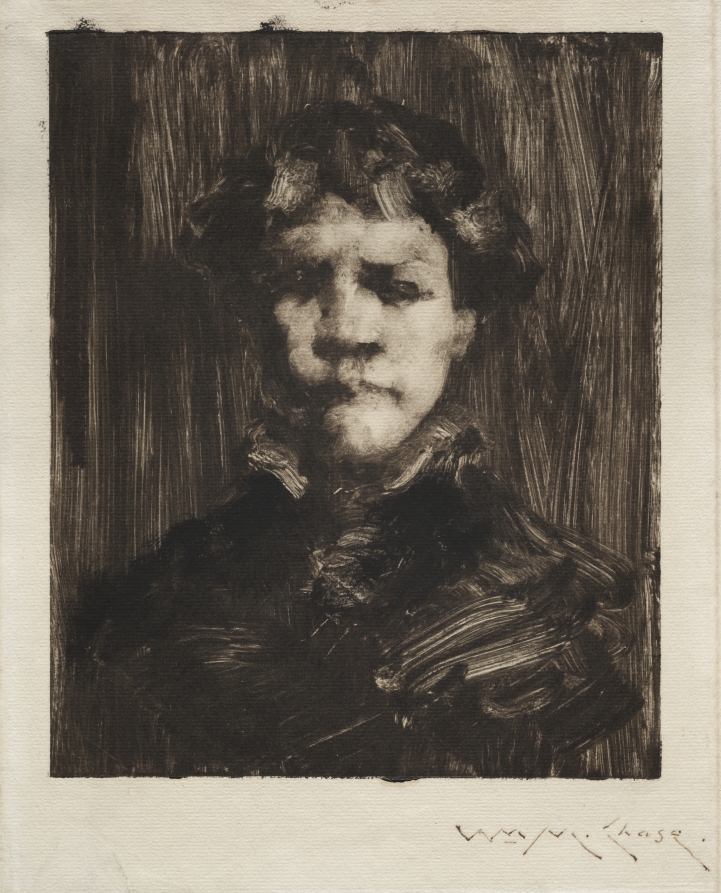
Head of a Boy, 1878
Chase was born in 1849 in Williamsburg, Indiana, a modest beginning that gave little outward indication of the cosmopolitan figure he would become. His family relocated to Indianapolis during his youth, and it was there that his early talent was recognized and encouraged. By his late teens he had begun formal study, first in New York under Joseph O. Eaton and later at the National Academy of Design.
The trajectory of his formation shifted decisively in 1872 when St. Louis merchants, impressed by his promise, sponsored his study in Europe. Chase arrived in Munich and enrolled at the Royal Academy, where he fell under the influence of Wilhelm Leibl and the broader tradition of painterly realism descending from Velázquez and Hals. The Munich years were formative in the deepest sense: he absorbed a technique built on bravura brushwork, tonal richness, and the confidence to let paint remain visible as paint.
William Merritt Chase
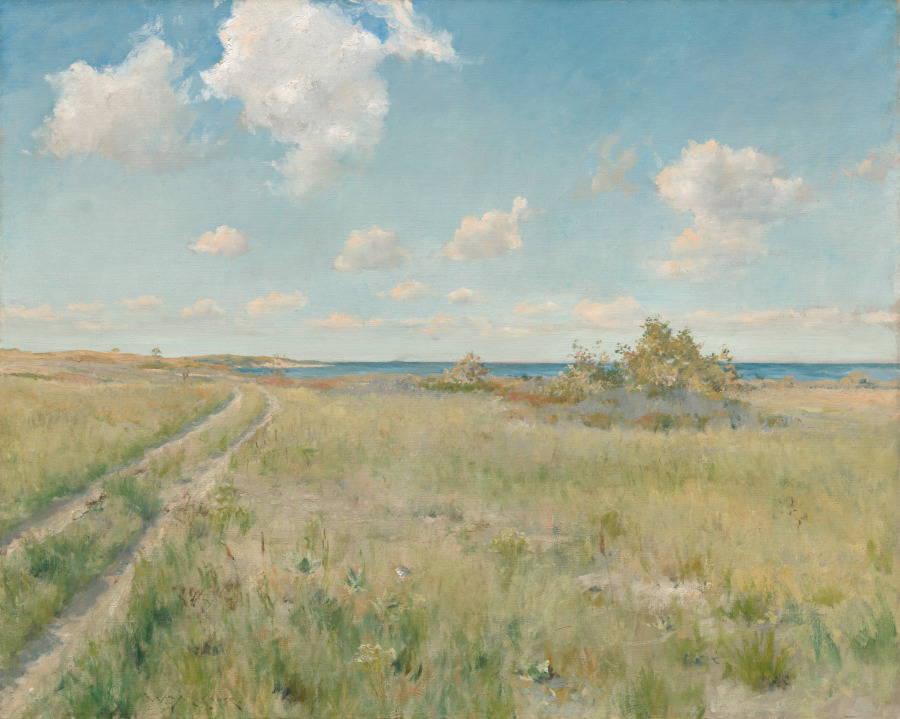
The Old Road to the Sea, 1888
He returned to New York in 1878 and immediately established himself as a force. His Tenth Street Studio in Manhattan became one of the most celebrated artistic spaces in American life, a deliberately theatrical environment filled with objects, textiles, props, and curiosities collected from his travels. It was both a workspace and a performance, a statement that the artist was a figure of culture and sophistication. Chase taught at the Art Students League beginning in 1878 and later founded the Chase School, which became the New York School of Art.
“Paint what you see, not what you know is there.”
William Merritt Chase, teaching notes
His influence on subsequent generations of American painters was immense, numbering among his students Georgia O'Keeffe, Edward Hopper, and Charles Sheeler, artists who would define modernism in America even as they moved beyond their teacher's aesthetic. Chase's practice was remarkably wide in its range. He moved fluidly between portraiture, interior scenes, still life, and landscape, and he brought to each genre a discipline and a freshness that resisted formula. His summers in the Shinnecock Hills of Long Island, where he established a school beginning in 1891, produced some of the most beloved plein air paintings in American art history.
William Merritt Chase
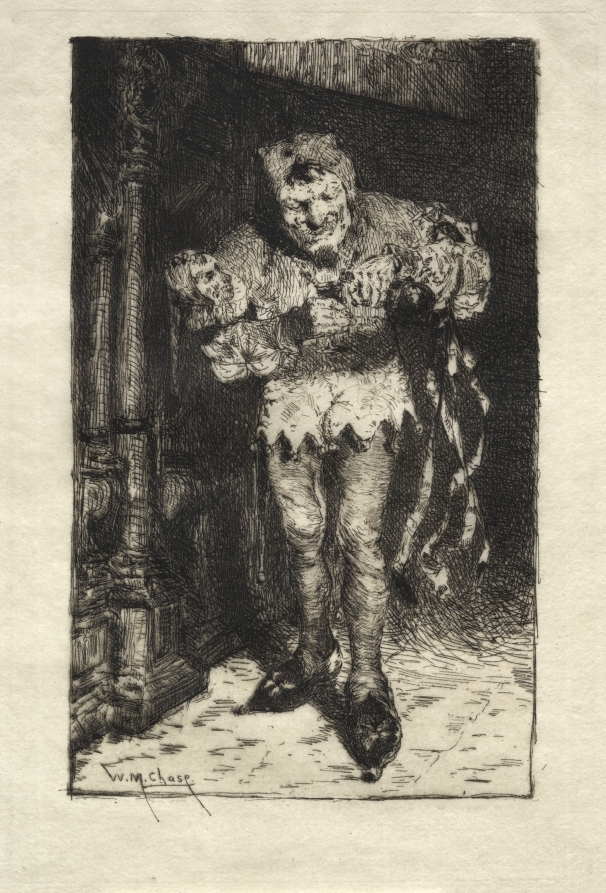
The Jester, 1890
Works from this period capture the quality of light on the Atlantic coast with a directness that recalls the French Impressionists, whom Chase had encountered during his European travels and whose influence he absorbed without wholesale imitation. A painting like The Old Road to the Sea, dating from 1888, exemplifies this synthesis: the composition is deceptively simple, the brushwork assured, and the mood one of open, breathing space that feels entirely American in its emotional scale. The works available through The Collection offer an unusually varied window into Chase's achievement across different media and subjects. Portrait of Dora Wheeler from 1882 is among his most celebrated canvases, a work of genuine ambition that depicts the textile designer and artist Dora Wheeler against a richly decorative background, nodding to the Aesthetic Movement that Chase admired.
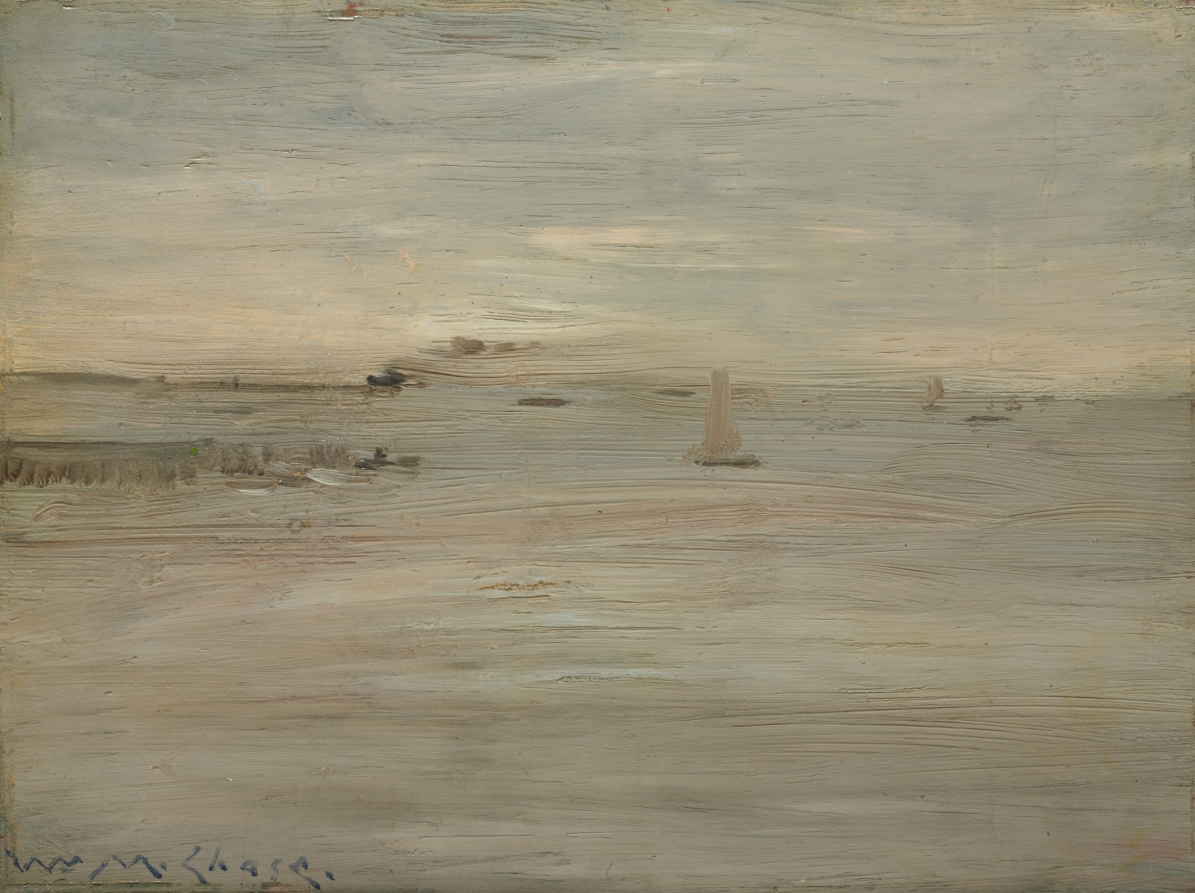
It was shown at the Paris Salon of 1883 to considerable attention, an early signal of his international standing. Marine from 1883, rendered in oil on wood, shows his facility with small format landscape, capturing tonal atmosphere with economy and grace. Portrait of My Daughter Alice from 1890 demonstrates the tenderness he could bring to domestic subjects without sentimentality, while The Jester of the same year, an etching and drypoint, reveals a printmaking sensibility far more sophisticated than is sometimes acknowledged. Gray Day on the Bay from 1881 anticipates the Shinnecock landscapes in its quiet mastery of coastal light and restrained palette.
William Merritt Chase
Marine, 1883
For collectors, Chase represents one of the most compelling propositions in American art. His work sits at the intersection of European academic training and American ambition, technically rigorous yet emotionally accessible, historically significant yet visually immediate. Major works by Chase have achieved significant results at auction over recent decades, with important portraits and Shinnecock landscapes consistently commanding strong prices at Christie's, Sotheby's, and Bonhams. Works on paper and prints, including etchings and monotypes from his mature period, offer an accessible entry point for collectors building a position in American art of the Gilded Age and Progressive Era.
Condition and provenance carry particular weight in this market, and works with documented exhibition histories carry a premium that reflects the appetite among serious collectors for well traced examples. To understand Chase fully is to understand him in relationship to a constellation of artists who shared his moment and his ambitions. John Singer Sargent, his contemporary and in some ways his transatlantic counterpart, brought a similar bravura technique and social fluency to portraiture. Thomas Eakins, who occupied a very different cultural position, shared Chase's commitment to rigorous observation and serious craft.
James McNeill Whistler, whom Chase knew and with whom he famously quarreled, influenced his tonal sensibility and his thinking about the relationship between painting and interior space. Together these figures constitute a high watermark of American painterly culture, a moment when American artists were engaging the European tradition on equal terms and beginning to inflect it with something distinctively their own. Chase died in New York in 1916, at the edge of a world that was already becoming unrecognizable to the values his art embodied. Yet the paintings have outlasted every shift in taste.
There is something in their combination of skill, pleasure, and generosity that remains irresistible, a quality of artistic confidence that is not arrogance but abundance. To collect Chase is to align yourself with a tradition of looking that prizes craft, light, and the human presence within a well made world. His work does not demand that you adjust your eyes or your assumptions. It simply opens, like a well lit room, and invites you in.
Explore books about William Merritt Chase
William Merritt Chase: A Life
Barbara Dayer Gallati
William Merritt Chase
Kathleen Pyne
Chase: The Complete Works
Ronald G. Pisano
William Merritt Chase: Summer Associates
Ronald G. Pisano
William Merritt Chase in the Company of Friends
Barbara Dayer Gallati and Andrew Martinez