William Henry Jackson
William Henry Jackson, Witness to Wild America
Artist Spotlight · The Collection Editorial
“I have been in love with the West ever since I first saw it, and that love has never grown cold.”
William Henry Jackson, Time Exposure: The Autobiography of William Henry Jackson, 1940
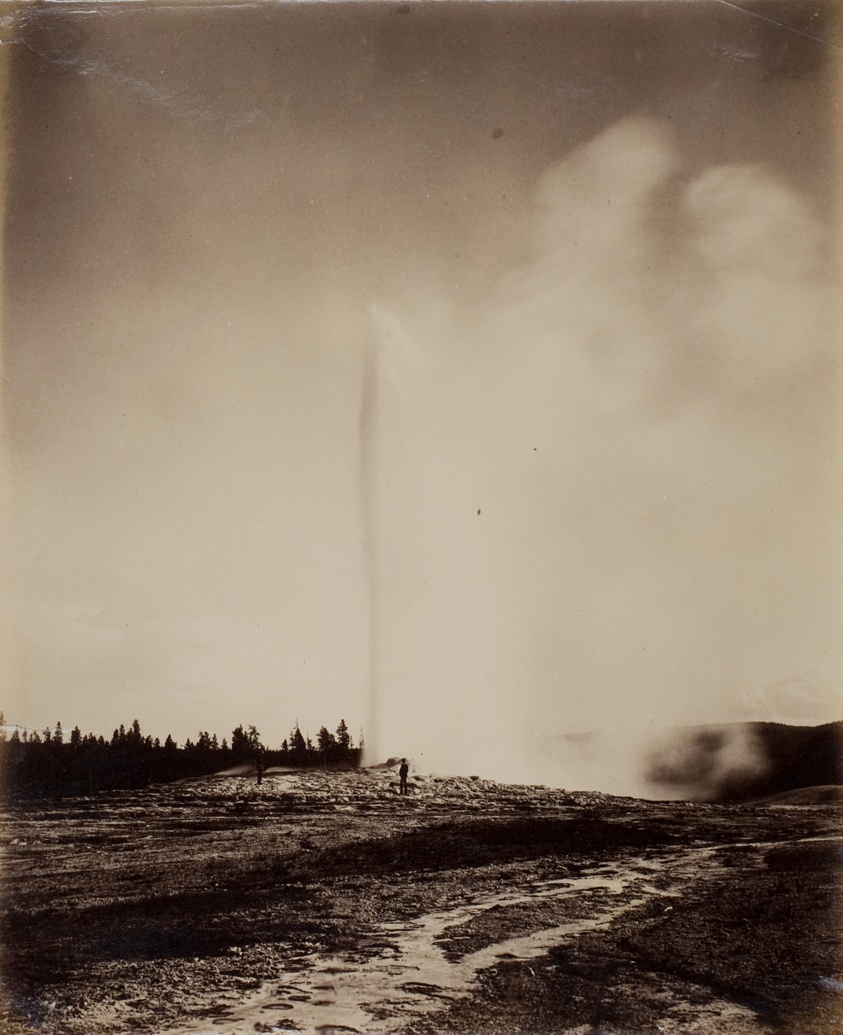
Stand before one of William Henry Jackson's albumen prints and you will feel it immediately: the silence of a continent in the process of being seen for the first time. His 1871 photograph of Old Faithful, made during the landmark Hayden Geological Survey expedition to the Yellowstone region, carries a stillness that feels almost sacred. The geyser rises against an open sky, the surrounding terrain rendered in those luminous silver tones that only the albumen process could conjure, and you understand in an instant why Congress voted to establish Yellowstone as the world's first national park just one year later. Jackson's images were part of the argument that made that history possible.
William Henry Jackson
Old Faithful, 1871
William Henry Jackson was born in 1843 in Keeseville, New York, into a family that encouraged artistic curiosity. He showed early aptitude for drawing and painting, skills that would later prove essential to his photographic vision. The formative rupture of his youth was the Civil War, after which he made his way west, working as a bullwhacker on wagon trails that crossed the Great Plains. That overland journey exposed him to the raw scale of the American landscape and lodged itself permanently in his imagination.
By 1867 he had established a photographic studio in Omaha, Nebraska, which placed him at the precise geographic threshold where settled America ended and the vast unknown began. His appointment as official photographer for the United States Geological and Geographical Survey under Ferdinand Vandeveer Hayden, beginning in 1870, was the defining commission of Jackson's career. The partnership lasted through the decade of the 1870s and took Jackson into terrain that few Americans of European descent had ever witnessed firsthand. He traveled with enormous quantities of glass plates and wet collodion chemicals across mountain passes, through canyon systems, and along river corridors that were genuinely unmapped.
William Henry Jackson
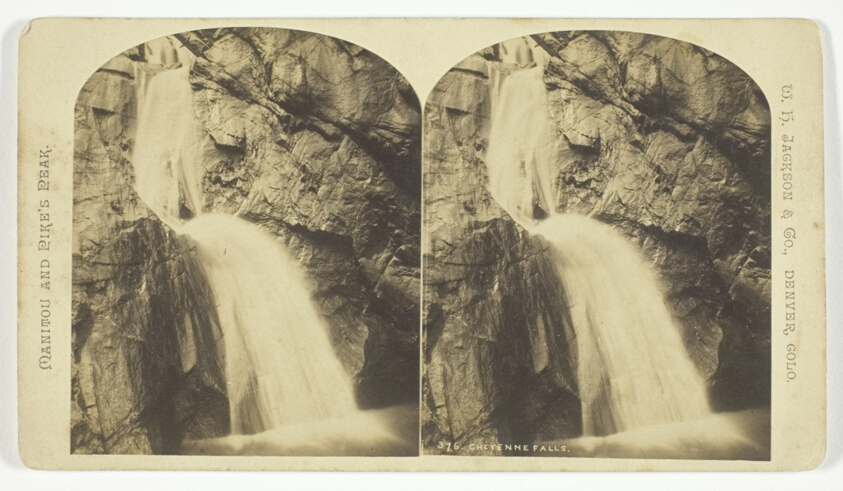
Cheyenne Falls, 1879
The physical demands of field photography in this era were extraordinary: plates had to be coated, exposed, and developed within minutes, all while managing mules, altitude, and weather that could shift from blazing sun to blizzard between breakfast and noon. What distinguishes Jackson as an artist rather than merely a documentarian is his compositional intelligence. Looking at the 1879 stereo albumen print of The Royal Gorge, one is struck by how deliberately he has positioned the viewer within the frame. The canyon walls rise with almost architectural authority on either side, and the sense of verticality is not accidental.
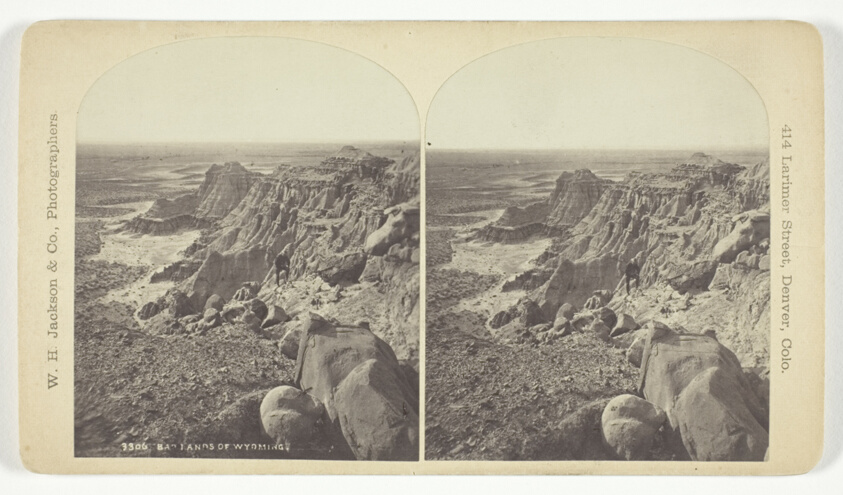
Jackson understood how to use the limits of his format to amplify drama, how to let shadow and light do rhetorical work. The stereo format, which he employed across much of his survey output including works such as Cheyenne Falls, Basaltic Canon at the Foot of Tower Creek, Badlands of Wyoming, and The Spanish Peaks, allowed viewers across America to immerse themselves in landscapes they might never visit. These were not mere records but experiences, carefully orchestrated encounters with a world that seemed almost too grand to be real. His 1870 stereo albumen print documenting the quarrying of granite for the Mormon Temple in Salt Lake City, part of his Views in the Rocky Mountains series, reveals another dimension of his practice.
William Henry Jackson
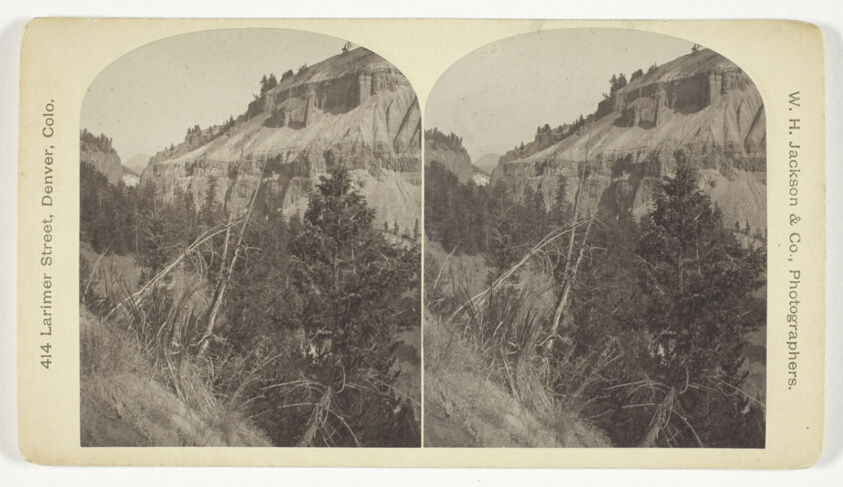
Basaltic Cañon, Foot of Tower Creek, 1879
Jackson was equally attentive to human endeavor within the landscape, to the story of a civilization being constructed at enormous effort in the midst of an indifferent wilderness. This image stands as a remarkable piece of social documentation, capturing a specific community's ambition and labor at a moment when the outcome of that ambition was far from certain. It broadens our understanding of Jackson from landscape photographer to genuine witness of an era. For collectors, Jackson's work occupies a position that is simultaneously historically significant and aesthetically rewarding.
Albumen prints from the survey years, particularly those in stereo format, represent the frontier of nineteenth century photographic technology applied with genuine artistic purpose. The stereo works are especially compelling for collectors interested in the material culture of the period, as they retain the sense of their original function as objects designed to be held, examined, and shared. When evaluating Jackson's prints, condition is paramount: albumen silver has a characteristic warmth that can shift toward unpleasant yellow tones when improperly stored, and prints that have retained their original tonal range carry meaningful premiums at auction. Major institutions including the Smithsonian American Art Museum and the Denver Public Library hold substantial Jackson archives, which has helped to anchor scholarly attention on his practice and maintain a strong baseline of collector interest.
William Henry Jackson
Badlands of Wyoming, 1879
Jackson belongs to a generation of American photographer artists who transformed the landscape image into a tool of national self understanding. His closest peers in this project include Timothy O'Sullivan, whose work for the Wheeler Survey across the Southwest shares Jackson's combination of technical rigor and visionary scale, and Carleton Watkins, whose mammoth plate photographs of Yosemite established the pictorial grammar that Jackson both inherited and extended. Where Watkins worked primarily within a single magnificent valley, Jackson ranged across the entire Rocky Mountain corridor, creating a portrait of the West that was encyclopedic in ambition. Together these figures constitute the founding generation of American landscape photography, artists who were simultaneously scientists, adventurers, and image makers.
William Henry Jackson lived an astonishing 99 years, dying in 1942, which means he witnessed the entire arc of photography from wet plate chemistry through color film, from stereo viewers through motion pictures. He continued painting and writing well into his later decades, leaving behind a body of work that crosses media and spans a century of American life. His legacy is not simply one of historical documentation, though that alone would be remarkable enough. It is a legacy of vision: the belief that the natural world, seen with patience and craft, could move the hearts and minds of those who had never set foot in it.
In an era of renewed attention to landscape, to wilderness, and to the question of what America owes its natural inheritance, Jackson's photographs feel less like history than like a conversation still very much in progress.
Explore books about William Henry Jackson
William Henry Jackson: Framing the Frontier
Peter B. Hales
The Pioneer Photographer: Rocky Mountain Adventures with a Camera
William Henry Jackson
William Henry Jackson: Selections from the Photograph and Manuscript Collections
William Henry Jackson Archive
The Western Photographs of William Henry Jackson
John Hillers and William Henry Jackson
Timelines & Shadows: Photographs by William Henry Jackson
Martin E. Stemler