William Bailey
William Bailey, Master of Luminous Stillness
Artist Spotlight · The Collection Editorial
There is a moment, standing before a William Bailey still life, when time seems to pause. The eggs rest on their table, the pitchers hold their silence, and the neutral ground behind them glows with a warmth that feels ancient and entirely present at once. It is no surprise that when the Yale University Art Gallery mounted a significant survey of Bailey's work, visitors lingered far longer than usual, drawn into what one catalogue essay described as a kind of visual meditation. For a painter who worked quietly for decades, largely outside the noise of prevailing trends, Bailey has earned a place among the most admired American realist painters of the twentieth century.
William Bailey
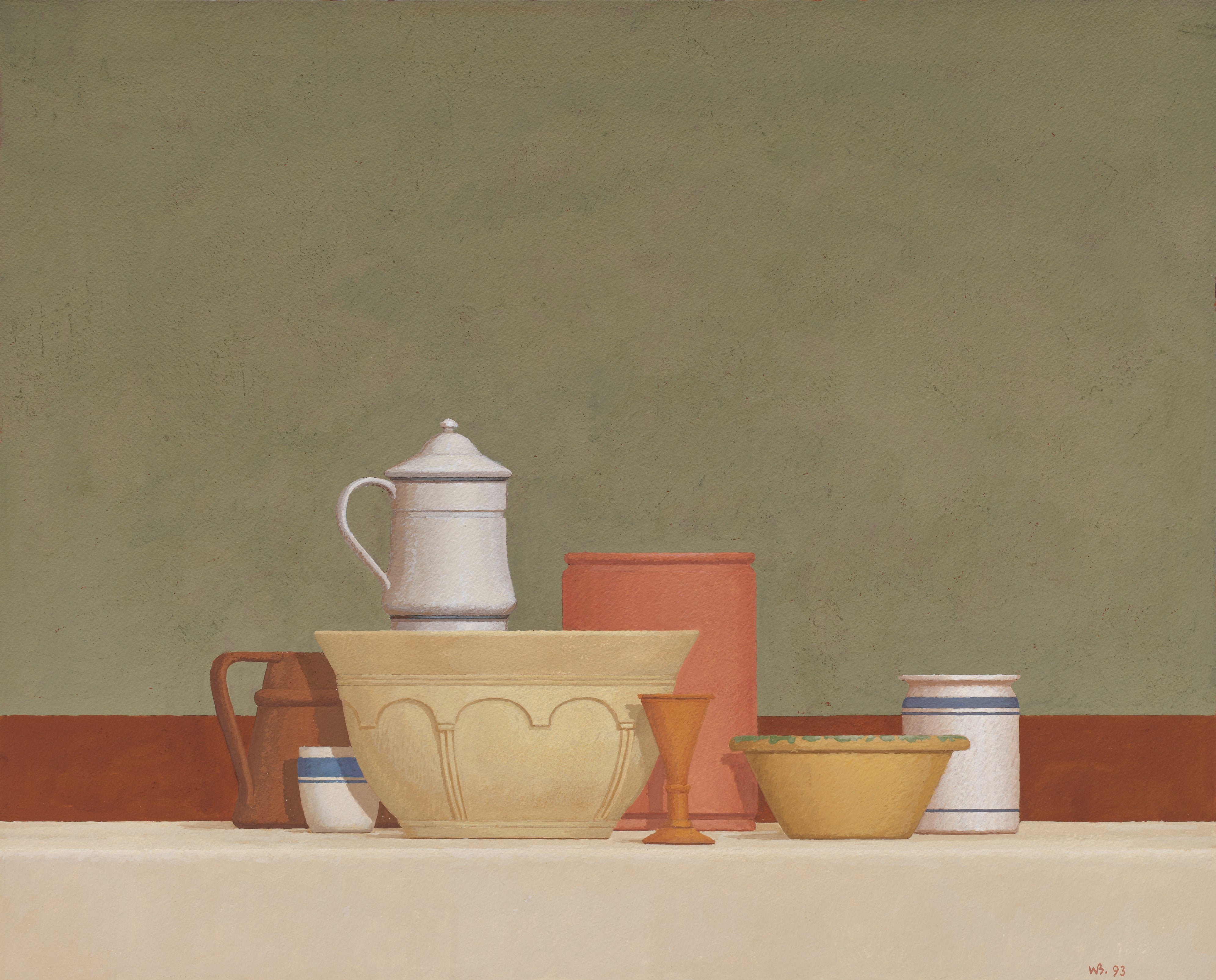
Untitled, 1993
William Bailey was born in 1930 in Council Bluffs, Iowa, a circumstance that placed him at some remove from the metropolitan centers that would later claim him. He served in the Korean War before returning to pursue his artistic education with seriousness and purpose. He studied at the Yale School of Art under Josef Albers, one of the most rigorous and demanding teachers in American art education, whose insistence on the expressive power of color and formal relationships left a permanent impression on Bailey's sensibility. The encounter with Albers gave Bailey a framework not for abstraction, which dominated the conversation at mid century, but for understanding how form and tone could carry immense emotional and intellectual weight.
Bailey's early career unfolded against the backdrop of Abstract Expressionism's dominance and the subsequent rise of Pop Art and Minimalism. He was, in this sense, a painter who chose a deliberately unfashionable path. Where his contemporaries embraced gesture, irony, or industrial cool, Bailey returned again and again to the table, the vessel, the egg. This was not nostalgia or timidity.
William Bailey
William Bailey
It was a deeply considered act of artistic commitment, rooted in his study of Italian Renaissance painting and his profound admiration for Giorgio Morandi, the Bologna based master whose bottles and canisters had elevated the still life into a vehicle for philosophical inquiry. Bailey traveled repeatedly to Italy, and the quality of Mediterranean light, its clarity and its weight, became inseparable from his pictorial language. The development of Bailey's signature practice was gradual and deliberate. Through the 1960s and 1970s he refined what would become his characteristic arrangement: simple objects, often ceramic or metallic vessels alongside eggs, placed on a shelf or table surface and set against a background of such subtle tonal variation that it seemed to breathe.
His drawing was impeccable, shaped by years of teaching at Yale where he eventually became a full professor and, later, Dean of the Yale School of Art. The act of teaching was not separate from his practice but integral to it. Bailey thought deeply about what painting could and could not do, and his students absorbed both his technical exactitude and his philosophical seriousness. Among those who passed through his classes were artists who would go on to significant careers of their own, testament to the generosity and rigor he brought to instruction.
William Bailey
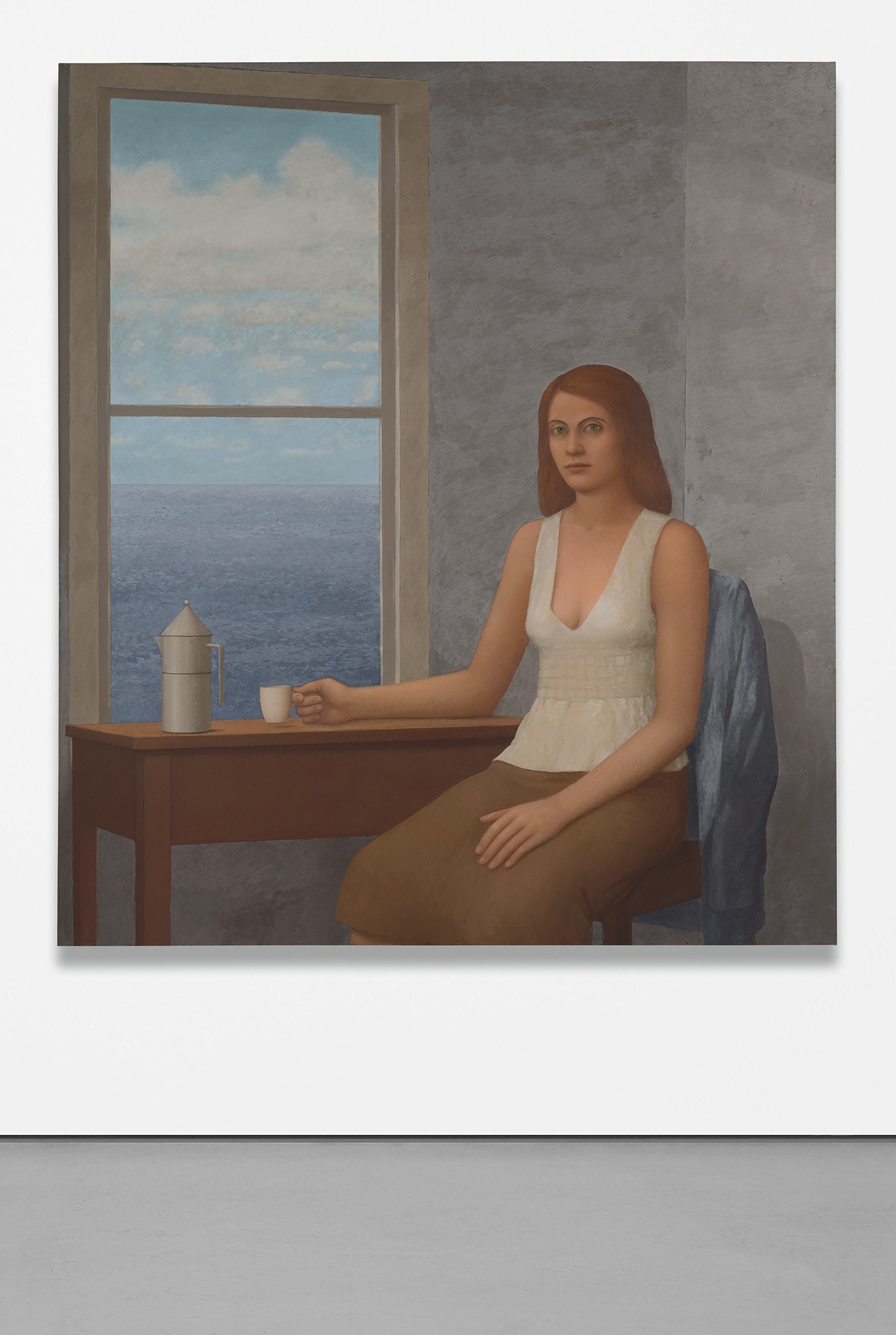
Room by the Sea, 2006
Among his most celebrated works, pieces such as Room by the Sea from 2006 demonstrate the full range of his ambition. Here the still life opens outward, admitting a glimpse of space and light that transforms the composition from an exercise in close observation into something approaching the sublime. The objects remain, but they inhabit a world that feels simultaneously intimate and expansive. Works from the early 1990s, including the untitled compositions that collectors prize so highly, show Bailey at a peak of technical and emotional confidence.
The surfaces are built with extraordinary care, the light falling across a pitcher or the curve of an egg with the precision of a painter who understood that every square inch of canvas carried meaning. These are not decorative pictures. They are arguments, made quietly and with great patience, about the relationship between seeing and being. From a collecting perspective, Bailey occupies a position of considerable and growing appeal.
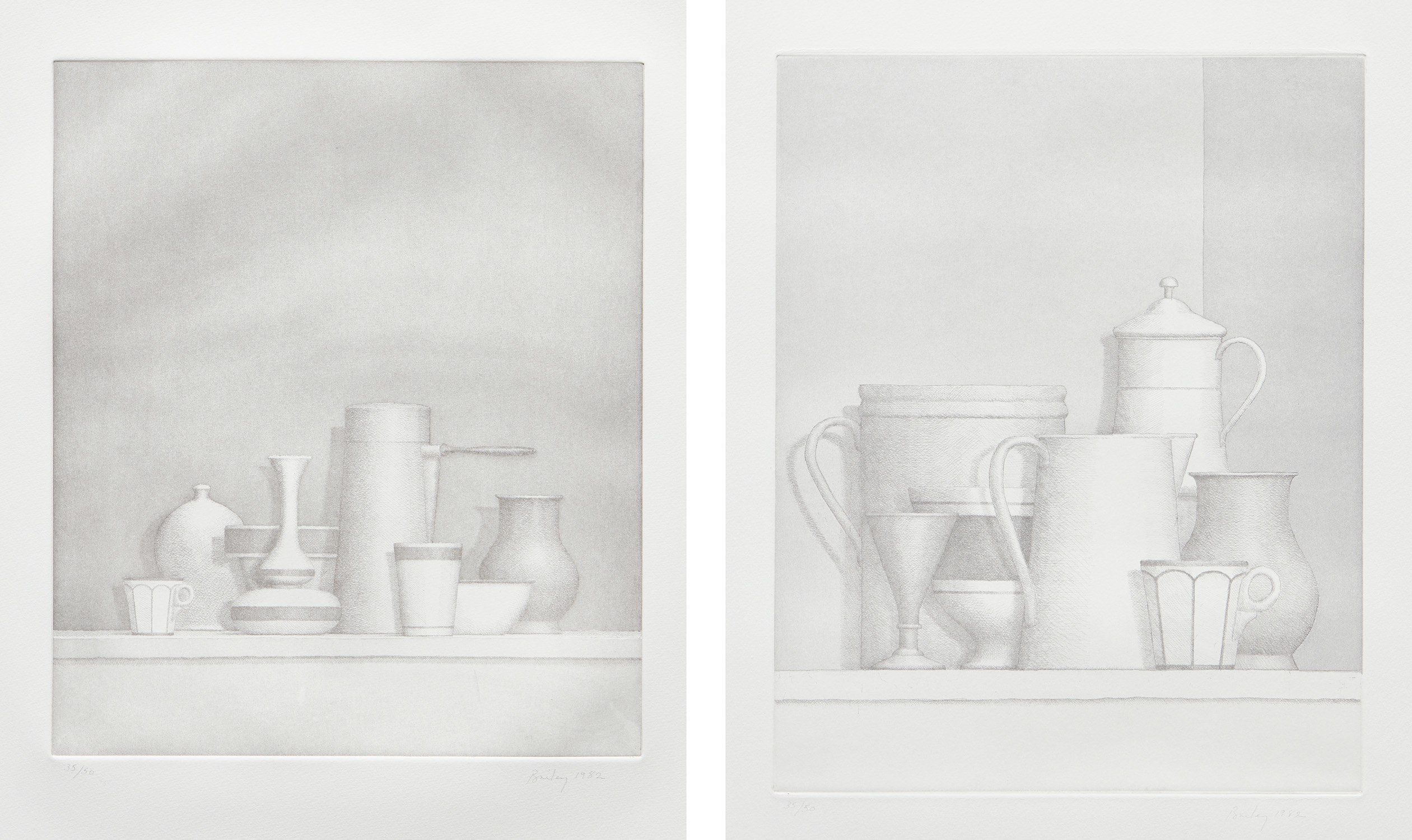
His work has been held by serious American collections for decades, and the market for his paintings and works on paper reflects the sustained respect of informed buyers. Limited edition prints, some signed and numbered in pencil in the artist's hand, offer a meaningful point of entry for collectors who wish to live with his vision without the investment required for a major canvas. Oil paintings from mature periods of his career, particularly works produced between the late 1980s and the mid 2000s, represent the strongest collecting territory. Collectors drawn to Bailey often share an admiration for artists who work within tradition without being enslaved to it, and his name appears naturally alongside those who have shaped American figurative painting: Fairfield Porter, Lois Dodd, and the long lineage of painters who found in observed reality an inexhaustible source of meaning.
Bailey's relationship to art history is one of conscious and loving engagement. He absorbed Morandi as deeply as any American painter of his generation, but he also looked to Chardin, to Piero della Francesca, and to the Flemish masters for whom the arrangement of objects was a form of philosophy. What distinguished Bailey from mere stylistic homage was the quality of his attention. His pictures do not quote the past; they inhabit a timeless present that the past made possible.
In an era of relentless novelty, this quality was and remains genuinely radical. The stillness in a Bailey is not emptiness. It is a fullness achieved through extraordinary discipline. William Bailey passed away in 2016, leaving behind a body of work that has only grown in significance as the appetite for contemplative, beautifully made painting has reasserted itself in contemporary collecting culture.
Museums and private collectors alike continue to seek out his canvases and works on paper, recognizing in them a quality that resists fashion precisely because it was never shaped by it. For those who discover Bailey for the first time, the experience is often described in terms of recognition, as if the paintings articulate something the viewer has long felt but never been able to name. That is the mark of an artist who worked at the very highest level, and it is the reason his legacy will endure.
Explore books about William Bailey