William-Adolphe Bouguereau
Bouguereau: Beauty Perfected, Beauty Eternal
Artist Spotlight · The Collection Editorial
“In art, everything is technique.”
William-Adolphe Bouguereau
When Christie's New York brought a luminous Bouguereau to the block in the early 2000s and watched the bidding surge past seven figures, it confirmed what a quiet constellation of serious collectors had long understood: that William Adolphe Bouguereau is one of the most technically commanding painters the Western tradition has ever produced. His canvases, once dismissed by modernist critics as saccharine relics of a bourgeois age, have completed one of the most remarkable rehabilitations in art market history. Today they hang in the collections of major museums and discerning private buyers alike, their surfaces still glowing with a porcelain luminosity that no photograph can fully capture. Bouguereau was born on November 30, 1825, in La Rochelle, a port city on the Atlantic coast of France, into a family of modest means with roots in the wine trade.
William-Adolphe Bouguereau
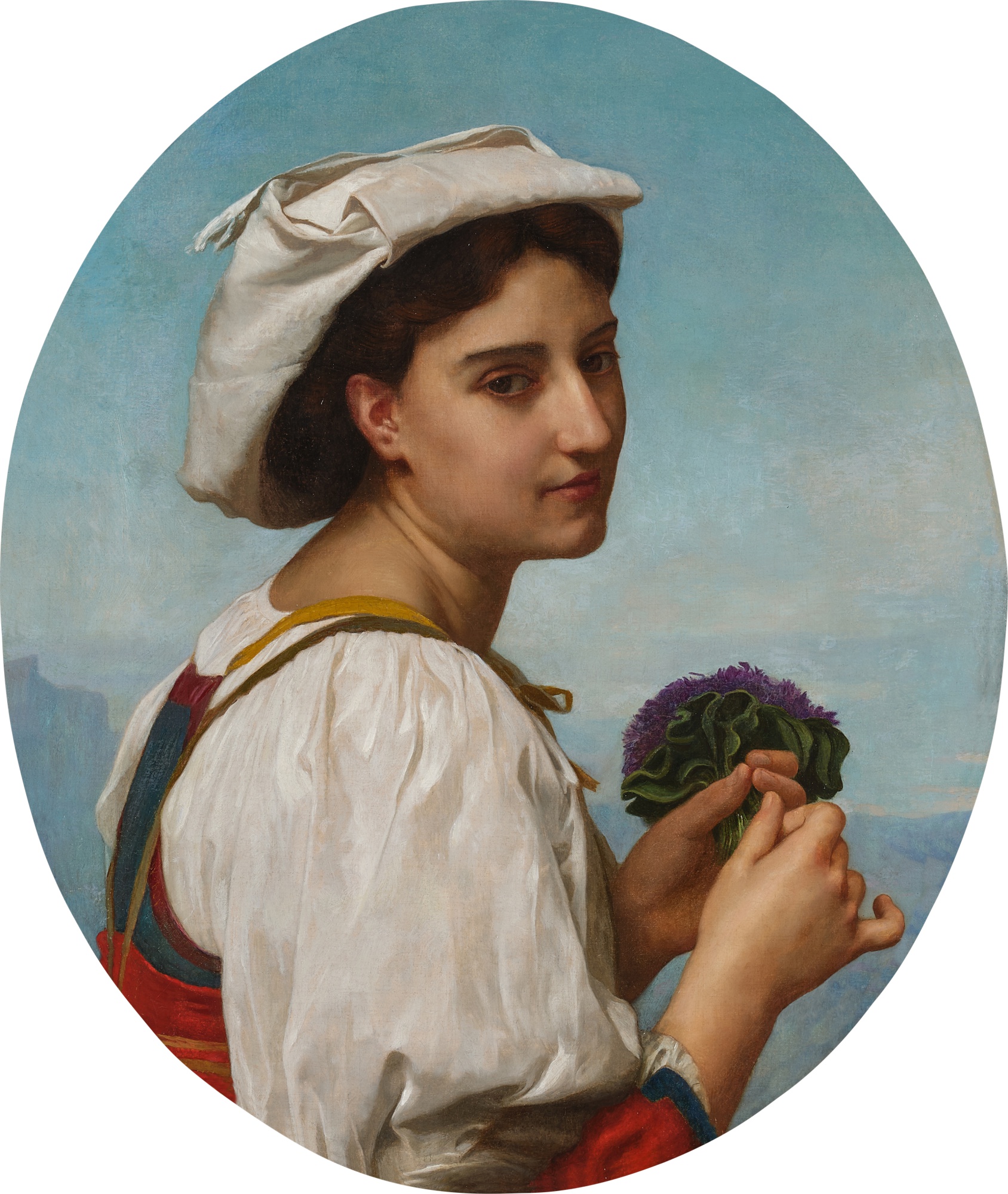
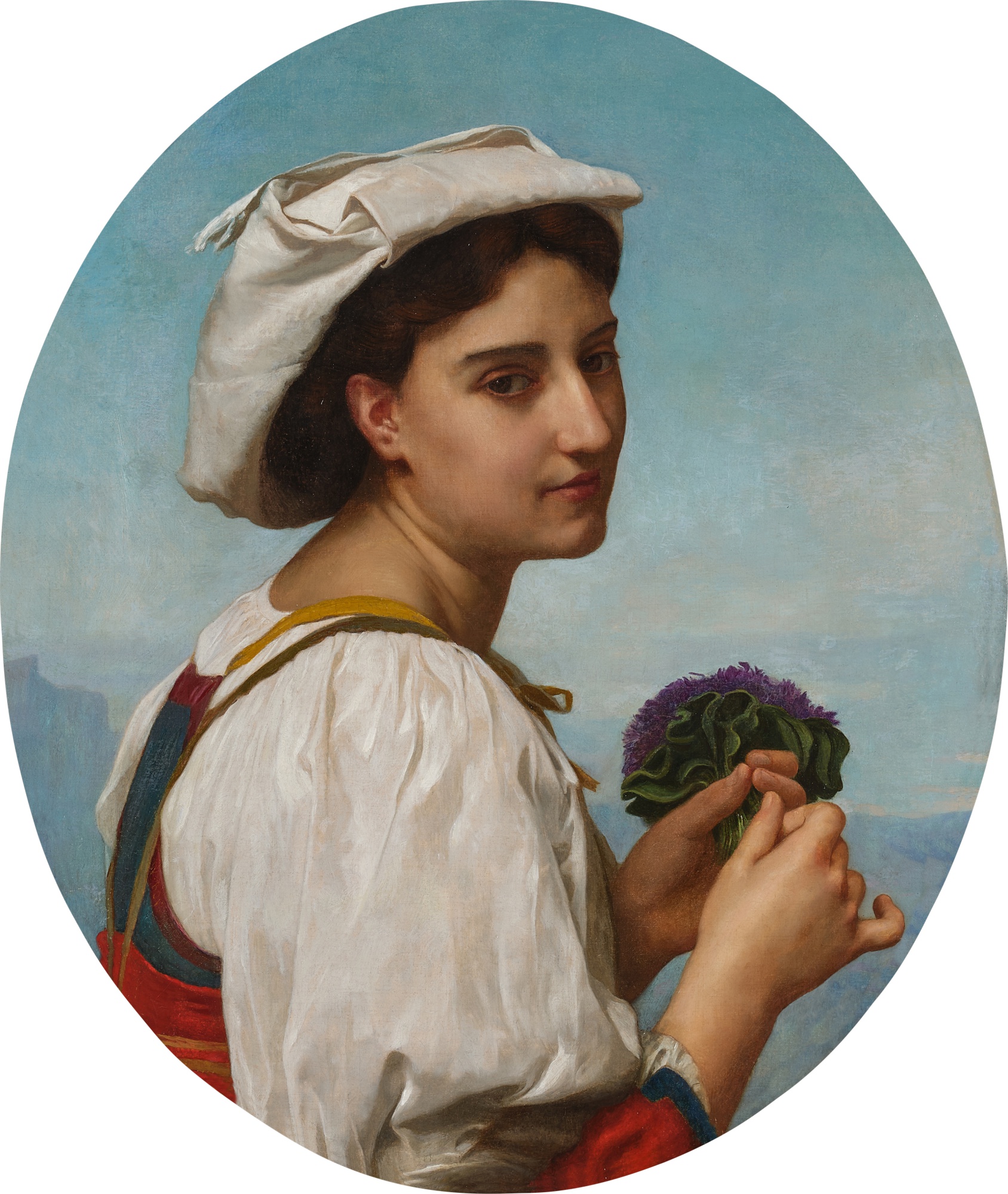
Le Bouquet de violettes
His early talent was recognized quickly, and his path toward formal training was shaped in part by the generosity of an uncle who saw in the young William Adolphe a gift worth cultivating. He entered the École des Beaux Arts in Bordeaux before making his way to Paris, where in 1846 he enrolled at the prestigious École Nationale Supérieure des Beaux Arts under the painter William Adolphe Picot. The rigorous academic curriculum of drawing from life, copying Old Masters, and mastering the hierarchy of genres formed the bedrock of everything that followed. In 1850, Bouguereau won the Prix de Rome, the most coveted prize in French academic art, which granted him several years of study at the Villa Medici in Rome.
Those Italian years were transformative. He absorbed the lessons of Raphael, studied ancient sculpture, and encountered the fresco cycles of the Renaissance with an intensity that would echo through every subsequent decade of his career. He returned to Paris not merely trained but formed, possessing a vision of ideal beauty rooted in both classical antiquity and the Catholic devotional tradition. His first Salon submissions in the early 1850s were received with admiration, and by the 1860s he had become a dominant presence in the annual exhibition that defined official French culture.
William-Adolphe Bouguereau
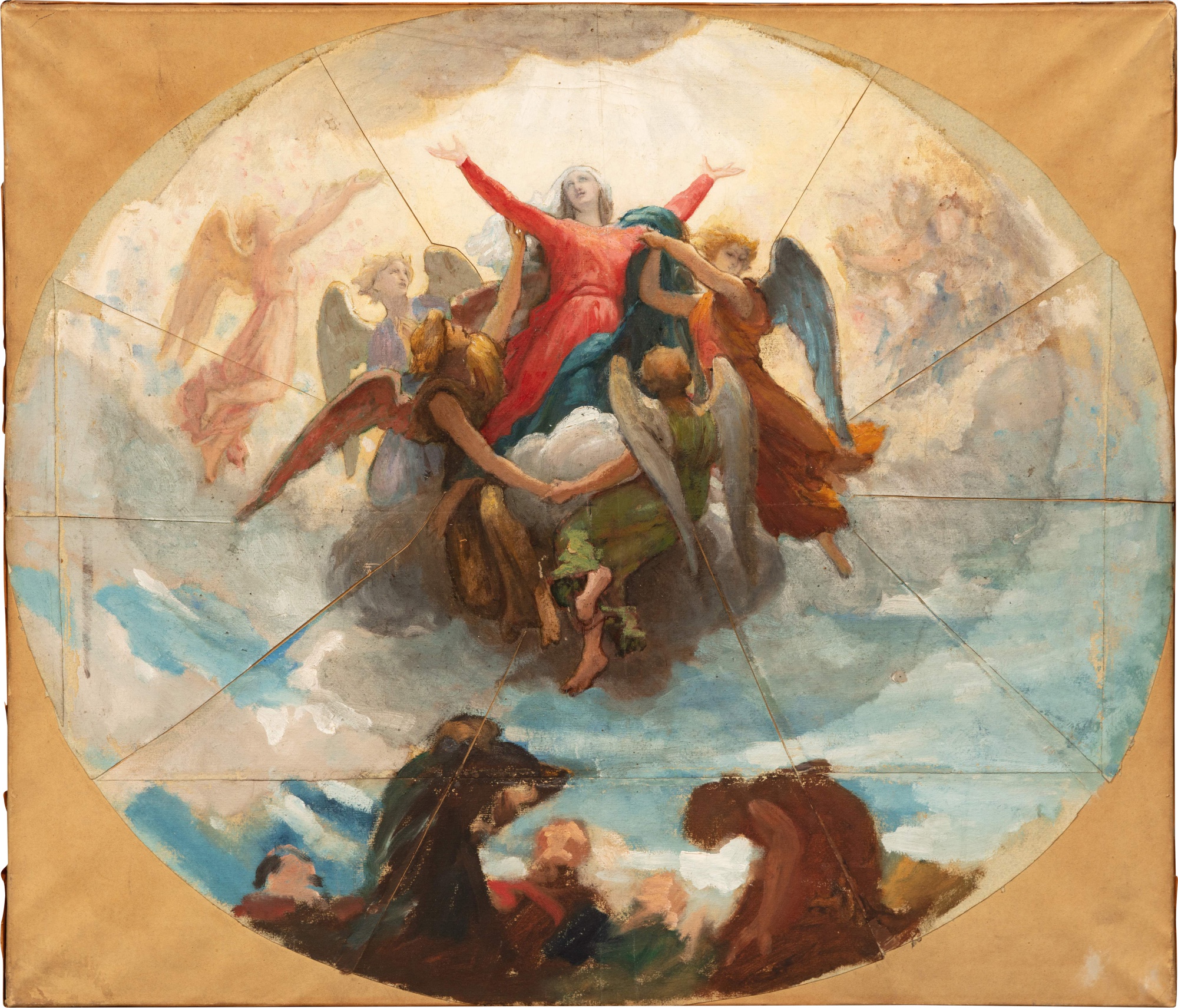
Étude pour le plafond de la Chapelle de la Vièrge à la Rochelle
The arc of Bouguereau's artistic development is one of sustained mastery rather than dramatic rupture. Through the 1860s and 1870s he refined his approach to mythological and allegorical subjects, producing works that placed the nude figure within idealized pastoral or celestial settings with a finish of breathtaking smoothness. His religious commissions, including monumental works for French churches, demonstrated that his virtuosity extended far beyond the easel into the grand decorative tradition. His studies for these larger commissions, such as the exquisite oil study for the ceiling of the Chapelle de la Vièrge in La Rochelle, reveal the intimacy of his working process: careful, meditative, deeply invested in getting the color and the spirit exactly right before committing to the final surface.
“Each day I work I try to better myself, and this will last until I die.”
William-Adolphe Bouguereau
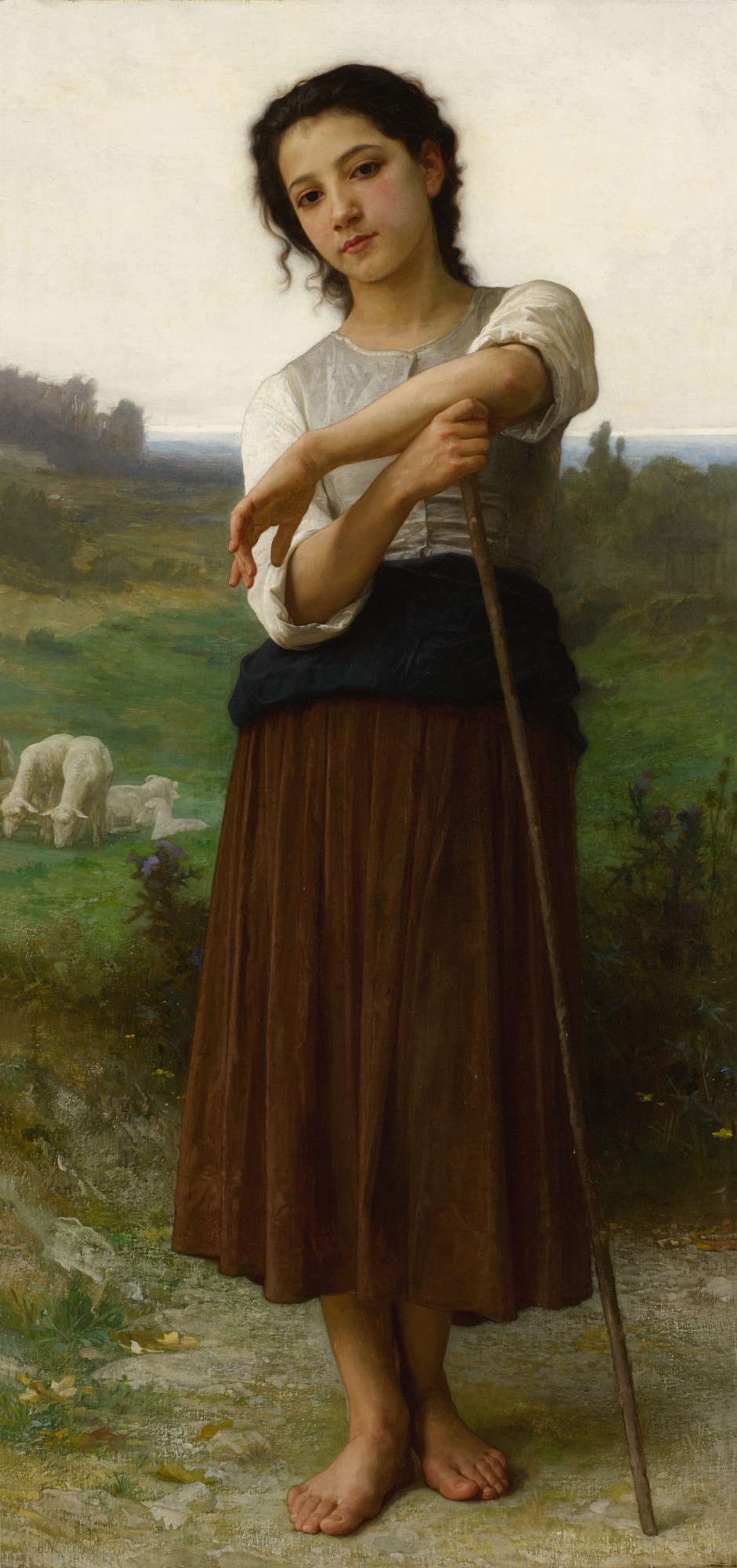
It is in these preparatory works that collectors today often find the most direct and moving contact with his intelligence as a painter. Among the works that best represent the range of his gifts, the tender figure paintings of young women and children stand apart for their combination of formal perfection and genuine warmth. A canvas such as Jeune bergère debout, a standing young shepherdess, illustrates his ability to invest an idealized figure with something that reads as real psychological presence. His portraits, including the Portrait Study of Gabrielle Drunzer executed in black chalk and oil on canvas, show an artist who could shift from grand allegory to intimate observation without losing a single degree of quality.
William-Adolphe Bouguereau
Jeune bergère debout
His mythological subjects, among them Prêtresse de Bacchus, demonstrate the full grandeur of his ambition: figures that seem to breathe, drapery that seems to move, light that seems to travel across skin as it does in the visible world. For collectors, the appeal of Bouguereau operates on several levels simultaneously. There is first the purely optical pleasure of his surfaces, which reward sustained, close looking in a way that reproductions simply cannot convey. Then there is the art historical significance: to own a Bouguereau is to hold a primary document of the French academic tradition at its absolute apex.
The market has responded accordingly. Major auction houses in New York and Paris have seen his finished oils achieve results well into the millions of dollars, while his preparatory studies and drawings offer serious collectors access to his process at price points that, relative to his canonical status, still represent genuine value. Works on paper and works that illuminate his preparatory methods, such as his chalk and oil studies, are particularly prized by sophisticated buyers who want to understand not just the destination but the journey. To understand Bouguereau fully it helps to situate him within a constellation of contemporaries who shared his commitment to the ideal.
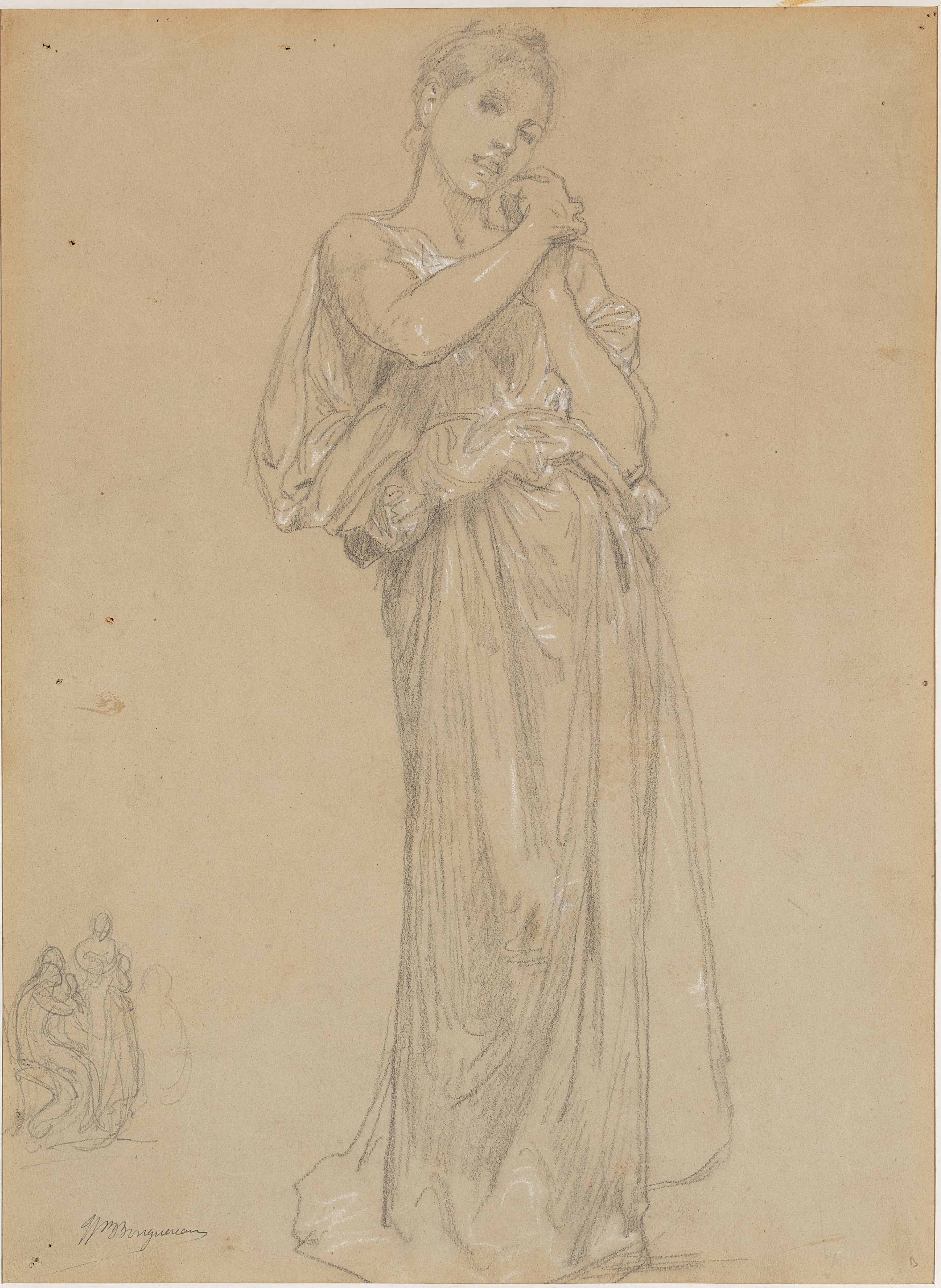
William-Adolphe Bouguereau
Jeune fille drapée et un groupe de figures, étude pour "Premiers bijoux"
Artists such as Alexandre Cabanel, whose Birth of Venus caused a sensation at the 1863 Salon, and Jean Léon Gérôme, whose orientalist precision brought a different kind of academic ambition to bear on exotic subjects, were part of the same world that Bouguereau inhabited and, in many ways, led. These painters collectively defined the visual culture of the Second Empire and the Third Republic, and their fortunes have risen together in the estimation of scholars and collectors over the past four decades as the reflexive modernist dismissal of academic painting has given way to a more honest engagement with what these artists actually achieved. The legacy of Bouguereau is, ultimately, a legacy of devotion: to craft, to beauty, to the idea that painting can aspire toward an ideal that transcends the merely observed. He worked until nearly the end of his long life, dying in La Rochelle in August 1905 at the age of seventy nine, and the body of work he left behind is staggering in both its volume and its consistency of quality.
Contemporary painters across the world continue to study his methods, academic ateliers teach from his examples, and institutions from the Musée d'Orsay in Paris to the Museum of Fine Arts in Boston hold his works as treasures. For collectors who believe that technical mastery is itself a form of meaning, and that beauty pursued without apology is a serious ambition, Bouguereau remains one of the most rewarding figures in the entire history of Western art.
Explore books about William-Adolphe Bouguereau
William-Adolphe Bouguereau
Damie Stillman
The Life and Work of William Adolphe Bouguereau
Léonce Bénédite
William-Adolphe Bouguereau: His Life and His Critical Essay
Albert Boime
Bouguereau
Genevieve and William Bouguereau
William-Adolphe Bouguereau: A Lost Realist
Aruna D'Souza