Wilhelm Kuhnert
The Lion Painter Who Captured Wild Africa
Artist Spotlight · The Collection Editorial
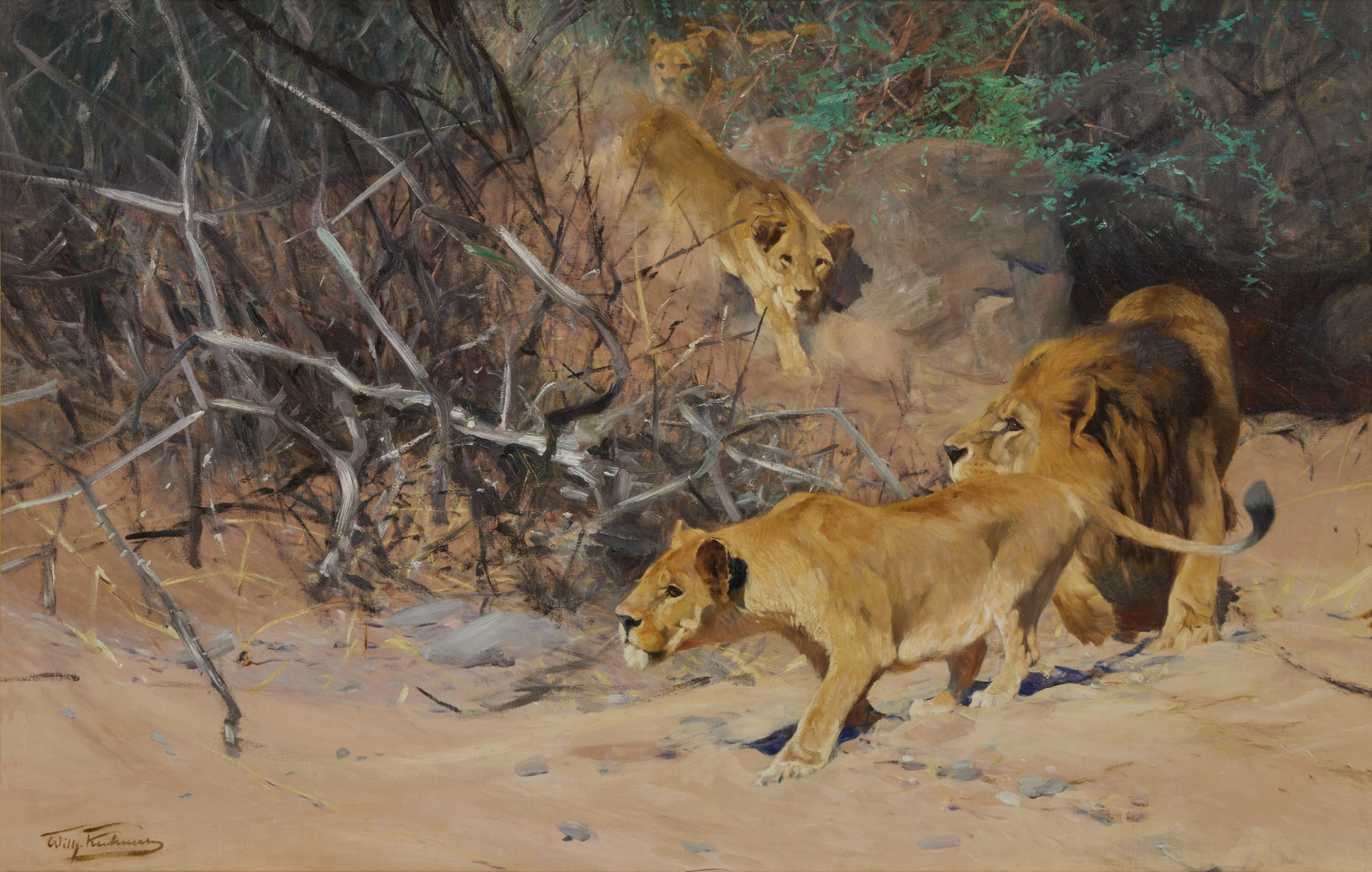
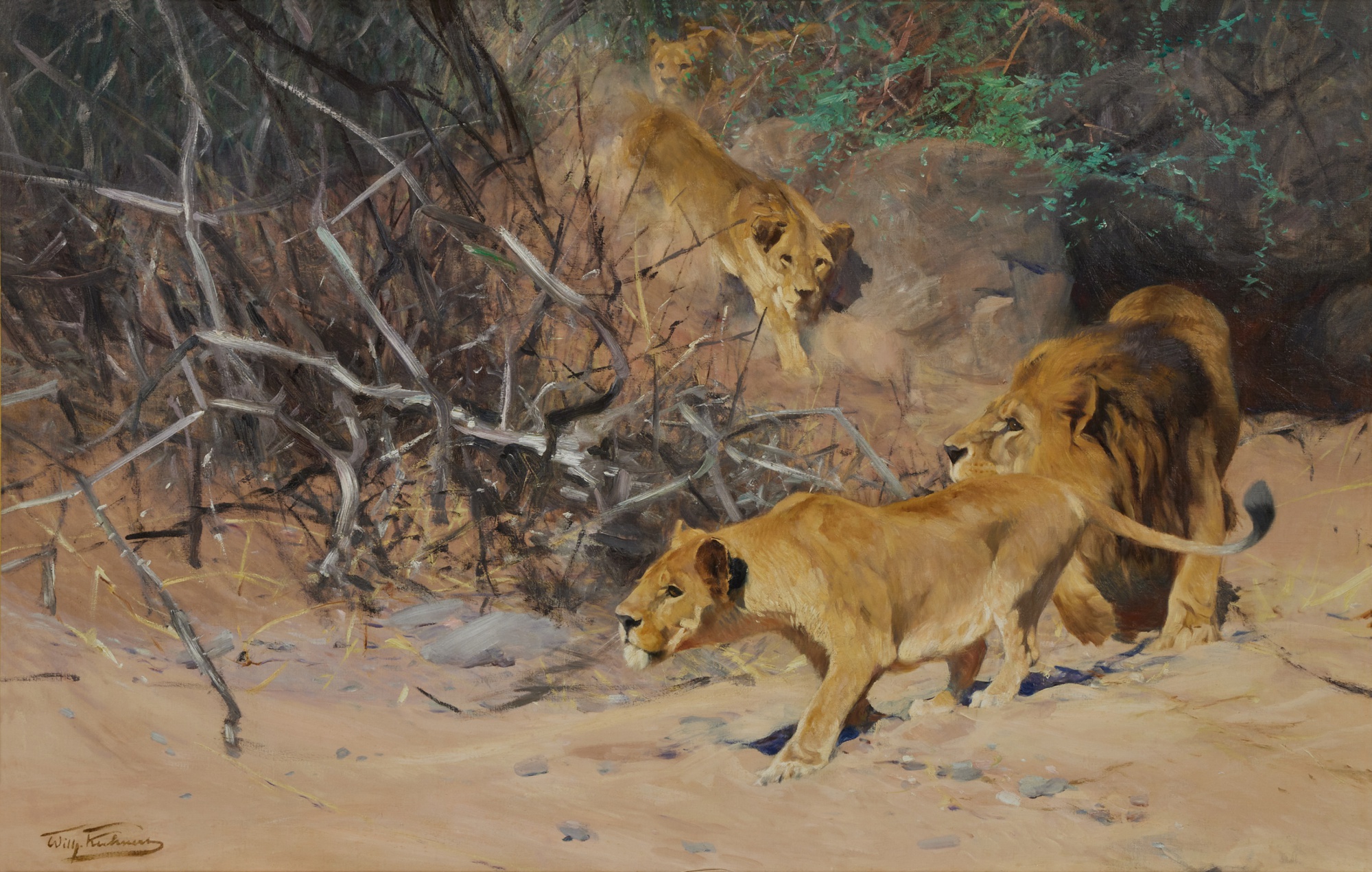
There is a painting that stops visitors in their tracks at auction previews across Europe and the United States. A pride of lions moves low through the golden grasses of the East African savanna, their amber eyes alert, their muscular bodies coiled with latent power. The artist is Wilhelm Kuhnert, and the work is unmistakably his: luminous, precise, alive with the kind of authority that only comes from firsthand observation. More than a century after these canvases were completed, the art world continues to rediscover why Kuhnert deserves a place among the great naturalist painters of any era.
Wilhelm Kuhnert
A Pride of Lions on the Prowl
Wilhelm Kuhnert was born in 1865 in Oppeln, in what was then the Prussian province of Silesia, a region that bred in him a deep appreciation for the natural world. He trained at the Berlin Academy of Arts, where he developed the technical discipline and meticulous draftsmanship that would define his mature work. Berlin in the late nineteenth century was a city electrified by scientific inquiry and imperial ambition, and for a young painter with a passion for animals, the currents of the time opened extraordinary possibilities. The great zoological collections of the era gave Kuhnert access to living specimens, but from the beginning he understood that the zoo was only a preparation for something far more demanding.
Kuhnert made his first expedition to East Africa in 1891, a journey that would transform not only his practice but his entire sense of purpose as an artist. He returned to the continent multiple times over the following decades, traveling through the territories that are today Kenya and Tanzania, embedding himself in landscapes that few European painters had ever witnessed firsthand. He traveled on foot and by whatever transport the terrain allowed, carrying his sketchbooks and his careful powers of observation into the bush. He studied the way light fell across a lion's flank at dusk, the precise articulation of a tiger's shoulder as it moved through undergrowth, the way a herd's behavior shifted when a predator was near.
Wilhelm Kuhnert
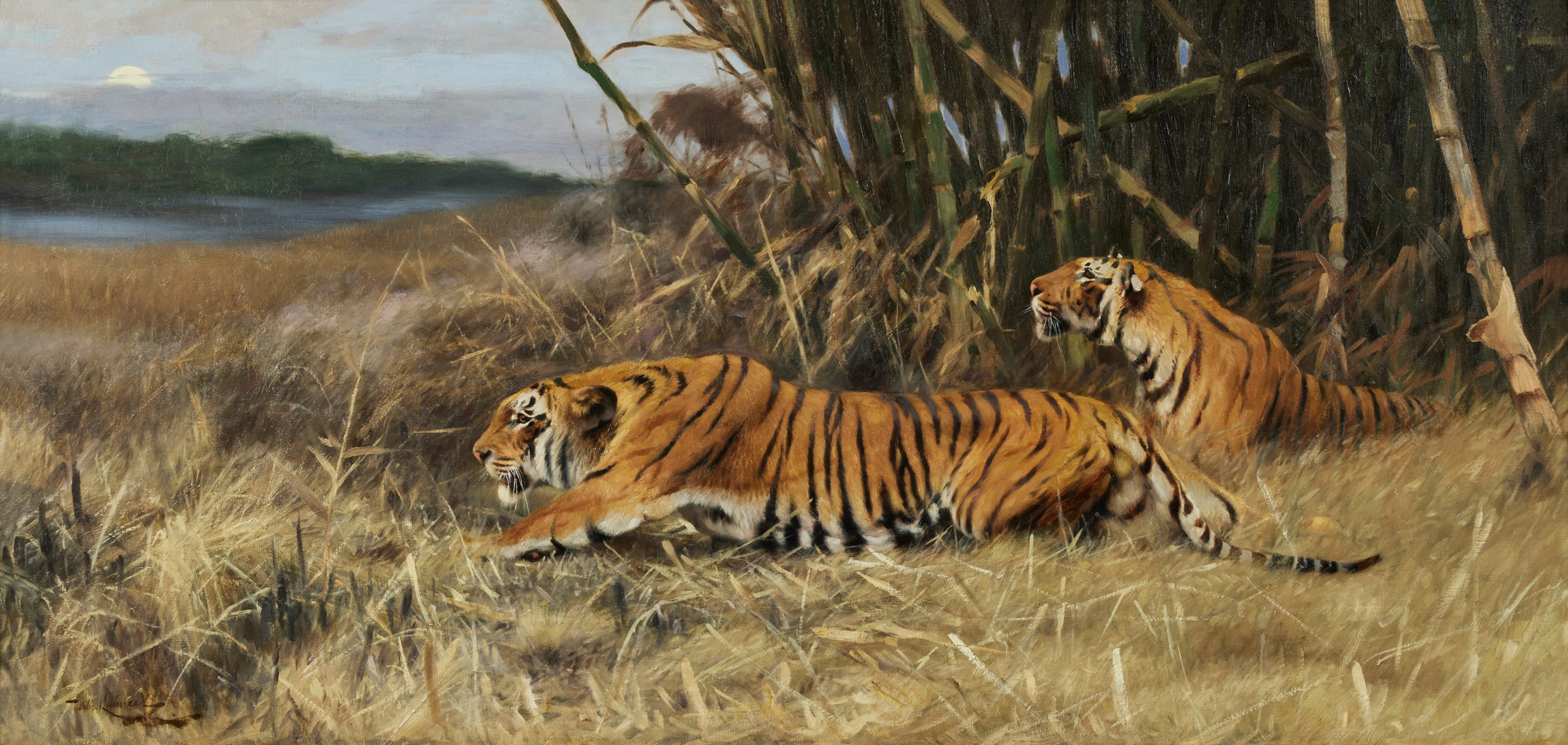
Two Stalking Tigers
This commitment to scientific accuracy was not merely academic vanity; it was the foundation of everything he made. His artistic development moved steadily from competent animal illustration toward something altogether more ambitious. By the 1890s and into the early twentieth century, Kuhnert had mastered the ability to synthesize rigorous natural history with the compositional drama of academic painting. His large scale oil canvases are organized with a theatrical intelligence: the viewer is placed close to the action, drawn into the scene rather than positioned as a safe observer from a distance.
Works such as A Pride of Lions on the Prowl demonstrate this quality vividly. The lions do not pose. They move through a world that exists independently of the viewer's gaze, and that sense of autonomy, of animals caught in an unguarded moment of natural behavior, is what separates Kuhnert from the decorative animal painters of his generation. His depictions of big cats remain the works for which he is most celebrated and most collected.
Wilhelm Kuhnert
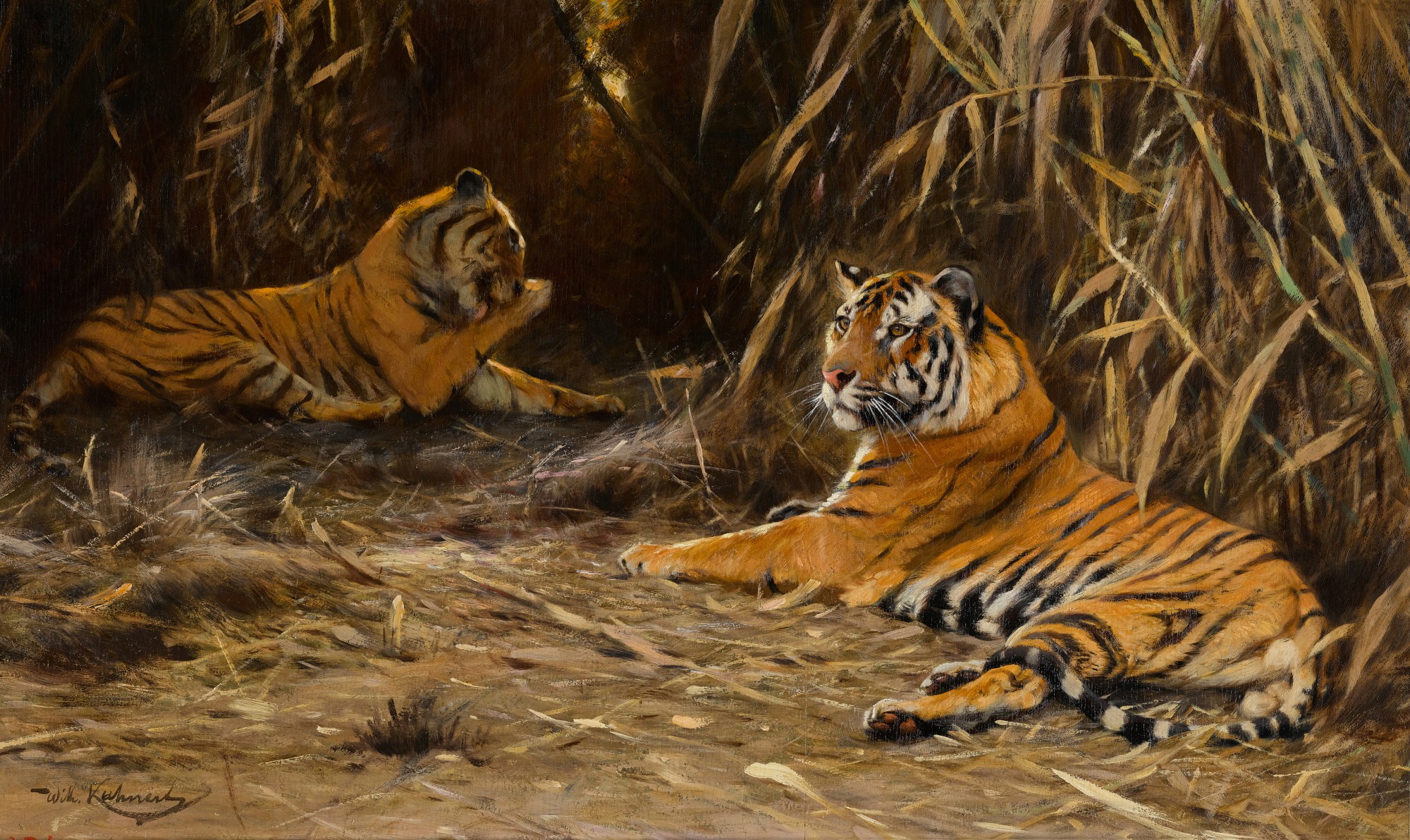
Tigers in the Jungle
Two Stalking Tigers and Tigers in the Jungle reveal a painter equally at home with the dense, filtered light of tropical forest as he was with the open horizons of the African plain. The tiger works are studies in compression and tension, the jungle canopy pressing down as the cats move through dappled shadow. The technical handling of foliage and light in these paintings shows a painter whose observational gifts extended well beyond his signature African subjects. Oil on canvas was his primary medium, though works on panel such as Tigers in the Jungle demonstrate his willingness to adapt his materials to the demands of a given composition.
For collectors, Kuhnert occupies a fascinating position in the market. His work sits at the intersection of fine art, natural history illustration, and the grand tradition of German academic painting, which means that interest in him draws from several distinct collecting communities at once. His paintings have appeared regularly at major auction houses including Christie's and Sotheby's, where strong examples command serious prices from international bidders. What distinguishes a great Kuhnert from a merely good one is typically the quality of the central animal study: the finest examples show that characteristic combination of anatomical precision and psychological presence, the sense that the animal is genuinely alive within the picture plane.
Collectors who approach his work for the first time are often surprised by its scale and ambition; these are not decorative cabinet pieces but serious paintings that hold their own in any room. In the broader context of art history, Kuhnert belongs to a distinguished lineage of painter naturalists that includes the French artist Rosa Bonheur, whose commitment to direct observation of animals paralleled his own, and the British painter Richard Ansdell, who brought similar academic rigor to animal subjects in the Victorian era. Closer to home, he can be understood alongside contemporaries in the German tradition of naturalist landscape and animal painting, artists who took the lessons of Barbizon and applied them to subject matter drawn from direct experience of the natural world. What makes Kuhnert singular within this company is the specificity of his geographic focus and the depth of his fieldwork.
No other European painter of his generation knew the East African landscape with comparable intimacy. Kuhnert died in 1926, leaving behind a body of work that has only grown in cultural resonance as the landscapes and wildlife he documented have become increasingly precious and fragile. His paintings now function as historical records as much as aesthetic objects, offering viewers a window into ecosystems observed before the transformations of the twentieth century. There is something profoundly moving about standing before one of his lion paintings today, knowing that the artist traveled thousands of miles and endured genuine hardship to deliver this image with honesty and care.
That dedication, more than any single technical achievement, is what collectors respond to when they encounter his work. Wilhelm Kuhnert painted what he saw, and what he saw was magnificent.