Wang Guangyi
Wang Guangyi, Where Power Meets Pop
Artist Spotlight · The Collection Editorial
“I want to explore the relationship between political ideology and commercial culture. They share the same visual logic.”
Wang Guangyi
Few living painters have so precisely caught the friction between two worlds colliding as Wang Guangyi. In recent years, major survey exhibitions across Europe and Asia have reaffirmed his position as one of the most consequential Chinese artists of the twentieth and twenty first centuries, with institutions from the San Francisco Museum of Modern Art to leading European kunsthalles holding his canvases as touchstones of the era. Auction rooms in Hong Kong and New York have consistently returned strong results for his most celebrated series, and a new generation of collectors, many of them too young to remember the Cultural Revolution firsthand, are discovering in his work something that feels newly urgent: a meditation on the seduction of ideology, whether it arrives wrapped in a red banner or a fast food logo. Wang Guangyi was born in Harbin in 1957, a northeastern industrial city whose winters are among the harshest in China.
Wang Guangyi
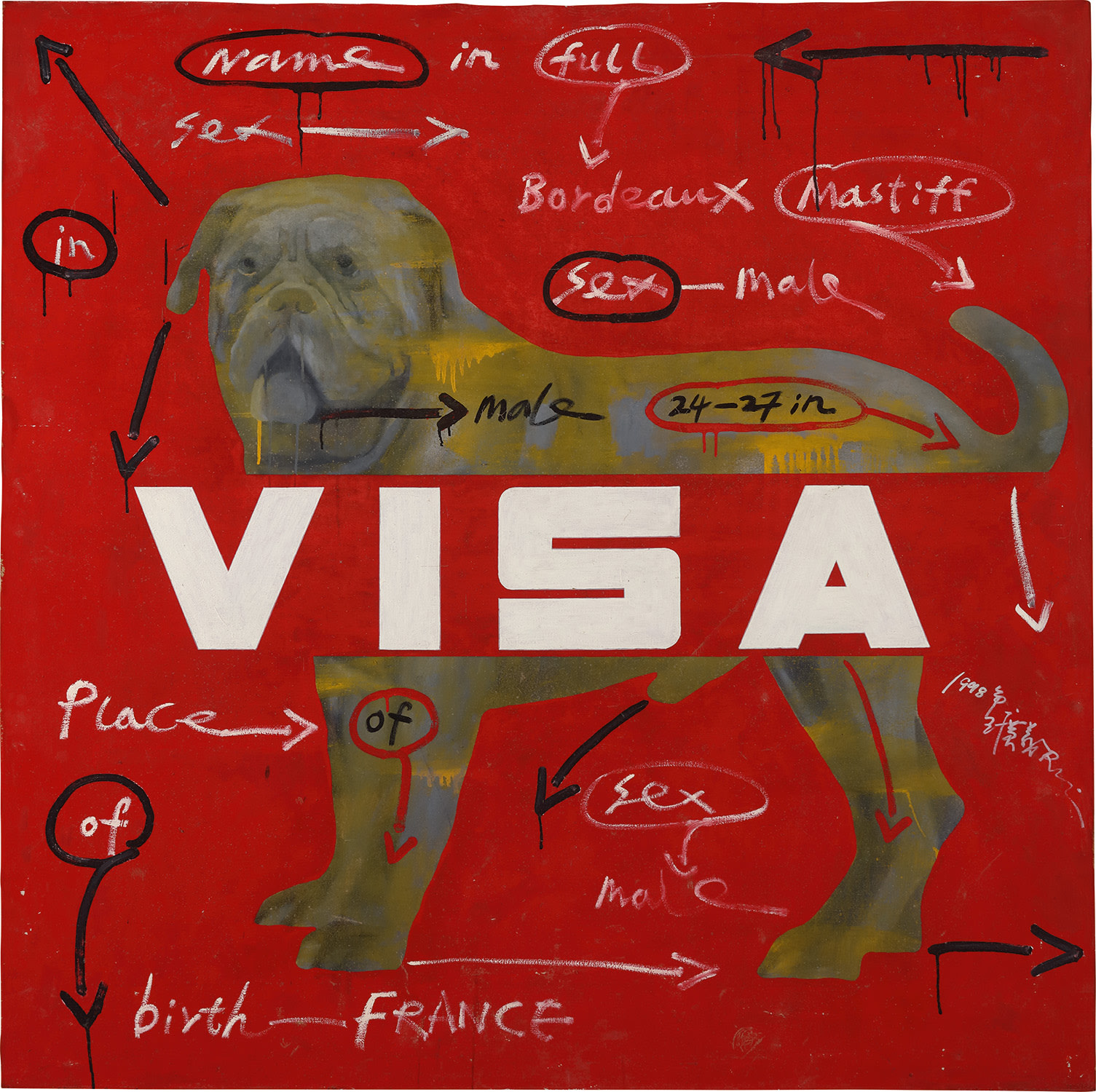
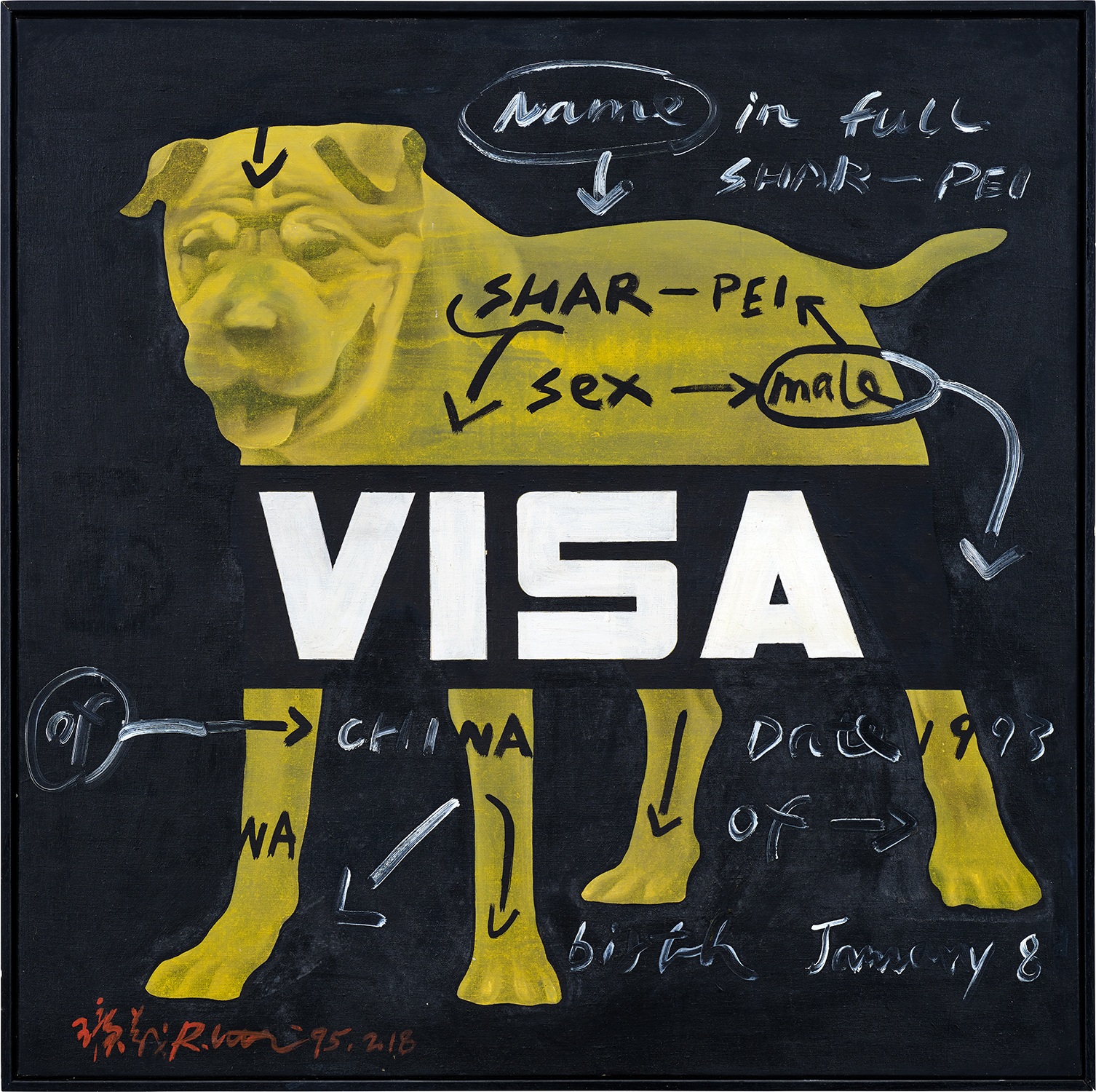
VISA Dog, 1995
He came of age precisely when the Cultural Revolution was reshaping every dimension of Chinese life, from how families spoke at dinner to what images were permitted on walls. The propaganda aesthetics of that period, the striding workers, the raised fists, the flat graphic certainty of Maoist poster art, were not distant history for Wang. They were the visual language of his childhood, absorbed before he had any framework for questioning them. That formative immersion would later become the raw material of some of the most searching paintings of his generation.
He studied at the Zhejiang Academy of Fine Arts in Hangzhou during the early 1980s, a period of intense intellectual ferment as China began cautiously opening to Western ideas. The academy was a crucible, and Wang emerged from it acutely aware of both the weight of Chinese visual tradition and the provocations arriving from abroad. He was drawn early to the Neo Expressionist energy coming out of Germany and the conceptual provocations of American Pop Art, not as styles to imitate but as lenses through which to examine his own inheritance. By the late 1980s he had become a central figure in the '85 New Wave movement, a loose but vital surge of experimental Chinese art that sought to break from the straitjacketed aesthetics of the recent past.
Wang Guangyi
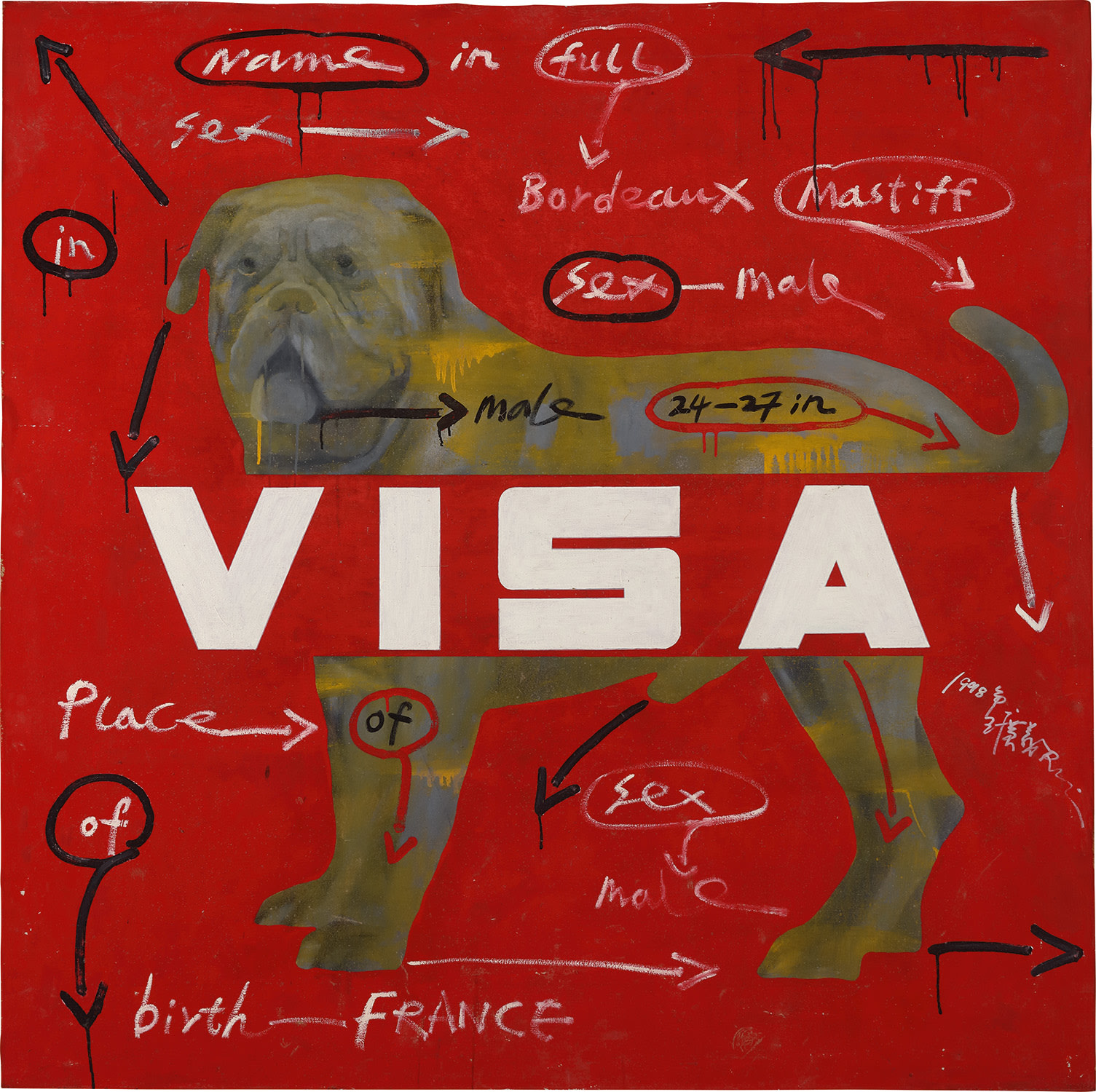
Visa, 1995
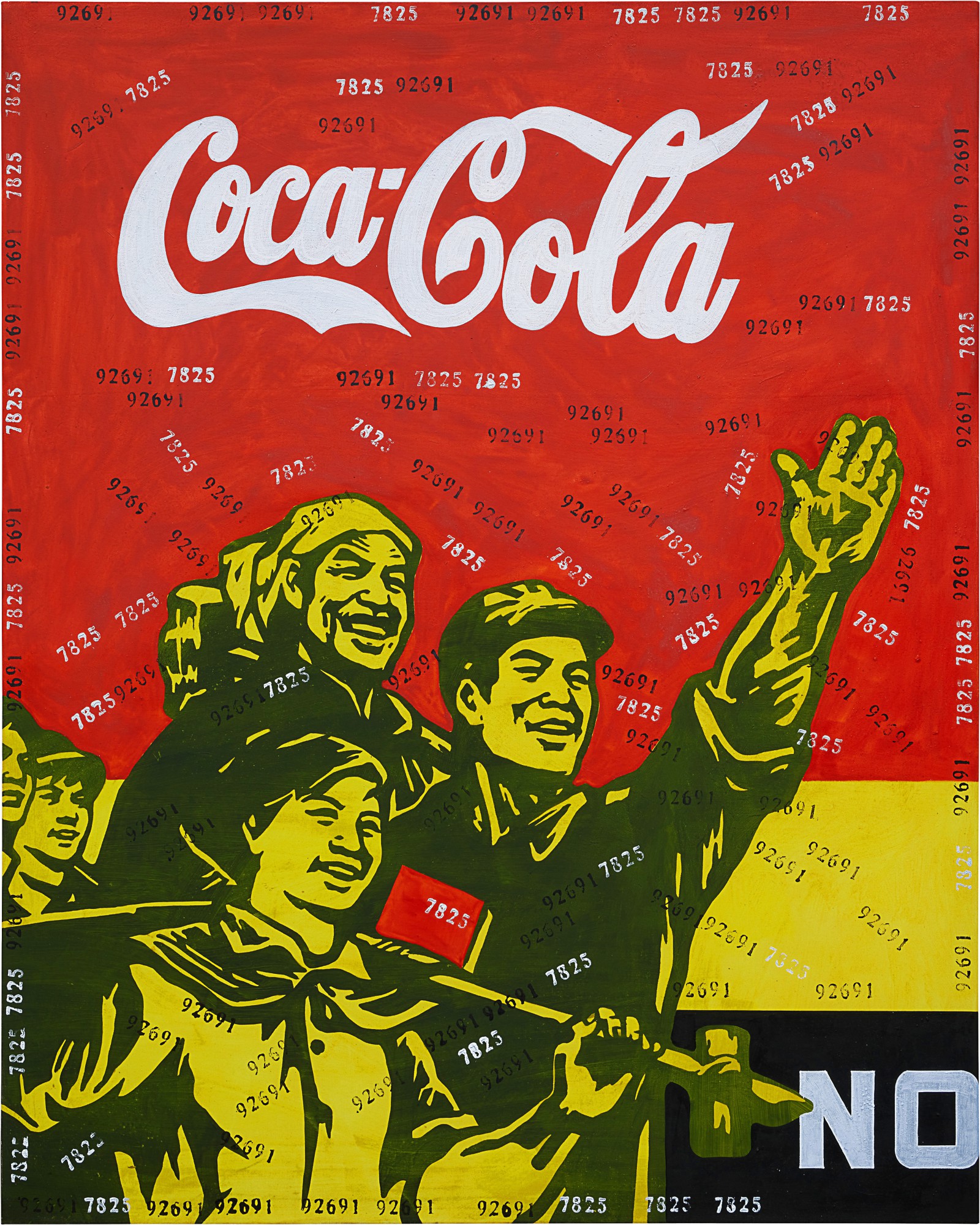
The breakthrough that would define Wang's international reputation arrived in the early 1990s with the Great Criticism series, and it remains among the most brilliantly conceived bodies of work in contemporary art. The conceit is elegantly simple and devastatingly effective. Wang takes the flat, heroic figures of Cultural Revolution propaganda posters, workers and soldiers caught in postures of revolutionary zeal, and places them directly alongside the logos of global consumer brands. Coca Cola, Marlboro, and others appear not as targets of straightforward satire but as near equals to the slogans of Maoism, both systems promising transformation and fulfillment, both deploying images of desire and belonging with extraordinary sophistication.
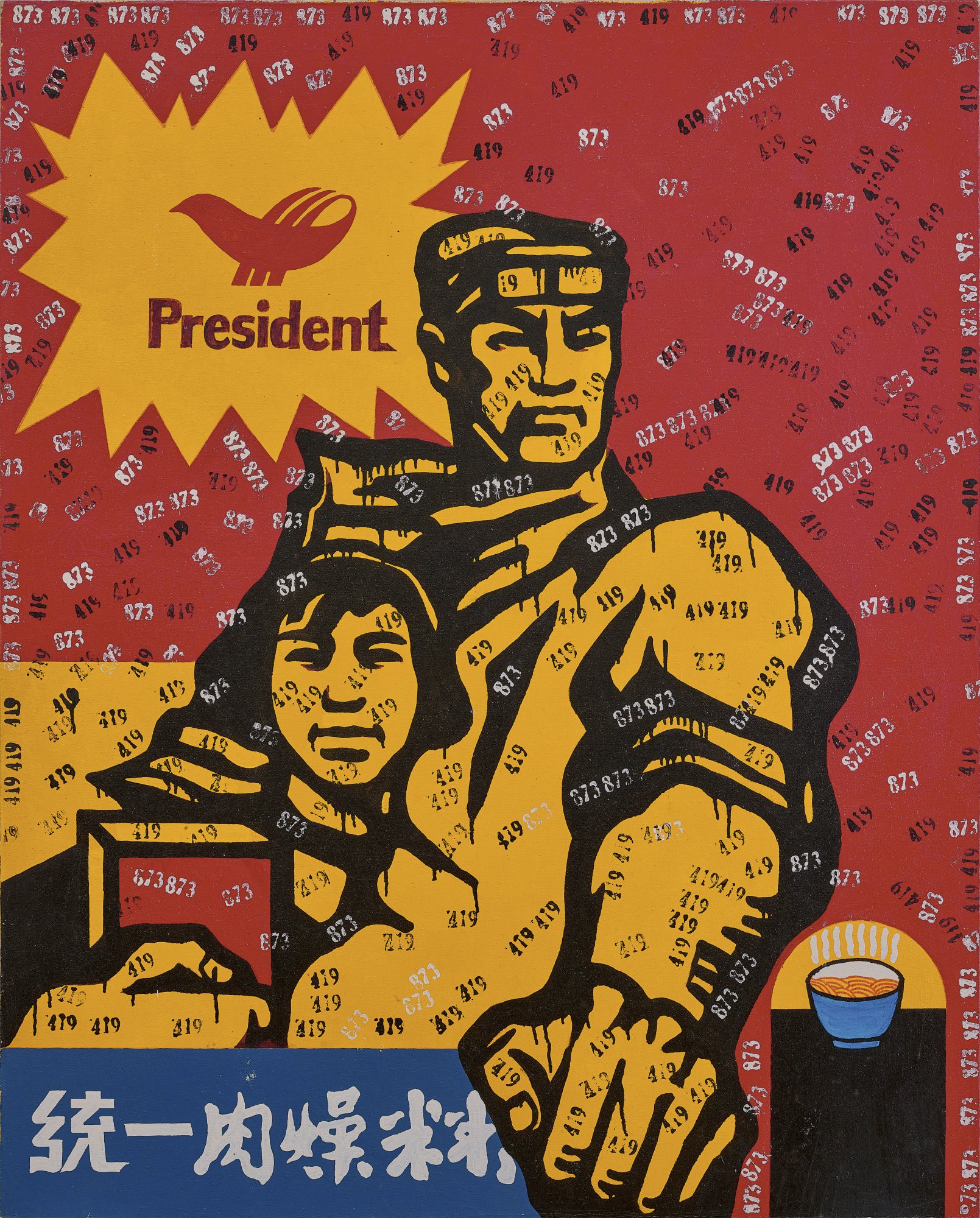
The visual tension is immediate and the conceptual payload accumulates slowly, the longer you look, the more unsettling the symmetry becomes. Among the most celebrated individual works from this period are the Visa canvases of 1995, which bring the iconography of financial power into the same charged field as revolutionary imagery. Great Criticism Series: Coca Cola and Great Criticism Series: President extend the inquiry across different registers of authority, one commercial, one political, each revealing the other's mechanisms by proximity. Great Criticism: Disney, created in 2000, expands the frame to include the global culture industry, placing the cheerful grammar of entertainment in conversation with the earnest grammar of mass mobilization.
Wang Guangyi
Great Criticism Series: President 大批判-統一面
The Aesthetics of War paintings introduce a cooler, more monumental palette, blue and grey and steel, shifting the register toward something closer to memorial than satire. Across all these works, Wang's technical command is formidable: his handling of flat color fields, his mastery of scale, and his instinct for the precise visual quotation that makes the collision land without collapsing into caricature. For collectors, Wang Guangyi occupies a particularly compelling position in the market. His work sits at the intersection of art history and cultural critique, which means it rewards both emotional and intellectual engagement, a combination that serious collectors consistently seek out.
Works from the Great Criticism series in oil on canvas represent the core of his market, and paintings with clear provenance from the 1990s have performed strongly at auction, particularly at Christie's and Sotheby's Hong Kong. Prints and lithographs, including the Coca Cola Green lithograph on Rives BFK paper, offer a more accessible entry point to the practice while sharing the conceptual DNA of the major paintings. Collectors approaching Wang for the first time are well advised to look for works where the juxtaposition of imagery is most precisely calibrated: the best pieces generate a productive unease rather than a resolved statement, and it is in that unresolved tension that the real value, aesthetic and historical, resides. Within the broader landscape of contemporary art, Wang Guangyi belongs to a cohort of artists who transformed national visual trauma into universal inquiry.
Wang Guangyi
Great Criticism Series: Coca Cola 大批判系列:可口可樂
His closest companions in this project include Ai Weiwei, whose practice similarly interrogates authority through the vernacular of Chinese cultural history, and Zhang Xiaogang, whose Bloodline series draws on comparable Maoist visual sources to explore identity and family under ideological pressure. Internationally, comparisons to Andy Warhol are frequently made and are not without merit: both artists understood that the iconography of mass persuasion was the defining visual language of their respective eras. But Wang's work carries a biographical weight that Warhol's cool detachment never sought. He lived inside the system he depicts, and that proximity gives the Great Criticism paintings an authority that purely ironic appropriation cannot reach.
Wang Guangyi's legacy is not merely historical. In a world where the merger of political messaging and consumer spectacle has only accelerated, where social media platforms deploy the aesthetics of desire with the efficiency of state propaganda, his canvases read less like period documents and more like prophecy. He gave form to a question that remains genuinely open: when two systems of mass belief stand side by side, each promising the good life through different emblems, how do we learn to see either clearly? The answer, in painting after painting, is that we start by looking very carefully at the image in front of us.
That is an invitation the most perceptive collectors have always been wise enough to accept.
Explore books about Wang Guangyi
Wang Guangyi
Gao Minglu
Wang Guangyi: A Retrospective
Museum of Modern Art Shanghai
Wang Guangyi: Post-Sense Sensibility
Carol Lu
Wang Guangyi: Great Criticism Series
Christopher Phillips
Wang Guangyi
Hans Ulrich Obrist
Contemporary Chinese Art: The Stars and Beyond
Melissa Chiu