Walter Gay
Walter Gay: Light Made Perfectly Still
Artist Spotlight · The Collection Editorial
Imagine stepping through a pair of tall French doors into a room that has been waiting for you. Silk draperies catch the afternoon sun. A gilded clock stands on the mantelpiece. Chairs are arranged as though their occupants stepped away only moments ago.
Walter Gay
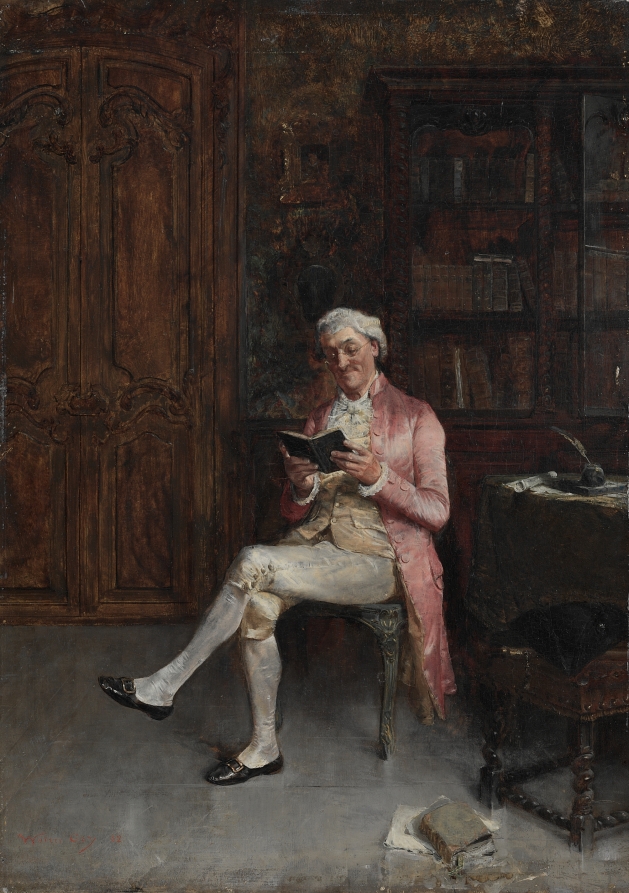
A Philosopher, 1882
This is the world Walter Gay spent a lifetime perfecting, and it is a world that feels, in our current moment of renewed appetite for intimate, meditative painting, more alive and more necessary than ever. Collectors and curators across Europe and the United States have returned with fresh eyes to Gay's oeuvre, recognising in his luminous interior compositions a mastery that places him squarely among the great chroniclers of civilised domestic life. Walter Gay was born in Hingham, Massachusetts in 1856, into a New England environment that valued craft, learning, and aesthetic seriousness. His early formation took him first to Boston, where he absorbed the disciplined traditions of American academic training, and then, decisively, to Paris.
There he entered the studio of Léon Bonnat, one of the most rigorous and sought after masters of the French academic tradition, whose students included a remarkable generation of American painters eager to absorb the lessons of European technique. Paris in the 1870s and 1880s was a city crackling with artistic ambition, and Gay arrived at precisely the moment when Impressionism was reshaping the conversation about light, surface, and the act of seeing itself. In his early career, Gay moved comfortably within the tradition of genre painting, producing canvases of French peasant subjects rendered with warmth and technical confidence. His 1882 painting "A Philosopher," an oil on panel, demonstrates the assured draftsmanship and sensitivity to character that earned him early recognition in Paris Salon circles.
Walter Gay
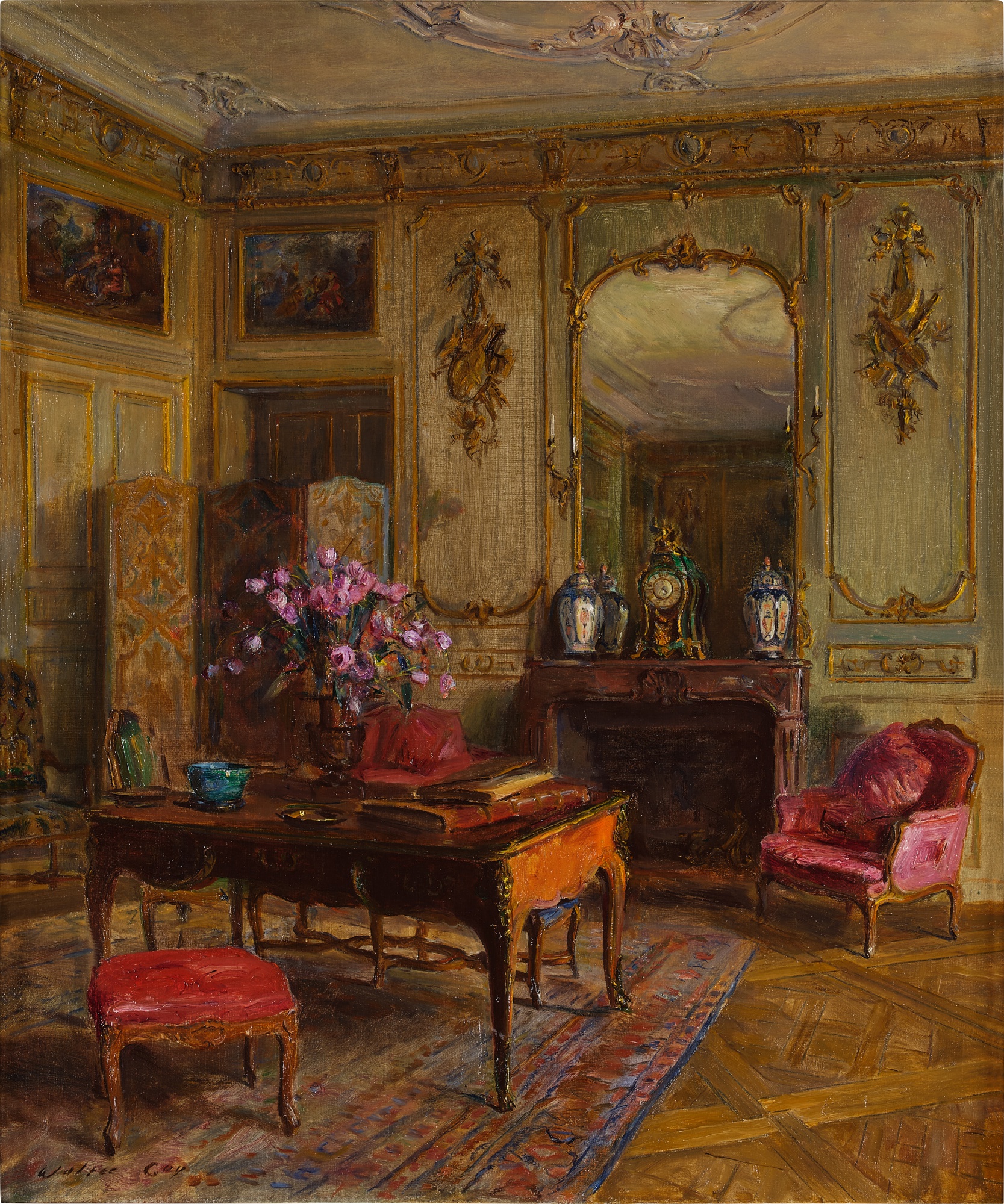
Interior with Clock Garniture
These peasant subjects were admired and collected, establishing Gay as a painter of genuine accomplishment within a well understood mode. But the work that would define his legacy was still ahead of him, waiting in the great rooms of the French countryside. The shift toward interior painting was not a sudden break but a gradual deepening of Gay's most natural instincts. Having settled permanently in France and eventually making his home at the Château du Bréau near Montigny sur Loing, Gay found himself surrounded by the kind of storied, furnished spaces that fired his imagination completely.
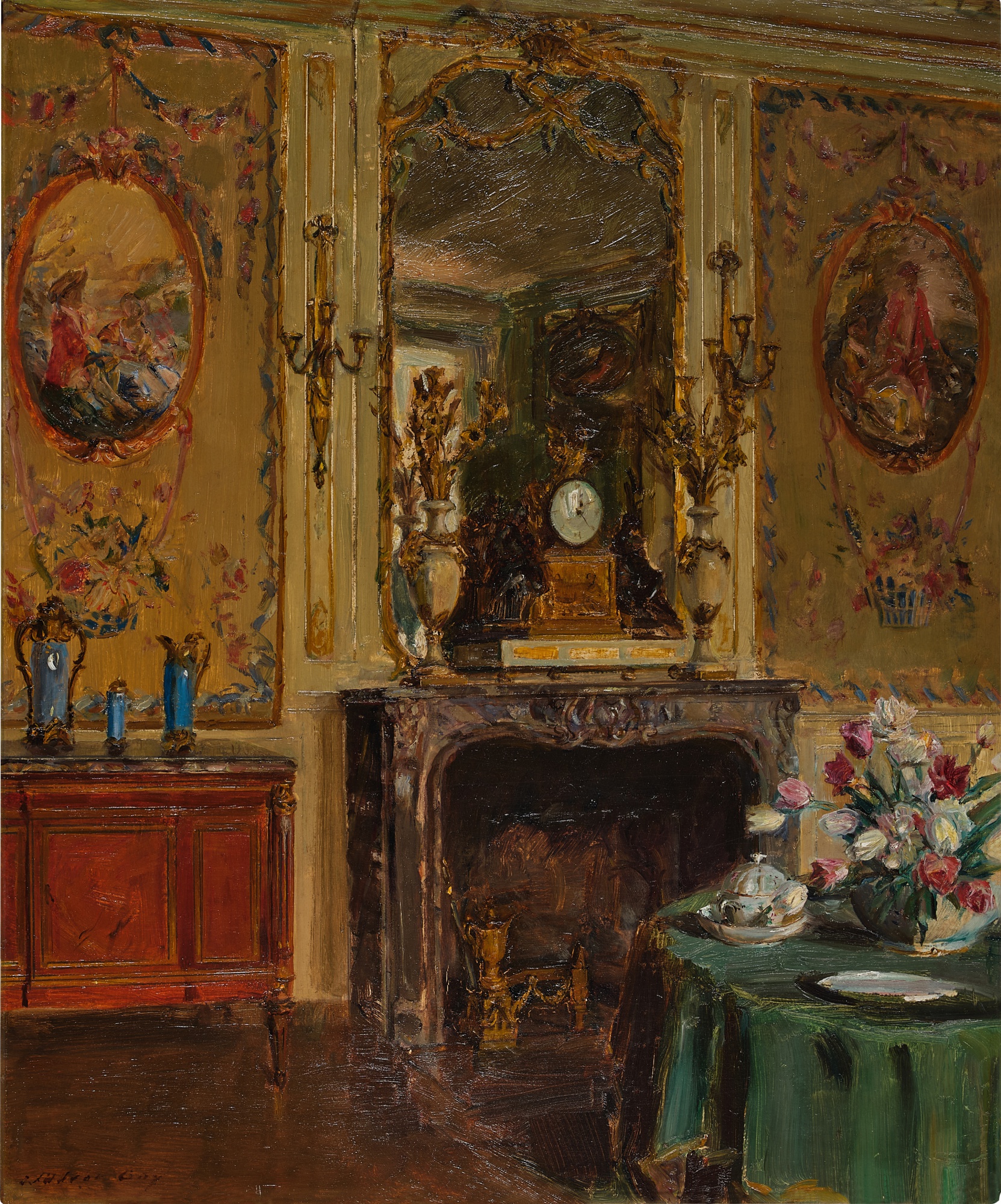
He began painting the rooms themselves, emptied of human figures yet saturated with human presence. Tapestries, Baroque furniture, parquet floors reflecting pale winter light, open windows giving onto gardens, porcelain arranged on side tables: these became his true subject. Works such as "Interior with Clock Garniture" and "Interior" on board reveal a painter at the height of his powers, organising complex arrangements of objects and architectural space into compositions of extraordinary balance and serenity. What distinguishes Gay's interiors from mere documentation is the quality of light he brings to them.
Walter Gay
Interior
Trained in the rigorous French academic tradition yet alive to the Impressionist understanding of atmosphere, Gay renders light as an active, almost breathing presence. Sunlight entering through tall windows does not simply illuminate objects; it transforms them, softening edges, warming silk, turning a plain floor into a field of shifting tone. This Impressionist inflection, always disciplined and never dissolving into looseness, gives his canvases a freshness and immediacy that photographs of the same rooms could never achieve. There is a reason his work was collected by discerning patrons on both sides of the Atlantic during his lifetime, and why it continues to reward close looking today.
Gay's achievements were recognised by some of the most prestigious institutions of his era. He received honours at the Paris Salon and won awards at international expositions, cementing his reputation as one of the foremost American painters working in France. His social world was equally distinguished: he moved among artists, writers, and collectors who recognised his work as the expression of a refined and deeply considered sensibility. Henry James, whose own prose shares something of Gay's attention to the eloquence of furnished rooms, was among those who admired him.
The intersection of Gay's painted world with James's literary one is not coincidental; both men were Americans who found in French and European domestic culture a richness of accumulated meaning that fascinated and sustained them throughout their lives. For collectors approaching Walter Gay today, the market presents a genuinely compelling opportunity. His work appears across major auction houses and specialist dealers in both the United States and Europe, and prices reflect the range of his output: smaller oil studies and works on board offer accessible entry points, while major interior compositions on canvas command serious attention from institutional and private buyers alike. Collectors who respond to the work of painters such as Édouard Vuillard, whose interior scenes share Gay's feel for the emotional charge of domestic space, or John Singer Sargent, whose facility with light and surface places him in a closely related aesthetic conversation, will find in Gay a complementary and deeply satisfying companion.
The Danish painter Vilhelm Hammershøi, whose silent room interiors have attracted extraordinary collector enthusiasm in recent decades, offers another useful frame of reference: both painters understood that an empty room is never truly empty. What Gay offers the serious collector is not just beauty, though beauty is present in abundance. He offers a record of a vanished world rendered with enough skill and feeling that it does not feel like loss. His rooms are places of repose, of cultivated pleasure, of the long accumulation of taste across generations.
In an era when so much contemporary art engages with disruption, fragmentation, and anxiety, there is genuine cultural value in the kind of attentive, loving observation that Gay practiced across eight decades of life and more than half a century of sustained artistic production. He died in 1937, having witnessed the transformation of the world he painted beyond all recognition, yet his canvases preserve something that endures: the particular quality of afternoon light in a well loved room, and the feeling that beauty, carefully tended, outlasts almost everything else.
Explore books about Walter Gay